


Liberating Syria
May 24, 2014 by Administrator · Leave a Comment
One Archeological Site At A Time…
Krac des Chevaliers, Between Homs and the Lebanese border.
Visiting archeological sites in Syria can arouse within one a rather sharp and distinct feeling of trekking along the same paths traveled a century ago by the field archaeologist, and later colonel in the British Army, T.E. Lawrence. Indeed there are a number of still-visible “Lawrence of Arabia” footprints to be found here—both in Damascus as well as deep in the Syrian countryside.
In Damascus, for instance, one may marvel at the Khan As’ad Pasha, the majestic 18th century residence of the Ottoman governor of Damascus—As’ad Pasha al-Azem—whose palatial domicile today houses the Museum of Arts and Popular Traditions. Most foreigners like to spend time at Azem, and Lawrence was frequently there as a guest of Emir Faisal, a son of Sharif Hussein, of Mecca. It was Faisal’s irregular troops that Lawrence fought alongside while sabotaging the railway lines of the overstretched Ottoman forces and significantly contributing to their defeat.
As Ottoman domination crumbled, in no small measure due to the Arab revolt around Damascus, Lawrence tried in vain to salvage something for the Arabs, whom he loved and admired even if he sometimes expressed his affection for them in an elitist English orientalist turn of phrase. By the summer of 1917, it had become clear to both Lawrence and Faisal that the four-century rule over Arabia by the Ottoman Turks was about to collapse, thanks in no small part to the revolt and the bravery and sacrifices of those who joined it. Also clear to Lawrence, if not to his friend Faisal, who was a bit naïve on the subject of Western history, was that his country, England, a pillar of the “Big Four” at the Versailles Peace Conference, conference which included the President Woodrow Wilson, British Prime Minister David Lloyd George, France’s Georges Clemenceau and the Prime Minister of Italy, Vittorio Orlando was planning once again, and not for the last time, to stab the Arabs in the back and renege on the very promises that Lawrence had been commanded to deliver.
Photos of Lawrence and Faisal hang today on the walls of what was Lawrence’s bedroom and office at the Azem Palace—and it is clear from his facial expressions that Lawrence sensed what was coming to Syria and Palestine. Before he died, in a motorcycle accident shortly after his return to England at the age of 46, Lawrence increasingly discussed what he regarded as his personal failure, during the closing years of the war, when he told friends and family that he had failed to convince his superiors in the British government that Arab independence was in their interests. The secret Sykes-Picot Agreement between France and Britain, according to Lawrence, was an abject betrayal of the promises of independence he had made to the Arabs and for which he felt personally responsible.
This observer crossed paths with Lawrence, in a manner of speaking, once again a few weeks ago, at Palmyra, the archeological and UNESCO World Heritage site which lies across the Syrian desert to the northeast of Damascus. The area was recently liberated from Islamist jihadists, and it was here I came across the words of Lawrence himself, inscribed on a plaque: “Nothing in this scorching, desolate land could look so refreshing…Moslem story-tellers ascribe the building of Palmyra to the Jinn commandeered by Soloman…”
Frankly, this observer is reluctant to demure from Lawrence’s description, but in the many years since he spoke those words, it has become clear that the “Tadmor” (Arabic and Hebrew name for Palmyra) referred to in the Torah is not the Tadmor of Syria, but rather refers to a different site, one now lost to the sands of Palestine, if it ever existed at all. Lawrence in fact would probably be sorely vexed to learn that his words linking Palmyra to Soloman are today being misused by cheap, tawdry, Zionist land seekers prowling to assert a bogus claim over Palmyra in Syria as part of God’s putative philanthropy, with the expectation, undoubtedly, of swallowing more Arab land for the ever-expanding Eretz Israel. But the misuse of Lawrence’s quote at Palmyra for political purposes is a subject for another Syrian update.
Lawrence and Lamb also crossed paths (again in a manner of speaking that is) on 5/15/14 in the course of this observer’s six-hour excursion up and around the medieval fortress known as Krak des Chevaliers (Castle of the Kurds—who reportedly first inhabited the area in the 11th century). The Syrian Arab Army recaptured the castle and the nearby village of al-Hosn from rebel forces on March 20, 2014. Both the castle as well as the village of 10,000 had been seized by rebels (aka ‘takfiri terrorists’), with the “Krak” sustaining extensive damage from especially violent clashes in 2012 and again in July and August of 2013. My excellent companion and government guide during my day at the Krak was “Mohammad,” a Syrian army security commander with 40 troops under his command. The detachment has been stationed inside the fortress, this so as to keep anyone from attempting to retake it “by a nighttime sneak attack,” I was told.

Krac des Chevaliers..liberated from rebels on 3/20/14
Apparently a history buff, Mohammad’s first comment, as we began to ascend the steep three floors of medieval steps, was to quote—who else?—T.E. Lawrence.
“We are walking in the footsteps of Lawrence,” he informed me as we made our way, gazing from time to time at the marvelous, gothic ceilings. “He called this fortress—” then, to my surprise, reciting from memory: ‘perhaps the best preserved and most wholly admirable castle in the world, and a castle which forms a fitting commentary on any account of the Crusading buildings of Syria.”
Many historians have agreed with that assessment by Lawrence, including Hugh Kennedy, who wrote that “the defenses of the outer wall were the most elaborate and developed anywhere in the Latin east…the whole structure is a brilliantly-designed and superbly-built fighting machine.”
Indeed, Krak des Chevaliers is considered one of the greatest and best preserved castles in the world due to its unique architecture in terms of its defense facilities, building materials and decorations. In 2006, the castle was inscribed on the UNESCO List of World Heritage sites along with its “sister fort,” the Citadel of Saladin, further north in Lattakia.
Among the approximately 400 damaged or destroyed antiquity sites that are now back under government control, Krak des Chevaliers is viewed by locals as a sort of “success story” because, for sure, it is still standing! A major restoration project was begun in April, and is now well underway, with the effort being directed by fifteen fulltime restoration specialists, who in turn are assisted by volunteers. Government officials, including the Ministers of Culture and of Tourism, drop by from time to time and praise their work, and a “Krak des Chevaliers reopens to the public” event is scheduled for 6/1/14. Whether many foreign tourists (or any at all) will be able to attend the gala happening is dubitable.
But hopefully conditions will allow for the return of tourists to the country at some point soon. One of my traveling companions the day I feasted my eyes on the Krak was a Syrian tour operator who pronounces himself more than willing to pitch in and help rebuild the tourist industry, Syria’s second largest foreign-exchange earner, which in 2010, prior to the outbreak of the conflict, brought in more than $1.5 billion.
Less fortunate than the castle is the formerly picturesque village of al-Hosn, which too was packed with rebels, and where current conditions now rival those in some parts of the cities of Aleppo and Homs for complete and total destruction. This observer did not see one bird, one feral cat, or even a fly in what locals call “the village of death.” Two weeks ago, a four man unit from Mohammed’s battalion at Krak did discover two hold-over rebels hiding out in the rubble. They killed them on the spot.
After 12 centuries of invaders trying to conquer this land, and a number succeeding—such as when the Muslims took it from the Christians in the seventh century employing the time tested ‘surrender or starve’ tactic—things have a way of getting rebuilt and repaired. And this time will likely be no different.
This observer’s purpose in visiting Krak was to detail the damage caused by 18 months of fighting over the fortress. The notes I made on my trip on 5/15/14 include the following:
- Complete destruction of the staircase and halls in front of the internal building of the fort.
- Partial damage in the façade of the Hall of the Knights, including some damage to the decorations and arches inside the Hall.
- Traces of fire behind the church and damage to the library hall, opposite the leader’s tower, and a part of the staircase leading to the roof of the library hall.
- Damage in the façade of the King’s Daughter’s Tower and partial destruction in the wall between the tower and the roof of the church.
- Partial destruction in the entrance to the stairs in front of Qalawun Tower; damage and destruction in some parts of the tower itself.
- Damage to one wall of the warehouse adjacent to the main offices of the castles overlooking the courtyard.
- Destruction of a part of the pillar supporting the ceiling of the library tower opposite the tower of the knights.
- Severe damage in the office of the Ottoman House, as well as the administration offices.
- Partial damage and destruction of some walls in several places of the castle, including minor damage in the outer wall of the castle.
- Surface damage caused by domestic fires built by rebels for heating and cooking, this by the dozens of rebel families that occupied different areas of the vast fortress.

To this observer it is clear that the Syrian public and their officials, in all 14 of the country’s governorates, are committed to the complete restoration of their nation’s peerless and incomparable archeological heritage sites as soon as security conditions permit.
Dr. Franklin Lamb is Director, Americans Concerned for Middle East Peace, Beirut-Washington DC, Board Member of The Sabra Shatila Foundation, and a volunteer with the Palestine Civil Rights Campaign, Lebanon. He is the author of and is doing research in Lebanon for his next book. He can be reached at
Dr. Franklin Lamb is a regular columnist for Veracity Voice
Vodou Lounger: A Tourist’s Eye-View of Haiti
March 5, 2014 by Administrator · Leave a Comment

“Please don’t go to Haiti — it could be dangerous down there!” several worried friends begged me right before I left. But boy were they wrong. Haiti is totally fun! I never had so much fun in my life as I did this past week in Haiti. And this is my very own tourist guidebook to all the neat stuff that I’ve done down here. Not exactly the Lonely Planet. But boy am I having a good time.
The most frequently asked question before I left was, “Are you going down there to do humanitarian work?” No no no. I’m going down there to be a tourist!
To start with, I got a really great bargain deal on Expedia — $800 to fly me from SFO to Port au Prince and five nights in a convenient, clean and quiet hotel called the Diquini Guest House. This was absolutely the smartest thing that I did on this trip. Why? Because the manager of the guest house, a former member of the Haitian diaspora and long-time resident of Washington DC, took me under his wing and for a reasonable fee let me hire his driver, translated for me, kept me fed on nicely-flavored Haitian stew and rice — and then took me off to explore Port au Prince. www.diquinigh.com.

First we went to the famous Hotel Oloffson where the ghosts of past American ex-pat writers such as Graham Greene and Lillian Hellman roam its gardens, terraces and gingerbread-style balconies; where Mick Jagger and even Jacqueline Kennedy have stayed — and where the famous vudou-inspired RAM band was playing that night.
The next day we explored what is left of the 2010 earthquake ruins, from what was left of the tragically beautiful stone-filigreed huge rose window of the old cathedral and the site of the historic National Palace to various small tent cities dotting Port au Prince that still house earthquake victims today, and the ruined buildings that still have market stalls precariously tucked into whichever concrete slabs are still left standing.
“So, Jane, how is Port au Prince actually doing now, four years after the quake?” you might ask, now that I’m an actual eye-witness to the scene of the crime. It’s not doing super-good, but not doing as badly as I had expected either. Most of the tent cities are gone now — as a lot of the homeless victims have by now squashed themselves in with relatives, left for the countryside or otherwise made do.

“But what are Haitians really like?” you might ask next. You can tell what Haitians are really like by the way that they drive. There are only a handful of traffic signals in Port au Prince and even fewer rules of the road. And Haitians drive very fast. But they also drive in a way that is almost polite. Everyone wants to get where they are going (and to get there fast) — but no one wants to actually hurt anyone else. I didn’t see any road rage there. Just people trying to get by.
Basically, Haitians are just people trying to get by after having been dealt a very rough hand for a very long time, from the moment they were kidnapped from Africa and sold as slaves here — starting in 1503, just eleven years after Columbus discovered the island. And those slaves were expendable too, worked to death in a few years at most and then replaced by other new slaves.
Then after having fought for and achieved its freedom in 1804, Haiti was also constantly attacked, exploited and/or invaded for the next 200-plus years by America, Canada and various combinations of European nations. And now Haiti is one of the poorest countries in the world, resembling the slums of Uganda or the slums of Zimbabwe. And yet despite their poverty, which is dire and extreme, Haitians still remain stoically polite.
Next we went off to the Iron Market bazaar to buy Haitian stuff to hang on my walls when I get home. And then we drove all over Port au Prince — the grand tour. And that night we went off to Carnival in the Carrefour district. Are you jealous yet?

Carrefour’s pre-Lenten carnival was like one gigantic block party and was actually as much fun as Berkeley in the 1960s, the benchmark against I always measure how much fun something is.
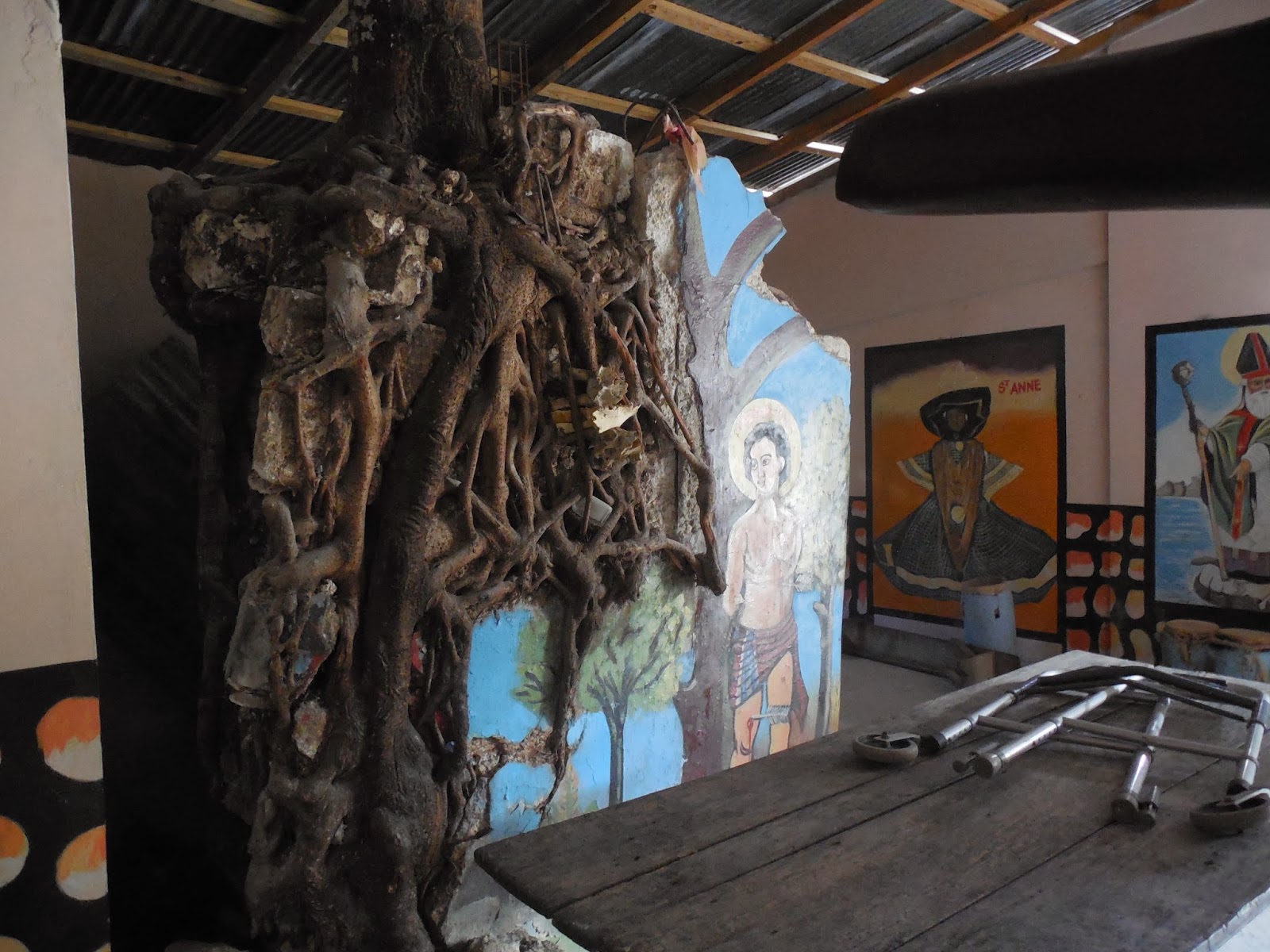
I also wanted to go see San Souci and the Citadel, UNESCO world heritage sites up in Cap Haitien, but it was a seven-hour drive to get there, so we went to Fonds des Negres instead, which was only a three-hour drive, and I met a vodou master there. “No one is cursing you,” he told me. Not even the NSA? Good to know. Then he performed a candlelight ritual to help my knees get better. Then he pulled out a business card for his son who owns a botanica in SoCal who, for a price, could finish my knee treatment when I got back home .
And there’s also a cave in the mountains near Fonds des Negres where a “Suzan,” a vodou spirit, resides. But you have to get there by motorcycle and we didn’t have time to do all that on this day trip. So I just bought a sequin-covered vodou flag instead.
“Have you seen any zombies in Haiti?” might be your next question. Sorry, no. But on my plane ride down here, we ran into a bunch of really scary turbulence over Chicago and I thought I was going to die. So I had an epiphany. “When you are in your mother’s womb, the only way out is by going through a whole bunch of pain first — and death is also like that. First you pass through a whole bunch of pain and then, poof, you are out on the Other Side.” As a zombie? Let’s hope not.
The next day we went out searching for Jean-Bertrand Aristide and then ended the day in that famous five-star hotel in Petionville — just to see how the other 1% lives. Trust me, they are living well.
What else have I done down here? I can’t remember exactly. But I will tell you this: I have really had fun. And if you ever want to go to Haiti too, I totally recommend it highly. And, no, I’m not getting paid to say this.
PS: While in Haiti, I also watched the winter Olympics on TV — thus getting a chance to compare Port au Prince and Sochi. One city has far too little city planning and one city had far too much!
According to journalist Roi Tov, “With less than 350,000 denizens, [Sochi] has been occupied by at least 25,000 police officers, 30,000 soldiers, 8,000 special forces, and an undisclosed number of FSB agents.”
Port au Prince is nothing like that. The streets go every which-way like a patchwork quilt. But it does have one thing in common with Sochi — abuse of its fragile labor force.

And let’s also compare Port au Prince with Havana. I’m currently reading Carlos Eire’s autobiography, “Learning to Die in Miami”. Eire appears to believe with all his heart that the Castro experience was a nightmare — and yet just compare Cuba and Haiti today. Haiti has been under the thumb of American and European corporatists for ages and ages. And now, despite all its amazingly fertile soil and impressive mineral riches, Haiti is currently one of the poorest countries in the world. Seven out of ten Haitians live on less than $2 a day, according to the International Red Cross.
But in Havana under the Castro brothers, everyone has a good chance of getting a college education.
But, hell, most Haitians are lucky to have a chance to even get as far as fourth grade!
If Fulgencio Batista and the American corporatists who owned him back in 1959 had remained in power and Castro had never taken over Cuba, Cuba today would more than likely look just like Haiti today. And does anyone with a working brain really think that having American and European oil companies, bankers, war profiteers and neo-cons in control in Syria, Venezuela and Ukraine are going to help those countries either? Hell, just look at what those guys did to Afghanistan, Iraq and Libya — and to Detroit!
Jane Stillwater is a regular columnist for Veracity Voice
She can be reached at:
Urban War Zones In America
February 2, 2014 by Administrator · 4 Comments

Urban War Zones are now a reality inside many American cities.
It’s no longer necessary to go to Iraq, Afghanistan or Africa to enter a real war zone and have to fight for your life.
Thanks to massive CIA drug trafficking and American Free-trade Treaties like NAFTA, CAFTA, GATT & WTO, many American inner cities have been transformed into actual war zones.
These inner city war zones are infested with drug gangs that outnumber police and out gun them too.
At present these gangs are typically competing and battling with each other for turf and making a living selling drugs and running prostitutes, some captive sex-slaves. At some point if the economy worsens and the SHTF, they could easily start looting and attacking anyone and everyone.
However, in every major city in America at present, violent urban predators prey on the unarmed, old, weak, sick or disabled. And while out of control Police Swat Teams battle these predators and drug gangs, they often tyrannize the innocent which include women and young children, using excessive force all too often. There are numerous incidents of such teams murdering innocents after attacking the wrong home.
The massive War on Drugs was designed as a dualistic program. One hand, the top secret part involves the USG bringing in massive amounts of illegal drugs to raise “off the books money” for covert ops. The other hand uses all serious gang crimes arising as a pretext to militarize the police as justify their deployment as Nazi Storm Troopers.
This second part of the War on Drugs is for public disclosure and consumption. In response to all this massive urban breakdown, the worsening economy and increasing government tyranny from the Department of Homeland Security, the TSA and out of control local police, Americans are arming at an astounding rate. Guns are literally flying off the shelves and ammo sales are at an all time high also.
Americans now arming up in mass in order to protect themselves from and this increasing USG Tyranny of the USG, DHS and their local militarized and Mind-kontrolled local police (1) and from increasing and spreading urban crime which includes robberies, car-jackings, home burglaries and home invasions.
Also given as an important reason for arming up for the first time when asked, is a fear of possible impending economic collapse with an associated SHTF occurrence. Many express a salient and absolute need to be able to protect themselves and/or their family members from possible looters and armed home invaders which would likely accompany a SHTF urban breakdown situation.
And who should be credited with creating such a foreboding urban environment? It is the Globalist Traitors and infil-Traitors who have hijacked the political process and Banking in America.
These Globalist “enemies within” have rammed through economically disastrous Free-Trade Agreements and forced Diversity, Perversions and Political correctness accompanied by massive immigration, most illegal. All this has been designed to destroy the borders, language and culture of America, to neutralize its Constitution, Bill of Rights and Rule of Law while transforming America into a economically distressed Third World Nation.
These Globalist enemies within the Gates have been working very hard to transform America into a Democracy (Mob rule by the masses) from the Republic which was set up by our Founding Fathers. Obviously any real enforcement of the US Constitution would assure that American would remain a republic the way it was set up.
Since the imposition of so-called “Free Trade” policies upon the American Republic, urban decay and blight have become epidemic in major American cities. Many cities have turned into Urban Jungles, where only the strongest survive. In these Urban Jungles, violent gangs prevail and the weak are parasitized and consumed, afraid to go out of their homes, especially after dark.
Take Chicago, which has become a “kill or be kill” free fire Urban War Zone in some of its Urban areas. Chicago is the one of the most gun restricted areas ever, but the only ones that do not carry guns to defend themselves are law abiding citizens.
Gang members have all the guns they want, supplied by drug gangs and the CIA and BATF.http://www.cbsnews.com/news/gang-wars-at-the-root-of-chicagos-high-murder-rate/
Some of these areas such as Washington DC have been rated as having a 300% chance of being mugged if out after dark in certain areas, which means you could likely be robbed three times in a single block if you have a victim profile (old, young, weak, disabled, female). The real unemployment rate is 37%, despite phony USG that it is 7% or less.(2)
And now Detroit has been declared Bankrupt. It has been reported that retired police and City workers will now receive approximately 13% of their pensions due.
The Ruins of Detroit:
The ten Most Dangerous American Cities which are truly Urban Jungles at Night:
There are areas in Detroit, South Chicago and St. Louis that are so violent and infested with violent gangs that even the police refuse to enter unless ordered and then do so with major forces.
Until recently parts of Detroit was so violent that police and ambulances refused to provide service during the night hours and often found abandoned dead bodies (murder victims) days later. Detroit, known as “Iron City”, the jewel of America, used to be prosperous beyond measure based on the manufacture of the world’s finest cars.
Remember what a 1965 Olds Starfire coupe was like, or a mid 60′s Buick Wildcat or Pontiac Bonneville was like. How about a mid 60′s Chevy with a HP409 engine or a Plymouth Belvedere with a 426 Hemi or 440 Wedge engine?
That all changed in 1971 with the introduction of very extreme anti-pollution “clean air” laws which reduced automotive engine compression ratios from approximately 10.5 to 8.5, required the installation of retarded, goofy extremely inefficient camshafts. The result was garbage engines that had little power, consumed huge increases in gasoline and a major shift in chassis quality to near complete crap. At that point American automotive quality was gone and is only starting to come back now forty years later.
This is but one symptom of the covert Globalist engineering of American Society on behalf of the City of London zionist Central Banksters.
This of course created a great opportunity for the Japanese Auto manufacturers, secretly owned and controlled by the super-elite American Banking families. When W. Edwards Deming, an astute American engineer approached American Automotive Manufacturers in Detroit and proposed his plan to drastically reduce defects and lemons, he was rebuffed because it was felt his plan was too expensive and too slow.
Deming’s plan required 100% quality checks and verification of all parts from every supplier instead of the approximately 1% or less sampling. When Deming approached the Japanese, who had already shown a new coming expertise in motorcycles and quality circles in their electronics manufacturing, his program was accepted and implemented.
The rest is history, and after about 15 years, the American Automotive manufacturers have been playing a catch up game ever since for quality with the Japanese Auto manufacturers.
And now the Korean Automotive Manufacturers have hired retired Japanese automotive engineers as consultants and have adopted many of their same practices and principals to their automotive manufacturing. The result?
Some Autos manufactured in South Korea have attained the same quality as the Japanese which are considered to currently be the highest quality in the world. As many automotive enthusiasts suggest, if you want the best performance buy German, if you want the highest quality buy Japanese.
It is a fair assumption that Globalism and the Free-Trade Agreements it produced, have resulted in the exportation of most American heavy industry, manufacturing and millions of good paying jobs. This alone has seriously harmed the American economy and set America on a path of destruction, starting first with its Urban Centers which have become urban wastelands and jungles, and now progressively spreading to middle class and upper middle class outlying suburbs.
Fair Trade with suitably adjusted reasonable Tariffs to protect American Jobs are necessary to America’s economic survival and prosperity. Free Trade is not Free at all and is an abomination to the American republic and its Sovereignty.
It is a tool of the Globalists to enhance the earnings of their international offshore Globalist corporations at the expense of the American worker. It is nothing less than a secret war against America’s Sovereignty and the Republic itself.
The only other globalist tactic to destroy America that approaches its effectiveness are the policies of unrestricted illegal immigration, forced diversity, cultural programming that perversion is good, required perversion programming in the public schools that it is normal, and political correctness.
Obviously these are all Globalist weapons of covert war waged against America to destroy its borders, language and culture and gut it economically. These Globalist weapons have been deployed against Americans in order to transform America into a Third World “Democracy” instead of the Republic that it was set up to be by the Founding Fathers.
These Traitors and Infil-Traitors in Congress and the Administration keep financing and running foreign wars for Israel in order to establish Democracy like they keep claiming we have in America. We have never had a democracy but they have been doing their best to kill the Republic on the behalf of their zionist owners and masters This is of course one of the biggest lies ever told.
America has always been a Republic, a democracy is mob rule. Of course bringing in 30-60 million illegal immigrants and millions of legally sanctioned foreign workers has quickly undermined American culture and tradition and established a real base to elect politicians who appeal to the masses. The election of President Obama was the first of such travesties.
Up until recently when American aircraft manufacturers starting buying foreign parts, American aircraft were the best in the world, especially the military aircraft and fighter/interceptors. Now we have an F-22 with a contaminated O2 system from China that causes some pilots to start passing out and a Boeing Dreamliner with a faulty battery system that was imported.
For years St. Louis has been so poor that some of their police radio don’t work properly and their squad cars are in disrepair. In East Los Angeles, despite how tough and well armed the LA Police Department is, top police officials know that they are completely outgunned by Mexican drug gangs allowed to enter and do business inside America and also provided arms shipped by the CIA and the BATF.
It’s not as if Americans weren’t duly warned what such Free-Trade Treaties would produce, because Presidential Candidate Ross Perot went public with what was coming. He described the effects as a “giant sucking sound” for American jobs as they would leave America in droves.
But despite Perot’s grave warnings, President George HW Bush signed NAFTA on Dec. 17, 1992 with full Congressional support. The NAFTA Treaty was ratified after Bill Clinton became President. Soon after the sucking sound started, with shocking support the the US Department of State which provided massive grants to major corporations to move manufacturing to Mexico. These grants continued at American taxpayer expense under the subsequent Trade Treaties that were subsequently signed and ratified such as CAFTA, GATT, and WTO.
Unbeknownst to most Americans, President Obama is now deeply involved in secret negotiations to pass the Trans Pacific Partnership Treaty (TPP) which experts have described as “NAFTA on Steroids”. TPP is far more than just another Free Trade Treaty which continues to lower the value of American wages to the “rock bottom” levels in third world countries. If signed and ratified by Congress, the TPP would be the complete end to any remaining American Sovereignty.
What established this frenzy for Free-Trade Agreements? It is now known that The last duly elected President of the United States of America was Ronald Reagan. It is also known by seasoned intel officers that Ronald Reagan distrusted American Intel in general and especially his Vice President George HW Bush.
In fact it has now been discovered that President Reagan distrusted the CIA and American Intel so much, he set up his “Kitchen Cabinet” and brought in Lee Wanta as his Secret Agent under the Totten Doctrine (3).
George HW Bush was illegally elected later as President, since his father Prescott Bush had signed an Immunity Agreement that no future Bushes (Scherfs) would ever run for office after he was arrested for “aiding the enemy” and his Union Bank assets were seized by FDR during WW2.
It is also known that George HW Bush ran his own private CIA inside the CIA which served the specific needs of the zionist City of London Central Banksters and their franchisees, the American private Federal Reserve and major Wall Street Banksters.
Some former top American Intel believe that it was this private GHW Bush Intel organization that tried to assassinate President Reagan, by using their man, a secret service man who fired a high speed plastic disc from a compressed air powered disc-gun, the type displayed by William Colby in Congressional Hearings on the abuses of American Intel.
PBS Judy Woodruff had reported this of seeing the SS man fire a gun from a second story window that night on PBS but the story was quickly squelched and she changed it after a very convincing “not to worry visit” from some very serious American Intel agents. President Reagan, despite a long slow disjointed route to the hospital, survived. This assassination attempt however signaled that the Treasonous Bush Cabal had attained a major power base inside the Military and Congress.
The sad thing is that all the political power and influence necessary to accomplish this and to transform the American Congress into Traitors was due to the vast money provided to K Street Lobbyists and zionist espionage groups like AIPAC, ADL, B’nai B’brith, and the like by the Central Banksters and the various Judaic groups shaken down and manipulated by zionist for donations.
So the first beach-head of the Globalists (aka zionist City of London Central Banksters and the “Old Black Nobility” they represented) was established with a bought, owned and controlled US Congress. Once GHW Bush was elected President, the circle of control was complete.
One of George W. Bush’s major assignments was to take American further down the Globalist path by fighting more Mideast wars for Israel. Another was to destroy the Republic party by being the worst President ever and fully debasing the Republican, which he did. Now the Republican leaders in Congress are tricking the Republican Party into committing suicide by agreeing to back the Democratic legislation for making illegal immigrants legal and future citizens.
So it is now obvious that the Republic Party is finished and Americans need to rise up and form a new Third Party. Otherwise you can be assured that just like in the last Presidential election, both candidates will be owned by the Bush Cabal.Unless the Bush Cabal has been fully exposed and displaced by then which is now real possibility.
It has been estimated that there are now approximately 30 million illegal immigrants inside Americaallowed in by a Globalist controlled USG who prevented border enforcement and liberal immigration laws which are not enforced. With the the passage of the currently proposed Democratic plan for legalizing illegal immigrants, this number could easily grow to 60 to 100 million.
In most major American Cities, Police are not allowed to arrest suspected illegal immigrants for minor traffic violations or check their identification for legal status. Not so for those whose license plates are run and show up as actual American Citizens. And this is all due to orders coming down from a few top policy-Makers who operate at the nexus of the Secret Shadow Government (SSG).
GHWB could now institute major efforts to undo all the excellent plans for the economic and industrial reconstruction of America that President Reagan had set in place and activated. As has been disclosed in a previous article (4), President Reagan had brought in Lee Wanta to serve as his Secret Agent because he didn’t trust the CIA which had been corrupted and hijacked by GHWB.
It should now be exceedingly clear to those who are well informed about the degradation of the American economy and rule of law accompanied by increasing tyranny, deployment of DHS, TSA and the passage of all the unConstitutional draconian laws (like the so-called Patriot Act, the Military Commissions Act, and NDAA 2014).
All this is being engineered by foreign controlled Globalist traitors and infil-Traitors who have hijacked America and worked hard to export heavy industry, manufacturing and jobs.
And that they are doing this to asset strip America, destroy it’s economy and the Republic itself in order to Balkanize America and prevent it from ever rising in economic strength again and operating as a Republic “of the people, by the people and for the people”.
Their motives for all this? To covertly re-fight the Revolutionary war that was lost and retake America on behalf of the zionist City of London Central Banksters and their Kingpin overlords the Old Black Nobility (OBN). These hidden masters of the world-wide occult network which runs the IZCS prefer to stay hidden in the background where they can pull all the strings of several top Policy-Makers in America with no personal risk to themselves.
What can be done to turn this around? Obviously the first step is to get rid of all Free-Trade Agreements. In order to do this all the zionist espionage fronts inside America such as AIPAC, ADL, B’nai B’rith and the like must be fully exposed and prosecuted to the fullest extent of the law. In order to do this zionist Israeli-American dual citizens inside Congress and the USG and its Agencies must be exposed as traitors and agents of foreign espionage and routed out of power.
America has to stop fighting Israel’s illegal Mideast wars and withdraw all aid and support for Israel as long as it is a criminal, racist apartheid state persecuting and murdering Palestinians and stealing their land incrementally.
Lee Wanta, a great American Heroe that served as President Reagan’s Secret Agent under the Totten Doctrine and was instrumental in bringing down the evil Soviet Union
We need to re-institute the Wanta Reconstructing America Plan based on the Maglev High Speed Rail System which has the necessary funding already available. (5)
And it is time to also re-establish the Want Economic Recovery Plan for America that was also set up under President Reagan, but later stopped cold by George HW Bush and his Cabal when they instituted a secret coup to take over the whole USG on behalf of the City of London zionist Central Banksters and their Wall Street and Federal Reserve Franchisees.(6)
In fact it is a reasonable assumption that the massive Free-Trade attack on America’s economy was largely a reaction by the Bush Cabal to these amazing economic reconstruction plans President Reagan had put in place through his Secret Agent Lee Wanta, who was the master strategist that took down the Soviet Union for President Reagan.
Recent respected surveys show that a majority of American are disgusted with the current administration and rating of the lowest ever experienced in America in the last century. Congress is also rated at an all time low with only 9% approving of it. Many view the current President as an alien imposter with no traceable past. Some alternative media writers have stated that he is a sheep-dipped CIA creation just like Bill Clinton. All this is a mute point. Why?
Because Ronald Reagan was the last duly elected President of the United States of America, the Republic, all presidents since have been fraudulently elected and owned by the Bush Cabal. And this Bush Cabal is the Action Agent of the City of London zionist Central Banksters and their International Zionist Crime Syndicate (IZCS).
The IZCS is centered in Israel where most intel is done by privatized Israeli corporations serving as American Defense and Intel contractors. It is these private Israeli contactors who control all NSA raw intel and almost all American communications including internal White House phone calls and messaging, as well as all Pentagon and DOD communications.
Obviously the Bush Cabal has been able to install its own Presidential puppets and run a lucrative illegal drug trafficking operations into America. All done to destabilize and “dirty up” American Cities while absorbing a great deal of the Welfare dollars and capturing vast “off the books” funds for their own covert operations and bribery of Congress. It is a fair conclusion that the Bush Cabal has destroyed the American Rule of Law, debased any true enforcement of the US Constitution and Bill of Rights and has corrupted every institution and agency of the USG.
However there is good news. A growing force for good has emerged in the Alternative Media now transmitted everywhere instantly on demand by the worldwide Internet, the new Gutenberg Press and the NWO Globalist’s Achilles Heel. Yes, the Controlled Mass media (CMMM) has been a propaganda mouthpiece for the Bush Cabal and the IZCS, but is now losing its appeal and credibility. The CMMM keeps feeding lies and crap to the American public that are obviously false, like the Mideast American wars are wars to establish Democracy. More and more Americans now realize this is complete BS, that we are there to fight Israel’s wars and defend British Oil interests.
Compare the articles of Veterans Today and other respected truth media now which are being published and read by millions inside America and all over the world with the CMMM. You will see the gap between the alternative media truth and the CMMM lies is ever widening and we are starting to see Alternative Media’s popularity driving stories into the CMMM, even thought the CMMM usually attempts to neutralize their significance.
Many thousands of brave American Soldiers who were lied to and deceived into fighting these illegal, unConstitutional, unprovoked, undeclared wars for Israel and Big Oil, thinking that they were defending America and its freedom. Few greater lies and deceptions has ever been predicated on Americans than this complete lie. Many thousands of Americans have been killed and horribly wounded and disabled in this war.
If the American Military ever fully realizes that all these wars were phony and based on a lie and that Israel did the 9/11 attacks with the help of a cabal within the USAF and JCS, there will be hell to pay for all those perps involved. And now there is good reason to believe that day is coming in the not too distant future.
As most Americans are beginning to realize, America has been infil-Traited by Traitors and Infil-Traitors in the highest positions of the USG. The major economic deterioration and loss of assets to the Wall Street Banksters and the private Federal reserve through financial Fraud have been staggering and Americans are catching on the the BLATANTLY OBVIOUS.
When American society reaches a critical mass awakening to this obvious situation that Globalists have been doing everything they can to destroy America, there will be major Blow-back of astounding proportions. When 12% of Americans are awakened, a critical mass and major turning point will be reached and you will begin to see major social change like never conceived, and this will all be due to major Blow-back from awakening.
The elites hate to acknowledge it, but when large numbers of ordinary people are moved to action, it changes the narrow political world where the elites call the shots. Inside accounts reveal the extent to which Johnson and Nixon’s conduct of the Vietnam War was constrained by the huge anti-war movement. It was the civil rights movement, not compelling arguments, that convinced members of Congress to end legal racial discrimination. More recently, the townhall meetings, dominated by people opposed to health care reform, have been a serious roadblock for those pushing reform…. A big turnout … can make a real difference….When someone tells you to stop imagining that you are having an impact, ask them to please direct their energy into getting 10 friends to join you in doing what needs to be done. If it has no impact, you’ll have gone down trying. If it has an impact, nobody will tell you for many years. (7)
This coming complete awakening will be due to information dispensed and diffused by the Alternative Media and the worldwide Internet as well as word of mouth. it is best viewed as a byproduct of a new and powerful emerging worldwide populism which has now reached the point it is unstoppable. One recent study has established 10% as a critical mass, turning point for Society.(8)
I believe we are already at 11% and when we reach 12%, the days of the Bush cabal will be dated. They know it too and are scared sh*tless. That is why they have been going for broke trying to ram the NWO down our throats and militarize local police and build up DHS to oppress and then mass murder us.
It’s time to speak up to all your family, friends and associates that we need to abandon the Republican and Democratic political Parties. Both parties are owned and controlled by the same Overlord, the IZCS who bought them and can blackmail them with NSA provided intel.
Former Minnesota Governor Jesse Ventura, who is also a Vet and a Navy Seal/UDT man had it right in his book of the Replican and Democrat Political Gangs in America, DemoCRIPS and ReBLOODlicans (9).
Gov. Ventura recommends Americans dump both political Parties which serve the same corrupt masters and start electing alternative candidates only who are not associated with either of the two parties.
Conclusion:
It should now be exceedingly clear to those who are well informed about the degradation of the American economy and rule of law accompanied by increasing tyranny, deployment of DHS, TSA and the passage of all the unConstitutional draconian laws (like the so-called Patriot Act, the Military Commissions Act, and NDAA 2014), that all this is being engineered by foreign controlled Globalist traitors and infil-Traitors who have hijacked America and worked hard to export heavy industry, manufacturing and jobs.
And that they are doing this to asset strip America, destroy it’s economy and the Republic itself in order to Balkanize America and prevent it from ever rising in economic strength again and operating as a Republic “of the people, by the people and for the people”.
Their motives for all this? To covertly re-fight the Revolutionary war that was lost and retake America on behalf of the zionist City of London Central Banksters and their Kingpin overlords the Old Black Nobility (OBN). These hidden masters of the world-wide occult network which runs the IZCS prefer to stay hidden in the background where they can pull all the strings of several top Policy-Makers in America with no personal risk to themselves.
(1) http://www.veteranstoday.com/2013/02/17/robocops/
(2) http://www.tpnn.com/2014/01/22/actual-unemployment-rate-37-2-not-6-7-says-wall-street-adviser/
(3) TOTTEN DOCTRINE [ 92 U.S. 105, 107 (1875) ]
(4) http://www.veteranstoday.com/2014/01/05/the-wanta-reconstructing-america-plan/
(5) http://www.veteranstoday.com/2013/12/28/high-speed-rail/
(6) http://wantarevelations.com/2014/01/wanta-plan-macro-financial-economic-check-list/
(9)
Source: Preston James | Veterans Today
Will Lebanon Survive 2014? Should It?
January 4, 2014 by Administrator · Leave a Comment

Beirut – Another week, another terrorist bombing. It’s beginning to look a lot like that here in Lebanon these days. Another apparent suicide bomber detonated a car rigged with explosives in the southern suburbs yesterday killing at least five people and injuring at least 77. The health ministry released a statement just a short while ago reporting that an additional 67 people were treated in hospitals for wounds and released, while 10 people remained hospitalized with more severe injuries.
Many who thought their team and its local and international supporters were invincible appear to be rethinking recent events. More are realizing that their enemies are also skilled and fearless fighters and not at all afraid to die for their religion, or related causes, and may well be growing in number as they view the results of their handiwork.
Yesterday’s explosion is the fourth bombing since last July in Beirut’s southern suburbs known as Dahiyeh. It targeted al-Arid Street two blocks almost directly behind the office of the Sabra-Shatila Scholarship Program (SSSP) near the old Al Manar building which re-located after being repeatedly bombed by US funded Israel forces in 2006. Some preliminary reports indicate that a 20 kilogram bomb was used in the explosion hidden and then detonated inside an olive green Jeep Grand Cherokee.
The latest information this morning comes from Hezbollah security guys who guard our building (and my motorcycle—bless them for both favors!) and who have been visibly present throughout Dahiyeh for the past six months, ever since the spate of neighborhood bombings began. People in South Beirut tend to believe that al-Qaeda-linked groups are responsible for this latest in a series of attacks and some point to the recent reports from UPI and other media that Al-Nusra leader Abu Mohammad al-Golani and Islamic State of Iraq and Syria (ISIS) chief Abu Bakr al-Baghdadi have ordered their fighters specifically into Lebanon for the sole purpose of fighting and destroying Hezbollah.
There are reports, whose accuracy is difficult to verify that scores of jihadists are arriving here from Syria, Iraq and other countries. The last half of 2013 has seen a dramatic rise in the number of young male fighters from North Africa and the Levant. Many are joining Al Nusra and ISIS rather than choosing more “moderate” groups. The six-week training camps are attracting a majority of the wannabe jihadists who come for a number of religious and non-religious reasons and who want to join the better established and most widely admired ‘winning teams.’ Additionally, the Golani and Baghdadi groups reportedly offer the best food, the most “inspiring” jihadist ideology, newer and more powerful weapons, heavy winter clothing including gloves, and salaries of up to $ 450-500 per month depending on potential exhibited during the 45 days training camp with credit given to applicants with vetted previous experience.
Reports suggest that the current “slow war” will intensely in Lebanon following the assassination of a rumored candidate for Lebanese Prime Minister, when and if a new government is formed around here, the former Lebanese Finance Minister Mohammad Chatah. That murder came at a very critical time in Lebanon. It is difficult to identify a period during the past three decades during which divisions and tensions among the Lebanese have previously reached such dangerous levels. Verbal attacks and thinly veiled threats from the pro-Western alliance known as March 14 against the National Lebanese Resistance lead by Hezbollah (March 8) have intensified. Common now are open calls to confront Hezbollah “by all means in order to save Lebanon.” The anti-Assad groups blame the pro-Assad March 8 coalition for last month’s assassination of Mohammad Chatah which occurred near the spot in central Beirut where Prime Minister Rafik Hariri and 25 others were killed by a massive car bomb on Valentine’s Day 2005. The Hague based Special Tribunal for Lebanon (STL) is due to start trying that case last this month.
People in the street, from the depressed expressions on the faces of even apparently well to do women these days trudging along fashionable Hamra street–to the young from across the confessions who seek to depart Lebanon and the sooner the better, often cite a laundry list or reasons they think Lebanon never has been a real country, is not and likely never will be.
Indeed, to some foreigners living in Lebanon, it often seems that locals habitually blame outsiders for most, if not all, of their current problems. The Sykes-Picot secret process of creating nations, the French, the USA, Saudi Arabia, “the West”, Iran, Syria, the Gulf countries are among others being identified as the main culprits.
Others are quite sure, for a long list of commonly elaborated reasons that it’s the Lebanese themselves who created the current mess of this claimed ‘non-country.’ The reasons are many but a short list would include that there is no functioning government, no Armed Forces worthy of the name, corrupt politicians who regularly sell out their constituents who for some unfathomable reason keep voting them back into power. In addition, the poisonous sects and confessions that even give rising ethno-nationalism a bad name, defective character that is exhibited daily among the general population from cheating others at the slightest opportunity, insane, selfish, aggressive driving creating the highest auto accident rates per capital in the world, and considering it their birth-right to disparage others religions while threatening death to those who dares to criticize theirs. This, just for starters.
The gifted writer Michael Young of Beirut’s Daily Star wrote recently that “Everywhere, it seems, the Lebanese are swindled, and feel it. Restaurants charge European-standard prices, but the vast majority serves mediocre food. Many contractors will demand the highest fees for their work, but take no pride in it. They will bring in cheap laborers to save money, so that one must pay nearly double to repair the myriad errors.” Young continues “Every day, it seems, Lebanon has become a vast con game, an unprincipled country where violence is given free rein, where charlatanism is rewarded, where incompetence is generalized and where legalized theft is widespread – a country which it is easy to leave and from which the young understandably seek escape.”
On a related subject some of these observers’ friends in Syria articulate a solution to the problem that Lebanon has become and that they claim “would be best for all concerned!” They sometimes insist that whatever the outcome of the “current situation” at a minimum and for sure stolen Syrian territory, now referred to generally but not exclusively as “Lebanon” that was unnaturally and wrongfully ripped away and patched into a country by the French and British colonists must be returned to “Mother Syria”. It is true than whenever this observer crosses over into Syria from Lebanon and arrives in Damascus and engages with people, that despite the current tragic situation there, one feels that Syria in a “real country” with laws and standards and well, civilization. Not only have I never felt that to be the case when in Lebanon I do not recall discussing the subject with any foreigner who does feel that Lebanon is a ‘real country’ or even with many locals in Lebanon who do.
Well, it not this observers business and not only does my own country appear to have more problems than few in this whole region would want to face, the Lebanese do have some good qualities—one imagines.
And for sure this damaged goods observer has no will at all to challenge the Almighty’s creation wisdom these days as there is way too much now on my soggy paper plate without entering the new year with her or him scowling at me too.
For New Years a cherished Lebanese friend, a sweet complainant of what her life has become, sent me this thoughtful message and insight about her personal dilemma and what went wrong with her life:
“When God created Lebanon he said to the angels nearby that it will be a land of terrific natural beauty with tall majestic mountains full of snow, beautifully sparkling rivers cutting through forests filled with many types of trees and high cliffs over-looking sandy beaches and waters with an abundance of sea life. I shall make the land rich and make the people prosper!”
One angel intervened and said, “Lord, isn’t that unfair to the rest of the world?”
“Actually no” God replied, “Just wait and see the neighbors I shall give them.”
Hopefully God will review and amend his work so Lebanon survives 2014. It is not apparent that the Lebanese are capable of doing so.
Dr. Franklin Lamb is Director, Americans Concerned for Middle East Peace, Beirut-Washington DC, Board Member of The Sabra Shatila Foundation, and a volunteer with the Palestine Civil Rights Campaign, Lebanon. He is the author of and is doing research in Lebanon for his next book. He can be reached at
Dr. Franklin Lamb is a regular columnist for Veracity Voice
Iraqi Weapons of Mass Destruction Have Finally Been Found – In Syria!
September 4, 2013 by Administrator · Leave a Comment
 Secretary of State John Kerry: “There is no doubt that Saddam al-Assad has crossed the red line. … Sorry, did I just say ‘Saddam’?”
A US drone has just taken a photo of Mullah Omar riding on a motorcycle through the streets of Damascus. 1
So what do we have as the United States refuses to rule out an attack on Syria and keeps five warships loaded with missiles in the eastern Mediterranean?
- Only 9 percent of Americans support a US military intervention in Syria. 2
- Only 11% of the British supported a UK military intervention; this increased to 25% after the announcement of the alleged chemical attack. 3
- British Prime Minister David Cameron lost a parliamentary vote August 29 endorsing military action against Syria 285-272
- 64% of the French people oppose an intervention by the French Army. 4 “Before acting we need proof,” said a French government spokesperson. 5
- Former and current high-ranking US military officers question the use of military force as a punitive measure and suggest that the White House lacks a coherent strategy. “If the administration is ambivalent about the wisdom of defeating or crippling the Syrian leader, possibly setting the stage for Damascus to fall to Islamic fundamentalist rebels, they say, the military objective of strikes on Assad’s military targets is at best ambiguous.” 6
- President Obama has no United Nations approval for intervention. (In February a massive bombing attack in Damascus left 100 dead and 250 wounded; in all likelihood the work of Islamic terrorists. The United States blocked a Russian resolution condemning the attack from moving through the UN Security Council)
- None of NATO’s 28 members has proposed an alliance with the United States in an attack against Syria. NATO’s Secretary General Anders Fogh Rasmussen said that he saw “no NATO role in an international reaction to the [Syrian] regime.” 7
- The Arab League has not publicly endorsed support of US military action in Syria; nor have key regional players Saudi Arabia and Qatar, concerned about a possible public backlash from open support for US intervention. 8
- We don’t even know for sure that there was a real chemical attack. Where does that accusation come from? The United States? The al-Qaeda rebels? Or if there was such an attack, where is the evidence that the Syrian government was the perpetrator? The Assad regime has accused the rebels of the act, releasing a video showing a cave with alleged chemical-weapon equipment as well as claiming to have captured rebels possessing sarin gas. Whoever dispensed the poison gas – why, in this age of ubiquitous cameras, are there no photos of anyone wearing a gas mask? The UN inspection team was originally dispatched to Syria to investigate allegations of earlier chemical weapons use: two allegations made by the rebels and one by the government.
- The United States insists that Syria refused to allow the UN investigators access to the site of the attack. However, the UN request was made Saturday, August 24; the Syrian government agreed the next day. 9
- In rejecting allegations that Syria deployed poison gas, Russian officials have argued that the rebels had a clear motivation: to spur a Western-led attack on Syrian forces; while Assad had every reason to avoid any action that could spur international intervention at a time when his forces were winning the war and the rebels are increasingly losing world support because of their uncivilized and ultra-cruel behavior.
- President George W. Bush misled the world on Iraq’s WMD, but Bush’s bogus case for war at least had details that could be checked, unlike what the Obama administration released August 29 on Syria’s alleged chemical attacks – no direct quotes, no photographic evidence, no named sources, nothing but “trust us,” points out Robert Parry, intrepid Washington journalist.
So, in light of all of the above, the path for Mr. Obama to take – as a rational, humane being – is of course clear. Is it not? N’est-ce pas? Nicht wahr? – Bombs Away!
Pretty discouraging it is. No, I actually find much to be rather encouraging. So many people seem to have really learned something from the Iraqi pile of lies and horror and from decades of other American interventions. Skepticism – good ol’ healthy skepticism – amongst the American, British and French people. It was stirring to watch the British Parliament in a debate of the kind rarely, if ever, seen in the 21st-century US Congress. And American military officers asking some of the right questions. The Arab League not supporting a US attack, surprising for an organization not enamored of the secular Syrian government. And NATO – even NATO! – refusing so far to blindly fall in line with the White House. When did that last happen? I thought it was against international law.
Secretary of State John Kerry said that if the United States did not respond to the use of chemical weapons the country would become an international “laughingstock”. Yes, that’s really what America and its people have to worry about – not that their country is viewed as a lawless, mass-murdering repeat offender. Other American officials have expressed concern that a lack of a US response might incite threats from Iran and North Korea. 10
Now that is indeed something to laugh at. It’s comforting to think that the world might be finally losing the stars in their eyes about US foreign policy partly because of countless ridiculous remarks such as these.
United States bombings, which can be just as indiscriminate and cruel as poison gas. (A terrorist is someone who has a bomb but doesn’t have an air force.)
The glorious bombing list of our glorious country, which our glorious schools don’t teach, our glorious media don’t remember, and our glorious leaders glorify.
- Korea and China 1950-53 (Korean War)
- Guatemala 1954
- Indonesia 1958
- Cuba 1959-1961
- Guatemala 1960
- Congo 1964
- Laos 1964-73
- Vietnam 1961-73
- Cambodia 1969-70
- Guatemala 1967-69
- Grenada 1983
- Lebanon 1983, 1984 (both Lebanese and Syrian targets)
- Libya 1986
- El Salvador 1980s
- Nicaragua 1980s
- Iran 1987
- Panama 1989
- Iraq 1991 (Persian Gulf War)
- Kuwait 1991
- Somalia 1993
- Bosnia 1994, 1995
- Sudan 1998
- Afghanistan 1998
- Yugoslavia 1999
- Yemen 2002
- Iraq 1991-2003 (US/UK on regular no-fly-zone basis)
- Iraq 2003-2011 (Second Gulf War)
- Afghanistan 2001 to present
- Pakistan 2007 to present
- Somalia 2007-8, 2011 to present
- Yemen 2009, 2011 to present
- Libya 2011
- Syria 2013?
The above list doesn’t include the repeated use by the United States of depleted uranium, cluster bombs, white phosphorous, and other charming inventions of the Pentagon mad scientists; also not included: chemical and biological weapons abroad, chemical and biological weapons in the United States (sic), and encouraging the use of chemical and biological weapons by other nations; all these lists can be found in William Blum’s book “Rogue State: A Guide to the World’s Only Superpower”.
A story just released by Foreign Policy magazine, based on newly-discovered classified documents, reports how, in 1988, the last year of the 8-year Iraq-Iran War, America’s military and intelligence communities knew about and did nothing to stop a series of nerve gas attacks by Iraq far more devastating than anything Syria has seen. 11 Indeed, during that war the United States was the primary supplier to Iraq of the chemicals and hardware necessary to provide the Saddam Hussein regime with a chemical-warfare capability. 12
Now, apparently, the United States has discovered how horrible chemical warfare is, even if only of the “alleged” variety.
Humanitarian intervention
Some of those currently advocating bombing Syria turn for justification to their old faithful friend “humanitarian intervention”, one of the earliest examples of which was the 1999 US and NATO bombing campaign to stop ethnic cleansing and drive Serbian forces from Kosovo. However, a collective amnesia appears to have afflicted countless intelligent, well-meaning people, who are convinced that the US/NATO bombing took place after the mass forced deportation of ethnic Albanians from Kosovo was well underway; which is to say that the bombing was launched to stopthis “ethnic cleansing”. In actuality, the systematic forced deportations of large numbers of people from Kosovo did not begin until a few days after the bombing began, and was clearly a Serbian reaction to it, born of extreme anger and powerlessness. This is easily verified by looking at a daily newspaper for the few days before the bombing began the night of March 23/24, and the few days after. Or simply look at the New York Times of March 26, page 1, which reads:
… with the NATO bombing already begun, a deepening sense of fear took hold in Pristina [the main city of Kosovo] that the Serbs would NOW vent their rage against ethnic Albanian civilians in retaliation.
On March 27, we find the first reference to a “forced march” or anything of that sort.
But the propaganda version is already set in marble.
If you see something, say something. Unless it’s US war crimes.
“When you sign a security clearance and swear oaths, you actually have to abide by that. It is not optional.” – Steven Bucci, of the neo-conservative Heritage Foundation, speaking of Chelsea Manning (formerly known as Bradley) 13
Really? No matter what an individual with security clearance is asked to do? No matter what he sees and knows of, he still has to ignore his conscience and follow orders? But Steven, my lad, you must know that following World War II many Germans of course used “following orders” as an excuse. The victorious Allies of course executed many of them.
Their death sentences were laid down by the International Military Tribunal at Nuremberg, Germany, which declared that “Individuals have international duties which transcend the national obligations of obedience. Therefore individual citizens have the duty to violate domestic laws to prevent crimes against peace and humanity from occurring.”
Nuremberg Principle IV moreover states: “The fact that a person acted pursuant to order of his Government or of a superior does not relieve him from responsibility under international law, provided a moral choice was in fact possible to him.”
Manning, and Edward Snowden as well, did have moral choices, and they chose them.
It should be noted that Barack Obama has refused to prosecute those under the Bush administration involved in torture specifically – he declares – because they were following orders. Has this “educated” man never heard of the Nuremberg Tribunal? Why isn’t he embarrassed to make this argument again and again?
I imagine that in the past three years that Manning has had to live with solitary confinement, torture and humiliation, adding mightily to her already existing personal difficulties, the thought of suicide has crossed her mind on a number of occasions. It certainly would have with me if I had been in her position. In the coming thousands and thousands of days and long nights of incarceration such thoughts may be Manning’s frequent companion. If the thoughts become desire, and the desire becomes unbearable, I hope the brave young woman can find a way to carry it out. Every person has that right, including heroes.
The United States and its European poodles may have gone too far for their own good in their attempts to control all dissenting communication – demanding total information from companies engaged in encrypted messaging, forcing the closure of several such firms, obliging the plane carrying the Bolivian president to land, smashing the computers at a leading newspaper, holding a whistle-blowing journalist’s partner in custody for nine hours at an airport, seizing the phone records of Associated Press journalists, threatening to send a New York Times reporter to jail if he doesn’t disclose the source of a leak, shameless lying at high levels, bugging the European Union and the United Nations, surveillance without known limits … Where will it end? Will it backfire at some point and allow America to return to its normal level of police state? On July 24, a bill that would have curtailed the power of the NSA was only narrowly defeated by 217 to 205 votes in the US House of Representatives.
And how long will Amnesty International continue to tarnish its image by refusing to state the obvious? That Cheleas Manning is a Prisoner of Conscience. If you go to Amnesty’s website and search “prisoner of conscience” you’ll find many names given, including several Cubans prominently featured. Can there be any connection to Manning’s omission with the fact that the executive director of Amnesty International USA, Suzanne Nossel, came to her position from the US Department of State, where she served as Deputy Assistant Secretary for International Organizations?
A phone call to Amnesty’s office in New York was unable to provide me with any explanation for Manning’s omission. I suggest that those of you living in the UK try the AI headquarters in London.
Meanwhile, at the other pre-eminent international human rights organization, Human Rights Watch, Tom Malinowski, the director of HRW’s Washington office, has been nominated by Obama to be Assistant Secretary of State for Democracy, Human Rights and Labor. Is it really expecting too much that a high official of a human rights organization should not go to work for a government that has been the world’s leading violator of human rights for more than half a century? And if that designation is too much for you to swallow just consider torture, the worst example of mankind’s inhumanity to man. What government has been intimately involved with that horror more than the United States? Teaching it, supplying the manuals, supplying the equipment, creation of torture centers in much of the world, kidnaping people to these places (“rendition”), solitary confinement, forced feeding, Guantánamo, Abu Ghraib, Bagram, Chile, Brazil, Argentina, Chicago … Lord forgive us!
Surrounding Russia
One of the reactions of the United States to Russia granting asylum to Edward Snowden was reported thus: “There was a blistering response on Capitol Hill and calls for retaliatory measures certain to infuriate the Kremlin. Sen. John McCain (R-Ariz.), long one of the Senate’s leading critics of Moscow, blasted the asylum decision as ‘a slap in the face of all Americans’ and called on the administration to turn up the pressure on Moscow on a variety of fronts, including a renewed push for NATO expansion and new missile-defense programs in Europe.” 14
But we’ve long been told that NATO expansion and its missiles in Europe have nothing to do with Russia. And Russia has been told the same, much to Moscow’s continuous skepticism. “Look,” said Russian president Vladimir Putin about NATO in 2001, “this is a military organization. It’s moving towards our border. Why?” 15 He subsequently described NATO as “the stinking corpse of the cold war.” 16
We’ve been told repeatedly by the US government that the missiles are for protection against an Iranian attack. Is it (choke) possible that the Bush and Obama administrations have been (gasp) lying to us?
America’s love affair with Guns
Adam Kokesh is a veteran of the war in Iraq who lives in the Washington, DC area. He’s one of the countless Americans who’s big on guns, guns that will be needed to protect Americans from their oppressive government, guns that will be needed for “the revolution”.
On July 4 the 31-year-old Kokesh had a video made of himself holding a shotgun and loading shells into it while speaking into the camera as he stood in Freedom Plaza, a federal plot of land in between the Washington Monument and the Capitol. This led to a police raid of his home and his being arrested on the 25th for carrying a firearm outside his home or office. The 23-second video can be seen on YouTube. 17
I sent Kokesh the following email:
“Adam: All your weapons apparently didn’t help you at all when the police raided your house. But supposedly, people like you advocate an armed populace to protect the public from an oppressive government. I’ve never thought that that made much sense because of the huge imbalance between the military power of the public vs. that of the government. And it seems that I was correct.”
I received no reply, although his still being in jail may explain that.
Kokesh, incidentally, had a program on RT (Russia Today) for a short while last year.
Notes
- The three preceding jokes are courtesy of my friend Viktor Dedaj of Paris ↩
- Reuters/Ipsos poll, August 26, 2013 ↩
- Sunday Times (UK), YouGov poll, August 25 ↩
- Le Parisien, August 30, 2012 ↩
- Christian Science Monitor, August 29, 2013 ↩
- Washington Post, August 29, 2013 ↩
- The Wall Street Journal, August 30, 2013 ↩
- Washington Post, August 31, 2013 ↩
- UN Web TV, August 27, 2013 (starting at minute 12:00) ↩
- The Washington Post, August 31, 2013 ↩
- Shane Harris and Matthew M. Aid, “CIA Files Prove America Helped Saddam as He Gassed Iran”, Foreign Policy, August 26, 2013 ↩
- William Blum, “Anthrax for Export”, The Progressive (Madison, Wisconsin), April 1998 ↩
- Washington Post, August 22, 2013 ↩
- Washington Post, July 31, 2013 ↩
- Associated Press, June 16, 2001 ↩
- Time magazine, December 2007 ↩
- Washington Post, August 13, 2013 ↩
William Blum is the author of:
- Killing Hope: US Military and CIA Interventions Since World War 2
- Rogue State: A Guide to the World’s Only Superpower
- West-Bloc Dissident: A Cold War Memoir
- Freeing the World to Death: Essays on the American Empire
Portions of the books can be read, and signed copies purchased, at www.killinghope.org
Email to
Website: WilliamBlum.org
William Blum is a regular columnist for Veracity Voice
The Future For Egypt Is Looking Increasingly Bloody
July 28, 2013 by Administrator · Leave a Comment
 Cairo — Hundreds of thousands of people turned out outside Cairo’s Rabaa mosque yesterday to protest against the coup d’état in Egypt, while hundreds of thousands poured into Tahrir Square to support their favourite general, Abdel Fattah el-Sisi, who staged the coup-that-we-mustn’t-call-a-coup.
Grotesque, unprecedented, bizarre. Call it what you like. But the helicopters swooping happily over Tahrir, and the line of visor-wearing riot police and troops standing opposite the Muslim Brotherhood’s barricades, told their own story. Journalists should not be merchants of gloom, but things did not look too good in Cairo last night.
The saddest thing – the most tragic, if you like – was that the crowds in Nasr City, close to the airport road where the mosque stands, were as cheerful and welcoming as the masses in Tahrir who regard their opposite numbers as “terrorists” rather than supporters of Mohamed Morsi, the legally and democratically elected President of Egypt who was overthrown by the army three weeks ago. The tens of thousands of Egyptians crossing the Nile River bridges or sweating in the 40C heat on the highway to the airport were so happy they could have been heading for a football match.
But there the jollity ends. The Muslim Brotherhood men and women carried Morsi’s picture and had painted Stars of David on the military barracks near the mosque. The Brotherhood had piled thousands of sandbags around their tent encampment and piles of stones to hurl at anyone trying to move them. But the soldiers down the road – also, it has to be said, cheerful and quite friendly – were holding automatic weapons beside French and American-made armoured vehicles, and they also held wooden batons and were flanked by policemen in shoddy black uniforms.
It looked as if they were only a few hours away from moving in on the Brotherhood, and no matter how many bearded men were reading the Koran on the roadway – and they were quite literally doing that – it was difficult to imagine the coming hours being anything but deadly.
One point that stood out – and it may be unfashionable to say so – is that the Brotherhood supporters were generally poor and looked poor in their grubby abayas and plastic sandals. Some of the Tahrir demonstrators, who were truly revolutionaries against Mubarak in 2011, trooped over the Nile bridges waving posters of General al-Sisi. And one has to say, painful as it is to do so, that the sight of well-heeled people holding aloft the photograph of a general in sunglasses – albeit a wonderful and very democratic general – was profoundly depressing. What really happened to the 25 January 2011 revolution?
“We love the soldiers but we don’t need the general,” a scarved woman shouted near the Rabaa mosque, but Sisi is now a well-known face, the man who will return Egypt to its true revolutionary path, if you can forget for the time being that the first genuinely elected president in modern Egyptian history is probably incarcerated in one of those barracks we drive by so blithely on the way to the airport.
But Egypt does need a government. Driving back from Nasr City to central Cairo tonight, my car was blocked in a traffic jam because rival families were fighting a gun battle across the highway. About 1,000 Cairenes had joined in by throwing stones from an overpass. Two miles further on, a middle-aged woman was driven down by a motorcycle and lay on the road in great pain. Many of the drivers who saw her carried on their journeys, the noses of their families pressed to the window as this lady lay spread-eagled on the highway in her black dress. The near future does not look good.
Source: Robert Fisk | The Independent
What Do You Think A MOTHER Is?
May 11, 2013 by Administrator · Leave a Comment
 Last night mothers and daughters gathered at St. Peter’s Church for the annual Mother – Daughter Dinner. Dads and men cooked, dished up, and served the meal, comprised of several courses. Garden Salad, fresh and tangy, a main dish comprised of a d’Poulet au Croissant, Sweet Corn Collage and fresh vegetables. Dessert was Velvet Chocolate Cake.
The service was astonishing. Plates were placed in front of each lady with a smile and attention to our every need.
Amidst the happy voices and drawings for prizes, talk went on about children and what it means to be a mother. Nudged, I shared a story about my own motherly experience with my youngest son, now advanced into college and a serious ball room dancer.
What do you think a mother is was the question. I learned the answer one morning in 1998 while driving my son to school after extracting him, belatedly, from bed. It was one of those dark and very damp days in Santa Barbara which the Chamber of Commerce does not admit happen.
I asked my son that very question. After a pause of around 90 seconds, he answered. “Why, Mom, you ought to know that. Just consider the spelling of the word and it is obvious.” He paused.
Huh? I spelled it out in my mind. Honestly, no lights went on.
Then, slowly spelling out each word in the acronymistic definition he had devised in such a short time, he patiently recited, “Multi-Operational-Tasking-
It had been a tough few months for both of us. His older brother, Arthur, was still in a wheelchair, paralyzed from having shot himself through the brain in the wake of his motorcycle accident. I was just finding out what it meant to become a full time caretaker of one son, who was an adult, with this one still at home, upset and depressed, at the changes in his life which also included his father leaving me.
“Do you want to stop at MacDonalds?” I asked him. “Yes, please,” he responded, sitting up finally.
“Breakfast McMuffin, two hash browns and a large orange juice? “Yep.” Life goes on, bringing unexpected joys when you least expect it.
Melinda Pillsbury-Foster will soon begin her new weekly radio program on Surviving Meltdown. The program examines how government can be brought into alignment with the spiritual goal of decentralizing power and localizing control and links also to America Goes Home americagoeshome.org, a site dedicated to providing information and resources.
She is also the author of GREED: The NeoConning of America and A Tour of Old Yosemite. The former is a novel about the lives of the NeoCons with a strong autobiographical component. The latter is a non-fiction book about her father and grandfather.
Her blog is at: http://howtheneoconsstolefreedom.blogspot.com/ She is the founder of the Arthur C. Pillsbury Foundation. She is the mother of five children and three grandchildren.
Melinda Pillsbury-Foster is a regular columnist for Veracity Voice
Liberals Created the Culture of Evil and Death, Part 1
August 11, 2012 by Administrator · 1 Comment
 The world did not become a different place because of the Second Amendment. It became a different place because of the perverted and evil philosophies that have been sown into our culture consistently for the last 40 or 50 years through pornography and mass media. –-Christian J. Pinto
Liberals would have us believe that the Second Amendment bears the responsibility for the mass murder that took place inside an Aurora Colo. theater during the screening of The Dark Knight Rises. But when we examine the evidence it becomes apparent that much of the blame goes to the entertainment industry (EI). That’s right, Hollywood is partly responsible.
It is no secret that a large number of liberals are the movers and shakers in the EI. The people who work in entertainment have had a hand in corrupting old and young alike.
Liberals, not pro-family and religious conservatives, have brought us the culture of death and destruction. They are the ones who insist that all mention of God and the scriptures be removed from the public square through their misinterpretation of the First Amendment.
How did liberals accomplish this? Judd W. Patton explains:
[I]n the 1947 Supreme Court case of Everson vs. Board of Education, a major conceptual change occurred. Citing only Jefferson’s eight words (“a wall of separation between Church and State”) and not their context or previous Supreme Court interpretations, it declared a new meaning: a separation of basic religious principles from public life. Indeed, Jefferson’s eight words became the catch phrase for this new concept. (Source)
Was the First Amendment really intended to push prayer and the Bible out of our schools, while at the same time giving license to pornography that brings with it every sort of evil imaginable?
When we track the increase of heinous crimes against children such as rape, sodomy and abductions since 1947, we see a huge spike. Is this a result of the values that flow from the Bible?
Those who are unclear as to why there was a spike in child abuse need only to ask:
Who sat on the Supreme Court in 1947?
Answer: 5 liberal justices
Who are the big dogs in the entertainment industry?
Answer: Liberal elites.
Even though the culture is experiencing a moral meltdown the EI chooses to ignore it and instead continues to produce vile, disgusting, and increasingly violent movies, TV programs, video games, board games – many with occult themes.
Ever noticed that some of the music the EI turns out is awash in race bating? Likewise much of today’s music is sexually explicit…contains filthy profanity…glorifies violence — even against women! And much of this repugnant music is aimed at children!
In an interview with the Hollywood Reporter, famed film director Peter Bogdanovich remarked: “What if movies are part of the problem?”
Well, duh!
In 1968 Bogdanovich produced Targets. The movie ends with an angry Vietnam War vet randomly shooting teenagers at a drive-in movie theater. The movie, which did not do well at the box-office, was released with a pro-gun control message – of course!
When asked about the same sort of random shootings during The Dark Knight Rises, Bogdanovich lamented:
At first, some of the people … thought it was part of the movie. That’s very telling.
He believes,
Violence on the screen has increased tenfold. It’s almost pornographic. In fact, it is pornographic. Video games are violent, too. It’s all out of control. I can see where it would drive somebody crazy.
Later he observes:
Today, there’s a general numbing of the audience. There’s too much murder and killing. You make people insensitive by showing it all the time. The body count in pictures is huge. It numbs the audience into thinking it’s not so terrible. Back in the ’70s, I asked [Academy Award winning actor] Orson Welles what he thought was happening to pictures, and he said, “We’re brutalizing the audience. We’re going to end up like the Roman circus, live at the Coliseum.” The respect for human life seems to be eroding. () (emphasis added)
If only other Hollywood elites shared Peter Bogdanovich’s concern over the lack of respect for human life.
Since this article is not about gun control I’ll add something Selwyn Duke said regarding the liberal’s fib that gun control is about saving lives and then I’ll move on:
For the sake of argument, let’s accept the supposition that outlawing firearms would save lives. Does it logically follow from this that guns should be restricted or banned?
Well, it would certainly save lives and countless injuries if people didn’t engage in mountain-climbing, hang-gliding, motorcycle-racing, trampolining, big-wave surfing, cave-diving, heli-skiing and a host of other dangerous activities. And, like guns, knives and baseball bats are common murder weapons. Does it logically follow that these items and activities should be banned?
The point is that we never treat saving lives as the only imperative when devising policy. If we did, we’d perhaps consider reducing speed limits on highways to 5 mph, since this might save most of the 43,000 lives lost on the road each year. Speaking of which, since 40 percent of those deaths are alcohol related, we can consider resurrecting Prohibition, too. (Source)
LOOK WHAT LIBERALS HAVE DONE TO CHILDREN
A newly released study suggests that children that watch sex on movies and TV will be more promiscuous and sexually active from a younger age. The Telegraph reported that,
Psychologists concluded that teenagers exposed to more sex on screen in popular films are likely to have sexual relations with more people and without using condoms.
And,
for every hour of exposure to sexual content on-screen, participants were more than five times more likely to lose their virginity within six years.
Later we learn that Dr. Ross O’Hara, who led the study, cautioned:
“This study, and its confluence with other work, strongly suggests that parents need to restrict their children from seeing sexual content in movies at young ages.” (Source)
Even more bad news for parents from Live Science. In “Why 6-Year-Old Girls Want to Be Sexy” Jennifer Abbasi reported that,
Psychologists at Knox College in Galesburg, Ill., used paper dolls to assess self-sexualization in 6- to 9-year-old girls. Sixty girls were shown two dolls, one dressed in tight and revealing “sexy” clothes and the other wearing a trendy but covered-up, loose outfit.
Using a different set of dolls for each question, the researchers then asked each girl to choose the doll that: looked like herself, looked how she wanted to look, was the popular girl in school, she wanted to play with.
Across-the-board, girls chose the “sexy” doll most often. The results were significant in two categories: 68 percent of the girls said the doll looked how she wanted to look, and 72 percent said she was more popular than the non-sexy doll.
Here is an interesting tidbit from Abbasi’s piece that hopefully will garner the attention of a few moms. It seems religious moms may be a blessing to their children:
Mothers’ religious beliefs also emerged as an important factor in how girls see themselves. Girls who consumed a lot of media but who had religious mothers were protected against self-sexualizing, perhaps because these moms “may be more likely to model higher body-esteem and communicate values such as modesty,” the authors wrote, which could mitigate the images portrayed on TV or in the movies. (Source)
From these studies we see that Hollywood films do have an impact on our children.
TURNING BACK THE CLOCK
Spiritual forces of evil gained control over America in the 1960s with the hippie drug culture that gave us “sex, drugs, and rock and roll” and the self-absorbed “Me” culture. Young people rebelled against authority, including parental authority. Biblical morality was discarded like an old worn out shoe. They latched on to the slogan “do your own thing” and immersed themselves in every sort of immorality one can imagine – and they did it with gusto! If we look at how the actions of that day have impacted our society today we recognize that there are dire consequences when morality goes by the wayside.
So – is it too late to turn back the clock to a time when people weren’t immune to wickedness? Is it possible to have a society where children are protected rather than exploited?
In past articles I’ve made the case that children have been robbed of their innocence because godless secularists see the younger generation as fair game in their indefatigable struggle to advance an anti-Christian agenda in America. “The Barbarians are no longer at the door; they’ve kicked it down and have taken over the house!”
How do we turn back the clock to a time when children were allowed to be children, before America took a very dark turn?
First, Bible believing Christians must share the Gospel of Jesus Christ with the lost. “For I am not ashamed of the gospel of Christ: for it is the power of God unto salvation to every one that believeth; to the Jew first, and also to the Greek. For therein is the righteousness of God revealed from faith to faith: as it is written, the just shall live by faith” (Rom 1:15-7).
We must make disciples of all nations. (Mat. 28:19) This is a command not a suggestion. People will not change unless hearts and minds are changed. It is men and women who need changing, not just the system (but the system needs changing too). There’s a Holy Spirit filled power in the gospel that can change the most hardened criminal into a saint.
Second, Christian parents must instill in their children a Christian worldview on a variety of moral issues such as premarital sex, bearing babies out of wedlock, abortion, homosexuality, biblical marriage, gambling and drug use.
Third, parents must address what’s going on in the government-run-schools they send their children to, where individual thinking is discouraged and group-think is rewarded. What kids are being exposed to is humanistic education. A large number of our public school teachers and counselors are radical liberals. Their aim is to persuade students to reject their parent’s values and instill their own leftist ideology. In her book “Total Truth,” Nancy Pearcey warns parents that they’re youngsters “must be equipped to analyze and critique the competing worldviews they will encounter when they leave home” and she explains how to equip them. In short, young people must have the confidence to stand up for what they believe, both in college and the workplace. Turning the other cheek has never deterred a liberal.
Fourth, “Preach the word; be instant in season, out of season; reprove, rebuke, exhort with all longsuffering and doctrine.” Why is this important? “For the time will come when they will not endure sound doctrine; but after their own lusts shall they heap to themselves teachers, having itching ears; And they shall turn away their ears from the truth, and shall be turned unto fables. But watch thou in all things, endure afflictions, do the work of an evangelist, make full proof of thy ministry” (2 Tim 4:2-5).
Fifth, pray! “Elias was a man subject to like passions as we are, and he prayed earnestly that it might not rain: and it rained not on the earth by the space of three years and six months. And he prayed again, and the heaven gave rain, and the earth brought forth her fruit” (James 5:17, 18). When you pray you must pray to the only true God.
Part 2 coming soon!
Marsha West is a regular columnist for Veracity Voice
She can be reached at:
What Everyone Forgets When Debating Gun Control
July 27, 2012 by Administrator · Leave a Comment
 In the wake of the Auroramass shooting, the usual pattern is playing out with respect to gun control. People such as Mayor Michael Bloomberg, Piers Morgan and Bill Moyers are beating the drum to restrict firearm ownership, as others try to beat them back. One side says we’d be safer if guns were rarer; the other says that more guns equal less crime. One side says guns kill people, the other that people kill people. Facts and feelings are bandied back and forth (although one side specializes in the facts and the other in the feelings), but in all the commentary, some of which is very good, one point is universally missed.
For the sake of argument, let’s accept the supposition that outlawing firearms would save lives. Does it logically follow from this that guns should be restricted or banned?
Well, it would certainly save lives and countless injuries if people didn’t engage in mountain-climbing, hang-gliding, motorcycle-racing, trampolining, big-wave surfing, cave-diving, heli-skiing and a host of other dangerous activities. And, like guns, knives and baseball bats are common murder weapons. Does it logically follow that these items and activities should be banned?
The point is that we never treat saving lives as the only imperative when devising policy. If we did, we’d perhaps consider reducing speed limits on highways to 5 mph, since this might save most of the 43,000 lives lost on the road each year. Speaking of which, since 40 percent of those deaths are alcohol related, we can consider resurrecting Prohibition, too.
Now, since gun-control advocates think they have morality on their side, they may want to ponder a question: is it moral to sacrifice 43,000 lives just so we can be free to zip around at 55 or 65 mph? The answer here is that the safety imperative is balanced against an economic one, in that too much productivity would be lost with a five-mph speed limit.
But sometimes far more trivial things trump the safety imperative. No one needs to drink alcohol, go rock-climbing, or play baseball when doing so necessitates the availability of a dangerous weapon. So, imagine that, we’re actually placing fun and enjoyment ahead of saving lives. In fact, some among us will even tolerate death on a massive scale if we think the reason is good enough. An example is when the anti-gun left is willing to accept 1.2 million killings a year through abortion.
So if we’ll accept death through fun, should we question death through the gun? As with dangerous recreation, the enjoyment justification exists with firearms, too, in the form of target and sport shooting. As with driving, an economic justification exists in that revenue is collected from hunters and because some poorer rural Americans help feed themselves through hunting. But there is something here that is a true imperative, one that’s greater than most any other:
Thwarting evil.
The apocryphal saying, “God made some men big and others small, but Samuel Colt made them equal,” gets at the point here. Whether it’s a smaller person or group, firearms tend to even the odds. They help create parity, and that’s not what criminals want—they want easy prey. Thus, like a predator in the wilds that generally won’t attack a creature more than half its size, even if a criminal is armed himself, he’ll be reluctant to tackle a target that can target him back.
Even more significantly, as Prohibition, prostitution and drugs have proven, illegal isn’t synonymous with unavailable. So, again, let’s assume a gun criminalization that left firearms in the hands of a few criminals did save lives overall. What should we conclude if those armed miscreants could nonetheless ply their dark trade with little resistance? What should we feel if good people were declawed and rendered powerless to thwart their evil?
A virtuous, justice-oriented person should find this intolerable to the point of outrage.
He should quote Emiliano Zapata and say, “It’s better to die on your feet than live on your knees.” Yet better still is to live on your feet. And a gun in the hand makes that more likely.
As for debating the Second Amendment, there’s nothing wrong with using facts to refute the notion that more guns equal more deaths. But this should be only part of the debate, not the debate itself. Otherwise we miss some great principles, one of which is that life at all costs is too great a cost. Living is about more than just life, and whether the matter is sports that can kill, drink that can kill or guns that can kill, you can’t really live if you’re suffocated with a Big Brother bubble-wrap mentality.
Selwyn Duke is a writer, columnist and public speaker whose work has been published widely online and in print, on both the local and national levels. He has been featured on the Rush Limbaugh Show and has been a regular guest on the award-winning Michael Savage Show. His work has appeared in Pat Buchanan’s magazine The American Conservative and he writes regularly for The New American and Christian Music Perspective.
He can be reached at:
Selwyn Duke is a regular columnist for Veracity Voice
Elite Killers Kill At Large For Kidon, Mossad
July 14, 2012 by Administrator · Leave a Comment
 A new book reveals that a department known as Kidon within the Mossad has dispatched assassins into Iran in order to murder the nuclear scientists, thereby stunting the country’s nuclear energy program.
Authors Dan Raviv and Yossi Melman in their book Spies against Armageddon: Inside Israel’s Secret Wars state that the notorious spy agency has killed at least four Iranian nuclear scientists, including targeting them with operatives on motorcycles, an assassination technique used by the elite killers at Kidon.
The Kidon killers “excel at accurate shooting at any speed and staying steady to shoot and to place exquisitely shaped sticky bombs” and consider it their hallmark.
Kidon, known to be one of the world’s most efficient killing machines, is technically described as a little Mossad within Mossad.
Tasked with carrying out covert ops across the world, Kidon has embarked on a number of black ops and assassinations in different countries.
Those who kill for Kidon are selected either from within the Mossad spy agency or from among the natives of the countries where they plan to carry out assassinations.
For instance, in case of the nuclear assassinations conducted in Iran by Kidon, they basically hired people with Iranian or dual nationalities. One of the Mossad assassins was Majid Jamali Fashi who confessed he had cooperated with Mossad for financial reasons only.
Majid Jamali Fashi assassinated Massoud Ali-Mohammadi, a professor at Tehran University in January 2011 by blowing an explosive-laden motorbike via a remote-controlled device. He reportedly received training from Mossad inside Israel as well as $120,000 to assassinate the Iranian scientist. According to his confession, Jamali Fashi received forged documents in Azerbaijan’s Heydar Aliyev Airport to travel to Tel Aviv.
He confessed, “I woke up early in the morning and as we were trained I went to the warehouse. I had to prepare the box which contained the bomb. I took the motorbike out of the house and reached a location that I had to contact them. I went to the alley [where the professor resided]. It was vacant. No one was there. I brought the bike to the sidewalk and parked it in front of the house. They told me that the mission had been accomplished and that I had to discard my stuff.”
Jamali Fashi was executed under the Iranian judicial system on 15 May, 2012. Parenthetically, Azerbaijan has in recent years become an apparent haven for Mossad spies and assassins.
Another Mossad operative of Iranian nationality has been identified as Ja’far Khoshzaban, alias Javidan, who has been working under the auspices of Azeri security forces and who has been involved in nuclear assassinations. Iranian intelligence ministry has demanded the extradition of Mossad’s Iranian spy from Azerbaijan. Iran has reportedly obtained documents, suggesting that Azeri officials have aided and abetted Mossad and CIA agents in their targeted killings of Iranian nuclear scientists, namely Mostafa Ahmadi Roshan. As a matter of fact, CIA is constantly mentioned along with Mossad as the main elements in the nuclear assassinations.
Ahmadi Roshan was assassinated on January 11, 2012 when an unknown motorcyclist attached a magnetic bomb to his car near a college building of Allameh Tabatabaei University in northern Tehran.
Using the same ‘sticking bomb technique’, the Kidon assassins attached bombs to the vehicles of Iranian university professors Majid Shahriari and Fereydoun Abbasi and detonated the explosives on November 29, 2010. Professor Shahriari was killed immediately, but Dr. Abbasi and his wife only sustained minor injuries.
As a rule, the Kidon kill team is comprised of four highly seasoned men: 1. Tracer 2. Transporter 3. Helper 4. Killer. The tracer spots the target. The transporter guides the assassination team to the target. The helper basically serves as the motorcycle driver who helps the killer and the killer is tasked with shooting the target or attaching magnetic bomb to the car of the victim.
According to the book Spies against Armageddon, the Kidon agents are well-trained in shooting and placing “exquisitely shaped sticky bombs” and consider it their hallmark.
These facts aside, it rather seems sort of naïve to disregard the role of the CIA-backed MKO terrorists in the nuclear assassinations and give all the credit to the Kidon agents. There is solid evidence which evinces the MKO role in the assassination of the Iranian scientists.
American commentator Richard Silverstein believes that the primary source of income for the terrorist Mojahedin-e Khalq Organization (MKO) comes from the assassinations the group conducts within the Iranian soil at the behest of the Mossad. He argues that “If you’re a terrorist on behalf of Israel, as MKO is, then you’re kosher as far as (US-based Israeli publicist) Dershowitz is concerned. And your money is golden. Where does the money come from? Possibly from the Iran assassinations the MKO performs on Mossad’s behalf, which undoubtedly pay well. Then there’s the possibility that the USD 400-million Bush allocated for destabilizing Iran in 2007 has found its way either to the MKO or Mossad (or both)”
More to the point, the CIA works in the same satanic league with the Mossad and MKO. Time and again, the officials in Washington have encouraged and even confessed to the killings of the Iranian nuclear scientists.
Former US senator Rick Santorum callously described the assassination of Iranian scientists as “wonderful,” threatening that those who work for Iran’s nuclear program “are not safe.”
“On occasion, scientists working on the nuclear program in Iran turn up dead. I think that’s a wonderful thing, candidly.”
He also said, “I think we should send a very clear message that if you are a scientist from Russia, North Korea, or from Iran and you are going to work on a nuclear program to develop a bomb for Iran, you are not safe.”
Also, former Bush administration ambassador to the UN John Bolton said on Fox News that the killing of an Iranian scientist and sanctions against Iran constitute only “half-measures in the quest to stunt Iran’s nuclear ambitions”.
Former White House Speaker Newt Gingrich has called for covert action, including “taking out their scientists” and cyberwarfare.
Quotations of this nature are legion and all these facts reinforce the idea that Washington has been making clandestine efforts to sabotage Iran’s nuclear energy program in cahoots with Tel Aviv and their lackey i.e. the MKO.
Dr. Ismail Salami is a regular columnist for Veracity Voice
Dr. Ismail Salami is an Iranian author and political analyst. A prolific writer, he has written numerous books and articles on the Middle East.
Birmingham News Drops The Ball on Black-on-White Crime
April 14, 2012 by Administrator · Leave a Comment
 This past Tuesday I reported on the stabbing of white truck driver Nick Stokes by members of a black motorcycle gang called the Outcasts of Alabama. It’s not merely a scary story but also an unusual one, mostly because of the behavior of law enforcement. The Adamsville, AL police department not only failed to question or detain any of the gangsters, but, outrageously, also told Stokes that they “don’t mess” with the Outcasts.
What isn’t at all unusual about the story is the mainstream media’s reluctance to cover a case of black-on-white crime. In particular, I cited the Birmingham News (BN), whose crime-beat reporter, Carol Robinson, had brusquely dismissed the incident as not newsworthy. After my article was published in American Thinker, however, she finally treated it – no doubt as a result of pressure – but in a manner so incomplete that it reflects a grudging attitude. More on that in a moment.
The BN’s dereliction of duty didn’t escape its readers, some of whom savaged the paper in the comments section under Robinson’s piece. One wrote, “Wow. Birmingham News finally prints this story. Only after being shamed into it by the American Thinker….” Another quipped, “Hey Birmingham news, if you don’t watch out someone is gonna start a newspaper around here.” We can only hope.
In an effort at damage control, managing editor Chuck Clark posted a response, saying that they had not purposely ignored the story and that they reported on it “[a]s soon this was brought to our attention today.” This is simply not true.
This isn’t synonymous with saying that Clark is lying. I believe the paper reported on the story as soon as it was brought to his attention, but the fact is that Robinson was tipped off a full week before. She obviously, however, disagreed with her managing editor, who also wrote under her piece, “A road rage incident that results in a stabbing is a news story.”
I confirmed this information this past Tuesday in an interview with the man who apprised Robinson of the Stokes affair, Scott Boyd of the Macon Beacon. Boyd, owner and editor of the paper, was the first to report on the crime and told me that he approached Robinson on Tuesday, April 3rd, only to be rebuffed. Not only did he find her wholly uninterested, she was completely ignorant of, and unsympathetic about, the situation. About the biker gang she said, “I have been covering crime in Birmingham for 25 years, and I’ve never heard of them.” The icing on the cake was when Boyd said he was amazed at the police’s dereliction of duty, and she brushed him off with, “Well, what do you want me to do about it?”
It appears Robinson doesn’t want to do much, given the nature of her reportage. Consider that while she provides the basic details of the attack on Stokes, she omits the most newsworthy part of the story: the police’s admission that they “don’t mess” with a local band of criminals.
Instead, she is one-sided. She quotes Adamsville Police Chief Bob Carter and writes, “‘It [the crime] was never viewed lightly by the Adamsville Police Department. All I can tell you is in any investigation, there is a search for the truth,’ the chief said. ‘We’re trying to get to the bottom of it, and prosecute whoever is guilty of wrongdoing.’” This is fine and dandy, but it’s also damage-control boilerplate. What is striking about the story is Stokes’ claim that a police officer told him, “We don’t mess with those Outcast guys.” They also advised him to let the matter go because the gang could come after him. And I tend to doubt he’s lying.
Now, how can Robinson consider herself an honest reporter when omitting the most newsworthy aspect of the story? Stokes’ claims should have been juxtaposed with the police chief’s. But it seems to me that the reportage just reflects the police investigation: both may be examples of going through the motions, of not wanting to “mess with” something politically incorrect and perhaps dangerous.
As to this dangerousness, Boyd tells me that the one biker who was injured and found at the scene, Laddarious Clay of Birmingham, was sporting a holster on each hip and told the police that he had given the pistols to the other bikers. I guess that was enough to scare the Adamsville Keystone Kops.
Getting back to the BN, I’m sure Robinson didn’t tell managing editor Clark that she was ignoring a newsworthy story, so I take his claims at face value. But it’s also clear that she was less than forthcoming with him, and I informed him about this via email. The question is, will he do anything about it?
If the mainstream media’s history is any guide, we shouldn’t hold our breath waiting. NBC got burned recently because it had an editor who misrepresented George Zimmerman’s 911 phone conversation so as to inflame passions. Dan Rather got burned because he had underlings who peddled forged documents. The New York Times got burned because it coddled affirmative-action hire and plagiarist Jayson Blair. And now the Birmingham News is getting burned, albeit less severely, because it retains a reporter who seems to filter news through a politically correct prism. Sure, none of these media organs prescribed this malpractice, but where does the buck stop? When you lie down with dogs or hire liberals, you get fleas.
You also get lower circulation, dropping stock prices and lost credibility.
(Note: I want to issue two corrections on my initial article. “We don’t mess with those Outcast guys.” is the exact police quotation as related to me by Boyd; the one I used on Tuesday was, apparently, a grapevine-altered version. Second, I was mistaken in my first piece in reporting that Boyd had heard the police utter the comment as well; he tells me that only Stokes did.)
Selwyn Duke is a writer, columnist and public speaker whose work has been published widely online and in print, on both the local and national levels. He has been featured on the Rush Limbaugh Show and has been a regular guest on the award-winning Michael Savage Show. His work has appeared in Pat Buchanan’s magazine The American Conservative and he writes regularly for The New American and Christian Music Perspective.
He can be reached at:
Selwyn Duke is a regular columnist for Veracity Voice
Police To White Victim: We “Don’t Mess” With Black Gang
April 12, 2012 by Administrator · Leave a Comment
 Most of us have heard about how the media won’t report on black-on-white crime. We also may know that authorities sometimes sweep it under the rug due to political pressure, usually with a wink and a nod. But not so in rural Alabama, where the police actually told a white crime victim that they “don’t mess” with a local black motorcycle gang.
The tragic event that led to this shocking admission occurred on March 28, as truck driver Nick Stokes and neighbor Johnathan Cooper were heading out of Birmingham hauling a portable cabin. While rounding a curve, one of Stokes’ tires slipped and kicked up some gravel, which angered a black motorcycle-gang member who was in close proximity. The gangster – part of the notorious “Outcasts of Alabama” – gave chase and tried to force Stokes to pull over to the side of the road. Here’s what happened next, as reported by the Macon Beacon’s Scott Boyd, whose piece has been published online by J. Christian Adams:
The motorcyclist then sped up and pulled in front of Stokes [sic] F-250. He stopped in the middle of the road and forced Stokes to stop. He then jumped off his bike and came around to the passenger side and hit the rear passenger window with his fist but it didn’t break. Stokes then made the quick decision to get out of there and pulled out around the parked motorcycle.
Stokes said he looked back in his rear-view as he pulled away and noticed the biker rolling in the highway. “He either tried to jump in the back of the truck or onto the trailer and somehow slipped.”
Stokes said when he noticed the injured man flailing in the roadway he stopped, worried about leaving the scene of an accident. Stokes said he was getting out of his truck to go check on [the biker] when a woman in a red Jeep pulled alongside and shouted a warning: “You better get out of here – they’ve got guns.” That’s when Stokes looked back down the highway and [saw] some [of] the motorcycle gang – 30 or 40 bikes strong – headed his way. “I jumped back in the truck and took off until I could find a busy intersection and that’s where I stopped.”
Stokes said he and Cooper were immediately surrounded by a gang of black bikers, all with black bandanas covering the bottom half of their faces.
The gang forced him out of the truck and commenced their revenge attack. “After I saw the knife and then felt the stabbings I fell to the ground and played dead – I think that may have saved my life,” he said.
Stokes heard police sirens seconds later, as his friend, Cooper, had called 911 on his cellphone. But despite the authorities having identified the injured gangster as Ladarrious Clay of Birmingham, none of the bikers were detained or even questioned, reports Boyd. Shocking.
And the silence is deafening. Boyd contacted the Birmingham News, only to be told that the incident wasn’t “newsworthy.” In fact, if J. Christian Adams hadn’t published the story at PJ Media, we probably never would have heard about it. The Macon Beacon is so small that it doesn’t even have a website.
As for the relevant law-enforcement agency, the Adamsville Police Department, its public affairs officer had not responded to Boyd’s inquiries as of his press time. Yet it’s not as if they had no answers at all. They told Stokes that there was nothing they could do, as it would be impossible to identify those who actually wielded the knives. And then there was that more shocking admission, made to both Stokes and Boyd by the Adamsville police.
We “don’t mess with the Outcasts of Alabama.”
Wow. Just wow. These guys sound like Barney Fife – without the guts.
We’re used to hearing stories about law enforcement being intimidated by organized crime – in places such as Colombia and Mexico. But in the US? This is yet another example of our descent into Third Worldism.
Stokes also reported the crime to the FBI, which has promised an investigation. The question is, will the agency do anything more than just go through the motions? I don’t know, but three things are for sure. First, if this had been an attack by a white gang on a black victim, the national media would be all over the story. Second, Eric Holder’s DOJ won’t be getting involved like it has in the Trayvon Martin case. And, lastly, we can be sure that Barack Obama won’t get on his soapbox and accuse the Adamsville police of acting stupidly.
Selwyn Duke is a writer, columnist and public speaker whose work has been published widely online and in print, on both the local and national levels. He has been featured on the Rush Limbaugh Show and has been a regular guest on the award-winning Michael Savage Show. His work has appeared in Pat Buchanan’s magazine The American Conservative and he writes regularly for The New American and Christian Music Perspective.
He can be reached at:
Selwyn Duke is a regular columnist for Veracity Voice
Televangelists Spend Millions On Private Jets, Mansions
March 25, 2012 by Administrator · Leave a Comment
Two former employees of the world’s largest Christian television channel Trinity Broadcasting Network are accusing the non-profit of spending $50 million of its funding on extravagant personal expenses.
Among purchases, the network founded by Televangelists Paul and Jan Crouch, is accused of misappropriating its ‘charitable assets’ toward a $50 million jet, 13 mansions and a $100,000-mobile home for Mrs Crouch’s dogs.
Their granddaughter, Brittany Koper, 26, recently filed her allegations in court after a brief appointment as the network’s chief finance director in July.

Accused: Brittany Koper, center, recently filed a suit accusing the Trinity Broadcasting Network, its founders Janice Crouch (left) and Paul Crouch Sr (far right), in squandering $50 million of its funding
She claims she was fired in September after discovering the ‘illegal financial schemes’ according to the lawsuit obtained by the Los Angeles Times, and consequently reporting them to Mr Crouch.
Her lawsuit follows a second by another former employee and Koper in-law, Joseph McVeigh, the uncle of Mrs Koper’s husband, Michael Koper, who detailed the opulent spending by the Christian network.
According to Mr McVeigh’s accounts filed in his lawsuit, the network used their collections for side-by-side mansions in Florida, as well as in Texas, Tennessee and California.
The network’s $50 million luxury jet was purchased through a sham loan while Mrs Crouch’s personal jet, a Hawker, totalled $8 million, according to his suit.

Dog house: Mrs Koper claims she was fired after reporting financial irregularities in their spending which according to one of two suits filed accuses Mrs Crouch of spending $100,000 on a mobile home for her dogs
The 13 properties listed in the suit were also referred to as ‘guest homes’ or ‘church parsonages’ while their directors also received $300,000 to $500,000 in meal expenses, as well as the use of chauffeurs.
The suit also accuses the network of using funds to cover up sex scandals according to the Times’ review of the suit.
CLAIMED EXPENDITURES
- $100,000-mobile home for Mrs Crouch’s dogs
- $50 million luxury jet purchased through a sham loan
- $8 million personal Hawker jet for Mrs Crouch
- 13 properties listed in the suit as ‘guest homes’ or ‘church parsonages’ in Florida, Texas, Tennessee and California
- $300,000 to $500,000 meal expenses for network directors, as well as the use of chauffeurs
In a reverse lawsuit filed by debt-collection company Redemption Strategies last year, the Kopers have been accused of forging documents to obtain items such as several vehicles, jewelry, a boat, motorcycle, and life insurance. The debt collection company was registered with the state by a TBN attorney one day before it filed suit against Mr Koper.
They accuse Mr McVeigh of also receiving thousands of dollars from the non-profit without their authorization.
That lawsuit against Mr McVeigh and Mr Koper was later dropped by the court, but not before Mrs Koper and two in-laws were added as defendants.
Mrs Koper countersued, alleging that TBN’s attorneys formed Redemption Strategies to retaliate against her for whistleblowing.
Her suit doesn’t list TBN as a defendant, but it alleges that Mrs Koper was fired and made to turn over her house, condominium, life insurance policy, car, furniture and jewelry as ‘an act of Christian contrition’ when she complained about the financial misdeeds at TBN.
In the similar suit filed by Mr McVeigh, he alleges that TBN attorneys also targeted him as part of a campaign of retaliation for his reporting of their lavish spending.
TBN attorney Colby May called the McVeigh’s lawsuit a ‘tabloid filing’ and said the allegations in both cases were ‘utterly and completely contrived.’ TBN suspects McVeigh, who claims he received a $65,000 loan from the family empire, was working with the Kopers to steal money from the ministry, Mr May said.
Attacks: The family feud could draw further scrutiny of TBN after its previous trouble with allegations of a homosexual encounter by Mr Crouch and a five-year battle with the FCC
The network’s spending is in line with its mission to spread the gospel throughout the world, Mr May said, and the Crouches travel by private jet because they have had ‘scores of death threats, more than the president of the United States.’
The ministry keeps large amounts of cash in reserve because incurring debt goes against the Biblical exhortation to ‘owe no man any thing,’ he said.
‘The answer is, there is no fire there,’ Mr May said. ‘They pay as they go and every now and then one of the things that they pay as they go on is the acquisition of a broadcast facility and that’s a multi-million dollar transaction.’
The outbreak of legal skirmish offers a rare window into the secretive world of the sprawling religious non-profit and exposes a family feud that could draw more outside scrutiny of TBN. Attorneys from both sides say they have contacted police and the Internal Revenue Service.

Growth: The network, whose headquarters is pictured, is seen on every continent but Antarctica 24 hours a day, seven days a week, raking in $92 million in donations in 2010 and $175 million in tax-free revenue
The Crouches founded TBN in 1973 and grew it into an international Christian empire that beams prosperity gospel programming — which promises that if the faithful sacrifice for their belief, God will reward them with material wealth — to every continent but Antarctica 24 hours a day, seven days a week.
It has 78 satellites and more than 18,000 television and cable affiliates and owns seven other networks, as well as its headquarters in Costa Mesa in Orange County, an estate outside Nashville called Trinity Music City, USA and the Holy Land Experience, a Christian amusement park in Orlando.
On any given day — or night — viewers from the United States to India can watch Christian-inspired news updates, documentaries, movies, talk shows and sermons by preachers such as Benny Hinn, T.D. Jakes and Dr. Creflo Dollar without leaving their armchairs.

Expenditures: Additional claims detail the purchase of two jets at a cost of $50 million and $8 million each, and 13 mansions across the U.S. reported as ‘guest homes’ or ‘church parsonages’
The lawsuit attention comes at a bad time for TBN, which has seen viewer donations drop steeply.
TBN raked in $92 million in donations in 2010 and cleared $175 million in tax-free revenue, but its net income plummeted from nearly $60 million in 2006 to a loss of $18 million in 2010, the most recent year available. Donations fell by nearly $30 million in the same period — a hit the network blames on the bad economy.
At the same time, Mrs Koper’s father — the eldest Crouch son — resigned abruptly as vice president and chief-of-staff late last year. The unexplained departure of Paul Crouch Jr. roughly coincided with his daughter’s legal battle and came just months after he launched iTBN, a project to expand the network’s online and mobile reach.
TBN places a premium on privacy and it’s almost impossible to divine what is going on behind the scenes. Yet televangelist empires built largely on charisma often encounter choppy waters as their founding personalities age.

Needs: The attorney for Mrs Crouch, seen shielded by security in New York, said the Crouches travel by private jet because they have had scores of death threats, more than the president of the United States
‘It’s true that in these large ministries, they do become family enterprises … and in many ways that can be a most precarious problem for them,’ said David E. Harrell, a professor emeritus of American religion at Auburn University, who has written about well-known televangelists. ‘Business squabbles, if they’re complicated with family squabbles, can get nasty indeed.’
Mr May dismissed the idea of family turmoil and said the reason behind the legal fight was simple: Mrs Koper and her husband stole from the network.
‘They’re attempting to create a diversion and to create as much public spectacle as they can in the vain hope that this will all get resolved and that’s simply not going to happen,’ he said.
TBN’s reach and programming are expansive, but what is more impressive is the amount of money it receives from viewers — even in a downturn.
Sex scandals: The suit also accuses the network, whose headquarters is pictured from the roadside, of using funds to cover up additional sex scandals according to the Los Angeles Times’ review of the suit
During TBN’s Praise-A-Thon earlier this month, a preacher exhorted viewers to bellow ‘Fear not!’ three times, count down from 10 and then rush to the phone with donations. In exchange, he said, they would receive a miracle from God ‘about this time tomorrow.’ Within seconds, all 200 phone lines were busy.
Ministry watchdogs have long questioned how TBN — which declared more than $800 million in net assets in 2010 — spends that wealth.
TBN files reports with the IRS, but the Crouches run nearly two dozen other organizations that are harder to track and they operate extensively overseas, said Rusty Leonard, who founded Wall Watchers, an organization that monitors the financial transparency of church ministries to which its members donate.
Wall Watchers gives TBN an ‘F’ for financial transparency and keeps them on its list of the 30 worst ministries.
Lawsuits: In a reverse lawsuit filed against Mrs Koper and her husband, they have been accused of forging documents to steal from the network themselves, whose Texas location is shown, but that case was dropped by the court
‘They could run a loss like the one they ran last year for an awfully long time before they would run out of money,’ Mr Leonard said. ‘They’re basically taking money from old people and putting it in their pocket and living the high life.’
TBN is no stranger to outside scrutiny.
In 1998, the elder Crouch secretly paid an accuser $425,000 to keep quiet about allegations of a homosexual encounter. Crouch Sr. has consistently denied the allegations, which were first reported by the Los Angeles Times, and has said he settled only to avoid a costly and embarrassing trial.
In 2000, after a five-year battle, a federal appeals court overturned a ruling by the FCC that found Mr Crouch had created a ‘sham’ minority company to get around limits on the number of TV stations he could own.
With their termination from the network, both Mr MacLeod and Mrs Koper plan to file a wrongful-termination suit according to the Times.
Source: Mail Online
Truth, Lies and Afghanistan
March 17, 2012 by Administrator · Leave a Comment

I spent last year in Afghanistan, visiting and talking with U.S. troops and their Afghan partners. My duties with the Army’s Rapid Equipping Force took me into every significant area where our soldiers engage the enemy. Over the course of 12 months, I covered more than 9,000 miles and talked, traveled and patrolled with troops in Kandahar, Kunar, Ghazni, Khost, Paktika, Kunduz, Balkh, Nangarhar and other provinces.
What I saw bore no resemblance to rosy official statements by U.S. military leaders about conditions on the ground.
Entering this deployment, I was sincerely hoping to learn that the claims were true: that conditions in Afghanistan were improving, that the local government and military were progressing toward self-sufficiency. I did not need to witness dramatic improvements to be reassured, but merely hoped to see evidence of positive trends, to see companies or battalions produce even minimal but sustainable progress.
Instead, I witnessed the absence of success on virtually every level.
My arrival in country in late 2010 marked the start of my fourth combat deployment, and my second in Afghanistan. A Regular Army officer in the Armor Branch, I served in Operation Desert Storm, in Afghanistan in 2005-06 and in Iraq in 2008-09. In the middle of my career, I spent eight years in the U.S. Army Reserve and held a number of civilian jobs — among them, legislative correspondent for defense and foreign affairs for Sen. Kay Bailey Hutchison, R-Texas.
As a representative for the Rapid Equipping Force, I set out to talk to our troops about their needs and their circumstances. Along the way, I conducted mounted and dismounted combat patrols, spending time with conventional and Special Forces troops. I interviewed or had conversations with more than 250 soldiers in the field, from the lowest-ranking 19-year-old private to division commanders and staff members at every echelon. I spoke at length with Afghan security officials, Afghan civilians and a few village elders.
I saw the incredible difficulties any military force would have to pacify even a single area of any of those provinces; I heard many stories of how insurgents controlled virtually every piece of land beyond eyeshot of a U.S. or International Security Assistance Force (ISAF) base.
I saw little to no evidence the local governments were able to provide for the basic needs of the people. Some of the Afghan civilians I talked with said the people didn’t want to be connected to a predatory or incapable local government.
From time to time, I observed Afghan Security forces collude with the insurgency.
FROM BAD TO ABYSMAL
Much of what I saw during my deployment, let alone read or wrote in official reports, I can’t talk about; the information remains classified. But I can say that such reports — mine and others’ — serve to illuminate the gulf between conditions on the ground and official statements of progress.
And I can relate a few representative experiences, of the kind that I observed all over the country.
In January 2011, I made my first trip into the mountains of Kunar province near the Pakistan border to visit the troops of 1st Squadron, 32nd Cavalry. On a patrol to the northernmost U.S. position in eastern Afghanistan, we arrived at an Afghan National Police (ANP) station that had reported being attacked by the Taliban 2½ hours earlier.
Through the interpreter, I asked the police captain where the attack had originated, and he pointed to the side of a nearby mountain.
“What are your normal procedures in situations like these?” I asked. “Do you form up a squad and go after them? Do you periodically send out harassing patrols? What do you do?”
As the interpreter conveyed my questions, the captain’s head wheeled around, looking first at the interpreter and turning to me with an incredulous expression. Then he laughed.
“No! We don’t go after them,” he said. “That would be dangerous!”
According to the cavalry troopers, the Afghan policemen rarely leave the cover of the checkpoints. In that part of the province, the Taliban literally run free.
In June, I was in the Zharay district of Kandahar province, returning to a base from a dismounted patrol. Gunshots were audible as the Taliban attacked a U.S. checkpoint about one mile away.
As I entered the unit’s command post, the commander and his staff were watching a live video feed of the battle. Two ANP vehicles were blocking the main road leading to the site of the attack. The fire was coming from behind a haystack. We watched as two Afghan men emerged, mounted a motorcycle and began moving toward the Afghan policemen in their vehicles.
The U.S. commander turned around and told the Afghan radio operator to make sure the policemen halted the men. The radio operator shouted into the radio repeatedly, but got no answer.
On the screen, we watched as the two men slowly motored past the ANP vehicles. The policemen neither got out to stop the two men nor answered the radio — until the motorcycle was out of sight.
To a man, the U.S. officers in that unit told me they had nothing but contempt for the Afghan troops in their area — and that was before the above incident occurred.
In August, I went on a dismounted patrol with troops in the Panjwai district of Kandahar province. Several troops from the unit had recently been killed in action, one of whom was a very popular and experienced soldier. One of the unit’s senior officers rhetorically asked me, “How do I look these men in the eye and ask them to go out day after day on these missions? What’s harder: How do I look [my soldier’s] wife in the eye when I get back and tell her that her husband died for something meaningful? How do I do that?”
One of the senior enlisted leaders added, “Guys are saying, ‘I hope I live so I can at least get home to R&R leave before I get it,’ or ‘I hope I only lose a foot.’ Sometimes they even say which limb it might be: ‘Maybe it’ll only be my left foot.’ They don’t have a lot of confidence that the leadership two levels up really understands what they’re living here, what the situation really is.”
On Sept. 11, the 10th anniversary of the infamous attack on the U.S., I visited another unit in Kunar province, this one near the town of Asmar. I talked with the local official who served as the cultural adviser to the U.S. commander. Here’s how the conversation went:
Davis: “Here you have many units of the Afghan National Security Forces [ANSF]. Will they be able to hold out against the Taliban when U.S. troops leave this area?”
Adviser: “No. They are definitely not capable. Already all across this region [many elements of] the security forces have made deals with the Taliban. [The ANSF] won’t shoot at the Taliban, and the Taliban won’t shoot them.
“Also, when a Taliban member is arrested, he is soon released with no action taken against him. So when the Taliban returns [when the Americans leave after 2014], so too go the jobs, especially for everyone like me who has worked with the coalition.
“Recently, I got a cellphone call from a Talib who had captured a friend of mine. While I could hear, he began to beat him, telling me I’d better quit working for the Americans. I could hear my friend crying out in pain. [The Talib] said the next time they would kidnap my sons and do the same to them. Because of the direct threats, I’ve had to take my children out of school just to keep them safe.
“And last night, right on that mountain there [he pointed to a ridge overlooking the U.S. base, about 700 meters distant], a member of the ANP was murdered. The Taliban came and called him out, kidnapped him in front of his parents, and took him away and murdered him. He was a member of the ANP from another province and had come back to visit his parents. He was only 27 years old. The people are not safe anywhere.”
That murder took place within view of the U.S. base, a post nominally responsible for the security of an area of hundreds of square kilometers. Imagine how insecure the population is beyond visual range. And yet that conversation was representative of what I saw in many regions of Afghanistan.
In all of the places I visited, the tactical situation was bad to abysmal. If the events I have described — and many, many more I could mention — had been in the first year of war, or even the third or fourth, one might be willing to believe that Afghanistan was just a hard fight, and we should stick it out. Yet these incidents all happened in the 10th year of war.
As the numbers depicting casualties and enemy violence indicate the absence of progress, so too did my observations of the tactical situation all over Afghanistan.
CREDIBILITY GAP
I’m hardly the only one who has noted the discrepancy between official statements and the truth on the ground.
A January 2011 report by the Afghan NGO Security Office noted that public statements made by U.S. and ISAF leaders at the end of 2010 were “sharply divergent from IMF, [international military forces, NGO-speak for ISAF] ‘strategic communication’ messages suggesting improvements. We encourage [nongovernment organization personnel] to recognize that no matter how authoritative the source of any such claim, messages of the nature are solely intended to influence American and European public opinion ahead of the withdrawal, and are not intended to offer an accurate portrayal of the situation for those who live and work here.”
The following month, Anthony Cordesman, on behalf of the Center for Strategic and International Studies, wrote that ISAF and the U.S. leadership failed to report accurately on the reality of the situation in Afghanistan.
“Since June 2010, the unclassified reporting the U.S. does provide has steadily shrunk in content, effectively ‘spinning’ the road to victory by eliminating content that illustrates the full scale of the challenges ahead,” Cordesman wrote. “They also, however, were driven by political decisions to ignore or understate Taliban and insurgent gains from 2002 to 2009, to ignore the problems caused by weak and corrupt Afghan governance, to understate the risks posed by sanctuaries in Pakistan, and to ‘spin’ the value of tactical ISAF victories while ignoring the steady growth of Taliban influence and control.”
How many more men must die in support of a mission that is not succeeding and behind an array of more than seven years of optimistic statements by U.S. senior leaders in Afghanistan? No one expects our leaders to always have a successful plan. But we do expect — and the men who do the living, fighting and dying deserve — to have our leaders tell us the truth about what’s going on.
I first encountered senior-level equivocation during a 1997 division-level “experiment” that turned out to be far more setpiece than experiment. Over dinner at Fort Hood, Texas, Training and Doctrine Command leaders told me that the Advanced Warfighter Experiment (AWE) had shown that a “digital division” with fewer troops and more gear could be far more effective than current divisions. The next day, our congressional staff delegation observed the demonstration firsthand, and it didn’t take long to realize there was little substance to the claims. Virtually no legitimate experimentation was actually conducted. All parameters were carefully scripted. All events had a preordained sequence and outcome. The AWE was simply an expensive show, couched in the language of scientific experimentation and presented in glowing press releases and public statements, intended to persuade Congress to fund the Army’s preference. Citing the AWE’s “results,” Army leaders proceeded to eliminate one maneuver company per combat battalion. But the loss of fighting systems was never offset by a commensurate rise in killing capability.
A decade later, in the summer of 2007, I was assigned to the Future Combat Systems (FCS) organization at Fort Bliss, Texas. It didn’t take long to discover that the same thing the Army had done with a single division at Fort Hood in 1997 was now being done on a significantly larger scale with FCS. Year after year, the congressionally mandated reports from the Government Accountability Office revealed significant problems and warned that the system was in danger of failing. Each year, the Army’s senior leaders told members of Congress at hearings that GAO didn’t really understand the full picture and that to the contrary, the program was on schedule, on budget, and headed for success. Ultimately, of course, the program was canceled, with little but spinoffs to show for $18 billion spent.
If Americans were able to compare the public statements many of our leaders have made with classified data, this credibility gulf would be immediately observable. Naturally, I am not authorized to divulge classified material to the public. But I am legally able to share it with members of Congress. I have accordingly provided a much fuller accounting in a classified report to several members of Congress, both Democrats and Republicans, senators and House members.
A nonclassified version is available at www.afghanreport.com. [Editor’s note: At press time, Army public affairs had not yet ruled on whether Davis could post this longer version.]
TELL THE TRUTH
When it comes to deciding what matters are worth plunging our nation into war and which are not, our senior leaders owe it to the nation and to the uniformed members to be candid — graphically, if necessary — in telling them what’s at stake and how expensive potential success is likely to be. U.S. citizens and their elected representatives can decide if the risk to blood and treasure is worth it.
Likewise when having to decide whether to continue a war, alter its aims or to close off a campaign that cannot be won at an acceptable price, our senior leaders have an obligation to tell Congress and American people the unvarnished truth and let the people decide what course of action to choose. That is the very essence of civilian control of the military. The American people deserve better than what they’ve gotten from their senior uniformed leaders over the last number of years. Simply telling the truth would be a good start.
Source: LT. COL. DANIEL L. DAVIS | AFJ
An Advocate For The Deprived
February 15, 2012 by Administrator · Leave a Comment
Honoring Mohammed Hussein Fadlallah…
 Dahiyeh, South Beirut – Rushing to an appointment last Saturday I passed the Mohammad Hussein Fadallah Hassaniyeh (Mosque), which for many in my immediate Dahiyeh neighborhood is the religious institution we feel most connected to because of its long and continuing history of social and religious work in our community.
Nearly 18 months after the July 4th, 2010 death of Lebanon’s preeminent Islamic scholar, the Grand Ayatollah Mohammad Hussein Fadlallah, but seeming more like three months ago, the ‘Fadlallah Hassaniyeh’ is an ever active beehive of social work and religious study and truly a working people’s institution.
It is also the manifestation of Sayed Fadlallah’s achievement’s for and commitments to all in our community, Shia, Sunni, Christians and non-believers.
Unaware that it was the 12th day of the lunar month of Rabih el Awwal, the Prophet Mohammad bin Abdillah’s birthday, I was surprised by all the activity saturating the surrounding streets and the hundreds of school children in celebratory clothes doing various activities enjoying the festivity with their families.
Suddenly a gaggle of pre-teen friends from our neighborhood ran up to me and pulled me to the front of the vast ornate Fadlallah Mosque and to the tables in front where children were distributing small cloth wrapped candies in celebration. When night descends, which is early these days, the children might be given fireworks by their parents as was common in the past. Yet given so much uncertainly these days in the region and in Lebanon, even relatively mild explosive noises cause my neighbors to hustle their flocks inside and avoid balconies and windows until they understand what the noise was all about.
By then too late for my appointment, I postponed it and entered the Mosque and sat on a bench near the burial chamber (Maqam) of Ayatollah Fadlallah. I reflected on what he meant to Muslims and Christians in Lebanon and to all people of good will around the world and to me personally. I had the honor to meet with him several times and count his son Ali, who has succeeded him in much of his work, as my friend. As I sat close to the Maqam, I was surprised to see members of our community still arriving to his resting place, lean forward and speak privately to him and pledge to follow his progressive teachings, fatwas, and examples. Some, inspired by his life’s work took vows to become better people in their relations with others.
I also still recall vividly his funeral and the untold thousands who came to our neighborhood to join his funeral procession on July 6, 2010.
Friends carried his body around our neighborhood. They then marched to the spot of the 1985 CIA-Saudi assassination attempt, which killed 90 mainly school children and women and wounded more than 250, before returning to Imam Rida Mosque where he was laid to rest. Tens of thousands of mourners gathered at the mosque for prayer services before the funeral procession.
From all across the region delegations arrived and every Lebanese political and religious leader attended except the small minded Maronite Cardinal Patriarch Sfeir who took umbrage at Fadallah’s positive views about one person-one vote democracy. Sayeed Fadlallah did not favor Lebanon being ruled by the current archaic French colonial legacy of parceling out political power based on the undemocratic confessional formulae of the 1943 Paris installed National Pact.
His passing shocked and saddened the region and the loss of his advocacy of dialogue, respect and unity among all religions is incalculable. Justice for Palestine and ending the Zionist occupation was part of his unwavering lifelong work. Some media outlets, reported that shortly before he died, and upon being asked by a medical attendant a few days ago if he needed anything, he replied, “Only the end of the Zionist occupation of Palestine.”
I recalled the morning of July 4, Zeinab, the nurse on duty at the blood donor’s clinic at Bahman Hospital, a block from my home in Haret Hreik, had just instructed me to remain sitting for five minutes and to drink the juice she gave me before I returned to south Beirut’s blazing sun.
A companion and I had each just donated a pint of blood in response to an appeal from friends who worked in the Translation Office of Fadlallah. He had been hospitalized for the past 12 days but on Friday his stomach bleeding had increased dramatically, related to complications from a liver problem he had been treated for over the past several years. Sayeed Fadallah also suffered from diabetes and high blood pressure.
As we waited, Zeinab returned, tears in her eyes, and simply said, “The Sayeed has passed away.” And she disappeared. So did my Shia hijabed companion, and as it seemed, everyone from the floor.
I decided to walk down the stairs to the main level and could hear sobs from hospital staff on each floor, now seemingly darkened with each level eerier than the preceding one as I descended.
As I left the main entrance of Bahman hospital, I was thinking about some of the more than a dozen meetings I had the honor to attend with Grand Ayatolah Fadlallah and some of his staff over the past three years. Such as those who regularly visited him from the Washington DC based Council for the National Interest and one visit that I had arranged for former President Jimmy Carter.
Suddenly there was movement for two blocks in front and along the side streets adjacent to Bahman, a state of the art and science Hospital operated by Fadlallah’s Al Marbarrat Charity. This hospital was among hundreds of civil buildings in Haret Hreik and South Beirut, that Israel had bombed in July of 2006. The Fadlallah home was also reduced to rubble.
“How did these guys get here so fast” I wondered, for it was only minutes since the Majaa (religious guide) to millions in the Middle East had died. Some security units, dressed in black shirts, caps and trousers, walkie talkies in their left hands, others in civilian clothes, quickly placed traffic barriers in the area. They politely asked that all vehicles including motorcycles be relocated a least two blocks away.
Some, from their appearance, obviously war toughened fighters, wept and consoled men and women who began arriving at the hospital to pay their respects, first in two and three’s and then streams.
The loudspeakers from the Hassanayn Mosque, where every Friday Fadlallah for the past nearly 20 years, delivered sermons to tens of thousands of faithful, Muslim and Christian alike, began broadcasting religious music and Koranic verses to our shocked and grief stricken neighborhood. During the night of the 27th day of Ramadan, known as Laylat al-Kadr, (according to the Al Kadar Sura in the Koran, this is the day that the Angel Gabriel came down from heaven and the beginning of the revelation of the Koran) more than 50,000 filled Fadlallah’s Mosque and surrounding streets.
“The father, the leader, the marjaa, the guide, the human being is gone.” Sayyed Fadlallah has died this morning,” senior aide Ayatollah Abdullah al-Ghurayfi told a hastily called news conference, at the hospital, joined by the late cleric’s sons, Sayyed Ali Fadlallah and Jaafar, who, like nearly everyone else in attendance, could not hold back tears.
The sweltering evening of July 5th, an American delegation was given by his family and Hezbollah security the rare honor of viewing the body of Lebanon’s senior Shia cleric inside his Mosque near where he would be buried at 1:30 p.m. the following afternoon. The group met a wide spectrum of Lebanon’s political and resistance leadership but were not joined by anyone from the US Embassy since their government would boycott Lebanon’s national day of mourning and the burial of this Washington branded “Terrorist.” It was in 1995, that then President Bill Clinton, at the urging of AIPAC and facing a re-election campaign, so designated him. Former President Carter promised during a visit in June of 2009 that he would contact President Obama immediately about this travesty but was unable to have his name removed before the Sayeed’s death.
The American delegation paying their respects included residents of New York, Massachusetts, New Jersey, California, Hawaii and Oregon, a Catholic Priest and two nuns, some of whom were in Beirut as participants in the delayed Lebanon flotilla to help break the siege of Gaza. They felt they were the true representatives of their country, not their Embassy. Ever misleading the public with respect to the Middle East, the main stream western media began a thousand reports with the words, “A fiery anti-American critic died.” It is nonsense of course. Fadallah was very pro-American in the sense that he often extolled the founding American principles and his relationship with the American people was valued by both. Barely two weeks before his death he left his sick bed to meet with a group of Americans from Washington DC, against the advice of his doctors, and he urged them to work to preserve the founding principles on which their country was founded and to encourage dialogue between Muslims, Christians and Jews and to end the occupations of this region.
Like the rapidly growing number of American critics of US policy in the Middle East, many of Fadlallah’s Friday prayer sermons denounced arming and supporting serial Israelis aggressions.
For more than 50 years, he worked at “modernizing” the Shari’a and rendering it accessible to modern day youth, addressing their concerns, expectations and fears in a fast-changing world. He was truly the Mufti of the youth and of women, their guide who never oppressed their dreams and always simplified rulings. He was available for questions regarding the most taboo of social and political subjects. He was also the enemy of stalemate and a rejecter of tradition in its inflexible sense. He insisted on subjecting all ideas to discussions, debates and reassessments and was much more interested in human beings than doctrines.
His followers revered him for his moderate social views, openness and pragmatism. Fadlallah issued religious edicts forbidding female circumcision, condemning domestic violence-even allowing women to wear cosmetics and finger nail polish which some clerics opposed, and insisting that women could physically resist abusive husbands. He strongly supported female-male equality. He rejected the blood-letting at Ashoura events and like Hezbollah encouraged his followers to donate blood to the Red Crescent Society instead of cutting themselves. He also opposed the call to “jihad,” or holy war, by Osama bin Laden and he was among the first to condemn the 9/11 attacks. Fadlallah opposed ‘suicide attacks” but distinguished the right of an individual to sacrifice himself as a weapon during asymmetrical warfare by aggressors.
Fadlallah supported the Islamic revolution in Shiite Iran, and advocated armed resistance to Israel. In 2009, again during a meeting with Americans, including Jews, Fadlallah, whose family came from the southern Lebanese village of Ainata, reiterated his call for a Muslim-Jewish dialogue as part of interfaith efforts aimed at bridging the gap among various religious, rejecting any offensive against Jews or Christians in any Arab or Muslim country. But he emphasized to the delegation the importance of a Muslim-Jewish dialogue away from Zionist influence, stressing that Jews need to be freed from the cycle of world Zionism and Israel should be confronted because of its occupation of Arab lands.
He welcomed the election of Barack Obama in the US, telling the Wall Street Journal in 2009 that “some of Obama’s statements show that he believes in the method of dialogue”. He added: We don’t have a problem with any American president, but our problem is with his policy that might affect our strategic interest.” He later told visitors of his disappointment at President Obama’s Middle East policy, accusing him of being “under pressure” from Israeli supporters and “not a man who has a plan for peace”.
Mohammad Hussein Fadlallah had a widespread reputation for piety and scholarship through his teaching and the more than 40 books and treatises he wrote. He established religious schools and foundations, clinics and libraries as part of the charitable Al Marrarat Foundation.
In summary, Mohammad Hussein Fadallah was too moderate, progressive and too effective a spokesman advocating for the deprived to be tolerated by the US administration and Israel. Both required more stereotypical radical Muslim clerics to smear the region. The Mossad is believed to have targeted him more than half a dozen times including during the July 2006 Israeli attack.
A generation was inspired by Sayeed Fadallah and listened to him and studied his voluminous writings. Two generations feel the emptiness of his passing away.
Mohammad Hussein Fadallah was a rare man of an angel’s wit, mirth and singular learning. A marvelous man of gentleness, humbleness and affability. Sometimes when defending the rights of Muslims,Christians, Jews and all people of faith or non-believers of good will, his countenance was changed by a sad gravity and his smiling eyes darkened. For to his core, Grand Ayatollah Fadlallah believed in the right and responsibility to resist injustice and occupation.
He was a man for all seasons whose conscience and piety would not allow him to be idle as long as the poor and downtrodden remained dispossessed and voiceless or his beloved Lebanon and Palestine was occupied. For this, and for no other reason he was placed and kept on the US Political Terrorism list as a Specially Designated Terrorist (SDT) in the Treasury Department’s Office of Foreign Asset Control and his American charitable assets confiscated.
Like Thomas More, Fadlallah rejected offered inducements and bribes including T list removal from Washington if he followed the King’s wishes and stop support to the Lebanese National resistance. He wore his nonsensical Terrorist label as a badge of honor as his daily good works mocked and marked the list keepers with shame and cowardice for squandering American founding principles and for funding, arming and providing diplomatic cover to the Zionist colonial enterprise that stole Palestine.
Each month since Sayed Fadlallah’s passing brings deeper understanding about the greatness of this public servant and the value of his achievements. Following Arbeen, the Muslim 40 day period of mourning for the departed, I visited with two of Fadallah’s close associates who wondered whether the future without his leadership would lead to his social service agency, the Mabarrat, having to cut back on its 30 schools, medical facilities, and social service agencies. They were worried that with his parting, his life’s work might become diminished and growing demands in the community could not be met.
This morning I was advised by a key aide of the late Ayatollah Fadlallah that the Marbarrat, thanks to Fadlallah’s administrative skill, planning and foresight, is strong, expanding and will long serve our community.
May Mohammad Hussein Fadlallah forever rest in Peace.
Dr. Franklin Lamb is Director, Americans Concerned for Middle East Peace, Beirut-Washington DC, Board Member of The Sabra Shatila Foundation, and a volunteer with the Palestine Civil Rights Campaign, Lebanon. He is the author of and is doing research in Lebanon for his next book. He can be reached at
Dr. Franklin Lamb is a regular columnist for Veracity Voice
1.4 MILLION Gang Members And More Pour Into The United States Every Single Day
January 22, 2012 by Administrator · Leave a Comment
 A vast army of heavily armed criminals has embedded itself in every major city in the United States. In fact, nearly every community in America is now affected by these thugs. Drugs, theft and brutal violence are all part of the every day lifestyle of the members of this army. They aggressively recruit our young people and floods of illegal immigrants are joining their ranks. Once civil unrest erupts in America, they will go on a crime spree that will be absolutely unprecedented and they will burn large areas of some U.S. cities to the ground. So who am I talking about? I am talking about the rapidly growing gangs that are terrorizing cities all over the nation. The FBI tells us that there are now 1.4 million gang members involved in the 33,000 different gangs that are active inside the United States. The number of gang members in the U.S. has increased by 40 percent since 2009. Just think about that. That is absolutely astounding. Just since 2009, the number of gang members has increased by 40 percent. The FBI says that 48 percent of all violent crime in this country can be directly traced to gangs and that this is a national crisis that is progressively getting worse. Unfortunately, the federal government refuses to secure our borders and is allowing new waves of illegal immigrants to enter the United States every single day. A substantial number of those illegal immigrants end up involved in these gangs. Yet the federal government just stands by and allows it to keep happening. One day, the foolishness of this policy will be evident to all.
In many areas of America today, families live behind windows that have bars on them and they won’t ever go out at night because it is just too dangerous. There are some communities that have pretty much been entirely taken over by the gangs, but instead of addressing the problem the federal government continues to spend a massive amount of resources checking out what might be in our underwear at U.S. airports.
Meanwhile, criminal gangs are thriving. They are becoming incredibly powerful and increasingly sophisticated. The following is from an FBI press release….
Gangs are increasingly engaging in non-traditional gang-related crime such as alien smuggling, human trafficking, and prostitution. Gangs are also engaging in white-collar crime such as counterfeiting, identity theft, and mortgage fraud.
You can find much more background information about gang activity in the United States from the FBI right here.
You have probably heard of some of the largest of these gangs.
For example, the 18th Street Gang is the largest gang in the state of California. It is said that they have 15,000 members in California alone, and that on average they are responsible for at least one major crime in Los Angeles County every single day.
It has been reported that police in Los Angeles are extremely hesitant to ever venture into the areas most heavily controlled by the 18th Street gang. They are absolutely brutal and they do not back down to anyone. The following is whatWikipedia has to say about the 18th Street Gang….
A US Justice Department report from 2009 estimates that the 18th Street gang has a membership of some 30,000 to 50,000 with 80% of them being illegal aliens from Mexico and Central America and is active in 44 cities in 20 states. Its main source of income is street-level distribution of cocaine and marijuana and, to a lesser extent, heroin and methamphetamine. Gang members also commit assault, auto theft, carjacking, drive-by shootings, extortion, homicide, identification fraud, and robbery.
Another very prominent gang that you may have heard of is the Latin Kings. It is reported that they have 18,000 members in the city of Chicago alone. They are believed to be the largest Hispanic gang in the entire nation.
One of the gangs that has law enforcement authorities the most concerned is MS-13. There are chapters of MS-13 in 42 states now, and if you cross a member of MS-13 there is a good chance that you will lose a limb or be hacked to death with a machete.
This tough economic environment has made it even easier for these gangs to recruit new members. Today, there are way too many young people sitting around with nothing to do.
Back in the year 2000, more than 50 percent of all Americans teens had a job. This past summer, only 29.6% of all American teens had a job.
When you have lots of teens and young adults sitting around with nothing but time on their hands, bad things are prone to happen.
As the family unit continues to decline in America, young people are looking for a sense of belonging. For many youths, a gang becomes a new “family” for them.
But unfortunately, these new “families” do not exactly teach “family values”. Instead, they teach our young people about how to be brutal and violent.
And we are seeing evidence of this out on the streets every single day. For example, a group of 6 young thugs recently attacked a 64-year-old Vietnam veteran in Philadelphia and beat him up so badly that he almost died….
Kate Schaefer, the victim’s wife, told Eyewitness News, ‘They just smashed every bone in his face. I can’t tell you the words. I guess I was just happy that he was alive.’
During 2011, we saw a large increase in “group crime” behavior. Some of the incidents have been absolutely horrific. For example, the following is how one local ABC News affiliate described the “flash mob” attacks that took place at the Wisconsin state fair earlier this year….
Milwaukee police said that around 11:10 p.m., squads were sent to the area for reports of battery, fighting and property damage being caused by an unruly crowd of “hundreds” of people. One officer described it as a “mob beating.”
Police said the group of young people attacked fair goers who were leaving the fair grounds. Police said that some victims were attacked while walking. They said others were pulled out of cars and off of motorcycles before being beaten.
Can you imagine taking your kids to the state fair and having them witness that?
But this is just the beginning.
These gangs are becoming very organized and they are becoming very heavily armed.
The FBI says that rifles, machine guns, grenades and even artillery rounds are being found in the possession of gangs more frequently than ever.
Some examples of this were recently posted on military.com. These gangs seem to have a particular affection for AK-47s….
In late July, 27 AK-47s were stolen from a Fort Irwin warehouse, officials said. Those close to the case, who would speak only under the condition of anonymity because they were not authorized to discuss the subject, said investigators believe gang members were involved in the theft.
Sadly, that same article noted that members of the U.S. military have even been arrested for trying to sell weapons to these gangs….
In November 2010, three former Marines were arrested in Los Angeles for selling assault weapons to members of the violent street gang, Florencia 13, according to the NGIC report. That same month, a Navy Seal from San Diego and two others were arrested in Colorado for smuggling about 18 military-issued machine guns from Iraq and Afghanistan to be sold and shipped to buyers in Mexico.
Those that want to steal guns are becoming increasingly bold. For example, 21 machine guns were stolen a while back right out of an LAPD training facility.
Down in Miami, thieves have become so bold that they have actually beenbreaking into parked police cruisers and stealing guns and ammo out of them.
When people are stealing guns directly from the police, that is a sign that it is very late in the game.
Our politicians spend so much time talking about the violence in Afghanistan and Iraq, but the truth is that the area right along the U.S./Mexico border is far more dangerous.
Just check out the following information from CNSNews.com….
According to the Mexican government, from January through September 2011 2,276 deaths were recorded in the Mexican state of Chihuahua, which borders Texas and New Mexico.
A Nov. 2011 Congressional Research Service (CRS) reportstates that over nearly the same period – January through October 2011 – 2,177 civilians were killed in Afghanistan, where a U.S.-led war against the Taliban is underway. It did not provide a breakdown of responsibility for that period, but said that in 2010, 75 percent of civilian deaths were attributed to the Taliban and other “anti-government elements.”
Per capita, a person was at least nine times more likely to be murdered in Chihuahua last year than in Afghanistan.
Many of the areas along our border with Mexico are open war zones.
But do we hear about this much in the mainstream media?
Of course not.
Just across the U.S. border lies the city of Juarez, Mexico. Juarez is considered to be one of the most dangerous cities on the entire planet because of the brutal drug war being waged there. In fact, Juarez is the murder capital of the western hemisphere.
But most Americans have never even heard of Juarez.
Complete and total chaos reigns in vast areas of northern Mexico, and yet most Americans don’t even realize that there is a problem.
Overall, more than 35,000 people have been killed since the Mexican government declared war on the drug cartels back in 2006.
You would think that would warrant some significant news coverage.
But no, the mainstream media can’t talk much about that because then the people might actually start demanding that we secure our borders.
Amazingly, instead of securing our borders the Obama administration has been busy sending guns down to the drug cartels in Mexico.
That is what this whole “Fast and Furious” scandal is all about. As I have written about previously, ATF agents purposely allowed thousands of guns to be sold to individuals that they believed would get them into the hands of Mexican drug cartels.
But so far, nobody in the Obama administration has been held accountable for this.
During 2009 and 2010, 70 percent of the 30,000 guns that were recovered by authorities in Mexico were determined to have come from inside the United States.
That is a major problem.
These Mexican drug cartels and the gangs that work with them have become very heavily armed and they have become very bold.
It has been reported that Mexican drug cartels are now openly conducting military operations inside the United States. Scouts for the cartels maintain strategic lookout bases in the hills of southern Arizona, and the federal government has even put up signs that warn tourists to say out of certain areas. The cartels very much try to avoid any confrontations with our border patrol or with our local police, but once they are approached they are not afraid to open fire.
One very frustrated border patrol agent told Fox News the following about what is going on in his area….
“To say that this area is out of control is an understatement.”
So how in the world can the federal government allow this to go on?
Well, a big part of it is that Barack Obama does not want to do anything that could scare away his Hispanic voters.
In fact, he is doing just about everything that he can to portray himself as “Hispanic-friendly”.
A few months ago, I wrote about how the Obama administration has announced that there will now be a case-by-case review of all deportation cases involving illegal immigrants. Those involving “criminals” will be prioritized and almost all the rest will be thrown out.
Yes, you read that correctly.
If you are an illegal immigrant and you have not been convicted of a crime that means that you almost certainly get to stay in this country.
So that is basically a big green light for even larger waves of illegal immigrants to enter this country.
That means that the ranks of the gangs will swell even more.
The chaotic drug war that is going on in northern Mexico has spread into many areas of Texas, New Mexico, Arizona and California. With each passing day, the gangs that are embedded in all of our major cities are getting stronger. They are a ticking time bomb that eventually will go off.
One day, when mass civil unrest erupts in the United States, the gangs will have a field day. Given the opportunity, most gangs will gleefully indulge in brutal violence, looting, arson, rape and mindless property destruction.
Sadly, this all could have been avoided.
Instead of strip-searching old women at airports, this is what we should have been dedicating our law enforcement resources to.
Instead of spending billions of dollars spying on the American people, the federal government should have spent billions of dollars on securing our borders.
Unfortunately, we made the wrong choices as a nation and so now we are going to pay the price.
Source: The American Dream
Next Page »

