


When Liberal Preferences Meet Islamic Principles
December 14, 2014 by Administrator · 13 Comments

There was a recent scandal that, as much as anything else, illustrates the intellectual emptiness and moral ennui of the modern liberal man. It occurred in Britain but reflects a wider phenomenon; what can be said about it can be said about happenings in Sweden, France, Holland, Canada or Belgium — or the United States.
It was discovered recently that Muslims in seven London schools were indoctrinating children with Islamic propaganda, ignoring Western culture and refusing to inculcate the “British values” of the moment. The situation was such that all of one school’s library books were in Arabic and many students couldn’t tell investigators whether they should follow British or Sharia law or which was more important. And one of these schools, mind you, was a state-run Church of England institution — that happens to now be upwards of 80 percent Muslim.
When hearing about the subordination of British law to Sharia and other such Islamic cultural inroads, one of my instincts is to say “So what?” Cry me a river of multiculturalist tears.
Multiculturalism, we’ve been told, dictates that all cultures are morally equal and deserve the same respect and footing within “Western” civilization. Never mind that the ideology is self-defeating. After all, since different cultures espouse different values, not all cultures can be “morally” equal unless all values are so. This makes multiculturalism not only a corollary of, but also a Trojan horse for, moral relativism. And consider the implications. If all values are equal, how can showing cultures equal respect be superior to cultural chauvinism? And what if another culture does prescribe the latter? It then follows that the people within it cannot both have their own culture, unaltered, and accept multiculturalism.
Nonetheless, since multiculturalism is considered enlightened by Western pseudo-intellectuals, it’s time for some personal petard hoisting. A Daily Mail piece on the Londonistan school situation tells us that some students told inspectors “it would be wrong to learn about other religions” and that “it was a woman’s job to cook and clean.” The paper furthermore reported that schools were criticized for “failure to give girls equal opportunities,” narrow curricula, not preparing students “for life in a diverse British society,” not encouraging students “to respect other people’s opinions” and for creating a situation in which students’ “understanding of the fundamental British values of democracy, the rule of law, individual liberty and mutual respect and tolerance, is underdeveloped.”
And the problem is…?
What if these Muslims’ faith and culture dictate that women should be steered toward domesticity and shouldn’t have equal opportunity; that there should be not diversity but Islamic homogeneity; that not all opinions should be respected and that it is wrong to learn about other religions; and that Islamic theocracy is preferable to democracy? And the matter of “tolerance” is an interesting one. Since the term implies a perceived negative — you wouldn’t tolerate a delectable meal or fine car, but would have to tolerate a stubborn cold or bad weather — the reality is that tolerance is only admirable under two circumstances:
- When something you dislike isn’t objectively bad, such as when you tolerate a vegetable you’re not partial to for health reasons.
- When you’re powerless to change something that is objectively bad, such as an irremediable crippling condition.
But if something is objectively wrong and can be eliminated, it is an abdication of moral responsibility to refuse to do so. And has it occurred to anyone that pious Muslims may instinctively realize this and, considering Western culture a misbegotten force (their perspective), view changing it a divine mission?
Be that as it may, given that multiculturalism espouses cultural equivalence and its correlative moral relativism, by its lights none of the bemoaned Islamic curricula standards and outcomes can be any worse than what secularists prefer. So what gives? Are you liberals denying these Muslim immigrants their culture and creed?
You certainly are. But this hypocrisy is nothing new. Multiculturalism has been used for decades, at every turn, as a pretext for denuding Western traditions and Christian symbols and messages from our cultural landscape, using “tolerance” and “diversity” as rallying cries. Even as I write this, a Washington state high-school senior faces expulsion from school for sharing his Christian faith, the idea being that such expression is “offensive.” Multiculturalism was always nonsense. “Anything goes” — as long as it’s branded “culture” — could never be a recipe for organizing anything because it doesn’t allow for distinguishing between anything and any other thing. A standard of some kind must be applied when devising laws, regulations and social codes; and standards, by definition, involve the upholding and imposition of values.
This is why G.K. Chesterton once noted, “In truth, there are only two kinds of people; those who accept dogma and know it, and those who accept dogma and don’t know it.” Except for leftists possessed of evil genius, most are in the latter camp. Multiculturalism certainly felt right when useful for purging an element of tradition contrary to the liberal agenda; it doesn’t quite have the same glitter, however, when it would allow the institution of such an element. Multiculturalism is for use on other people’s dogmas; it’s not for use on the Left’s own.
Now, one pitfall of being a slave to one’s age who unknowingly embraces its dogmas is that you generally make the mistake of mirroring. This is when you project your priorities, feelings and basic suppositions onto others; in a nutshell, you assume that they take for granted the things you do.
Consider, for instance, Muslims’ subordination of host-country law to Sharia law. Outrageous? Impudent? Perhaps.
Shocking?
In reality, you should expect nothing less — or more.
When pondering this, realize that devout Christians (of which I’m one) are very similar to Muslims in this regard. This statement may raise eyebrows and even some dander, but just consider the recent cases in which Christians have accepted career destruction and punishment rather than be party to same-sex “weddings” or homosexual activism. Why are these Christians opposing the “law of the land”? And what standard informs them man’s law is wrong? What standard are they subordinating the law of the land to?
What they see as the only law that could be, and must be, above it: God’s law.
This isn’t to say Christians and Muslims are the same. They certainly have different conceptions of God’s law. And in keeping with this, Christian law generally didn’t clash with Western “secular” law — until secularists started holding sway — because our secular law reflected Christian morality; it was authored by Christian men, such as the Founding Fathers, who naturally imbued their system of law with their world view. As an example, the Declaration of Independence enunciates the basis for our constitutional rights, stating that men are “endowed by their Creator with certain unalienable Rights.”
The situation with Sharia is far different. Since the tree of Western secular law wasn’t germinated from the seed of Islam, it was traditionally and remains today largely incongruent with Muslim principles; thus is a clash, in which Islam will ever try to burn that tree root and branch, inevitable.
Some moderns will now say that this is why no “religious” law should influence society. But not only is this a philosophically unsound position that fails to recognize the basis of just law (Absolute Truth), it also places a person in bad company: The Marxists and Nazis also aimed to neuter the Church and squelch belief in religious law. After all, a devout statist wants the state’s law to be pre-eminent; “Thou shalt have no gods before thy government.” And this won’t happen if people recognize a higher law.
And this recognition is what believing Christians, Muslims and Jews all have in common. It is also why it is silly, in the extreme, to expect Muslims to subordinate Sharia to Western secular law. You are literally asking them to place government ahead of what they see as God. This simply isn’t going to happen, and no amount of blather about “tolerance,” “diversity” and multiculturalism — which is just another way of saying “Accept our liberal dogmas” — is going to change that. And when the population of believing Muslims becomes great enough in a Western land, they will succeed in Islamizing governmental law.
German chancellor Angela Merkel announced in 2010, finally, that multiculturalism in her country had “utterly failed.” Talk about being a biblical day late and a budget deficit short. And she and other Western leaders still don’t get it. One can’t understand ideologies such as multiculturalism if he views them as disconnected social mistakes; they are all part of a deep philosophical/spiritual malaise. It isn’t just that the multiculturalist branch needs to be pruned or even cut off. It’s that the devout Muslims are right: the liberal-secularist tree, that Gramscian mutation, must be pulled up and incinerated in the Hell fires whence it came. And it will be. The only question is whether we will return to our roots or allow the complete erasure of Western civilization.
Selwyn Duke is a writer, columnist and public speaker whose work has been published widely online and in print, on both the local and national levels. He has been featured on the Rush Limbaugh Show and has been a regular guest on the award-winning Michael Savage Show. His work has appeared in Pat Buchanan’s magazine The American Conservative and he writes regularly for The New American and Christian Music Perspective.
He can be reached at:
Selwyn Duke is a regular columnist for Veracity Voice
Question For ISIS: Where’d You Get All Those Swords?
October 11, 2014 by Administrator · Leave a Comment
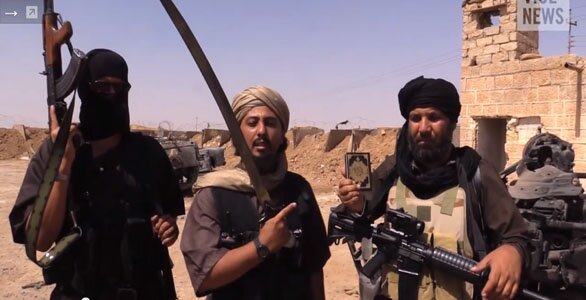
Okay, so what? So what if you’ve just joined ISIS, been given a sword and been sent off to Syria and Iraq. So what if you now have a huge bloody sword in your hand and you’ve just cut off somebody’s head? Big freaking deal. You’re the one that will be going to Hell, not me. But what I want to know is this: Where, exactly, did you get that huge bloody sword in the first place? “Swords R Us”?
From your local “Samurai of the Desert” katana convenience store?
To find out who is really financing, training and supplying ISIS, just check out who is supplying its swords.
“Made in China”? Of course. Isn’t everything these days. But who are the swords being shipped to?
Syrians aren’t supplying the swords. Syrians stand solidly behind Assad — as evidenced by their June elections, and also by the fact that almost all Syrian internal refugees flee to Assad refugee camps, and no one, I repeat, no one ever flees off to ISIS.
Syrians hate ISIS — almost as much as they hate being beheaded! Plus ISIS is still beheading their fathers and mothers and nephews and cousins and aunts. How can you possibly become BFFs with someone like that? Let alone give them more swords so that they can go after your wives and kids too?
According to a new Tweet just sent out from Kurdish Syria, “Hoped American planes will help us. Instead American tanks in the hands of ISIS are killing us.”
And Libya isn’t supplying the swords either. Why? Because Libya itself just had its head handed to it on a platter too — courtesy of the dread Sword of NATO. All that those American-backed “rebels” now in charge of the failed state of Libya are supplying ISIS with currently are some used American rocket launchers and RPGs left over from Benghazi, and a bunch of guys trained by the US to behead Gaddafi.
But perhaps Saudi Arabia is supplying the swords? After all, their state symbol is two swords and a palm tree. But I still don’t understand why the Saudis would do such a dumb thing — buy entire shipments of swords to give to creepy guys hovering right outside their borders? Aren’t the Saudis afraid of blow-back?
Aren’t the Saudi princes afraid that “Behead like a Pirate” day might be coming to Riyadh too?
And isn’t it bad enough already that a bunch of Saudis got their hands on those box-cutters over on the other side of the Atlantic back in 2001 — and just look at all the mischief that caused! Can Saudis really be trusted to play well with swords right in their very own backyards? Saudi Arabia is about to find out.
And how about Turkey? Seen any bloody swords stamped “Made in Istanbul” lately? But why would the Turks want to do that? The blow-back there would be even more immense. You’d have to be crazy to arm a horde of ISIS madmen to go next door and cut off your Syrian neighbors’ heads — no matter how much you hate Syrians. Oops, too late. Turkey has already supplied ISIS with every kind of weapon you can think of — and then naively hired ISIS to be its Neighborhood Watch.
But apparently Turkey thinks that by supplying weapons to ISIS (and also establishing a no-fly zone over Syria) that Syria will fail too and then Turkey will get the Ottoman empire back.
Sorry, Turkey. It’s heads. You lose.
But what about Israel? Did Israeli neo-cons supply all those swords? Who will ever know? Who the freak ever knows what Israeli neo-cons are up to? Certainly not the Jews who first hired them. And definitely not me. Ask the Mossad. But a fly on the wall at Mossad headquarters would probably hear something like this: “Those stupid Americans actually think that we are their only friends in the Middle East. However, before we came along America had no enemies there at all. Good job, guys!” Followed by a high-five.
The nightmare of having ISIS swordsmen let loose to create panic and havoc in the Arab world sounds like an Israeli neo-con wet dream to me.
And what about American neo-cons? Nah. Their most important product is weapons, sure, but they prefer selling Tomahawks rather than swords.
“But Jane,” you might say, “American weapons-manufacturers will sell anything to anyone, even swords to ISIS, if it will make them a buck.” Hell, they’d even sell drones to the Taliban if they thought that money was involved. They’d sell out America in a heartbeat for money. They’d probably even behead their own mothers for a few dollars more.
According to former Austrian general Matthias Ghalem, several years ago Al Qaeda wannabes “signed a financial-military contract to confront upcoming military and security challenges in southern Syria in the future…and that two deputies of Robert Stephen Ford, US former ambassador to Syria, were also present at the meeting…. And according to the Los Angeles Times, since the opening of a new US base in the desert in southwest of Jordan in November 2012, CIA operatives and US special operations troops have covertly trained these militants in groups of 20 to 45 at a time in two-week courses.”
But , the Saudis are to blame for arming ISIS. Of course they are. But it is American weapons that these ISIS cutthroats are firing — and it is American humvees that ISIS is doing donuts with out in the desert too. So why not brandish American swords as well? American neo-cons suddenly draw a line in the sand against swords? But RPGs are okay?
And then there’s Russia. Russia stood silently by while the “Coalition of the Willing” beheaded Iraq and Libya. Would it really be in their best interests to let Syria and Iran get beheaded next? Or is Russia playing the “Afghanistan Game” with the US instead — wherein America slowly but surely beheads its own economy by trying to put eleven trillion dollars worth of “boots on the ground” all over the freaking world where they don’t belong?
Or did Iran sell ISIS the swords? With the American military-industrial complex and Israeli neo-cons using every trick in the book to try to find an excuse to put Iran’s head on the chopping block for fun and profit even as we speak? I think not.
And a friend of mine just asked me the following question: “Or else could it be that Libya and Syria are/were among the few remaining countries that have resisted the imposition of a central bank associated with the Bank of England/Federal Reserve?” Hadn’t thought of that. Hell, maybe the banksters bought ISIS their swords!
And now we get to the next question. Who the freak would ever even want to behead anyone in the first place? That takes a whole bunch of work. Not to mention all that blood-splatter involved — and with no laundromats in sight either.
You’ve got to be really really angry or crazy or both to cut off someone’s head. So what got these ISIS fruitcakes so pissed off in the first place? Perhaps it might have been all these past 60 or 70 years that they, their parents and their grandparents have spent trying to survive the constant “War on Arabs” by American colonialists and Israeli neo-cons? Perhaps this is what has finally sent them around the bend and into horror-movie mode?
Just be glad that ISIS got their inspiration for weapons from watching the “Walking Dead” and not from watching the “Texas Chainsaw Massacre”. But I’m sure that the weapons industry would far rather prefer to produce chainsaws than swords. Chainsaws are a bit more profitable to make, more effectively bloody and just a bit less Old School.
Jane Stillwater is a regular columnist for Veracity Voice
She can be reached at:
Justice Is Immutable: Tyranny Is Elastic
September 28, 2014 by Administrator · Leave a Comment

As our society bounces down ward, flowing this way now and that way a little later, it is difficult to pinpoint exactly what is happening until it has already overwhelmed us.
Almost everyone now knows that football stars Ray Rice and Adrian Peterson are guilty of violence within their families; a video shows Rice knocking his wife unconscious and dragging her out of an elevator. Pictures of Adrian Peterson’s ten year of son with red switch welts on his back and legs have been widely circulated. Both are being disciplined by the National Football League.
Another one that still sticks in my mind happened way back in 1988, Dimetrios Georgios Synodinos (Jimmy the Greek Snyder), a popular 12 year employee of the CBS network was fired for contending at a lunch with TV reporter Ed Hoteling that African Americans were superior athletes because during slavery they had been bred to produce superior physical characteristics.
In July 2002 Phil Donahue, following a record 26 year stint of staring in his own show, returned to TV on MSNBC. His show was an immediate success but was terminated in slightly over six months ostensibly for opposing the Iraq War.
In 2003, Pulitzer Prize winner Peter Arnett was fired by NBC for spreading factual information about the Iraq war.
In 2004, Paul Craig Roberts was banned from the mainstream media for the crime of being critical of the George W. Bush Administration and the war in Iraq.
On January 26, 2009 Juan Williams was separated from National Public Radio for making this comment about First Lady Michelle Obama, “Michelle Obama, you know, she’s got this Stokely Charmichael in a designer dress thing going. If she starts talking…her instinct is to start with this blame America, you know, I’m the victim. If that stuff starts coming out, people will go bananas and she’ll go from being the new Jackie O to being something of an albatross”.
In 2007, Don Imus, pre-eminent New York radio shock-jock, for a flippant racial reference to a Rutgers Women’s Basketball player was fired in the syrupy sweet jargon of the lily white president of CBS, Leslie Moonves, who intoned “From the outset, I believe all of us have been deeply upset and revulsed by the statements that were made on our air about the young women who represented Rutgers University in the NCAA Women’s Basketball Championship with such class, energy and talent. There has been much discussion of the effect language like this has on our young people, particularly young women of color trying to make their way in this society. That consideration has weighed most heavily on our minds as we made our decision.”
In 2010, Lebanese journalist Octavia Nasr, a 20 year employee of CNN was fired for expressing admiration for fellow Lebanese Shiite cleric Ayatollah Mohammed Hussein Fadlallah after she read his obituary.
In 2013 Paula Deen, a popular chef on the Food Channel, was summarily dismissed. A law suit by a Black employee for sexual harassment and discrimination resulted in her admission that she had used racial slurs in the past. Perfuse apologies were useless.
Crystal Dixon was dismissed from her job at the University of Toledo for expressing this bit of sound logic in a letter to the editor of a local paper. “I take great umbrage at the notion that those choosing the homosexual lifestyle are ‘civil rights victims.’ Here’s why. I cannot wake up tomorrow and not be a black woman,” she wrote. “I am genetically and biologically a black woman and very pleased to be so as my Creator intended. Daily, thousands of homosexuals make a life decision to leave the gay lifestyle evidenced by the growing population of PFOX (Parents and Friends of Ex Gays) and Exodus International just to name a few.”
In 2014, Bob Eschliman, a Christian, lost his job as editor of the Newtown Daily News, an Iowa periodical, for criticizing the Queen James Bible Website. He was fired and publically castigated for expressing his opinion.
Additional examples of politically incorrect dismissals abound.
Some of these excoriations were at least partially a result of other behavior that offended the power structure. Jimmy the Greek once punched Brent Musburger in the face for calling him stupid. They were bitter enemies. He also brought Phyllis George to tears by insulting her husband. As popular as he was he did not fit into the media social structure.
Roger Goodell is a lonely Gentile in the midst of major sport commissioners. There may be an effort to replace him by criticizing his performance. Adrian Peterson is a professing Christian Any Christian is fair game.
When Phil Donahue joined NBC in 2002 Chris Matthews fancied himself the heart of the station. Matthews did not like the Donahue Show – it drew a larger audience and pursued peace. He was pro-war and also enjoyed and ethnic advantage.
Peter Arnette was just too honest to survive in the media sea of deception.
Paul Craig Roberts is a thinker, writer, and researcher. He is one of our nation’s most talented individuals but the American Media is monolithic and does not allow deviation from its unwritten and unacknowledged laws. Criticizing war and seeking peace when they support war and death is an affront to their superior agenda.
Juan Williams may have touched on a hidden truth with a conservative type statement. Either or both are no, nos. He is Black and is working again but if a White man had made the same statement he would be banned for life.
Don Imus referred to the Rutgers lady basketball players as “nappy-headed hos”, a racial slur against a race that is sacrosanct in press and media circles. He had friends that got him his job back.
Octavia Nasr expressed admiration for an enemy of the power elite. We must love what they love and hate what they hate.
Paula Deen’s situation was similar to that of Jimmy the Greek. Though she had a popular show and was herself a success story her family was a bit crude for the elite social structure.
Homosexuality is an idol of a high order in the educational hierarchy. Even though Crystal Dixon is Black, pointing in clear logic to the absurdity of comparing civil rights for Blacks to civil rights for homosexuals was unacceptable to the meritocratic humbugs at her university. Of course her reference to and tacit support of Christian organizations is damnable all by itself.
Christians are still naïve about the hate their religion engenders in those that control our press and media. Bob Eschliman found out.
When the powerful purveyors of news and entertainment forsook the Law given them by erstwhile religion they opened the door to the tyranny of their own power. They are now the determiners of good and evil within their sizeable dominions. Morality is now an arbitrary doctrine enforced by raw power.
We might blame the leadership which owns and controls most of the world’s press and media but that leadership is being supported by millions of American Christians and validated by others who support Zionism.
Humanism is the religion of the day. The oligarchs think of themselves as a superior race endowed with authority to exert their will on the world with physical force. They will use Evangelicals who support their wars but they will not abide God’s legal structure.
Questioning the authenticity of 9/11 or the validity of the War in the Middle East is not allowed. Conspiracy talk is squelched as is criticism of Blacks, Jews, The Media, the Iraq War, homosexuality and lesbianism. Christianity can be lambasted but never extolled or promoted. Even if the dismissal is a result of other behavior the elite power structure will look for one of the key “no noes” to re-enforce fear of future infractions.
Law is what the power elite say it is. Justice is a result of abiding by the immutable Law of our Creator – it has vanished from most of the earth. War and chaos have replaced justice and peace.
“To Learn who rules over you simply find out who you are not allowed to criticize.” Attributed to Voltaire
Al Cronkrite is a writer living in Florida, reach him at:
Al Cronkrite is a regular columnist for Veracity Voice
ISIS, Scotland, And The Politics of Mimicry
September 21, 2014 by Administrator · Leave a Comment

Is the fact that half of the Scots want to split from Britain and the news that hundreds of young Muslim Brits are fighting with Jihadi militant groups in Syria connected?
Of course they are. These two social phenomena are intrinsically linked, yet in the intellectual desert in which we live, no one dares to address the subject. The boundaries of our curiosity are limited by our deference to political correctness and Zionist sensitivities.
From a political perspective, Jihadi enthusiasm amongst young Western Muslims is an outcome of the emergence of tribalism in the West; but isn’t the call for Scottish independence driven by a similar tribal urge? From both a philosophical and dialectic perspective, Jihadi identification and the Scottish call for independence are the antithesis of the New Left and its corrosive Identity (ID) politics that have been spread in our midst for too long.
In the last five decades we have witnessed a relentless attack on nationalism and patriotic values. These attacks are commonly associated with the ‘New Left’ and have been led in large part by the Jewish intelligencia. It was the Frankfurt School’s thesis on Authoritarian Personality (Adorno & co) and Wilhelm Reich’s take on ‘Mass Conservatism’ that suggested that there was something wrong, dangerous and even vile to be found among the masses and their ‘reactionist’ political orientation. Contemporary Left cosmopolitan icon Noam Chomsky has been calling for the abolishment of borders and states (except, of course, the Jewish State* for many years. Chomsky is proudly hostile to patriotism and nationalism. Yet we must examine the alternative offered by Chomsky, The Frankfurt School, The New Left and The Guardian – the media outlet that enthusiastically disseminates these ideas.
For reasons that I have discussed numerous times, the New ‘Left’ and the Jewish intelligencia have vigorously advocated the replacement of the national patriotic discourse with ID politics. In practice, this was intended to break the cohesiveness of the working class and the national bond and replace it with a score of marginal and sectarian discourses. The Left that once claimed to be a universal voice for the working people was hijacked. It became the mouthpiece of ID groups, most of them defined by biology (gender, skin color and race), sexual preferences (LGBT) and even religion (Jews only).
The outcome has been devastating. ID politics that initially purported to promote authentic thinking ended up promoting the opposite. It dismantled authenticity and replaced it with ‘Identification.’ Instead of being who we really are (John, Sue, Nahida or Abraham) we’ve been trained to identify with group ideology. We adopted a new manner of speech. We convey our thoughts ‘as a’; ‘as a Jew,’ ‘as a woman,’ ‘as a gay,’ ‘as a black,’ instead of expressing our own and very personal authentic feelings and beliefs as we experience them in an unmediated existential mode.
In practice, we have replaced authenticity with detachment, alienation and mimicry. Instead of celebrating Being in the most existential manner we learned to pre-mediate what being a ‘woman’, ‘Jew’, ‘black’, ‘gay’ should sound like. We learned to envisage what our identification ‘may entail’ and to react as our identification demands. What I describe above is the practical result of the ‘forgetfulness of Being,’ a term coined by the great German philosopher Martin Heidegger. But it is at this point that tribal awareness; nationalism and patriotism are reinvigorated and seem to be gaining ground.
In order to explain this shift, l would like first to examine the case presented by Zionism, Israel and Jewish progressive politics.
Those who attend progressive meetings become accustomed to the righteous Jewish manner of speech. Many Jews launch their speeches with the ‘as a Jew’ cliché. Needless to mention, neither I nor any other scholar of Jewish ID politics have ever managed to figure out what this cliché means. The reason is that it doesn’t mean a thing.
For years I have asked many Jews to address this question and haven’t received a sound reply. The ‘as a Jew’ seems to convey a meaningful logos, but in practice it is used to block critical discussion of the emptiness of the notion of Jewish progressive ID. In truth, there is no Jewish value system and as the great Israeli philosopher Yeshayahu Leibowitz observed in the 1970s, there is no such a thing as ‘Jewish ethics.’ The Jew is expected to follow Mitzvoth and laws (halakha) instead of acting upon his ethical judgment. The conclusion is devastating – ‘as a Jew’ is an empty expression. It is a deceptive mode used to convey an image of a Jewish ethical heritage that doesn’t exist.
This is where Zionism and Israel intervene. They offer the Jew an opportunity to rid himself of the sham of clichés and offer a glimpse of authentic redemption. Zionism and Israel say to the young Diaspora Jew – instead of speaking ‘as a Jew’ why don’t you just ‘Be a Jew?’ – take the first El Al flight, come to Israel, join the IDF, learn how to drive a tank. By the time your transformation is complete you will be able ‘to pour your wrath on the Goyim’ in the name of the Jewish people and in accordance with Jewish heritage (as the Zionist interpret this heritage).
Whether we like it or not, Israel and Zionism give meaning to Jewishness.
The Zionist call is very appealing to young Diaspora Jews (American, British, French, Australian). The IDF is saturated with lone soldiers who arrived in the ‘promised land’ just to wear the uniform and serve their people.
Israel and Zionism provide an authentic patriotic answer to the anti-patriotic mode that has become the voice of the New Left.
ISIS and other Jihadi groups offer the young Muslim a similar product. Instead of talking ‘as a Muslim,’ a statement that means very little within a consumerist, materialist, multi cultural society, the Islamic State and other Jihadi organizations offer their young Western followers the opportunity to Be a proper Muslim. Instead of participating in the inauthentic ‘as a’ game, ISIS calls on its followers to participate in a holy war, the ultimate form of true spiritual fulfillment.
It would be foolish to tag ISIS Western combatants as “bad Muslims” or ‘evil fundamentalists’ while turning a blind eye to the rising popularity of Jihadi culture within Muslim communities in the region and in the West. I recommend that we examine the popularity of ISIS amongst young Muslims in the light of the popularity of the Zionist cause within Western Jewish communities. I can’t see why a young British Muslim fighting in Iraq is worse than a Jewish British citizen serving in the IDF and ruining the lives of Palestinians in Gaza and the West Bank.
The rise of nationalism and tribalism is prevalent throughout Europe and much of the world. This week Britain is on the verge of breaking up. Half of the Scots prefer to split from the Kingdom. What is going on in Scotland is a repetition of the same pattern. Instead of subscribing to a watery meaningless British ‘collectivism;’ Scotland, as a unifying symbolic bond has much more to offer its people.
To sum up, it seems that the attempt by the New Left to weaken the Nation state by promoting ID politics has backfired. It has led toward a sharp rise of tribal orientation and local patriotism. This reading may also help us to grasp the historical failures of the New Left and its mentors at the Frankfurt School. As we know, the masses never joined the Left. The promised revolution never occurred either. And the reason is plain: real working people didn’t have cause to impersonate working people – they were the working people.
The Left’s advocacy of mimicry was not without its benefits. It brought itself some popularity amongst middle class Guardian readers and progressive Jews. But the current outburst of tribalism suggests that our society is changing direction. Society may never be the same, and this may be a very positive occurrence.
Gilad Atzmon was born in Israel in 1963 and had his musical training at the Rubin Academy of Music, Jerusalem (Composition and Jazz). As a multi-instrumentalist he plays Soprano, Alto, Tenor and Baritone Saxes, Clarinet and Flutes. His album Exile was the BBC jazz album of the year in 2003. He has been described by John Lewis on the Guardian as the “hardest-gigging man in British jazz”. His albums, of which he has recorded nine to date, often explore political themes and the music of the Middle East.
Until 1994 he was a producer-arranger for various Israeli Dance & Rock Projects, performing in Europe and the USA playing ethnic music as well as R&R and Jazz.
Coming to the UK in 1994, Atzmon recovered an interest in playing the music of the Middle East, North Africa and Eastern Europe that had been in the back of his mind for years. In 2000 he founded the Orient House Ensemble in London and started re-defining his own roots in the light of his emerging political awareness. Since then the Orient House Ensemble has toured all over the world. The Ensemble includes Eddie Hick on Drums, Yaron Stavi on Bass and Frank Harrison on piano & electronics.
Also, being a prolific writer, Atzmon’s essays are widely published. His novels ‘Guide to the perplexed’ and ‘My One And Only Love’ have been translated into 24 languages.
Gilad Atzmon is a regular columnist for Veracity Voice
Visit his web site at http://www.gilad.co.uk
Obama’s “Strategy” And The Ensuing Non-Coalition
September 21, 2014 by Administrator · Leave a Comment

“French aircraft were due to begin their first reconnaissance flights over Iraq,” France’s Foreign Minister Laurent Fabius announced on September 15. Britain is already flying reconnaissance missions over Iraq. Several other countries – Arab ones included – say they are willing to support the air campaign. None seem interested in pledging any ground troops, however.
“Well, you will hear from Secretary Kerry on this over the coming days. And what he has said is that others have suggested that they’re willing to do that. But we’re not looking for that right now,” Chief of Staff Denis McDonough waffled on “Meet the Press” on Sunday, September 14. “We’re trying to put together the specifics of what we expect from each of the members,” he added, which is one way of saying the United States is finding it hard to persuade other countries to provide ground forces – something the self-designed leader of the “coalition” is unwilling to do. Also on “Meet the Press” James Baker noted that the biggest problem “of course, is who are our, quote, ‘partners on the ground’ that the president referred to in his speech. And I don’t know where they come from.” Let it be noted that Baker put forth an ad-hoc strategic plan that was, in fact, far better than the one outlined by Obama. He suggested joining forces with China, Russia, Iran, Syria and others, following a non-UN-sponsored international conference of genuine international leaders.
There are no “partners on the ground” for now, and those that the Administration wants to groom for the role are worse than none: McDonough conceded that ground troops are needed, “that’s why we want this program to train the [Syrian] opposition that’s currently pending in Congress.” In my curtain-raiser on President Obama’s much-heralded speech of September 10, posted two days before he delivered it (“Obama’s Non-Strategy”), I warned that he – disastrously – still counts on the non-existent “moderate rebels” in Syria to come on board, and still refuses to talk to Bashar al-Assad, whose army is the only viable force capable of confronting the IS now and for many years to come. In short, “he has no plan to systematically degrade the IS capabilities, no means to shrink the territory that they control, and certainly no strategy to defeat them.”
Obama’s address to the nation on September 10 confirmed all of the above, but it also contained numerous non sequiturs, falsehoods, and delusional assertions that need to be addressed one by one. (The President’s words are in italics.)
I want to speak to you about what the United States will do with our friends and allies to degrade and ultimately destroy the terrorist group known as ISIL.
This is an audacious statement of intent: not what the U.S. and America’s unnamed “friends and allies” will try to do, but what they will do to destroy an effective fighting force of some 30,000 fanatical jihadists at the time of this writing, and rapidly rising – an army, in fact, which is well armed and equipped, solvent, and highly motivated. Regardless of the coherence of Obama’s proposed methods – more of that later – what he announced is the beginning of yet another open-ended Middle Eastern war in which the United States will be fully committed and in which the “job” will not be considered “done” until and unless the IS is “destroyed.” Newt Gingrich is already salivating at the prospect of America spending “half of a century or more hunting down radicals, growing reliable self-governing allies, and convincing friends and neutrals to be anti-radical.” This nightmare is good news – at home – only for the military-industrial complex, and abroad for the jihadists of all color and hue. “Half a century or more” of such idiocy can only accelerate this country’s road to bankruptcy, financial as well as moral.
Over the last several years, we have consistently taken the fight to terrorists who threaten our country. We took out Osama bin Laden and much of al Qaeda’s leadership in Afghanistan and Pakistan.
Osama bin Laden’s death did not make one scintilla of difference. Al Qaeda’s (AQ) leadership is not a snake but a hydra: you can “take out” a hundred of its leaders today, and another hundred will take their place tomorrow. Successfully killing scores or thousandsof jihadists should not be confused with winning against jihad. More importantly – and Obama seems to be oblivious to the fact – al Qaeda is not a hierarchical organization, but a state of mind and a blueprint for action. Its non-affiliates, too – in Nigeria, Libya, Syria, the Philippines, Kashmir etc. – follow the same guiding principles and seek the same millenarian objectives. As any counterterrorism expert can tell you, “targeted” drone killings are doing more damage than good by angering local populations – which suffer “collateral damage” – thus providing an inexhaustible pool of fresh recruits for the jihadists (quite apart from legal and moral considerations).
We’ve targeted al Qaeda’s affiliate in Yemen, and recently eliminated the top commander of its affiliate in Somalia.
It is breathtaking that Obama should imply that Yemen and Somalia are his administration’s success stories that should be emulated in the campaign against the IS. As Nicholas Kristof noted in The New York Times, “Obama may be the only person in the world who would cite conflict-torn Yemen and Somalia as triumphs.”
Yemen is an ever-growing hotbed of terrorist activity regardless of (and more likely partly due to) more than 100 American airstrikes since 2002, which killed some 500 militants and over a hundred civilians. (When Yemeni kids are disobedient, their parents have a new tool of enforcing discipline: “A big American drone will come and get you!”) The Department of state admitted in its most recent worldwide terrorism report that “of the AQ affiliates, AQAP (Al Qaeda in the Arabian Peninsula) continues to pose the most significant threat to the United States and U.S. citizens and interests in Yemen.” Its success, according to the report, is “due to an ongoing political and security restructuring within the government itself” [i.e. no effective government and no reliable security forces]. “AQAP continued to exhibit its capability by targeting government installations and security and intelligence officials, but also struck at soft targets, such as hospitals,” and it continues to expand territory under its control. Somalia is an utterly failed state with no functioning government, and al-Shabaab’s terrorist base from which complex operations are launched against soft targets in neighboring countries (notably last year’s attack on Nairobi’s Westgate mall, which killed at least 67 people).
If this is the model for the anti-IS campaign, then even a century of Newt’s “hunting down radicals, growing reliable self-governing allies, and convincing friends and neutrals to be anti-radical” will be a fiasco – albeit on an infinitely grander scale.
We’ve done so while bringing more than 140,000 American troops home from Iraq, and drawing down our forces in Afghanistan, where our combat mission will end later this year. Thanks to our military and counterterrorism professionals, America is safer.
The fruits of the war in Iraq are all too visible. It cannot be stated often enough that America’s war against Saddam – who never threatened the United States, and opposed Islamic terrorism – produced the IS, which is now treated as an existential threat which requires another American war to eliminate.
In Afghanistan the Taliban is well poised to make a comeback one, two, at most three years after the end of the American combat mission. It is able to carry out attacks in the center of the capital, Kabul, the latest of which – on September 16 – killed three members of NATO’s International Security Assistance Force. Safer, indeed.
Now let’s make two things clear: ISIL is not “Islamic.” No religion condones the killing of innocents, and the vast majority of ISIL’s victims have been Muslim.
This is surreal. Obama may have been born and raised a Muslim, but he claims not to be a Muslim now; it is therefore as preposterous for him to pass judgments on the Islamic bona fides of Muslim entities as it would be for the Saudi king to decide whether the Orange Order of Ulster or the Episcopal Church are “Christian” (a purely technical parallel, of course). In any event, Obama’s theological credentials were established with clarity in the aftermath of James Foley’s beheading by the IS, when he declared (also in the context of absolving Islam of any connection with the IS) that “no just God would stand for what they did yesterday and what they do every single day.” Since they did what they did, this unambiguous statement means that – in Obama’s opinion – either there is no God, or God is not just.
Contrary to Obama’s assurances, Islam does condone the killing of infidels (non-Muslims) and apostates (Shiites) – they are not “innocents” by definition. And of course Muslims have been killing other Muslims – often on a massive scale – ever since three of the four early caliphs, Muhammad’s immediate successors, were murdered by their Muslim foes. It is immaterial whether ISIS is true to “Islam” as Obama chooses to define it. It is undeniable that it is true to the principles and practices of historical Islam.
Obama either does not know what he is talking about, or . As Nonie Darwish put it bluntly in the American Thinker on September 12, Obama does not want to go down in history as the one who destroyed and extinguished the dream of resurrecting the Islamic State. Under his watch Islam was placed on a pedestal and that helped revive the Islamic dream of the Caliphate:
Muslims felt that Obama was their man, under whom they had a chance to achieve their powerful Islamic state. Obama himself was not happy with the military takeover and destruction of the Muslim Brotherhood in Egypt. Jihadist ambition had to move away from Egypt to war-torn Syria and Iraq. For more than two years, Islamists have carried out flagrant and barbaric mass terrorism – beheadings, torture, kidnapping, and sexual slavery of women, men, and children. Obama ignored the problem until it blew up in our faces with the beheading of two Americans.
Even if he could defeat ISIS, Darwish argues, that would turn him into an infidel enemy number one of Islam – one who supported Muslims in their dream of the Caliphate by looking the other way, only to later crush it. Obama therefore cannot be honest about this dilemma regarding ISIS; “a dilemma between his duty to the USA, the country he chose to lead, and his dream of becoming the hero of the Muslim World who taught the West a lesson on how to treat Muslims. Obama will not obliterate ISIS but will contain it, as he said. He will eventually kick the can to the next administration, not only because he hates wars as he claims, but because he does not want to be enemy number one of Islam and the Muslims.” That is Obama’s dirty little secret that explains his paralysis before ISIS, Darwish concludes: “Ironically, the man who claimed to have healed the relationship between the West and the Muslim world will go down in history as the one who helped the rise and the bloody fall of the Islamic State and perhaps America itself.”
And ISIL is certainly not a state… It is recognized by no government, nor the people it subjugates.
Obama does not know the feelings of some ten million people under IS control. Many of those who did not cherish life under its black banner have already fled to Damascus, Baghdad, or Erbil. There is no doubt that it is successful in attracting thousands upon thousands of new recruits every month. And as I wrote in the current issue of Chronicles, the Caliphate is a “state” whether we like it or not:
Traditional international law postulates the possession of population, of territory, and the existence of a government that exercises effective control over that population and territory: a state exists if it enjoys a monopoly on coercive mechanisms within its domain, which the caliphate does. After all, unrecognized state entities such as Transnistria, Abkhazia, Northern Cyprus, South Ossetia, and Nagorno-Karabakh command their denizens’ overwhelming loyalty and exercise effectively undisputed control over their entire territory. Some international jurists may cite the ability of the self-proclaimed state’s authority to engage in international discourse, but that is a moot point. The capacity to control a putative state’s territory and population almost invariably leads to such ability, regardless of the circumstances of that state’s inception: South Sudan is a recent case in point, and the creation of Israel in 1947 also comes to mind.
ISIS controls an area the size of Montana in northeastern Syria and western and northwestern Iraq. It has substantial funds at its disposal, initially given it by the Saudis, Kuwaitis, Turks, Qataris, Bahrainis, UAE donors, et al., and augmented to the tune of half a billion dollars looted from the Iraqi government vaults in Mosul and Tikrit. It is effective in collecting taxes, tolls, and excise duties. With no debts or liabilities, the existing stash and ongoing cash flow makes the emerging Caliphate more solvent than dozens of states currently represented in the UN. It has enough oil and derivatives not only for its own needs, but also to earn the foreign exchange needed to buy all the food and other goods it needs from abroad.
ISIL is a terrorist organization, pure and simple.
It is not that (see above). This statement reflects a conceptual delusion which ab initio cannot provide the basis for a sound strategy. Obama’s own State Department declared as far back as July 23 that “ISIL is no longer simply a terrorist organization” – or at least that is what Brett McGurk, deputy assistant secretary for Iraq and Iran, told a House Foreign Affairs Committee hearing on that day. “It is now a full-blown army seeking to establish a self-governing state through the Tigris and Euphrates Valley in what is now Syria and Iraq.”
And it has no vision other than the slaughter of all who stand in its way.
It does have a vision. That vision is eminently Islamic in its millenarian strategic objectives, in its tactics, and in its methods. It is no more utopian than Obama’s vision of an “indispensable” America, which – as he put it at the very end of his speech – stands for “freedom, justice and dignity,” an America which defends those “timeless ideals that will endure long after those who offer only hate and destruction have been vanquished from the Earth.”
In its self-proclaimed status as a caliphate, the IS claims – in principle – religious authority over all Muslims in the world, and ultimately aspires to bring all Muslim-inhabited lands of the world under its political control. Last June ISIS published a document which announced that “the legality of all emirates, groups, states and organizations becomes null by the expansion of the khilafah’s authority and arrival of its troops to their areas.” It rejects the political divisions established by Western powers in the Sykes–Picot Agreement of 1917. Its self-declared immediate-to-medium-term goal is to conquer Iraq, Syria and other parts of al-Sham – the loosely-defined Levant region – including Jordan, Israel, Palestine, Lebanon, Cyprus and southeastern Turkey. It is a bold, even audacious vision, but a vision it most certainly is.
In a region that has known so much bloodshed, these terrorists are unique in their brutality. They execute captured prisoners. They kill children. They enslave, rape, and force women into marriage. They threatened a religious minority with genocide.
There is absolutely nothing “unique” in the IS fighters’ brutality. They are only following the example of their prophet. Muhammad executed Meccan prisoners after the battle of Badr in 624AD. He condoned the killing of women and children besieged in Ta’if in 630. He and his followers enslaved, raped and forced into marriage Jewish women after he massacred the men of the Jewish tribes of Banu Qurayzain 627 and Banu Nadir in 629. He even “married” one of the captured Banu Nadir women, Safiyya bint Huyayy captured after the men Banu Nadir were massacred. He did not “threaten” the Jews of the Arabian peninsula with genocide, he carried that genocide so thoroughly that not a trace of them remains to this day. Christians living in the IS who want to remain in the “caliphate” face three options according to IS officials: converting to Islam, paying a religious tax (jizya), or “the sword.” This choice is as conventionally Islamic as it gets, having been stipulated many times in the Quran and hadith.
But this is not our fight alone. American power can make a decisive difference, but we cannot do for Iraqis what they must do for themselves, nor can we take the place of Arab partners in securing their region. That’s why I’ve insisted that additional U.S. action depended upon Iraqis forming an inclusive government, which they have now done in recent days… I can announce that America will lead a broad coalition to roll back this terrorist threat.
The would-be coalition of Sunni Muslim “partners” includes those who had been aiding and abetting ISIS for years, and who have neither the will nor the resources to fight it. As I wrote here last week, those countries’ military forces are unable to confront an enemy which consists of highly motivated light infantry, knows the terrain, enjoys considerable popular support, and operates in small motorized formations:
On the basis of its poor showing in Yemen it is clear that the Saudis in particular are no better than the Iraqi army which performed so miserably last June. Even when united in their overall strategic objectives, Arab armies are notoriously unable to develop integrated command and control systems – as was manifested in 1947-48, in the Seven-Day War of 1967, and in the Yom Kippur War of 1973. Their junior officers are discouraged from making independent tactical decisions by their inept superiors who hate delegating authority. Both are, inevitably, products of a culture steeped in strictly hierarchical modes of thought and action. Furthermore, their expensive hardware integrated into hard to maneuver brigade-sized units is likely to be useless against an elusive enemy who will avoid pitched battles.
An additional unresolved problem is Turkey, which is staying aloof and will not allow even U.S. facilities in its territory to be used for the air campaign. Erdogan is definitely not a “partner,” and Turkey continues to tolerate steady recruiting of ISIS volunteers in its territory as well as the passage of foreign jihadists across the 550-mile borderit shares with Syria and Iraq.
The most important problem in creating a coalition with Obama’s “Arab partners” is religious, however. The leaders of all Sunni Arab countries and Turkey are well aware that, contrary to Obama’s claims, ISIS is a Muslim group firmly rooted in the teachings and practices of orthodox Sunni Islam. They are loath to ally themselves with the kuffar in fighting those who want to fulfill the divine commandment to strive to create the Sharia-based universal caliphate. Those leaders are for the most part serious believers, and they do not want to go to hell.
Our objective is clear: we will degrade, and ultimately destroy, ISIL through a comprehensive and sustained counter-terrorism strategy. First, we will conduct a systematic campaign of airstrikes against these terrorists. Working with the Iraqi government, we will expand our efforts … so that we’re hitting ISIL targets as Iraqi forces go on offense.
The Shia-dominated Iraqi army is not to be counted upon, as attested by its flight from Mosul, and it cannot be counted upon to cooperate with the armed forces of the overtly anti-Shia regimes, even if in the fullness of time they provided ground troops. The Kurdish pershmerga also would be loath to treat Saudis or Qataris as brothers-in-arms. Even if they were capable of major operations, which they are not, both the Iraqi army and the peshmerga would be perceived by the Sunni Arab majority in northwestern Iraq as an occupying force with the predictable result that the “caliphate” could count on thousands of fresh volunteers. Obama’s “regional allies” could end up helping their Sunni coreligionists fight the Shia “apostates.” They regard the IS in western Iraq and northeastern Syria as a welcome buffer against the putative Shia crescent extending from Iran to the Lebanese coast. As for the “Iraqi forces,” they are devoid of any offensive potential now and that will not change for years to come.
Across the border, in Syria, we have ramped up our military assistance to the Syrian opposition… In the fight against ISIL, we cannot rely on an Assad regime that terrorizes its people; a regime that will never regain the legitimacy it has lost. Instead, we must strengthen the opposition as the best counterweight to extremists like ISIL, while pursuing the political solution necessary to solve Syria’s crisis once and for all.
“The Syrian opposition” is ideologically indistinguishable from the IS, militarily ineffective, internally divided, and far keener to renew its stalled fight against Bashar al-Assad than to fight the Caliphate. America’s would-be “coalition” partners have indirectly indicated that they are aware of this fact: several mentioned Iraq when announcing the proposed military measures last Monday, but none made any mention of the challenge next door.
Obama’s present heavy reliance on the “Syrian opposition” is at odds with his own doubts about its viability, which were openly expressed in an interview with New York Times’s Tom Friedman only a month earlier:
“With ‘respect to Syria,’ said the president, the notion that arming the rebels would have made a difference has ‘always been a fantasy. This idea that we could provide some light arms or even more sophisticated arms to what was essentially an opposition made up of former doctors, farmers, pharmacists and so forth, and that they were going to be able to battle not only a well-armed state but also a well-armed state backed by Russia, backed by Iran, a battle-hardened Hezbollah, that was never in the cards.’”
Now, however, Obama is rejecting cooperation with Damascus – the only realist course with any chance of success – and is relying on a “fantasy” scenario to create some boots on the ground. No lessons have been drawn from Libya’s collapse into bloody anarchy, or from the failure of America’s decade-long effort to train and equip the Iraqi army, which disintegrated when faced with the IS three months ago. Such fiascos notwithstanding, Obama wants to build up a Syrian rebel force as one of the pillars of his strategy – that same force of which he said to Friedman on August 8 that “there’s not as much capacity as you would hope.”
We will continue providing humanitarian assistance to innocent civilians who have been displaced by this terrorist organization. This includes Sunni and Shia Muslims who are at grave risk, as well as tens of thousands of Christians and other religious minorities. We cannot allow these communities to be driven from their ancient homelands.
“Tens of thousands of Christians” is a hundred-fold reduction of the magnitude of the problem that long-suffering community has faced in the region since the start of the Iraqi war in 2003. Obama’s statement is the exact numerical and moral equivalent to saying that “hundreds of thousands of European Jews” were at grave risk at the time of the Wannsee conference. As Peggy Noonan wrote the other day in the Wall Street Journal, “genocide” is the right word to describe the plight of the region’s Christians, noting that “for all his crimes and failings, Syria’s justly maligned Assad was not attempting to crush his country’s Christians. His enemies were – the jihadists, including those who became the Islamic State.” As well as those, let us add, who are now being groomed by the President of the United States to fight the Islamic State. No wonder he is deliberately and cynically minimizing the plight of his protégés’ Christian victims.
This is our strategy.
Lord have mercy!
This is American leadership at its best: we stand with people who fight for their own freedom; and we rally other nations on behalf of our common security and common humanity.
Cringe.
My Administration has also secured bipartisan support for this approach here at home. I have the authority to address the threat from ISIL.
This is disputable. Obama refers to the authorization originally concerning action against al-Qaeda, treating as a blank check for starting a new war of unknown magnitude and duration.
This counter-terrorism campaign will be waged through a steady, relentless effort to take out ISIL wherever they exist, using our air power and our support for partner forces on the ground. This strategy of taking out terrorists who threaten us, while supporting partners on the front lines, is one that we have successfully pursued in Yemen and Somalia for years.
Deja-vu all over again. On the grimly positive note, more Yemeni and Somali-like “successes” may be needed to accelerate America’s eventual return home.
America is better positioned today to seize the future than any other nation on Earth.
It would be a cliché to state that Obama is either deluded or stunningly cynical. He is both, of course, I’d say roughly 60:40.
Our technology companies and universities are unmatched; our manufacturing and auto industries are thriving. Energy independence is closer than it’s been in decades. For all the work that remains, our businesses are in the longest uninterrupted stretch of job creation in our history.
Cringe again: tasteless, self-serving inanities that have nothing to do with ISIS or strategy. Obama’s psychopatic narcissism trumps that of the Clintons, impossible as it may have seemed.
Abroad, American leadership is the one constant in an uncertain world. It is America that has the capacity and the will to mobilize the world against terrorists.
“The world,” indeed, minus Russia, China, India, Brazil, Argentina, Iran, South Africa, and scores of lesser powers on all continents (save Australia) which have the capacity and the will to reject Obama’s audacious and increasingly absurd notions of global leadership.
It is America that has rallied the world against Russian aggression, and in support of the Ukrainian peoples’ right to determine their own destiny. It is America – our scientists, our doctors, our know-how – that can help contain and cure the outbreak of Ebola. It is America that helped remove and destroy Syria’s declared chemical weapons so they cannot pose a threat to the Syrian people – or the world – again.
There is no “Russian aggression,” and “the Ukrainian peoples’ right to determine their own destiny” was brazenly undermined by the State Department/CIA-engineered coup d’etat in Kiev last February. It is preposterous for Obama to take credit for the destruction of Syria’s chemical weapons – it was Vladimir Putin’s diplomatic coup which got Obama off the hook when Congress and the public at large expressed their opposition to the intended bombing of Syria. But yes, American scientists and doctors definitely “can help contain and cure the outbreak of Ebola.” That was the only true statement in Obama’s address. Its relevance to his anti-IS strategy is unclear.
And it is America that is helping Muslim communities around the world not just in the fight against terrorism, but in the fight for opportunity, tolerance, and a more hopeful future.
… especially in places like Marseilles, Antwerp, Malmo, Dortmund, and Dearborn, Michigan.
America, our endless blessings bestow an enduring burden. But as Americans, we welcome our responsibility to lead. From Europe to Asia – from the far reaches of Africa to war-torn capitals of the Middle East – we stand for freedom, for justice, for dignity. These are values that have guided our nation since its founding.
Obama wouldn’t know the founding values if they hit him in the head. He is the worst president of the United States in history after all. That is no mean feat, considering the competition.
Srdja (Serge) Trifkovic, author, historian, foreign affairs analyst, and foreign affairs editor of “Chronicles.” He has a BA (Hon) in international relations from the University of Sussex (UK), a BA in political science from the University of Zagreb (Croatia), and a PhD in history from the University of Southampton (UK).
Dr. Srdja Trifkovic is a regular columnist for Veracity Voice
Ukraine And Neo-Nazis
September 20, 2014 by Administrator · Leave a Comment

Ever since serious protest broke out in Ukraine in February the Western mainstream media, particularly in the United States, has seriously downplayed the fact that the usual suspects – the US/European Union/NATO triumvirate – have been on the same side as the neo-Nazis. In the US it’s been virtually unmentionable. I’m sure that a poll taken in the United States on this issue would reveal near universal ignorance of the numerous neo-Nazi actions, including publicly calling for death to “Russians, Communists and Jews”. But in the past week the dirty little secret has somehow poked its head out from behind the curtain a bit.
On September 9 NBCnews.com reported that “German TV shows Nazi symbols on helmets of Ukraine soldiers”. The German station showed pictures of a soldier wearing a combat helmet with the “SS runes” of Hitler’s infamous black-uniformed elite corps. (Runes are the letters of an alphabet used by ancient Germanic peoples.) A second soldier was shown with a swastika on his helmet.
On the 13th, the Washington Post showed a photo of the sleeping quarter of a member of the Azov Battalion, one of the Ukrainian paramilitary units fighting the pro-Russian separatists. On the wall above the bed is a large swastika. Not to worry, the Post quoted the platoon leader stating that the soldiers embrace symbols and espouse extremist notions as part of some kind of “romantic” idea.
Yet, it is Russian president Vladimir Putin who is compared to Adolf Hitler by everyone from Prince Charles to Princess Hillary because of the incorporation of Crimea as part of Russia. On this question Putin has stated:
The Crimean authorities have relied on the well-known Kosovo precedent, a precedent our Western partners created themselves, with their own hands, so to speak. In a situation absolutely similar to the Crimean one, they deemed Kosovo’s secession from Serbia to be legitimate, arguing everywhere that no permission from the country’s central authorities was required for the unilateral declaration of independence. The UN’s international court, based on Paragraph 2 of Article 1 of the UN Charter, agreed with that, and in its decision of 22 July 2010 noted the following, and I quote verbatim: No general prohibition may be inferred from the practice of the Security Council with regard to unilateral declarations of independence.
Putin as Hitler is dwarfed by the stories of Putin as invader (Vlad the Impaler?). For months the Western media has been beating the drums about Russia having (actually) invaded Ukraine. I recommend reading: “How Can You Tell Whether Russia has Invaded Ukraine?” by Dmitry Orlov
And keep in mind the NATO encirclement of Russia. Imagine Russia setting up military bases in Canada and Mexico, from the Atlantic to the Pacific. Remember what a Soviet base in Cuba led to.
Has the United States ever set a bad example?
Ever since that fateful day of September 11, 2001, the primary public relations goal of the United States has been to discredit the idea that somehow America had it coming because of its numerous political and military acts of aggression. Here’s everyone’s favorite hero, George W. Bush, speaking a month after 9-11:
“How do I respond when I see that in some Islamic countries there is vitriolic hatred for America? I’ll tell you how I respond: I’m amazed. I’m amazed that there’s such misunderstanding of what our country is about that people would hate us. I am – like most Americans, I just can’t believe it because I know how good we are.”
Thank you, George. Now take your pills.
I and other historians of US foreign policy have documented at length the statements of anti-American terrorists who have made it explicitly clear that their actions were in retaliation for Washington’s decades of international abominations. But American officials and media routinely ignore this evidence and cling to the party line that terrorists are simply cruel and crazed by religion; which many of them indeed are, but that doesn’t change the political and historical facts.
This American mindset appears to be alive and well. At least four hostages held in Syria recently by Islamic State militants, including US journalist James Foley, were waterboarded during their captivity. The Washington Post quoted a US official: “ISIL is a group that routinely crucifies and beheads people. To suggest that there is any correlation between ISIL’s brutality and past U.S. actions is ridiculous and feeds into their twisted propaganda.”
The Post, however, may have actually evolved a bit, adding that the “Islamic State militants … appeared to model the technique on the CIA’s use of waterboarding to interrogate suspected terrorists after the Sept. 11, 2001, attacks.”
Talk given by William Blum at a Teach-In on US Foreign Policy, American University, Washington, DC, September 6, 2014
Each of you I’m sure has met many people who support American foreign policy, with whom you’ve argued and argued. You point out one horror after another, from Vietnam to Iraq. From god-awful bombings and invasions to violations of international law and torture. And nothing helps. Nothing moves this person.
Now why is that? Are these people just stupid? I think a better answer is that they have certain preconceptions. Consciously or unconsciously, they have certain basic beliefs about the United States and its foreign policy, and if you don’t deal with these basic beliefs you may as well be talking to a stone wall.
The most basic of these basic beliefs, I think, is a deeply-held conviction that no matter what the United States does abroad, no matter how bad it may look, no matter what horror may result, the government of the United States means well. American leaders may make mistakes, they may blunder, they may lie, they may even on the odd occasion cause more harm than good, but they do mean well. Their intentions are always honorable, even noble. Of that the great majority of Americans are certain.
Frances Fitzgerald, in her famous study of American school textbooks, summarized the message of these books: “The United States has been a kind of Salvation Army to the rest of the world: throughout history it had done little but dispense benefits to poor, ignorant, and diseased countries. The U.S. always acted in a disinterested fashion, always from the highest of motives; it gave, never took.”
And Americans genuinely wonder why the rest of the world can’t see how benevolent and self-sacrificing America has been. Even many people who take part in the anti-war movement have a hard time shaking off some of this mindset; they march to spur America – the America they love and worship and trust – they march to spur this noble America back onto its path of goodness.
Many of the citizens fall for US government propaganda justifying its military actions as often and as naively as Charlie Brown falling for Lucy’s football.
The American people are very much like the children of a Mafia boss who do not know what their father does for a living, and don’t want to know, but then wonder why someone just threw a firebomb through the living room window.
This basic belief in America’s good intentions is often linked to “American exceptionalism”. Let’s look at how exceptional US foreign policy has been. Since the end of World War 2, the United States has:
- Attempted to overthrow more than 50 foreign governments, most of which were democratically-elected.
- Dropped bombs on the people of more than 30 countries.
- Attempted to assassinate more than 50 foreign leaders.
- Attempted to suppress a populist or nationalist movement in 20 countries.
- Grossly interfered in democratic elections in at least 30 countries.
- Led the world in torture; not only the torture performed directly by Americans upon foreigners, but providing torture equipment, torture manuals, lists of people to be tortured, and in-person guidance by American teachers, especially in Latin America.
This is indeed exceptional. No other country in all of history comes anywhere close to such a record.
So the next time you’re up against a stone wall … ask the person what the United States would have to do in its foreign policy to lose his support. What for this person would finally be TOO MUCH. If the person mentions something really bad, chances are the United States has already done it, perhaps repeatedly.
Keep in mind that our precious homeland, above all, seeks to dominate the world. For economic reasons, nationalistic reasons, ideological, Christian, and for other reasons, world hegemony has long been America’s bottom line. And let’s not forget the powerful Executive Branch officials whose salaries, promotions, agency budgets and future well-paying private sector jobs depend upon perpetual war. These leaders are not especially concerned about the consequences for the world of their wars. They’re not necessarily bad people; but they’re amoral, like a sociopath is.
Take the Middle East and South Asia. The people in those areas have suffered horribly because of Islamic fundamentalism. What they desperately need are secular governments, which have respect for different religions. And such governments were actually instituted in the recent past. But what has been the fate of those governments?
Well, in the late 1970s through much of the 1980s, Afghanistan had a secular government that was relatively progressive, with full rights for women, which is hard to believe, isn’t it? But even a Pentagon report of the time testified to the actuality of women’s rights in Afghanistan. And what happened to that government? The United States overthrew it, allowing the Taliban to come to power. So keep that in mind the next time you hear an American official say that we have to remain in Afghanistan for the sake of women’s rights.
After Afghanistan came Iraq, another secular society, under Saddam Hussein. And the United States overthrew that government as well, and now the country is overrun by crazed and bloody jihadists and fundamentalists of all kinds; and women who are not covered up are running a serious risk.
Next came Libya; again, a secular country, under Moammar Gaddafi, who, like Saddam Hussein, had a tyrant side to him but could in important ways be benevolent and do marvelous things for Libya and Africa. To name just one example, Libya had a high ranking on the United Nation’s Human Development Index. So, of course, the United States overthrew that government as well. In 2011, with the help of NATO we bombed the people of Libya almost every day for more than six months. And, once again, this led to messianic jihadists having a field day. How it will all turn out for the people of Libya, only God knows, or perhaps Allah.
And for the past three years, the United States has been doing its best to overthrow the secular government of Syria. And guess what? Syria is now a playground and battleground for all manner of ultra militant fundamentalists, including everyone’s new favorite, IS, the Islamic State. The rise of IS owes a lot to what the US has done in Iraq, Libya, and Syria in recent years.
We can add to this marvelous list the case of the former Yugoslavia, another secular government that was overthrown by the United States, in the form of NATO, in 1999, giving rise to the creation of the largely-Muslim state of Kosovo, run by the Kosovo Liberation Army (KLA). The KLA was considered a terrorist organization by the US, the UK and France for years, with numerous reports of the KLA being armed and trained by al-Qaeda, in al-Qaeda camps in Pakistan, and even having members of al-Qaeda in KLA ranks fighting against the Serbs of Yugoslavia. Washington’s main concern was dealing a blow to Serbia, widely known as “the last communist government in Europe”.
The KLA became renowned for their torture, their trafficking in women, heroin, and human body parts; another charming client of the empire.
Someone looking down upon all this from outer space could be forgiven for thinking that the United States is an Islamic power doing its best to spread the word – Allah Akbar!
But what, you might wonder, did each of these overthrown governments have in common that made them a target of Washington’s wrath? The answer is that they could not easily be controlled by the empire; they refused to be client states; they were nationalistic; in a word, they were independent; a serious crime in the eyes of the empire.
So mention all this as well to our hypothetical supporter of US foreign policy and see whether he still believes that the United States means well. If he wonders how long it’s been this way, point out to him that it would be difficult to name a single brutal dictatorship of the second half of the 20th Century that was not supported by the United States; not only supported, but often put into power and kept in power against the wishes of the population. And in recent years as well, Washington has supported very repressive governments, such as Saudi Arabia, Honduras, Indonesia, Egypt, Colombia, Qatar, and Israel.
And what do American leaders think of their own record? Former Secretary of State Condoleezza Rice was probably speaking for the whole private club of our foreign-policy leadership when she wrote in 2000 that in the pursuit of its national security the United States no longer needed to be guided by “notions of international law and norms” or “institutions like the United Nations” because America was “on the right side of history.”
Let me remind you of Daniel Ellsberg’s conclusion about the US in Vietnam: “It wasn’t that we were on the wrong side; we were the wrong side.”
Well, far from being on the right side of history, we have in fact fought – I mean actually engaged in warfare – on the same side as al Qaeda and their offspring on several occasions, beginning with Afghanistan in the 1980s and 90s in support of the Islamic Moujahedeen, or Holy Warriors.
The US then gave military assistance, including bombing support, to Bosnia and Kosovo, both of which were being supported by al Qaeda in the Yugoslav conflicts of the early 1990s.
In Libya, in 2011, Washington and the Jihadists shared a common enemy, Gaddafi, and as mentioned, the US bombed the people of Libya for more than six months, allowing jihadists to take over parts of the country; and they’re now fighting for the remaining parts. These wartime allies showed their gratitude to Washington by assassinating the US ambassador and three other Americans, apparently CIA, in the city of Benghazi.
Then, for some years in the mid and late 2000s, the United States backed Islamic militants in the Caucasus region of Russia, an area that has seen more than its share of religious terror going back to the Chechnyan actions of the 1990s.
Finally, in Syria, in attempting to overthrow the Assad government, the US has fought on the same side as several varieties of Islamic militants. That makes six occasions of the US being wartime allies of jihadist forces.
I realize that I have fed you an awful lot of negativity about what America has done to the world, and maybe it’s been kind of hard for some of you to swallow. But my purpose has been to try to loosen the grip on your intellect and your emotions that you’ve been raised with – or to help you to help others to loosen that grip – the grip that assures you that your beloved America means well. US foreign policy will not make much sense to you as long as you believe that its intentions are noble; as long as you ignore the consistent pattern of seeking world domination, which is a national compulsion of very long standing, known previously under other names such as Manifest Destiny, the American Century, American exceptionalism, globalization, or, as Madeleine Albright put it, “the indispensable nation” … while others less kind have used the term “imperialist”.
In this context I can’t resist giving the example of Bill Clinton. While president, in 1995, he was moved to say: “Whatever we may think about the political decisions of the Vietnam era, the brave Americans who fought and died there had noble motives. They fought for the freedom and the independence of the Vietnamese people.” Yes, that’s really the way our leaders talk. But who knows what they really believe?
It is my hope that many of you who are not now activists against the empire and its wars will join the anti-war movement as I did in 1965 against the war in Vietnam. It’s what radicalized me and so many others. When I hear from people of a certain age about what began the process of losing their faith that the United States means well, it’s Vietnam that far and away is given as the main cause. I think that if the American powers-that-be had known in advance how their “Oh what a lovely war” was going to turn out they might not have made their mammoth historical blunder. Their invasion of Iraq in 2003 indicates that no Vietnam lesson had been learned at that point, but our continuing protest against war and threatened war in Afghanistan, Iran, Syria, and elsewhere may have – may have! – finally made a dent in the awful war mentality. I invite you all to join our movement. Thank you.
Notes
- NBC News, “German TV Shows Nazi Symbols on Helmets of Ukraine Soldiers”, September 6 2014
- BBC, March 18, 2014
- Information Clearinghouse, “How Can You Tell Whether Russia has Invaded Ukraine?”, September 1 2014
- Boston Globe, October 12, 2001
- See, for example, William Blum, Rogue State: A Guide to the World’s Only Superpower(2005), chapter 1
- Washington Post, August 28, 2014
- Foreign Affairs magazine (Council on Foreign Relations), January/February 2000
William Blum is the author of:
- Killing Hope: US Military and CIA Interventions Since World War 2
- Rogue State: A Guide to the World’s Only Superpower
- West-Bloc Dissident: A Cold War Memoir
- Freeing the World to Death: Essays on the American Empire
Portions of the books can be read, and signed copies purchased, at www.killinghope.org
Email to
Website: WilliamBlum.org
William Blum is a regular columnist for Veracity Voice
Ted Cruz Another Israeli Mouthpiece
September 16, 2014 by Administrator · Leave a Comment

Presidential wannabe politicians seldom will champion an American First foreign policy, but are eager to stand behind a Pro-Zionist agenda, even at the expense of our own essential national interest. The mess that engulfs the Middle East is only getting worse. Throughout all the past administrations and swings in the post World War II cast of enemies, Israel is never mentioned by the establishment as a force that undermines American national security. The axiom that Zionism is an unquestioned ally and friend of the United States, goes unchallenged. Any honest evaluation of world affairs must concede that the political class accepts this illusion as fact. If this was not true, why does nothing ever improve in the regional caldron of eternal conflict?
Israel is a country based upon apartheid animus. The claim that it is a practicing democracy is preposterous with the exclusion of displaced Palestinians from the political process. Zionism is a political ideology and any assertions that it is a religion, totally ignores the policy-making nature of the Israeli government. Judaism historically, based upon a religious adherence to the tenants of the Old Testament, is not universally homogeneous. The differences in the Torah and the Talmud are contentions among some Jews since antiquity. Not all Israelis are professing religious believers. Jews are people. A false assertion, that interchangeably substitutes a population for the identity of the State of Israel, is a fatal error. If Jews, bonded together by a tribal lineage was true, the universe of converts would be most limited.
However, in a world, that advances a culture of guilt and adoration to a tribe of self-appointed “Chosen” that proclaims their superiority race, has deadly consequences for the rest of the globe. Practicing the Mosaic Jewish religion is not the problem. Adhering to the Khazars version of Talmudic Pharisaism is the conundrum.
Unless a distinctive separation from the Israeli state is made regarding the different communities of Orthodox Hebrew Semites, Jewish Babylonian zealots, secular Zionists and Kabbalah Satanic Worshipers, understanding the proper and necessary boundaries for a valid foreign policy towards Israel is impossible.
Democrat and Republican politicians have a habit of taking a vow of allegiance to Israel. Virtually all career-oriented aspirants take the pledge. Heretofore, few prostrate themselves so publically by displaying their own ignorance, as Senator Ted Cruz. Wearing his badge of courage, in the asinine hope that deranged Evangelical Zionists will rally enough support for his election, he largely closes the door on rational voters.
The Daily Caller reports, Ted Cruz Booed Off Stage At Middle East Christian Conference.
“Christians have no greater ally than Israel.”
“Those who hate Israel hate America,” he continued, as the boos and calls for him to leave the stage got louder.
“If you will not stand with Israel and the Jews,” he said. “Then I will not stand with you.”
What motivates such statements and assertions by Cruz? According to a post on the Daily Paul Liberty Forum, Ted Cruz is a hardcore Zionist and aligns himself with interests that are destroying America.
“Zionism is any enemy to the United States of America. We have subjugated our economic and military sovereignty to Israel, and the Israelis have taken advantage for far too long. We should not be engaged in wars for Israel and the U.S. and Israeli Zionists who were responsible for 9-11 must be brought to justice. AIPAC should NOT be ruling America and have her politicians in their back pockets. The banking system must be overhauled and rid of Zionist influence. The United States has become Israel’s whore and it must stop.
Zionism and its belief system has enormous control over our media, banking, and political systems and has masses of Americans snowed under. We must stop this and awaken to its effects.
It causes us to be involved in never ending war that is of no benefit to the U.S., it causes us to be fed a false version of reality such that the policies and the money keep flowing in Israel’s favor, and it causes the American people to be placed in the role of debt slaves under our masters in Israel.”
The Cruz fan club may marvel at his Tea Party advocacy, but the underlying question is whether Christian-Zionists, in this grass root movement, are just as clueless as the Senator is when it comes to a ridiculous support for an antagonistic regime, who threatens nuclear annihilation on any foe that challenges their greater Israel expansion.
Coming to the defense of Cruz is a dependable Glenn “Judas Goat” Beck and his Blaze, Listen to the Last Thing Ted Cruz Tells Audience Before He’s Booed Off Stage at Middle Eastern Christians Event. This article also cites another NeoCon exponent of Zionism, the Washington Free Beacon.
“As the Washington Free Beacon reported, “the roster of speakers includes some of the Assad regime’s most vocal Christian supporters, as well as religious leaders allied with the Iranian-backed terrorist group Hezbollah.”A Cruz spokesperson said the Texas senator decided to headline the event despite some of the associated individuals “because he wants to take every opportunity to highlight this crisis, the unspeakable persecution of Christians.”
So what was the reaction from the organizers of the sponsoring conference? Mideast Christian Conference Organizers Never Told Cruz That Israel Was Off Limits, quotes:
“Joseph Cella, a senior adviser to In Defense of Christians, confirmed there were no specific instructions for speakers, including Cruz, to shy away from Israel.”We gave him the following guideline: The theme to stick to is religious freedom and human dignity,” Cella told The Daily Signal. “There were really no guidelines beyond that. We anticipated he would focus on the theme and stick to it.”
When asked if Cruz deviated from that message, Cella said:
We didn’t expect the speech to delve into the matters of relationships of Jewish, Muslim and Christian brothers and sisters over the years. That was certainly a surprise as well as the reaction.
There is newly intense pressure for push back against Israeli mouthpiece politicians. In the Political Vel Craft article, Zionist Ted Cruz Praises Rothschild’s “State” Of Israel: Gets Booed Off Stage At D.C. Conference, the following appears.
“As we keep saying, Gaza has changed Israel’s image in American politics: the grassroots are appalled by Israel’s carnage and they’re going to be more and more of a force in American elections, countering the [Rothschild] Israel lobby. Last month [Rothschild Czar] Bernie Sanders stood by Israel at a Vermont Town Hall meeting and got heckled so angrily by his own leftwing base that he threatened to call the police. “Bullshit!” someone shouted when he said that Israel has a right to defend itself.
Well the rightwing grassroots are conscious too. Texas [Rothschild Proxy] Senator Ted Cruz got booed off a Washington stage last night after a Christian audience railed at him for praising Israel for defending Christians (when it’s undermining Christian life in the occupied territories).”
Those mostly ignored facts and dirty little inconsistencies have a way of popping up to spoil the Zionist luv fests.
Lastly, the incendiary Loonwatch.com essay Ted Cruz: Christian Dominionism’s Manchurian Candidate, lives up to their name. However, the Emperor author makes a valid point, even if he fails to understand what it is.
“When Keith Ellison ran for Congress he was incessantly attacked by the Islamophobia industry. For years he was assaulted by hostile Conservative organizations and lobbyists as a “stealth Jihadist.” His victories were viewed as a sign of “creeping Islamization.”To this very day the fact that he is in Congress is still a sore point that produces all sorts of vitriolic hatred on the Right.Ironically, the Christian fundamentalists who rant and rave about the phantasm of Muslim fundamentalist takeover of the USA are only projecting their own (hidden) inner desires. It is the Christian Dominionists who have a theology of covertly taking the levers of power and tilting the USA towards theocracy.”
The theocracy that really underpins American political life is not an immerging Islamic Sharia law movement or even the Christian gospel of Jesus Christ. Woefully, what permeates every stratum of politics is an unholy devotion to the temple of Baal. The country of Israel betrays YHVH with their heretical worldview of pre-eminence. America has blasphemed against the Prince of Peace. The United States cannot be a Good Shepherd by following the dictates of Israel. And Yahweh is not a Zionist.
Ted Cruz needs a lesson in religion from .
Texe Marrs in the account, Senator Ted Cruz an Israeli Lackey, sums up the situation nicely. “In the first month after winning the election, Cruz flew to Israel twice to get instructions from his new masters.”
The future restoration of America is impossible, unless and until, the blind obedience to the Israel lobby is broken for the last time. Genuine conservative populists will never support any candidate that subjugates national interests under the approved direction of Zionists. Ted Cruz is one of many, who deserve to be booed.
Sartre is the publisher, editor, and writer for Breaking All The Rules. He can be reached at:
Sartre is a regular columnist for Veracity Voice
Happy Workers of The Future
August 31, 2014 by Administrator · Leave a Comment
Life In 500 Square Feet…

One Hundred and Twenty Thousand results to a Google search on “city is more competitive”. The oligarchs who currently control our world intend to herd people in cities where inter-city contests will keep everyone producing at a high level.
Read how this is already being implemented in China.
More and more of the land is falling under government control and hundreds of thousands of homes have been repossessed. American citizens own fewer homes and less land. If this scenario is successful the earth will be enjoyed by elite overseers while the proletariat toils and lives in tiny cubicles in crowded cities.
I wrote recently about our connection to land
In his daily devotional books R. J. Rushdoony (These books are tightly connected to daily behavior and provide usable righteousness for the Christian seeker. Buy them here .)describes Rogation Sunday and its practice by early Americans. In the evening following Sunday prayer for the harvest “each farmer and his family walked the boundaries of their property and gave thanks for the good earth. As they walked, the boy of the family was ‘bumped’ against the landmarks, the boundary stone, or against a boundary tree. If a pond or stream marked the boundary he was ducked into it. Then the boy who was bumped or ducked was given a small gift. The purpose of the ‘bumping’ and of the gift was to make the boy remember the boundaries of the land he would someday fall heir to.”
Land plays a primary role in the Biblical narrative. The occupation of the Promised Land, the events the preceded, and the battles that followed make up a significant part of the Old Testament. The earth is the Lord’s and it is to be carefully maintained. He provided land for His people and it was apportioned to the Twelve Tribes. He provided the Year of Jubilee to provide stability and prevent a permanent centralization of wealth and power.
Borders of land are related to God’s Law – both are meant to restrain.
In some of America’s Western States 80 percent of the land is owned by the Federal Government. Alaska’s land is mostly government property. Oil drilling rights are controlled in Washington. If these rights were released United States would be energy independent. Reliable sources claim the government owns about 30 percent of the entire United States land mass.
There is evidence that powerful elite bankers may be conspiring to take over large tracts of land as collateral for debt. As our government obligates our posterity for trillions of dollars of debt some of it could be paid by sacrificing government owned land. This could be the genesis of the recent squabble over cattle grazing. .
In His provisions for the lands in ancient Israel God allowed the permanent sales of urban properties but had rural lands returned to their original owners in the year of Jubilee. Stability was vested in the families than owned and cultivated land. Though often overlooked it is still the same today; the cultivation of land provides sustenance for the populace of the earth.
Water and food are products of the earth. They sustain life. Without food and water death comes quickly. Control over access to water and food is power over life and death. The earth belongs to The Lord we are short term custodians. God tells us that those who do not work should not eat. It is the ability to produce food that is everyone’s God given right.
Robots are being touted as a means of reducing the need for human labor. The analyzer failed to address the fate of displaced workers. As technology replaces human labor a problem develops over the use of displaced workers. When Wal-Mart replaces cashiers with do-it-yourself checkout stations they realize an additional profit but the displaced cashiers are faced with the emergency of being deprived of their livelihood.
Societies benefit from technical progress and work that benefits the general population is deserving of reward. However, when technical improvements displace energetic workers the workers must be provided with the means of working to earn food and lodging for themselves and their families.
What is to be done with the leisure time our technical progress is giving us? For many it will be used for self-indulgence. Most of us work to provide the necessities of life but constantly pine for leisure time. But if leisure time is not filled with activity we soon hope for something to do. We were created for activity and when we are full of sleep we crave it.
Wealth provides a person with activity choices. Some wealthy individuals find productive activities; others waste their time in sinful indulgences. A few amass wealth consistently over several generations and use this tacit control of human life to manipulate world powers with an objective of world domination.
We are created beings vested with the mandate to live under the Law our Creator has provided. The Law is not an impediment to our happiness; obedience is the vehicle to righteous, peace, joy, and prosperity. God brings blessings for obedience and curses for disobedience.
It is not only difficult to experience but hard to believe that the United States of America is being gutted and destroyed on the altar of world government. Though the mainstream media is complicit and refuses to publish the atrocities the signs are everywhere. How can airplanes clearly visible to the entire population fly over our nation and spray long trails of an unknown cloud-like substance while the people, the weather channels, and the major news sources never acknowledge their presence? How can an entire government, 435 congressional representatives, 100 senators, and one president ignore hundreds of engineers and piles of evidence that the 9/11 attack was false flag operation and allow the policies of our government to be based on its authenticity? And most shocking of all, how can voters continue with confidence to cast ballots for candidates that invariably betray their trust?
U. S. Voters are like battered spouses that continue to return to the battering partner. It makes no sense to observers but to the voters its must seem like the only alternative. An intervention is sometimes the only solution – but how?
The United States of America has been filled with alien immigrants whose only interest is to rape its wealth. It is engaged in constant wars that sap its strength and destroys its youth. It has been saturated with pornography and bludgeoned into sodomy. For many years its citizens have been exposed to the most aggressive use of incarceration in the entire world. It has piled up debt that probably cannot be repaid but will enslave its children for generations. It is home to so many diverse and ineffective religions that the anarchy of secular humanism is helping push it into tyranny. Liberty has been lost to the lust for power and we now live under a police force that regularly kills citizens that do not obey.
More and more Americans are becoming concerned with our progressive downfall. They see the clouds of tyranny approaching and they feel the winds of turmoil. They are beginning to understand that their government has betrayed them and are apprehensive that unseen forces are overshadowing us. But in spite of this approaching avalanche they are unable to discern the hand of God.
During the 1930s in the small towns of Central United States a deep depression afflicted everyone. We were grateful to be able to eat from a 25 pound bag of oatmeal three times a day. Men without work hitched rides on railroad trains that took them to other areas where they hoped to find work. Those who had food to eat shared with the transients who would often do add jobs in payment.
In the little town where I lived an Evangelical pastor was called to our protestant church. In an effort to bring the congregation closer to the God of the Bible he began having altar calls. The altar call was too confrontational for the church leaders whose brush with Christianity consisted of a Sunday School Bible studies where God’s Word could be judged by the participants and they could decide whether they believed it or not. This minister was soon replaced with one who did not upset the status quo.
Before the Evangelical minister left there was a miracle at my mother’s home. She has been a Methodist all of her life and following my conversion we sometimes discussed religion. On this particular day she was sitting in her antique platform rocker in the living room when she asked me about conversion. I said, “The Bible says you must be born again”. At that very moment there was a knock on the front door. It was the recently dismissed minister. He came in and sat down. In familiar fashion mother said, “Now, Albert, tell the minster what you were telling me. I did, the minster affirmed it, and Mother said, “I don’t believe I have ever done that”. We bowed our heads and mother accepted Christ as her Savior. The minister left without ever mentioning why he had knocked on our door.
Neither my mother nor I made much progress in the Faith since correct Christian theology was not readily available and when it was preached it usually fell on deaf and recalcitrant ears. We are a nation of nominal Christians whose faith is selfish and sinful. We say we believe in God and have accepted Christ as our Savior but instead of becoming obedient servants we expect Him to serve us
During the 1930s there was a Christian patina that covered heavy layers of humanism. My mother was a good, dependable woman. She had earned a college degree from University of Illinois but with my father out of work and not having today’s labor saving devices she was forced to work hard to keep up our home and keep food on the table.
For a time my father worked in the WPA but for the most part society during the depression was free from government interference. Nevertheless, a pride-filled humanism had taken over the country and the seeds for our current tyrannical government were beginning to grow.
Evangelical Christianity brings the good news to individuals but when they are converted the lack of a solid theological base leaves them in a moral limbo that fails to bring change to society. Once our sins are forgiven and we are made new by the Blood of the Savior God seeks obedience as He always has. The Jews failed to obey God’s commandments and their disobedience broke the Covenant. All of God’s blessings are the result of obedience to His Law.
God will not long allow an oligarchy of wealthy humanistic elitists to control His creation. All things work together for good for those who love the Lord and He will bring blessing from this unprecedented quest for world domination. Unfortunately Christians who have failed to work against encroaching evil will be severely judged and will not see the blessing in store for His faithful servants.
Al Cronkrite is a writer living in Florida, reach him at:
Al Cronkrite is a regular columnist for Veracity Voice
SOS! Five Hospital Ships Needed To Save Gaza’s Children
August 17, 2014 by Administrator · Leave a Comment

The statistics are just beginning to be analyzed—by UN agencies and a myriad of NGO’s whose mandates include salvaging young lives from the nearly incalculable ravages of the five-week (and counting) Zionist aggression upon Gaza. It is of course the third aggression in six years against the 1.8 million Palestinians, sardine-canned into what is increasingly referred to as history’s largest open air prison, but the outcome this time is looking particularly cruel and grim.
As the Netanyahu regime announced (on 8/10/14) that its attacks on Gaza would continue, increasing numbers of obscene calls—for Israel to “finish the job” and “go all the way” etc.—are floating in the Zionist state’s malodorous public echo-chamber, emanating from such figures as the Knesset’s deputy speaker, who advocates driving Palestinians into the Sinai desert and resettling Gaza with Jews.
In Khuza’a “the Israeli military had trapped at least 32 people in a home and then prevented the Red Cross from evacuating them before shelling the area,” reported Lebanese-American journalist Roqayah Chamseddine. Hoping for safe haven, the people in the house sought refuge in the basement of a neighbor’s home, where they found additional families already inside.
“By that point we were 120 people, 10 men and the rest women and children,” Kamel al-Najjar recalled for Human Rights Watch.
After dawn and without warning (no polite leaflets or knocks on the roof apparently), Israel struck the house, killing three people and wounding 15 others.
The toll of the war on Gaza’s children has been “catastrophic,” according to UN agencies. At least 450 have been killed, and those not having their physical bodies buried have found their innocence entombed. It is another casualty in the war—a war against all things daring to live and resist in Gaza. According to Chamseddine:
“Israel has forced the children of Gaza to lay flowers atop headstones, and watch helplessly as coffins that are filled with not only their most beloved family members, teachers, neighbors, and friends but also their most treasured memories, lullabies, lessons learned and those that will never come, descend into the belly of the earth. Their lips will memorize and form prayers for the dead and the stars that defied the siege that flickered freely high above them will be snatched from their skies.”
Increasingly it is being heard from Gazans that “Israel has stolen everything beautiful in our lives,” and Israel’s barbarity confirms this sentiment.
Middle East analysts point out that it is difficult to recall a time in modern history when there has been so much sustained slaughter of this region’s civilian population, with more than two-thirds of the victims being women and children. For the past year, UN agencies and other humanitarian organizations have lamented a simple reality—that there is not a sufficient level of international aid to save lives and treat those in need of emergency and longer term medical care.
But now something is changing.
The horrors we have just witnessed, especially with respect to traumas inflicted on children, is producing, as should be the case, a major and rapidly growing international focus on salvaging young lives. Descriptions and evaluations of the consequences of Gaza wars are being published and urgently discussed. Some analysts and government officials, including Pentagon planners, are calling for a ‘Medical Marshall Plan,’ to save Gaza’s children. One proposed first step is the dispatching of a humanitarian support group of hospital ships that would sail to Gaza without further delay.
What can and must be done, by the United States and other countries with the naval and medical capacity to do so, is to organize a Hospital Ship flotilla to break the siege of Gaza, to anchor offshore, and to begin caring for the medical needs of all, with a special focus on children and their psychological well-being. Call it a Mercy Mission. Initially it could include the following countries—all well known for their hospital ships with up-and-running medical staffs: the USA, UK, France, China, Russia, Spain, Argentina, and Australia. Within this group of nations are ships with hundreds of patient beds and fully stocked pharmacies. Moreover, it is a group not likely to be interfered with by those who have imposed the inhumane blockade of Gaza (and of course it even includes some of their collaborators in the region), but perhaps most importantly, every country on the list possesses one or more hospital ships that are fully staffed and available to act.
France is reportedly ready to join such an effort and is also working on a related crisis—in Iraq, where it plans delivery of first aid equipment “in the coming hours,” according to the office of Francois Hollande. The French president has “reaffirmed the will of France to stand by the side of civilian victims of continued attacks” in Iraq, and his spokesmen said that “France will do the same thing for Gaza.”
“The European Union is called upon to also take necessary measures with great urgency to respond to immediate humanitarian needs,” the spokesman added.
Hundreds of EU citizens, with their specialized skills in fields of pediatric medicine and child psychology, are reportedly ready to help the children of Gaza. Two fully stocked and staffed American medical ships, the USNS Mercy and the USNS Comfort, could contribute greatly to the effort. Each ship’s hospital is a full floating medical treatment facility, containing 12 fully equipped operating rooms, a 1,000-bed patient capacity, digital radiological services, medical laboratory, pharmacy, optometry lab, and intensive care ward; each also has a dental clinic with full services, CT scanner, and two oxygen-producing plants.
Helicopter landing decks are available as well, for patient transports, and the ships also have side ports that could take on patients from Gaza fishing boats and other crafts at sea. In addition to these two mammoth-sized medical vessels, dozens of other US Navy ships also have hospitals on board. For example, in one year, the medical department of the USS George Washington handled over 15,000 out-patient visits, drew almost 27,000 lab samples, filled almost 10,000 prescriptions, took about 2,300 x-rays, and performed 65 surgical operations—and nearly 100 other US ships are capable of doing the same.
Just one example with respect to capacity is illustrative. In April of this year, the USNS Comfort—a converted 70,000-ton tanker—sailed from Norfolk, Virginia carrying 900 doctors, nurses, and engineers, including staff from the U.S. military, civilian agencies, non-government charities, and even foreign navies. The ship is designed to be deployed quickly for four month intensive full service medical assistance; yet similar capacities obtain in certain other US ships and in foreign navies as well. All of these resources must be put to immediate use to save Gaza’s children.
Looking at the longer term, the Pentagon should seriously consider ordering a sufficient number of catamaran transports and shallow-draft littoral ships to fill out the flotilla, vessels capable of delivering aid by sea via the relatively shallow Gaza coastline. The success of breaking the siege of Gaza will likely give impetus to a UN Security Council decision to construct a seaport for Gaza, perhaps with a shipping channel to Cyprus.
Similarly, the UK hospital ship, RFA Argus, designated as a ‘Primary Casualty Receiving Ship,’ is moored in Falmouth, England, and is also uniquely designed for this type of humanitarian crisis; and it, too, is reportedly ready to sail once given the green light by Downing Street.
Five Hospital ships are urgently needed along Gaza’s shoreline at the following locations: opposite Jabaliya and North Gaza, Gaza City, Deir al-Balah, Khan Younis, and Rafah.
Although attacking a hospital ship is clearly a war crime, the Israeli pattern of targeting medical facilities in Gaza is well known, and threats from the settler movement and the right wing Likud Party to “sink any ship that enters Gaza waters if judged to be aiding the terrorists” must be taken seriously. Yet one imagines the occupation regime would have to think carefully about sinking another US Navy vessel as it did in 1967 with the repeated bombing of the USS Liberty.
Instead of recycling raw combat power, the White House can best meet the demands of a war-weary American public through an emphasis on missions such as those the USNS Mercy and USNS Comfort are designed for. Poll after US public opinion poll reveal that Americans believe their humanitarian values are best reflected when our navy is tailored for delivering humanitarian aid to places like Gaza, and not by delivering munitions to occupying colonial regimes.
Dr. Franklin Lamb is Director, Americans Concerned for Middle East Peace, Beirut-Washington DC, Board Member of The Sabra Shatila Foundation, and a volunteer with the Palestine Civil Rights Campaign, Lebanon. He is the author of and is doing research in Lebanon for his next book. He can be reached at
Dr. Franklin Lamb is a regular columnist for Veracity Voice
Something Sinister Going On?
August 3, 2014 by Administrator · Leave a Comment
The Unanswered Questions of MH17…

“Recent history has repeatedly proven that nothing said by Washington and its officials should be accepted at face value. No other government in the world has been implicated in so many egregious lies as the United States.” Bill Van Auken, “US lies and hypocrisy on Gaza and Ukraine“, WSWS
“Mendaci neque quum vera dicit, creditor.” Cicero (“A liar is not to be believed even when he speaks the truth.”)
Without a shred of public evidence to support their claim that Moscow was involved in the downing of Malaysia Airlines Flight 17, the United States and Europe have levied a new round of sanctions on Russia. The sanctions, which are designed to restrict Russia’s access to both capital and technology, will be imposed as soon as August 1, despite the fact that Moscow has repeatedly denied either involvement in the incident or of providing material support for the militants fighting in east Ukraine. Not surprisingly, Russia will not be given a chance to defend itself in court or present its case before an independent tribunal. Due process and the presumption of innocence are breezily jettisoned whenever US interests are involved. Instead, Washington will act as judge, jury and lord high executioner arbitrarily imposing penalties on the country that has provided hard evidence of what actually transpired prior to the crash using data it compiled from radar and satellite imagery. In contrast, the US hasn’t lifted a finger to help the investigation even though it has the most advanced, state-of-the-art surveillance systems in the world and even though it had a satellite — capable of reading a license plate from outer space — hovering directly overhead at the time the aircraft blew up. And here’s something else to consider from blogger Moon of Alabama:
“Pentagon officials told CNN (on Tuesday) that the Ukrainian government fired three ballistic missiles towards the federalists during the last 48 hours.” (Moon of Alabama)
If the Pentagon picked up the ballistic missile launches on their radar, they certainly saw the surface-to-air missiles that brought down MH17. Case closed.
So why hasn’t Washington been more forthcoming with the information they have? Why are they basing their judgment on the nonsense they’ve gleaned from social media and Twitter feeds instead of spy-in-the-sky photos and satellite imagery? Why are they dragging their feet and obstructing the investigation? And why, for God sakes, why has Europe agreed to go along with this charade when they know there’s not a scintilla of evidence linking Russia to the downed plane?

These are just some of the questions that remain unanswered a full two weeks after MH17 was downed by what appears to have been a surface-to-air missile launched from a BUK platform somewhere in east Ukraine. (Although even that fact is now in dispute given that MH17 was being allegedly being shadowed by two Ukrainian warplanes. Some analysts believe the aircraft was actually destroyed by air-to-air missiles fired from one of the two Su25 interceptors.)
One thing that’s clear, is that the lack of public evidence hasn’t stopped the Obama administration from smearing Russian president Vladimir Putin in the media or blaming Moscow for the tragedy that killed 298 passengers. The campaign to hold Moscow responsible started just hours after MH17 crashed and has only intensified over the last two weeks. This is amazing considering that, most of what we know about the incident has been provided by Russia. For example, it was Russia that provided the information about the two Su25 interceptors and the US satellite. It was also Russia that came up with the photographic evidence that showed Kiev had deployed anti-air missile systems (BUK) around the area where flight MH17 was downed. The Kiev government has repeatedly denied claims that it had BUK systems in the area, but on Friday, Russian military analysts released satellite images that made mincemeat of those denials. Here’s the story from RT:
“Satellite images Kiev published as ‘proof’ it didn’t deploy anti-aircraft batteries around the MH17 crash site carry altered time-stamps and are from days after the MH17 tragedy, the Russian Defense Ministry has revealed.
The images, which Kiev claims were taken by its satellites at the same time as those taken by Russian satellites, are neither Ukrainian nor authentic, according to a Moscow statement.
The Defense Ministry said the images were apparently made by an American KeyHole reconnaissance satellite, because the two Ukrainian satellites currently in orbit, Sich-1 and Sich-2, were not positioned over the part of Ukraine’s Donetsk Region shown in the pictures….
At least one of the images published by Ukraine shows signs of being altered by an image editor, the statement added.” (“‘Wrong time, altered images’ Moscow slams Kiev’s MH17 satellite data“, RT)
Ask yourself this, dear reader: Why would you provide “altered” photos that were taken on a different day to prove your innocence if you weren’t guilty as hell? And why would the US go along with this farce unless they were involved too?
Like we said earlier, there’s photographic evidence that Kiev had BUK systems operating in the area at the time of the crash. These “new” fake photos only increase the probability that it was a Ukrainian missile that brought down MH17. That’s why the administration hasn’t released any of its radar data or satellite imagery. It’s because they know the truth.
Consider this: The Obama administration has never inquired about the communications recordings between Air Traffic Control (ATC) and the aircrew of MH17.
Why? Don’t they want to know what happened?
Nor have they asked for:
“The information on the specific instructions from the Ukraine Aviation Administration to the air traffic control units of Ukraine with relation to the imposed restrictions on the airspace utilization in the area of Donetsk and Lugansk.” (RT)
Nor are they interested in why MH17 was rerouted over a warzone, 200 kilometers north of all previous flights for the last two weeks. Or whether MH17 was in fact being followed by Ukrainian warplanes. Or whether Ukrainian SAM units were active in the area before the incident took place.
How does one explain the Obama administration’s total lack of interest in any area of the current investigation? Doesn’t that suggest that they already know what happened? And doesn’t that also suggest that they’re trying to prevent the facts from leaking out?
Readers should take a quick look at the 28 questions that Russia’s Air Transport Agency would like the Ukrainian government to answer in order to clarify what happened to MH17. (See questions here.) This is the approach the Obama administration would take if they were genuinely interested in finding out what happened. The reason the administration hasn’t taken this approach, is because they’re not really interested in what happened. Why is that?
Most of the lies about MH17 have been coming from the State Department, where just last Sunday, Secretary of State John Kerry appeared on all five Sunday morning talk shows claiming that Moscow had sent “a convoy of about 150 vehicles with armored personnel carriers, multiple rocket launchers, tanks, artillery, all of which crossed over from Russia into the eastern part of Ukraine and was turned over to the separatists.”
Imagine making a bold statement like that on five different news programs without even one of the hosts demanding evidence to support the claim. Such is the state of the media in the US today.
So far, neither Kerry nor any of the US Intel agencies have produced proof that Russia is providing material support for rebels in east Ukraine. Zilch. It’s all uncorroborated speculation and unsubstantiated rumor.
Do you remember Kerry said he had proof that the Syrian government was responsible for the Aug. 21 Sarin gas attack outside Damascus, an incident that he hoped would lead the US to launch a war against Syria?
It was a lie. Here’s a clip from Robert Parry:
“A new report by two American weapons specialists, entitled “Possible Implications of Faulty US Technical Intelligence in the Damascus Nerve Agent Attack,” makes clear that the case presented by Kerry and the Obama administration was scientifically impossible because the range of the key rocket carrying Sarin was less than a third of what the U.S. government was claiming.” (“The Mistaken Guns of Last August“, Robert Parry, Consortium News)
And what about Kerry’s grandstanding repudiation of the fake leaflets in Donetsk that said “Jews had to identify themselves as Jews … or suffer the consequences.”
Right. That was another whopper Kerry used to promote his attack on Russia.
And what about this from CNN: “Kerry: ‘Drunken separatists’ interfering at MH17 crash site“. Or this from Vice News “MH17 Crash Site Reportedly Looted by Rebels“.
It’s all just more outlandish speculation intended to smear Russia. There’s a great article in the Wall Street Journal by journalist Paul Sonne titled “After Flight 17 Crash, Agony, Debris and Heartbreak in Ukraine Villages” that dispels a lot of the lies that have popped up in the media in the last couple weeks. First of all, the rebels have not prevented inspectors from accessing the site (as Kerry claims) Here’s Sonne in an interview on NPR’s “All Things Considered” on Wednesday:
“The Organization for Security and Cooperation in Europe has actually gotten very good access to the site with the exception of the first day they showed up, which was the day after the crash where their time there was limited to 75 minutes, and they said that they weren’t given access to every piece of the crash site that they had wanted to see. So after the sort of first day standoff that they experienced with some of the rebel militants, it did seem like they were getting pretty full access to the crash site. The problem was that the investigation team, which is now being led by the Netherlands, wasn’t ready and didn’t, in fact, really arrive in Donetsk until a few days ago. And after they finally assembled in Donetsk, it took, you know, about a week or more. Then, fighting had already started to encompass the crash site. And the reason that they’re not getting access to the crash site now is not because the rebels are not allowing them to go to the crash site. It’s because the crash site has turned into an active, violent fighting zone.”
So the inspectors have had access to the site the whole time except just recently when US-backed goons from the Ukrainian army resumed hostilities in violation of their promise to honor a temporary ceasefire. It sounds like Kiev might have something they want to hide at the crash site, doesn’t it?
Meanwhile, according to the Independent, “John Kerry accused the separatists of displaying “an appalling disrespect for human decency” in carrying on fighting close to the area.”
Is Kerry lying again or is he just confused about the facts?
As far as the looting and drunken disrespect for the corpses of the victims; that’s all BS too. Sonne paints an entirely different picture of what took place on the ground. Just check out some of his description and see if it squares with Kerry’s breakdown:
“The plane’s cockpit and dozens of bodies plummeted into Rozsypne, about 2 miles from Petropavlivka. One body fell through a woman’s roof. A pilot strapped to a seat wound up next to a flight attendant in a nearby field. …Charred remains of an engine, landing gear and wings fell in a fireball next to Hrabove, with a tumbling storm cloud of at least 70 bodies, some of them largely intact…
No villagers on the ground died, but they are scared of what they might find next…
“We thought it was the end of the world,” the Orthodox priest says. He stayed on the ground in prayer, preparing to meet God, and then ran up the hill as burning pieces of the plane’s undercarriage and landing gear pelted a field like bombs. Then came a hail of bodies: arms, heads and fingers.
Farmers dashed to the village, afraid it would be engulfed by an inferno. Hrabove Mayor Vladimir Berezhnoi screamed at drivers and motorcyclists to get off the road as fire rolled across a field. When he saw bodies, Mr. Berezhnoi yelled at adults to take their children home.
A few miles away, Oleg Miroshnichenko, a retired miner who became the mayor of Rozsypne about 13 years ago, felt panic as he heard two loud blasts and watched the remains of about 40 passengers rain down on yards and homes. His phone started ringing off the hook.
“There’s a body here, a body there, another body,” he says…
“In mines, you don’t remove a body until they investigate it,” he says.
Villagers and emergency workers decided to start bagging bodies that were rotting in the sun. Local miners joined the effort. Heartbroken residents had been pleading in tears for the bodies’ removal.” (“After Flight 17 Crash, Agony, Debris and Heartbreak in Ukraine Villages“, Wall Street Journal)
See? These people were deeply traumatized by the experience, they weren’t throwing bodies around and disrespecting the dead. That’s pure bunkum, just like the claims that Russia has been firing rounds into Ukraine is bunkum. Just like the leaflets ordering “Jews to register or face deportation” were bunkum. It’s all bunkum. For whatever reason, the State Department doesn’t give a rip about its credibility anymore. They’ll say just about anything as long as they can skewer Moscow.
On Friday, State Department spokesperson Marie Harf was challenged by Associated Press reporter Matthew Lee, who demanded that Harf back up her claims that Russia has been firing rounds into Ukraine with something more substantial than the rubbish she’d read on Twitter. Here’s what the AP journalist said:
“I think that it would be best for all concerned here if when you make an allegation like that you’re able to make it up with something more than just ‘because I said so. You guys get up at the UN security council making these allegations , the secretary [of the State Dept., John Kerry] gets on the Sunday shows and makes these allegations, and then when you present your evidence to back up those allegations, it has appeared to, at least for some, fall short of definitive proof.”
The clearly-flummoxed Harf started backpeddling like crazy, unable to provide any hard evidence that her claims of Russian complicity were anything more than a complete fabrication. As it happens, the so called “satellite imagery data” and “electronic intelligence” that was used to incriminate Moscow was originally posted on coup-backer Geoffrey Pyatt’s Twitter account, which further underlines the fact that the real objective was to shape public opinion with propaganda not to reveal the truth. Here’s a bit more from Antiwar.com:
“During the past several days, there has not been a single report out of Ukraine of an artillery strike against any of their military bases, anywhere in the country. …And this is Ukraine we’re talking about, which comes up with its own dubious stories of Russian attacks on a near daily basis. If Russia was carried out concerted shelling against Ukrainian military targets, Ukraine would be harping on about it constantly. They aren’t even alleging anything close to that is happening. (“US Invents Reports of Russia Attacking Ukraine Bases“, antiwar.com)
A Twitter account, for god sakes! The US State Department is basing its theory on the crap they picked up on Twitter. It’s ridiculous.
Then there’s the State Department’s claim that Russia is massing troops along the border, another fairy tale that’s turned out to be complete baloney. In fact, an International team of inspectors were sent to Russia to check things out and here’s what the found:
“No instances of violations by Russia along the Ukrainian border had been registered by the inspectors,” the ministry said. “The last four months have witnessed 18 separate inspections along the Ukrainian border with the Russian Federation, all in line with the Vienna Open Skies Treaty and the Vienna agreement of 2011.” (RT)
If you’re starting to think that everything you’ve read about the MH17 crash is bullshit, you’re probably right. There’s not much truth to most of it.
But why would the administration lie about things that are so easy to disprove? What’s the point? Are they just getting sloppy and apathetic or is something else going on here?
To get a handle on what’s really going on, we have to understand that Ukraine is not just another bloody afterthought like Iraq, Afghanistan or Syria, none of which would dramatically impact the US’s role as the world’s only superpower. Ukraine is different. Ukraine is an essential part of Washington’s plan to pivot to Asia. If Washington is unable to achieve its objectives in Ukraine — create a chokepoint for vital resources flowing from Russia to the EU, establish NATO bases in the heart of Eurasia, and drive a wedge between Moscow and Brussels — then the plan to maintain US global hegemony for the next century will fail. And if the plan fails, then China will gradually become the world’s biggest and most powerful economy, economic ties between Moscow and Europe grow stronger, and the US will slide into irreversible decline. Get the picture?
This is the scenario that Washington wants to avoid at all cost. That’s why the anti-Russia hysteria in the media has been so ferocious and unrelenting. That’s why the State Department assisted in the coup d’état that toppled the Ukrainian government and triggered the crisis. And that’s why ruling elites of all stripes have thrown their support behind a policy that recklessly pits one nuclear-armed adversary against another. It’s because the bigshot money-guys who run this country are bound and determined to be the Kingfish for the next hundred years even if it means plunging the world into the abyss of a third world war. That’s just a chance they’re willing to take.
Mike Whitney is a regular columnist for Veracity Voice
Mike Whitney lives in Washington state. He can be reached at:
A Nail In Zionism’s Coffin?
August 2, 2014 by Administrator · Leave a Comment
The Slaughter Must End…

The 72-hour ceasefire was supposed to get under way on 8/1/14 starting at 8 a.m. local time—but no sooner had it begun than it appeared to collapse. According to the Gaza Health Ministry, more than 30 Palestinians were killed, and dozens more injured, in an Israeli attack near the southern town of Rafah.
If, against all odds, a genuine ceasefire were to actually take place, the pause would allow time for both sides’ fighters to regroup and re-arm. But what of the civilian population of a now substantially destroyed Gaza? Presumably many will try to visit their bombed homes to retrieve some belongings, as we have seen in Syria and Iraq, and many will try finding a place to hide, say, perhaps, a UN school—well, maybe that’s a bad choice. Others may simply stay in their homes and wait to die.
For the invading Zionist forces, they are insured of plenty of munitions both during and after any ceasefire—because the Obama Administration is supporting Israel’s aggression in the Gaza Strip, and it is doing so, in part, by allowing it to tap into local US arms stockpiles. The Israelis will be able to resupply themselves with 40mm grenades and 120mm mortar rounds, stocks that the Pentagon claims “need to be refreshed,” this according to Rear Admiral John Kirby, the Pentagon’s press secretary, who rejected out of hand this week’s Amnesty International demand that “the US government immediately end its ongoing arms deliveries to Israel, which are providing the tools to commit further serious violations of international law in Gaza.” And not only that. Earlier, the US Senate, by a vote of 100 to 0, passed a resolution drafted by AIPAC expressing support for Israel’s attack on Gaza, a resolution reading in part, “The United States Senate reaffirms American support for Israel’s right to defend its citizens and ensure the survival of the State of Israel”—and which says not a single word about Palestinian deaths.
Additionally, US politicians are working to provide millions of dollars in supplementary funding for Israel’s “Iron Dome” missile shield. The US Senate Appropriations Committee added $225 million for Iron Dome to a spending bill mainly intended to provide money to handle an influx of thousands of Central American children across the US-Mexico border.
“It is not that Iron Dome is all that effective, it fails 75% of the time,” said one Congressional staffer in an email to this observer earlier this week. “But Congress is under pressure to be seen as supporting Israel, and we’ve got to be seen doing something before we adjourn for five weeks.”
And likewise, as a sop to AIPAC, the White House announced on 7/31/14 that it “strongly opposes” a Republican-crafted emergency spending bill, in part because it contains no funds for Israeli missile defense and other presumed necessities. Earlier in the day the Senate had begun debating a $3.5 billion auxiliary spending measure that included the $225 million in additional funding for Iron Dome when suddenly the White House voiced its opposition to the House version, claiming it “does not include funding for the Department of Defense to support the government of Israel’s request for critical defense needs.”
It was also on 7/31/14, that Brian Wood, Head of Arms Control and Human Rights at Amnesty International, reminded Mr. Kirby, the illustrious rear admiral, of an unpleasant truth, one that doesn’t normally penetrate Washington’s deaf-dumb-and-blind bubble: “It is deeply cynical for the White House to condemn the deaths and injuries of Palestinians, including children, and humanitarian workers, when it knows full well that the Israeli military responsible for such attacks are armed to the teeth with weapons and equipment bankrolled by US taxpayers.”
But despite all the American government’s massive support for Israel, survival of the apartheid regime is not at all assured. Recently expressed antipathy toward the Zionist state from notables in Europe, South America and parts of Asia seems to be considerably more than just bluster. Israelis are correct in thinking they can no longer count on public opinion, not in Europe or even, to a lesser extent, perhaps, from the American public either. Increasingly the latter are pressuring their Zionist-bought politicians, admittedly on a modest scale still at this point, but in a manner causing them to ponder their electability as Israel continues its descent into a pariah state. A recent Gallup poll found a majority of Americans less than 30 years of age believe Israel’s actions in Gaza to be unjustified and criminal. This is because younger Americans have grown up witnessing a US-armed-and- propped-up Israel brutally occupying the West Bank, killing Palestinians, while also invading Lebanon in numerous, periodic attacks that claimed more than 30,000 lives between 1948 and 2006.
In aggregate, Americans still see Israel favorably…but in smaller numbers, while more are viewing it as illegitimate, as a 19th century colonial enterprise with no legitimate place in a civilized international society. “Delegitimisation,” says Einat Wilf, a former Israeli parliamentarian and one of the authors of an as-yet-unpublished study of the topic at the Jewish People Policy Institute (JPPI) in Jerusalem, is becoming “a strategic threat”.
As Robert Fisk pointed out this week, “Gaza, which is being so graphically covered by journalists that our masters and our media are suffering a new experience: not fear of being called anti-Semitic, but fear of their own television viewers and readers – ordinary folk so outraged by the war crimes committed against the women and children of Gaza that they are demanding to know why, even now, television moguls and politicians are refusing to treat their own people like moral, decent, intelligent human beings.”
From Antwerp to Warsaw, demonstrators’ placards have ranged from criticism of Israeli policy (“1,2,3,4, Occupation No More”) to condemning Israel itself (“5,6,7,8, Israel is a Terror State”). A growing percentage of the world’s population is coming to the conclusion that the regime occupying Palestine is a mistake and that history must be corrected. As The Economist recently reported, France is experiencing major unrest, which may be no surprise given that it claims the largest Jewish and Arab populations in Europe, but the extent of the tensions in France, including attacks on synagogues and raids on Jewish shops, has been shocking nonetheless. Even in normally sedate Oslo, the Jewish museum closed its doors.
Frankly, it comes as no great surprise then that many Jews feel that the world is against them, and view criticism of Zionist apartheid Israel as a mask for animosity towards Jews. In this they are very wrong. Let them visit the Middle East, in peace, and they will learn quickly that the rejection here is not at all about Jews, but only about Zionism as a fascist, racist creed. What people of good will reject, in the Middle East as elsewhere, is an antiquated movement that promotes a chosen people’s right to steal land belonging to others while ethnically cleansing an indigenous population; a movement that encourages chants of “Death to Arabs” among school children, whose settlers organize ‘fun-days,’ gathering as spectators to observe Zionist forces slaughtering Arab children in Gaza, as teachers hand out balloons and ice cream while leading the children in hate filled songs.
International public opinion matters. And much of it relating to the carnage being inflicted by those illegally occupying Palestine is right. The international public is increasingly aware that what is happening in Palestine today is not really about Hamas; it is not about rockets; it is not about “human shields” or terrorism or tunnels. It is about Israel’s permanent control over Palestinian land and Palestinian lives. It is about an unswerving, decades-long Israeli policy of denying Palestine self-determination, freedom, and sovereignty.
Having created a huge open-air prison in Gaza, PM Netanyahu now claims that Israel cannot relinquish security control of the West Bank for fear of Islamist attack—meaning that the Zionist occupiers intend to consolidate their illegal occupation, thus withdrawing all hope from Palestinians.
This region, and increasingly the global community as a whole, is planning for a post-Zionist Middle East and how best to achieve it without further suffering. The Zionist regime can stop the slaughter in Gaza; it can withdraw from Palestinian lands through agreement with international norms and UN resolutions, or, sooner or later, it will very likely cease to exist.
Dr. Franklin Lamb is Director, Americans Concerned for Middle East Peace, Beirut-Washington DC, Board Member of The Sabra Shatila Foundation, and a volunteer with the Palestine Civil Rights Campaign, Lebanon. He is the author of and is doing research in Lebanon for his next book. He can be reached at
Dr. Franklin Lamb is a regular columnist for Veracity Voice
The Cause and Consequences of World War I
July 29, 2014 by Administrator · Leave a Comment

With the centurial commemoration of the , the Timeline of World War I provides a chronological list of facts and occurrences. Contrast such details with a wholly inadequate and sanitized version of the Top 5 Causes of World War 1:
1. Mutual Defense Alliances
2. Imperialism
3. Militarism
4. Nationalism
5. Immediate Cause: Assassination of Archduke Franz Ferdinand
None of these simplistic categories or labels has any veritable bearing on the underlying political, social, economic and evil forces that conspired to drive Western Civilizations into a self-induced suicidal slaughter. The true history of World War I is rooted in the permanent struggle against satanic powers that seek the destruction of Christendom, the financial enslavement of humanity and the death of gentile society.
Understand the real history of The Rothschild 1901 – 1919: The secret creators of World War 1.
“In this war, the German Rothschild’s loan money to the Germans, the British Rothschilds loan money to the British, and the French Rothschilds loan money to the French. Furthermore, the Rothschilds have control of the three European news agencies, Wolff (est. 1849) in Germany, Reuters (est. 1851) in England, and Havas (est. 1835) in France. The Rothschilds use Wolff to manipulate the German people into a fervor for war. From around this time, the Rothschilds are rarely reported in the media, because they own the media.”
The video, , explains in the most fundamental manner, The Role of the Jews in WWI summarized by Benjamin H. Freedman. “The Balfour Declaration was merely Great Britain’s promise to pay the Zionists what they had agreed upon as a consideration for getting the United States into the war.”
Now read the essay, The Money Masters: How International Bankers Gained Control of America, for the account of America betrayal.
“In America, J.P. Morgan was the sales agent for war materials to both the British and the French.
In fact, six months into the war, Morgan became the largest consumer on earth, spending $10 million a day.
Other Rothschild allies in the United States made out as well from the war. President Wilson appointed Bernard Baruch to head the War Industries Board. According to historian James Perloff, both Baruch and the Rockefellers profited by some $200 million during the war.”
The more that things change the further they remain the same. The essay, International Bankers and WW I references, the book, A Century of War by William Engdahl.
“By 1920, Morgan partner Thomas W. Lamont noted with obvious satisfaction that, as a result of four years of war and global devastation, ‘the national debts of the world have increased by $210,000,000,000 or about 475% in the last six years, and as a natural consequence, the variety of government bonds and the number of investors in them have been greatly multiplied.’ These results have made themselves manifest in all the investment markets of the world but nowhere, perhaps, in greater measure than in the United States.”
“It may be noted that in 1913 the US government budget was a mere $714,000,000 (714 million dollars) while the Rockefeller empire was worth 950 million dollars in 1913. The Rockefeller and Morgan empires were built through financing by the Rothschild banking family.”

Such financial manipulation deserves an honest evaluation, as Brother Nathaniel offers, in his summary of the Benjamin H. Freedman viewpoint in the article, Jews Blackmailed Wilson Into WW I.
“Not a shot had been fired on German soil yet Germany was offering England peace terms. They offered England a negotiated peace on what the lawyers call a status quo ante basis, which means: “Let’s call the war off and let everything be as it was before the war started.”
England, in the summer of 1916, was considering Germany’s peace terms. They had no choice. It was either accepting this negotiated peace that Germany was offering them or going on with the war and being totally defeated.
While that was going on, the Zionists in Germany, led by the Jew, Chaim Weitzman, who later became the 1st President of Israel, went to the British War Cabinet and said: “Don’t capitulate to Germany. You can win this war if the United States comes in as your ally. We can arrange this. But in return, you must promise us Palestine once the tide turns in your favor.”
In this war, 115,516 American soldiers were killed and 202,002 were maimed for life.
That is what the Anti-Christian Jews of the world conspired to achieve in their crooked diplomatic underworld.”
Harsh words, but what was the actual outcome? Mujahid Kamran in the essay, International bankers and WW I, provides an insight into the true reason behind waging World War I.
“Historian Alan Brugar has pointed out that for every soldier who died in battle, the international bankers made a profit of $10,000 dollars! It was the bankers who manipulated the horrific World War I. This bloodletting was not just to make profits – this was also carried out to exhaust countries by bleeding them and enhance the control of bankers over governments with the objective of setting up the New World Order (NWO).”
“The penetration of the banking families into the power fabric of nations can be gauged from the astonishing fact that during WWI German intelligence was headed by the banker Max Warburg, brother of a naturalized US citizen Paul Warburg. Paul Warburg authored the diabolical Federal Reserve scheme. The Warburg’s were among the owners of the Federal Reserve. Both represented their respective “countries” in the “delegations” that met at the “peace” negotiations at Versailles after WWI in which Germany was ripped off completely.”
Remember that after World War I, Henry Ford published the Dearborn Independent and accounts on The Jewish Hand in the World War.
“As Henry Ford saw it, “Mr. Wilson, while President, was very close to the Jews. His administration, as everyone knows, was predominantly Jewish.”22 Wilson seems to have been the first president to have the full backing of the Jewish Lobby, including multiple major financial donors. And he was the first to fully reward their support.”
Today, such writings often criticized as anti-Semitic, present a viewpoint that is acknowledged by the Jewish Writer, Oscar Levy, The World Significance of the Russian Revolution; The International Jew, Vol. III, 1921, p. 184-87. The site, The Evil of Zionism Exposed by Jews, quotes Mr. Levy.
“There is scarcely an event in modern history that cannot be traced to the Jews. Take the Great War (World War I)…the Jews have made this war! … We (Jews) who have posed as the saviors of the world…we Jews, today, are nothing else but the world’s seducers, its destroyer’s, its incendiaries, its executioners … We have finally succeeded in landing you into a new hell.”
Henry Makow Ph.D. comments on the Webster Tarpley version of history (EVIL DEMIURGE OF THE TRIPLE ENTENTE AND WORLD WAR I) in the essay, Illuminati Bankers Instigated World War One, by saying that Dr. Tarpley “eschews mention of Jewish bankers in favor of euphemisms like “Venetians.” Therefore it is unusual for him to state bluntly that King Edward VII was in the pay of the Rothschilds and was responsible for World War One.”

In a “TC” environment, the modern genteelism, international finance has even more dire consequences facing the world today. The T. Hunt Tooley account, Merchants of Death Revisited: Armaments, Bankers, and the First World War references Professor Carroll Quigley and his books, Tragedy and Hope (1966) and The Anglo-American Establishment (written in 1949).
“In these works, Quigley described explicitly a kind of secret, benevolent “network consisting of international bankers and connected elites in business, education, the media, and government which had existed since the nineteenth century:
The powers of financial capitalism had another far-reaching aim, nothing less than to create a world system of financial control in private hands able to dominate the political system of each country and the economy of the world as a whole.
In Quigley’s telling, the role of this elite and its banking connections in World War I was that of financing the “Anglo-American” cause against the Central Powers, whose victory might have threatened what he viewed as the existing Anglo-American Pax Romana.”
Contrast these with the banksters inspired and executed system of the pre World War I reality as described by David A, Stockman in If Only The U.S. Had Stayed Out Of World War I. “Between 1870 and 1914, there was a 45-year span of rising living standards, stable prices, massive capital investment and prolific technological progress. In terms of overall progress, these four-plus decades have never been equaled — either before or since.”A century ago, the term Jew had negative connotations associated with a long history as shylock moneychangers. In the present day, polite and accepted conversation pressures discourse to strike the idiom from the vocabulary. Purging future history from the scourge of debt created finance requires the courage of Henry Ford to strip international finance from its economic dominance and political power. Any ethnic, religious or tribal identity that bears the responsibility of inciting anti-Christian demise is the avowed enemy of all humanity.
International banksters thrive on war. World War I proved that no political regime is immune from satanic belligerence. The last century is an anthology of fabricated conflicts designed to foster Quigley’s NWO financial and coercive control vision. The Rothschild Dynasty vastly extends beyond family and tribe, as it is a matrix for the eradication of the sacred tenants and sanctity of individual life that is a bedrock principle of Western Civilization.
World War I was not about national disputes, but was a planned destruction of Christendom. This defining struggle gave rise to the temple of Totalitarian Collectivism. The only GREAT WAR is the battle to defeat the demon forces that want to impose a Luciferian rule upon the planet. Wars kill citizens, while usury destroys societies.Few people know, much less, understand the essential lesson of World War I. The entire last century needs interpreting and evaluation through the lenses of the eternal struggle. Ignorance is bliss for most people, but faulty history is much more dangerous.

Sartre is the publisher, editor, and writer for Breaking All The Rules. He can be reached at:
Sartre is a regular columnist for Veracity Voice
Nihilism: The West’s Evil Religion of Idolatry, Lies and Hate
July 27, 2014 by Administrator · Leave a Comment

“The Christian religion is the religion of our country. From it are derived our prevalent notions of the character of God, the great moral governor of the universe. On its doctrines are founded the peculiarities of our free institutions.” (William McGuffey, d. May 4, 1873, professor at the University of Virginia, president of Ohio University, and author of McGuffey’s Readers; )
Andre Comte-Sponville, one of France’s preeminent atheist philosophers agrees. In his New York Times bestseller, “The Little Book of Atheist Spirituality,” Sponville observes that even though Western and American civilization has become nonreligious it is nevertheless profoundly rooted in transcendent Biblical morality and traditions. That overt and implied atheism has all but supplanted Biblical beliefs pleases yet simultaneously frightens Sponville as he clearly sees that if Western civilization entirely ceases to be Christian it will fall into something like a refined nihilism. And if we believe that nothing remains,
“….we might as well throw in the towel at once. We would have nothing left to oppose to either fanaticism from without or to nihilism from within—and, contrary to what many people seem to think, nihilism is the primary danger. We would belong to a dead civilization, or at least a dying one….Wealth has never sufficed to make a civilization, poverty, even less so. Civilizations require culture, imagination, enthusiasm and creativity, and none of these things come without courage, work and effort.” Without these necessities, “Good night…the Western world has decided to replace faith with somnolence.” (pp. 28-29)
Sponville admits that in his younger years he had believed in the supernatural God of Revelation and been raised a Christian. Up till around the age of eighteen his faith was powerful. But then he embraced evolutionary scientism and fell away, and this falling away said Sponville, was liberating because for the liberated autonomous ‘self’ whose life no longer has any ultimate meaning or purpose there is no valid reason why he personally should not do as he wants to do, or why his friends should not live in the way that they find most advantageous to themselves.
But the lies, amoralism and perverse license, the nihilism Sponville rejoices in becomes an unbearable source of horror and dread when reproduced in millions of souls. Sponville is right to fear the spread of nihilism, for when multiplied by millions it means there is no longer an ultimate, transcendent source of unchanging truth and moral law independent of sinful men, and as Sponville knows, therefore dreads, the lie is the father of violence:
“(The lie) is the word, act, sign of cunning or silence which makes use of wiles to deceive (all who seek) truth….the attitude of the liar, who full of subtlety, audacity and at times cruel cynicism, misleads his neighbor into the quick sands of falsity. The use of the lie reveals the liar as a person of evil intentions. He who tells lies as a way of getting ahead lacks a love of truth (he or she is) a self-centered dissimulator, cunningly manipulating his fellowmen for his own evil purposes.” (The Roots of Violence, Rev. Vincent P. Miceli, S.J., p.29)
Nihilism is the satanically inverted philosophy of violence, lies and license of America’s president, his cabinet, and the amoral progressive ruling class of which they are members. It is also the philosophy of the Marquis de Sade, Friedrich Nietzsche, Karl Marx and the Sophist Callicles in Plato’s ‘Georgias’ who declares:
“The fact is this: luxury and licentiousness and liberty, if they have the support of force, are virtue and happiness and the rest of these embellishments-—the unnatural covenants of mankind-—are all mere stuff and nonsense.” (Making Gay Okay, Reilly, pp. 31-32)
In other words, with a consensus of lies backed by force and the threat of violence, the Revelation of God, the Christian Church, virtue, true truth, marriage, gender, your children, your humanity, your wealth, your home, your business, and your Constitutional rights become whatever agents of violence and the mobs in back of them want them to be or not to be from one moment to the next.
What nihilism has already led to in England, said Nate Steuer of Jeremiah Cry Ministries, are buildings that once served as churches that are now museums, stores and even nightclubs, a strong belief in evolution and a strong homosexual-rights movement:
“They don’t want to hear the gospel. The gospel is pressed down,’ and the homosexual-rights movement is so rooted in England that Christians are afraid to go ‘into the streets and preach,’ fearing what the LBGT community will do.” (“Fate of Christianity in UK not too far from U.S., warns evangelist,” Chris Woodward, OneNewsNow.com, July 8, 2014)
Evolutionary scientism is a form of nihilism leading in practice to dehumanization, demoralization, reckless irresponsibility and genocide. It is a sham science said G.K. Chesterton. It is a license by which the stupidest,
“…or wickedest action is supposed to become reasonable or respectable, not by having found a reason in scientific fact, but merely by having found any sort of excuse in scientific language.” The program and attitude of scientism is a “serpent….as slippery as an eel,” a “demon…as elusive as an elf,” an “evil and elusive creature.” (The Restitution of Man: C.S. Lewis and the Case against Scientism, Michael D. Aeschliman, p. 43)
Evolutionary scientism has amply demonstrated itself as a virulently anti-human, catastrophically destructive, demonically murderous worldview. In just the first eighty-seven years of the twentieth century, violent spirits who love evil and devouring words and breathe out slaughter and death brutally exterminated between 100-170 million un-evolved ‘subhuman’ men, women, and children in the Soviet Union and Nazi Germany.
In the Soviet Union, the Triune God-and-human hating nihilist of violence, Vladimir Lenin, exulted that,
“Darwin put an end to the belief that the animal and vegetable species bear no relation to oneanother (and) that they were created by God, and hence immutable.” (Fatal Fruit, Tom DeRosa, p. 9)
In other words, the ‘death’ of the God of Revelation allows unfettered violence against millions of people because they are no longer the immutable image-bearers of the Triune God but rather expendable products of evolution on a par with slime, weeds, slugs and rocks. Empowered by evolutionary scientism, Lenin exercised godlike power over life and death. He saw himself as, “the master of the knowledge of the evolution of social species.”
Fueled by hate, contempt and murderous rage it was Lenin who “decided who should disappear by virtue of having been condemned to the dustbin of history.” From the moment Lenin made the “scientific” decision that the bourgeoisie represented a stage of humanity that evolution had surpassed, “its liquidation as a class and the liquidation of the individuals who actually or supposedly belonged to it could be justified.” (The Black Book of Communism, p. 752)
In Nazi Germany evolutionary scientism resulted in gas chambers, ovens, and the liquidation of eleven million “useless eaters” and other undesirables.
Alain Brossat draws the following conclusions about the two regimes of nihilism, the Soviet Union and Nazi Germany, and the ties that bind them:
“The ‘liquidation’ of the Muscovite executioners, a close relative of the ‘treatment’ carried out by Nazi assassins, is a linguistic microcosm of an irreparable mental and cultural catastrophe that was in full view on the Soviet Stage. The value of human life collapsed, and thinking in categories replaced ethical thought…In the discourse and practice of the Nazi exterminators, the animalization of Other…was closely linked to the ideology of race. It was conceived in the implacably hierarchical racial terms of “subhumans” and “supermen”…but in Moscow in 1937, what mattered…was the total animalization of the Other, so that a policy under which absolutely anything was possible could come into practice.” (Black Book of Communism, p. 751)
As in England, evolutionary scientism has replaced the God of Revelation, thus with the animalization of Americans millions of unborn humans have already been aborted, growing numbers of unwanted adults euthanized and late-term unborn babies cruelly dismembered.
Writing in, “New York Abortion Bill Allows Shooting Babies Through the Heart With Poison to Kill Them” Steven Ertelt reports that New York is already the abortion/murder capital of the United States, with practically no oversight of the industry. Throughout the second trimester, developing babies can be completely dismembered,
“… even when they can feel pain (by) pulling the baby out piece by piece until the mother’s uterus is empty. After the abortion, the abortionist must reassemble the child’s body to ensure nothing has been left inside the child’s mother.” (LifeNews.com | 5/20/14 6:28 PM)
What nihilists now demand for late-term abortions that will be legalized in New York by the abortion-expanding Women’s Equality Act, is the murder of babies,
“… by sliding a needle filled with a chemical agent, such as digoxin, into the beating heart, before being delivered.”
Then there is Wisconsin-based abortionist Dennis Christensen and his partner Bernard Smith who have performed 85,000 to 95,000 abortions in a 40 year period:
“So I see it as a calling, I guess,” Christensen said. “But I’ve been called, I’ve served and now I’d like to call someone else.” (Abortionist Who’s Killed 95,000 Babies in Abortions: “I See It as a Calling” Steven Ertelt, LifeNews.com, 7/7/14)
Something “called him” to murder 95,000 babies, but it wasn’t the Holy God of Revelation.
When for millions of nihilists the God of Revelation does not exist and life has no higher, fixed meaning or purpose with neither hope of an afterlife nor any accountability to their Maker for their actions here in this world, then men no longer have reason and purpose for being good, thus are free to be evil. They are at liberty to invoke meaningless law and perverted justice to destroy freedom, dismember babies, and force disordered appetites upon men, women, and children. They are free to accuse the good man of evil, to enslave other people and deprive them of life-sustaining electricity, gas, and water. With this freedom they vandalize and plunder the property and wealth of others and throw our borders open to floods of illegals, rapists, drug-lords, terrorists, pedophiles, murderers and other sinister individuals.
Nihilists can freely lie so as to “normalize” whatever wicked fantasies and schemes they desire, such as global warming/cooling/change, redistributive justice, common core, ‘gay’ equality and Decadence Festivals:
“The Southern Decadence Festival is one of our nation’s most notorious celebrations of sodomy, public sex acts, prostitution, drunkenness, and worse, but is by no means the only such festival….decadence festivals are held over and across post-Christian America and Western Europe as well as in Canada, Hong Kong, Australia, Thailand, Brazil, Belarus, Ireland, Japan, Scotland, China, S. Africa, India and Taipei.” (Sex slaves, sexual anarchy and decadence festivals: ominous signs of something really rotten,” L. Kimball, Renew America, Oct. 25, 2012)
A society of nihilists is a welcome mat to human predators of every stripe from drug lords, ISIS, and the Muslim Brotherhood to flesh-peddlers and the world’s criminal elite: the occult Luciferian New World Order super-wealthy criminal consortium and their merciless leftwing and rightwing allies. This cohort of sinister nihilists believe in nothing, know only hate, contempt, violence, greed and egotism and share a foundational hatred of the Tri-Personal God of Revelation, faithful Christians and Jews and traditional Christian grounded Western and American civilization.
In the impeccably documented book, “Sinisterism: Secular Religion of the Lie,” Bruce Walker describes the super-wealthy consortium and their like-minded allies as Sinisterists, making political labels like Far Right (Nazis/Fascists), liberals and Far Left (Progressives, Bolsheviks, Marxists, Communists) and even like-minded Radical Muslims the same thing.
What unite all Sinisterists are their hatreds:
“They hate Christians…Jews…America (and) Israel. They hate truth. They hate the very idea of truth. They hate the idea of humans as unique and special in the universe. They hate the idea of a great moral purpose unfolding in our lives. Sinisterism is a bundle of connected hatreds. For the sake of their hatreds, Sinisterists lust for power.”(preface)
Because Sinisterists hate the idea of man as God’s spiritual image-bearer they have ‘killed’ the Triune God and forced nihilistic Darwinism upon us because it reduces mankind to less than nothing. They also invent words and sound-bite phrases such as heterosexist, homophobe, global change and nonexistent categories of mankind such as “racial species” and “emerging genders” that imprison thought. Following are some other examples:
1. Multiculturalism: the stealthy destruction of America’s traditional Christian based culture by insidious elevation of pagan and pantheist cultures and belief systems in the name of politically correct tolerance, pluralism and inclusion.
2.’Gay rights/’gay’ marriage: rebellion against and negation of the two created sexes, procreation, and the idea of normal.
3. Political correctness, speech codes, sensitivity training, and hate crime laws: psychic-cages for the minds of traditional-values Americans.
4. Perverse sex education: As was the case in the Soviet Union, its ultimate purpose is the subversion and perversion of our youth—the awakening of the Devil, as Karl Marx’s comrade Bakunin admitted.
5. Critical theory: the mindless vomiting out of destructive criticism upon everything good, true, excellent, normal, and traditional.
6. Global change, Agenda 21, Green Movement, redistributive justice: the evisceration of our standard of living and individual liberties in order to ‘save the planet’ — in other words, penury, misery, death and slavery on behalf of Gaia.
7. Sustainability: Extreme population control calling for the annihilation of billions of people to achieve spiritual communism.
8. Religious pluralism: the erasure of faithful Judaism, Christian theism and America’s founding Christian-based worldview by way of elevating Wicca, animism, Islam, New Age occult spirituality, Gnostic paganism, Buddhism, shamanism, goddess worship, Luciferian Masonry and atheism in the name of politically correct tolerance and inclusion.
In order to destroy rational thinking, nihilists use words and phrases (i.e., change, “make love not war,” “we are Trayvon” “evolution is an established fact of science”) to create images rather than ideas and then concentrate on endless repetition of the same word-pictures,
“…to create a hypnotic effect to defend an otherwise hopeless case. Sinisterists use the same words over and over again.” (p.12)
Nihilism’s black heart is the worship of lies, particularly the Big Lie of evolution. ‘Elite’ transnational Robert Muller, father of Common Core Curriculum and former Assistant Secretary-General of the UN and former Chancellor of the UN University for Peace in Costa Rica speaks of the fate that will befall all politically incorrect thinkers, especially anti-evolutionists:
“…all those who hold contrary beliefs” to politically correct thought favored for the “next phase of evolution” will “disappear.” A hellish fate awaits all who resist political and spiritual globalization, “…those who criticize the UN are anti-evolutionary, blind, self-serving people. Their souls will be parked in a special corral of the universe for having been retarding forces, true aberrations in the evolution and ascent of humanity.” (False Dawn, Lee Penn, p. 133)
With malice aforethought, sinister nihilists have dumbed-down Westerners and Americans by infiltrating our education institutions and even our seminaries with nihilist philosophies, propaganda and schemes such as evolutionary scientism, perverse sex education, so-called ‘higher Biblical criticism,’ critical theory, multiculturalism and revised history.
As evolutionary scientism and the relativity of truth are fatal doctrines– types of nihilism that deny objective truth and reality— they result in the rapid disintegration of critical thinking, faith in God, respect and manners resulting in a twisted, inverted society dominated by moral imbeciles—narcissistic despots, thugs, human parasites and bizarre polymorphously perverse beings— at every level of government and society who know how they feel and what they covet and are thus entitled to but can’t think straight, can’t spell, and don’t know right from wrong.
It should be obvious by now, said Walker, that the relations of people in American and Western society are growing coarser,
“…..more dishonest….shallower….lonelier…more desperate for the narcotics of power, applause and fear as we perceive ourselves moving closer to the status of gods and goddesses. If we choose, as individuals, that idolatry, then we are doomed. All the dystopian nightmares of Orwell, Bradbury, Huxley and others will become real all too soon….we will (either) surrender to thugs governing enslaved nations or embittered terrorists.” (p. 252)
Our so-called “scientifically enlightened” age is an age of nihilism. Ecstatic with the voluptuous delight of destruction which rolls humans into satanic depths; nihilists keep pushing society to the brink of social chaos and suicide:
“The Modern Liberal will invariably (and) inevitably side with evil over good, wrong over right and the behaviors that lead to failure over those that lead to success. When I say the Modern Liberal is morally and intellectually retarded at the level of the five-year old child, it is not hyperbole: its diagnosis.” (Evan Sayet, The Kindergarten of Evil,)
Nihilism is lawlessness, idolatry, violence, perversion, fear, terrors of mind, and horrors of conscience and loss of true freedom since the despair of nihilism ends in man’s slavery to his dark side, death and damnation.
In his poem “The Second Coming,” Yeats reveals the murderous delight of de Sade’s, Nietzsche’s, Marx’s, and Callicles modern offspring:
“Things fall apart; the center cannot hold
The blood-dimmed tide is loosed and everywhere
The ceremony of innocence is drowned
The best lack all conviction, while the worst are
Full of passionate intensity.
Surely some revelation is at hand;
Surely the Second Coming is at hand.”
If Western and American nihilists continue to set the God of Revelation aside in favor of “self” and what they really do know are lies and empty, shallow, meaningless evil, then a tyranny of evil will come upon us swiftly and terribly. But there is another path before us: the way of repentance, truth, decency and God’s Divine Truth. His eternally unchanging Truth will set us free. We should choose the path of Truth and goodness:
“On that choice hangs the fate of humanity. People will either embrace goodness or deny that goodness can exist and commit moral suicide (and) worship The Lie.” (ibid, Walker, p. 252)
People who choose the way of true truth will find the goodness and Light of God. As they follow the Way of Truth they will stumble sometimes, occasionally journey down blind alleys, and perhaps be on the wrong side of causes at times, but they,
“…will never lose hope or the help of other normal people and the Blessed Creator of the Universe.” (ibid, p. 233)
The narrow way leads ever up toward truth, light, beauty, goodness, courage, hope, peace and eternal physical life in an unimaginably beautiful Paradise. The other way is a broad highway spilling into a downward spiraling vortex marked by the despair of nihilism, the darkness of lies, the sulphuric stench of soul-destroying hate, and the horror of nothingness finally issuing into an eternity in outer darkness.
Linda Kimball writes on culture, politics, and worldview. Her articles are published nationally and internationally. Linda can be reached at:
Linda Kimball is a regular columnist for Veracity Voice
Ukraine, Negroponte & Missiles
July 27, 2014 by Administrator · Leave a Comment

Poor Ukraine just can’t seem to catch a break.
Its ancient history reads like a whole patchwork quilt of disaster stories and its modern history gets even worse. First there was that insanely terrible Ukraine famine of 1932-33, artificially manufactured by Joseph Stalin in order to forestall a revolt. And in just those two short years, 25,000 Ukrainians a day died of starvation — until more than 10 million people were dead.
Then Hitler’s Nazis killed 150,000 Jewish Ukrainians at Babi Yar and used eastern Ukraine as a bloody staging area for the siege of Stalingrad. 3.5 million Soviet soldiers died in Nazi prison camps during World War II and many of those soldiers were local boys. Ultimately, more than five million Ukrainians died fighting Nazi Germany and most of Ukraine’s 1.5 million Jews were wiped out. Poor Ukraine!
Then Chernobyl blew up.
Then there was a series of corruption scandals, assassinations, price de-regulations, worker strikes, coal mine explosions and a 3.5 billion deficit to deal with during the 1990s, and the new Ukraine republic was destabilized to the point where its major exports became online porn, mail-order brides and Mafioso types running protection rackets in Sacramento.
Then there was that famous CIA-backed “Orange Revolution” in 2004, yet another total disaster — followed this year by Kiev’s famous beer hall putsch.
Geez Louise, why can’t our CIA ever come up with a plan that Americans can be proud of?
The 2014 neo-Nazi putsch in Kiev, the various resultant slaughters of Resistance fighters in eastern Ukraine and the recent shooting down of Malaysia’s MH17 all seem to have one thing in common: Like any other CIA-backed “nation-building” operation throughout the known world, they are all sort of shadowy, shady and hard to define. However, I am certainly going to try to define them.
To try to understand the pattern of what just happened in Ukraine, you first gotta to go all the way back to Central America during Ronald Reagan’s reign and climb into the mind of John Negroponte — a one-trick-pony kind of guy whose major contribution to America’s international diplomatic policy was the judicious use of snipers and other Trojan-horse-style agitators to initiate various casus-belli false-flag operations.
And since that time when all Hell was unleashed on Central America thanks to John Negroponte (and we still have all those kids at our borders to prove it too), wherever there have been any kind of protests against CIA policy throughout the world, our John’s dead-eye sniper dudes would show up on the sly, take out a few key people on both sides and then just sit back and watch the fun as both sides began to tear each other apart.
Negroponte’s signature handiwork soon became available in Iraq, for instance, happily starting wars between Sunnis and Shias.
And even before Iraq received the benefit of Negroponte’s ingenious full monty, there was also the bloody aftermath of 9-11 — wherein some crazy Saudi dudes blew up the Twin Towers and Negroponte’s homeys then blamed it on Afghanistan. And we taxpayers are still paying for that one.
And wasn’t Negrgoponte’s can’t-fail modus operandi also employed in Syria too? And Scotland? And Gaza? But I digress.
It’s almost 100% certain that Negroponte’s brain-children were also at play during the Ukraine protests in Maidan Square last winter too, when both police and protestors were shot at by snipers. And the result? Kiev’s very own beer-hall putsch and seizure of the government by pro-CIA thugs. Poor Ukraine.
The breadbasket of eastern Europe and a jewel in anybody’s crown is now once again wracked by war and killing and death. And the Odessa Steps run red with blood. Again.
“So get to your point, Jane.”
What am I really trying to say here? That perhaps Negroponte and his ballistic-favoring minions have now taken his sniper-attack method of starting conflicts to a whole new level — and are now using long-range missiles instead of long-range rifles to get the dance started? And thus shooting down the Malaysia airline and blaming it on Russia or Ukrainian Resistance fighters is an idea that he and/or his CIA buddies would definitely come up with? Just saying.
PS: According to several MSM reports regarding the deadly missile that shot down Malaysia MH17, apparently the Russians did it. Apparently Russian bad guys loaded a BUK missile onto a truck, drove through the night like Humphrey Bogart, arrived in eastern Ukraine, set up the equipment, fired at the plane and then high-tailed it back to Russia, not even stopping for coffee or to blow up anything else on their way back.
Russia wouldn’t benefit at all from doing something like this — but who else had means, motive and opportunity? Let’s ask our John.
And blaming it on Ukrainian Resistance fighters doesn’t make any sense either. They haven’t done anything like this before or since. Why just this one time?
Has anyone asked this one simple question yet? “Has the Resistance shot anything else out of the sky with missiles besides just this one plane?” Have any fighter jets, helicopters, dragons, pterodactyls or sea serpents been shot down by the Resistance as well? Or was it only this just one lucky shot from, perhaps, some out-of-control pissed-off Ukrainian Resistance fighter’s high-powered BB gun super-soaker?
Jane Stillwater is a regular columnist for Veracity Voice
She can be reached at:
Zionist Israel An International Pariah
July 26, 2014 by Administrator · 2 Comments

Gaza has become a slaughter zone for the eradication of Palestinians with the most advanced military technology that Israel posses. In comparison the blaming of Hamas for this latest barrage of rockets, fails to recognize any proposition in the mutual savagery. Depending on one’s view just who is the unlawful belligerent, sympathy and condemnation follows. This eternal struggle will never end peacefully. Debating international law, dissecting historic claims, strategizing military options, analyzing diplomatic intentions, and especially honoring superior doctrine among conflicting religious beliefs is a formula that offers no solutions. Yet, Israel is wedded to an expansionist political objective. Extending settlements prevent any permanent settlement agreement.
|
Gaza is an Engineered Flashpoint for WW3 |
Zionist Terror in Gaza Free Gaza and Free the World |
|
|
|
With the follow blown invasion of Gaza, the IDF proves once again that annihilation and ethnic cleansing is the cornerstone of Israeli imperium. For a perspective on the Gaza campaign that you will not hear in the controlled Zionist media, view video. Then if you have the courage to face the truth, , YouTube is a must watch.The notion that the government of Israel has some special right to be an apartheid state, only for Zionists, is the source of perpetual war. Strip away the heretical religious entitlements that only serves to rationalize the bogus legitimacy of a rogue regime, and what you have left is an aggressor tribe of Khazarian outlaws, who allege to be Jewish when it is politically expedient. This charade keeps the naive and uninformed Christian-Zionists pouring out their support for the high cost of claiming: CHOSEN.
No wonder that AIPAC Zionists are in control of American Middle East foreign policy, which is destroying the region for the betterment of Israeli zealotry. Even if you view Palestinians as a conquered people, confined to a leper colony by walls and checkpoints, how can any student of world politics conclude that this experiment of incremental death camps will ever bring peaceful co-existence?Are Zionists the only people who have a right for self-defense? The iron dome that knocks down, the projectiles based on the Chinese “Weishi-2″ or WS-2 rockets is effective in stopping these primitive missiles. “The al-Qassam brigades, the armed wing of Hamas, boasts on its website that it can make its own version of the M-302 – named the R-160 after one of its leaders, Abdel Rantisi, who was killed last decade.” Contrast these weapons with Operation Samson: Israel’s Deployment of Nuclear Missiles on Subs from Germany.
The essay, USrael and Armageddon, references the Samson Option and cites Colonel Warner D. “Rocky” Farr, from THE THIRD TEMPLE’S HOLY OF HOLIES: ISRAEL’S NUCLEAR WEAPONS.
“Israel is a nation with a state religion, but its top leaders are not religious Jews. The intricacies of Jewish religious politics and rabbinical law do affect their politics and decision processes. In Jewish law, there are two types of war, one obligatory and mandatory (milkhemet mitzvah) and the one authorized but optional (milkhemet reshut). The labeling of Prime Minister Begin’s “Peace for Galilee” operation as a milchemet brera (“war of choice”) was one of the factors causing it to lose support. Interpretation of Jewish law concerning nuclear weapons does not permit their use for mutual assured destruction. However, it does allow possession and threatening their use, even if actual use is not justifiable under the law. Interpretations of the law allow tactical use on the battlefield, but only after warning the enemy and attempting to make peace. How much these intricacies affect Israeli nuclear strategy decisions is unknown.”
The video, by Brother Nathanael indentifies the actual threat that Israel posses to the rest of the planet. However, in Gaza the potential becomes the immediate. Based upon the long record of Israeli atrocities, would any prudent person ignore the expected predictability that Zionist warmongers would use any weapon at their disposal to retain their regional power? Like the treasonous American politicians, the Israeli Knesset and Cabinet oversee tyrannical and despotic policies, which push the world to the brink of Armageddon.
Tanya Reinhart makes the argument that The Hamas Government Should be Recognized.
“The U.S. and Europe decided, despite Israel’s opposition, to permit the Palestinian people to hold democratic elections.
In a just and well-ordered world, it would be unthinkable for a government that was elected in this way to be disqualified because Israel does not like the choice of the electorate in question. But in a world in which the U.S. rules, might is right, and might can define democracy as it chooses. Thus, it was announced that the outcome of the Palestinian elections would not be recognized until the three “mantras” were fulfilled: Hamas must renounce terror, honor previous accords, and recognize the State of Israel. Meanwhile the Palestinian people would be punished and starved through an economic boycott, in the hope that this will lead to the collapse of the elected government.”

Nonetheless, in a Haaretz editorial, Israel’s refusal to deal with the Fatah-Hamas coalition is both puzzling and damaging, places blame where it is warranted.
“The Palestinian government to be formed is the result of the reconciliation between Hamas and Fatah and reflects Hamas’ recognition of the Palestinian Authority, which was born of the Oslo Agreements that Hamas had opposed with all its might. This reconciliation is the result of heavy Arab pressure, is supported by all the Arab states and by most of the Palestinian public, and has the backing of several European leaders. Israel, which invested great effort in foiling the diplomatic negotiations, is now citing the Palestinian reconciliation as a decisive reason for freezing the talks, as if before the reconciliation it was rushing to continue the process. Israel’s refusal to recognize this government is liable to portray it once again as the party refusing to give the diplomatic channel a chance.”
Israel is a social outcast for much the same reason that the United States government has become a threat to its own people. Alan Hart back in 2011 writes in the article,
“A short and fairly accurate description of the ideology Netanyahu was raised on is something like this. “The world will always hate Jews. Zionism must therefore do whatever is necessary to build and secure Israel as a refuge of last resort for Jews everywhere. And if that means telling the world to go to hell, so be it.” (That’s actually why David Ben-Gurion, Moshe Dayan and others insisted that Israel should possess nuclear weapons – to have the reinforced ability to tell the world, not just the Arabs, to go to hell if necessary).”
Mr. Hart end the essay with a profound question for all Israelis.
“Is it possible that a global perception of them as citizens of a pariah state and the possibility of real sanctions will alarm enough Israeli Jews to the point where they will take to the streets in significant numbers to demand that their leaders be serious about peace on terms virtually all Palestinians and most other Arabs and Muslims everywhere could accept?”
Watch the compelling interview video, , for an honest answer. When orthodox Jews admit the sacrilege of the pretenders that rule the state of Israel, you find hope that the conscience of honest Jewry will stand up and oppose a Zionist government that defies YHWH. Fast forward to the recent pronouncement from the Eidah Chareidis Rabbinical Court of Jerusalem Condemns Murder of Palestinian Boy, as Abbas urges UN to investigate alleged revenge killing of Arab boy by Jewish extremists.
“With pain and shock, the chief rabbi and the members of the rabbinical court heard about the heinous and foolish crime, the murder of a Palestinian boy here in Jerusalem, by people of Jewish descent. To make matters worse, according to current reports, the murder was committed by Jews in religious dress, may G-d spare us. It is understood and obvious to every Jew and every keeper of the Torah and its commandments that such an act is forbidden by the Torah, and Heaven forbid that a Jew should spill blood. And during our bitter exile, we have been commanded by the holy Torah and our Sages, and by our most recent rabbinic leaders, to bear the yoke of exile, not to provoke the other nations, Heaven forbid, and to wait for the complete redemption by the messiah, not by human intervention. All the more so when this act could lead to unknown consequences, Heaven forbid.”

When will the Israeli government declare its own condemnation, or will the deadly air raids on defenseless Gaza homes become its routine response for perfecting the murder of countless Palestinians noncombatants? As bombs fall on Gaza, take action: Endorse the academic and cultural boycott of Israel.
Sameer Bhat, in the Kashmir Reader, artfully expresses the proper synopsis, Condemn Zionists, not Jews. “Please resist linking Zionism (the terrible ideology practiced by the state of Israel) with Judaism. What Israel is doing in Palestine is a direct outcome of its occupational policies because of Zionism, a despicable colonialist and racist idea that denies rights to Palestinians and advocates their dispossession and expulsion. It is from the pot of Zionist hubble-bubble, filled with the blood of innocents, that Israel draws its strength from. We must criticize and denounce this fascist thought. And yes, anti-Zionism is not anti-Semitism.”
Sartre is the publisher, editor, and writer for Breaking All The Rules. He can be reached at:
Sartre is a regular columnist for Veracity Voice
Conquered But Not Occupied
July 20, 2014 by Administrator · Leave a Comment

First used in the Fifteen Century the word “Levant” has evolved over the centuries. It was originally used to refer to land east of Italy but today it has several different definitions but often refers to the countries of Cyprus, Israel, Jordan, Lebanon, Syria, Palestine, and part of southern Turkey. It has been used as a surname, and as a reference to particular countries. Its popularity has been enhanced by the immense publicity given to the tiny state of Israel which in spite of its diminutive size dominates the region and has tentacles throughout the world. See a map of the ancient Levant here.
Islamic jihadist forces have now conquered vast parts of Iraq and are calling the territory ISIS (Islamic State of Iraq and the Levant). It appears to be a victory for the forces the United States was attempting to destroy but consolidating power could be a victory cloaked in defeat. Consolidation decreases the blocks that must controlled and makes total control easier, it could be a victory for world government. Centralized power creates tyranny; dispersed power contributes to freedom.
From antiquity war and murder have been major problems for humanity. In a jealous rage Cain murdered his brother Abel. War has been the plight of mankind throughout history.
Though the intent was lasting peace, war was the vehicle that allowed God’s Chosen People to conquer the Promised Land. Disobedience caused wars to continue and finally wrested the land from its conquerors scattering those who refused the mercy of the New Covenant. The Temple was destroyed and the Jews of the First Covenant were scattered – by war.
The battle between obedience and disobedience (righteousness and sin) is an everlasting battle that will continue until Jesus comes again.
Sound theology is scarce in America. Arminianism and antinomianism have created a useless pietism that has resulted in the rise of a totalitarian government making the United States an enemy to the world and to its own people. Instead of confronted evil with personal rebukes we have evaded our responsibility transferring it to an increasingly totalitarian government.
Man was not created to govern himself. The anarchy of human opinion always ends in evil humanistic tyranny. We were created to obey God’s Law and when obedience is common conflict is minimized.
The emotional resistance to governmental tyranny that is evident throughout the world is worthless against the obdurate pressure from greedy power centers that consistently win the battle for hegemony. Democracy; government of the people, by the people, and for the people, has not and will not result in lasting freedom for the proletariat.
Manipulation by a controlled press and media keeps the people stuck in a dead end two party system. We have been successfully duped into centering our hope in politics (democracy, republic, monarchy, autocracy, autarky, etc.) believing that we can elect a leader who will bring us righteous government. This, of course, never happens because the leaders are pre-selected to obey the powerful hidden cabal.
Comic Stephen Colbert has coined a new word,” truthiness – truth that comes from the gut, and not from books”. A Washington Post article by cognitive psychologist Eryn Newman reports on the various ways people can “believe things are true when they are not”. Color and contrast affect our beliefs. Photographs bolster our certainties. Newman writes that “people are often unaware of their biases and how biased information influences their judgments”. The article infers that we should seek truth from books and not from the gut. While correct that the gut is often wrong, books are equally erroneous – truth is a product of God’s Word.
In my early Christian walk I was certain that the “Baptism of the Holy Spirit” was the ultimate goal of Christianity. I was adamant against any question concerning its manifestations. In spite of Charismania’s serious heresies, I defended it enthusiastically. .
Human beings are often wrong while adamant about being right. It is a fault common to the brilliant and the mundane; both need the immutable righteousness of God’s Law to exist in equanimity. We were not created to govern ourselves and when leaders bring error to bear on an entire population the results are disastrous.
Though I am an opponent of Christian Libertarianism, Christianity does have a common interest; both seek maximum freedom and minimum government. The Christian model is dependent on a population that is obedient to God’s perfect legal system while the Libertarian model is utopian and humanistic, equally as dangerous as any of the other human systems.
We have a serious problem with any attempt to rectify our current plunge into chaos. Most of our population, Christians included, act as if human beings control the world. The world was created by the God of the Bible and He controls it. What is happening in the United States is a result of the behavior of its citizens and what is required to stop it is a change in behavior.
“Scripture is very clear that the oppression of man follows apostasy from God. It is impossible to read scripture and come to any other conclusion: certainly, Leviticus 26 and Deuteronomy 28 are emphatic on this point. The Lord therefore regards it as further evidence of apostasy if we resist evil for personal reasons while continuing in apostasy. The root to eliminating the wicked ones who rule over us begins with ordering our lives, churches, families, communities, and civil governments in terms of God’s word. When the people are apostate or disobedient they will suffer as God declared through Samuel. Oppression will come upon them. They will cry out against their oppressors, and they will pray to God, but ‘the Lord will not hear you in that day’ (1Sam. 8:10-18). They were crying out against their oppressors, not against their sins and themselves. They were manifesting both sin and blindness.” R. J. Rushdoony, “The Sermon on the Mount”, Pg. 64
Neo-Israel and the Zionists are in the process of gaining control over the Levant. The United States of America is their weapon of choice. It is American soldiers that die supporting the neo-con agenda but it is Israel and the Zionist quest for power that benefits. As Iraq erupts in war and ISIS takes control rumor has it that the CIA controls ISIS. If ISIS can be controlled Iraq will be conquered.
As neo-Israel again bombards and invades Gaza, M. J. Rosenberg writes, “In short, America is a pathetic helpless giant in the Israeli-Palestinian arena. The donors have shut us down. They own our policy.” We are a conquered nation and the church of Jesus Christ and the people that claim the Name of Christ are substantially responsible.
Al Cronkrite is a writer living in Florida, reach him at:
Visit his website at:http://www.verigospel.com/
Al Cronkrite is a regular columnist for Veracity Voice
Next Page »

