


Silicon Valley Corporatists
September 28, 2014 by Administrator · Leave a Comment

Remember the days when an entrepreneur would perfect their whiz kid ideas in a garage and bring them to market? Did Steve Wozniak ever envision the behemoth that Apple would become and the cult camp that worships every new product that flows from their robotic coolie assembly lines? Riots Over Rotten Apple Mania describes an example of the forbidding underbelly of corporatist business model that Apple exemplifies so dramatically. Notwithstanding this record of 21th century sweat factories, do the venture vulture capitalists of Silicon Valley interject added value in the products and services they fund or do this culture of touting IPO offerings simply game a system to print money based upon imaginary dreams?
The Economic Policy Journal article, Silicon Valley Investor Joins The Corporatism March, cites Ron Conway, a Silicon Valley angel investor, who has backed many of the tech companies that we know and love.”
“Conway wrote a piece for Techcrunch where he’s calling for the other Fascism. Remember the Fascist Mussolini from Italy. It was he who said, “Fascism should more appropriately be called Corporatism because it is a merger of state and corporate power.”
“Gone are the days when the tech community can innovate and run their businesses in spite of government. As we saw with the SOPA/PIPA debate, public policy has a direct and significant impact on startups and the investors who support them.
Whether it is regulations that stifle innovation or tax policies that hinder job creation, government has a major role in the success or failure of a startup. It is critically important for the tech community to engage in public policy.”
Silicon Valley companies are not limited to IT development, just as much as investment funding is not wholly occupied from Wall Street firms. The principle is the same wherever the money comes from, as the Rise of the “venture corporatists” explores in an account about John Doerr of Kleiner Perkins Caufield & Byers.
“None of the alternative energy sources being developed today – solar, wind, geothermal, or biomass–is close to financial sustainability, which means that the supersize returns V.C. funds depend on will require massive government subsidies, regulations, and mandates… So Doerr has launched an audacious campaign to invest millions in handpicked political candidates and influential political action committees, to push for subsidies and pro-greentech policies and require the government to purchase the kinds of fuels and technologies his startups will be marketing. Since 2000, Doerr and his wife, Ann, have contributed more than $31 million to political candidates and causes.
In essence, Doerr is helping to create the biggest new market the world has seen since the dawn of the oil industry–and asking for taxpayer dollars to do it.”
“Green” alternative energy has more to do with replicating money than producing sustainable energy. Instead of writing code for computer-generated speech, the paradigm at play buys the ambassadors of government policy, circuitously as part of the business plan.
Lachlan Markay sums up the paradox for investors and the public in The Venture Corporatists. “As long as green technology remains not simply an economic venture but a moral one, taxpayers will continue to nobly lose money as politically connected “social entrepreneurs” reap a windfall.”
Here lies the rub. What exactly is the moral imperative? The lament of Alex Shud Bayley in No, I still don’t want to work for Google makes a universal point.
“Since I’ve been out of the Silicon-Valley-centred tech industry, I’ve become increasingly convinced that it’s morally bankrupt and essentially toxic to our society. Companies like Google and Facebook — in common with most public companies — have interests that are frequently in conflict with the wellbeing of — I was going to say their customers or their users, but I’ll say “people” in general, since it’s wider than that. People who use their systems directly, people who don’t — we’re all affected by it, and although some of the outcomes are positive a disturbingly high number of them are negative: the erosion of privacy, of consumer rights, of the public domain and fair use, of meaningful connections between people and a sense of true community, of beauty and care taken in craftsmanship, of our very physical wellbeing. No amount of employee benefits or underfunded Google.org projects can counteract that.”
The notion that Silicon Valley business enterprises automatically advance civilization and improve the human condition is one of the most disturbing viewpoints that have infected the smart phone sect. Placing the blame solely on tech executives avoids the reprehensible relationship that Ron Conway is so eager to exploit.
The article, Why DC And Silicon Valley Don’t Mix Well seems to agree.
“The thing that DC should be most focused on is “fixes to previous government efforts that tried but failed to fix a problem that turned out not to need a regulatory solution.” Other industries seem to want handouts and investments and the like, but you don’t see that much in Silicon Valley.”
REALLY ???
However, some executives excel in screwing up a once reliable service. Silicon Valley corporatist companies often fail. The next likely candidate for a downfall is Yahoo. Marissa Mayer’s tenure as CEO may be numbered according to Eric Jackson, founder and managing partner of hedge fund Ironfire Capital.
“Jackson says that since Mayer took over she has spent $2 billion buying companies and that most of those acquisitions have been for naught.
“Can you name any other acquisition Yahoo has made besides Tumblr? If not, what does that say about them?” Jackson writes at Forbes. “If these small acquisitions were mostly talent-driven as characterized by management, why was it necessary to spend, say, $30 million to hire 3 people from a dying company? Was this really the best use of shareholder capital? Yahoo should not [be] responsible for bailing out VCs from their failed investments. This isn’t TARP.”
Deplorably, many tech corporatists are mismanaged like Yahoo. Divesting a significant portion of Yahoo’s stake at the , raises a much needed current valuation, but what does this transaction do to improve the service? The Corporatists only care about tapping the rigged markets for immediate gain.
Sartre is the publisher, editor, and writer for Breaking All The Rules. He can be reached at:
Sartre is a regular columnist for Veracity Voice
High-Frequency Insider Trading
April 26, 2014 by Administrator · Leave a Comment

No one has ever claimed that the financial markets are a level playing field. Equities, bonds, currencies, options and futures are not arenas that operate by equivalent standards for all parties. Great fortunes were built not by chance, but on superior information, known to the few. Professional traders are not risk gamblers, but operate on the premise of special advantage. Through advance and proprietary techniques that reduce exposure hazards and provide exclusive head start triggers, which virtually guarantee profits, the elite firms dominate Wall Street.
Business Week states in the article, Is High-Frequency Trading Insider Trading?, that
“Classically defined, insider trading means having access to material, non-public information before it reaches the rest of the market; it’s like getting a heads-up about a merger before it’s announced, or maybe a phone call from a Goldman Sachs (GS) board member saying that Warren Buffett is about to invest $5 billion in the bank.”
With the introduction of super computers and Financial Algorithmic Trading, the era of generated trading strategies emerged that fill automatically, when predetermined prices are reached. Some would argue that exchanges were simply applying the latest technology to the time honored system of flipping positions.
Now we live in the High-Frequency matrix, based upon millisecond reactions, which activates on information that is not offered to everyone at the same time. Forbes explains accordingly in High Frequency Insider Trading – And It’s Completely Legal!
“According to a team of Wall Street Journal reporters from an article on June 12, the practice works to the advantage of professional traders. “Economic reports from public universities, trade groups and other nongovernmental organizations can move markets as surely as official data from the U.S. government,” according to the Journal’s team of four reporters: Brody Mullins, Michael Rothfeld, Tom McGinty, Jenny Strasburg. “But unlike government reports, where pains are taken to make certain no one gets them ahead of time, few rules control release of nongovernmental economic reports. Unknown to many investors, selling early access is routine.”
Access to this highly valuable information is the key. And such access comes at a price. Rapid traders pay information companies like Thomson Reuters thousands of dollars each month for a look at such reports, moments before they are widely disseminated. And it’s in those few key seconds, that they make their killing.”
Seemingly, this high-tech access to supercharged information is the newest version of insider information. The following assessment is also from the same Business Week account.
“New York Attorney General Eric Schneiderman has called HFT “insider trading 2.0″ on a number of occasions. His office is looking into the relationships between traders, brokers and exchanges and asking whether it all needs to be reformed. The FBI spent the last year looking to uncover manipulative trading practices among HFT firms; the federal agency is now asking speed traders to come forward as whistleblowers.”
Chicago is not much different from their Wall Street exchange cousins. Litigation over this practice is referenced in the report, CME Sued For Giving “High-Frequency Traders Peek At Market” Since 2007.
“In a lawsuit that was just filed by lead plaintiff William Charles Braman, seeking class-action status, and filed on behalf of all users of real-time futures market data and futures contracts listed on the CBOT and CME from 2007 to now, the CME is alleged to have sold order information to high-frequency traders ahead of other market participants.
Apparently it took the general public a Michael Lewis book to reread out post from October 2012 in which we showed that an estimated over 30% of CME revenues were made from HFT – in other words from selling proprietary data in direct feeds to high-paying subscribers, that hits collocated servers ahead of the consolidated tape.”
Well, what the layman would see as obvious, influential security lawyers see as neat ambiguity. The Forbes story continues.
“But it is legal, and so is trading on the advance peeks,” the Journal reported. “Even as securities rules bar companies from selective data disclosure, and as authorities vigorously pursue insider trading in all its forms, no law prevents investors from trading on nonpublic information they have legally purchased from other private entities. Trading would be illegal only if the information was passed through a breach of trust, said securities lawyers.”
It should be clear that the financial system is designed to accommodate creative and innovative methods of price manipulation. The defenders of “Crony Capitalism” see such stratagems as a 21th century sophisticated version of robber baron corporatism, in the fine tradition of Jay Gould and James Fisk. Clipping an ensured few cents on billions of transactions is surely a slick system.
Fabricating automatic returns is bad enough, but what is the public risk of producing a real panic when High-Frequency momentum turns into a full propelled blow off?
When a robot computer generates buy or sell orders, the difference between winning and losing is based upon the speed of the information used to place and execute orders. If your algobots taps into info, not available to the entire market, the game is rigged.
Matthew O’Brien in Everything You Need to Know About High-Frequency Trading, makes a valid point.
“Every HFT strategy depends on not only being faster than ordinary investors, but being faster than each other too. Anytime somebody comes up with a new way to cut a few microseconds—that is, a millionth of a second—off of trading time, they have to spend whatever it takes to do it. Otherwise, they’ll lose out to their competitors who do.”
Imagine this disconnect with real economic reality that place trades, with little concern if it is a long or short. Only the speed matters. The conclusion from the Negotium essay Financial Algorithmic Trading, holds true. “Banning the interconnect of proprietary programs that amalgamate directly into the systems on the floor of the exchanges is the only way to prevent the integration of systemic collusion among the 1 and 0 computer programs.”
Sartre is the publisher, editor, and writer for Breaking All The Rules. He can be reached at:
Sartre is a regular columnist for Veracity Voice
Ukraine: The Corporate Annexation
March 26, 2014 by Administrator · Leave a Comment

As the US and EU apply sanctions on Russia over its annexation’ of Crimea, JP Sottile reveals the corporate annexation of Ukraine. For Cargill, Chevron, Monsanto, there’s a gold mine of profits to be made from agri-business and energy exploitation.
On 12th January 2014, a reported 50,000 “pro-Western” Ukrainiansdescended upon Kiev’s Independence Square to protest against the government of President Viktor Yanukovych.
Stoked in part by an attack on opposition leader Yuriy Lutsenko, the protest marked the beginning of the end of Yanukovych’s four year-long government.
That same day, the Financial Timesreported a major deal for US agribusiness titan Cargill.
Business confidence never faltered
Despite the turmoil within Ukrainian politics after Yanukovych rejected a major trade deal with the European Union just seven weeks earlier, Cargill was confident enough about the future to fork over $200 million to buy a stake in Ukraine’s UkrLandFarming.
According to the Financial Times, UkrLandFarming is the world’s eighth-largest land cultivator and second biggest egg producer. And those aren’t the only eggs in Cargill’s increasingly ample basket.
On 13th December 2013, Cargill announced the purchase of a stake in a Black Sea grain terminal at Novorossiysk on Russia’s Black Sea coast.
The port — to the east of Russia’s strategically and historically important Crimean naval base — gives them a major entry-point to Russian markets and adds them to the list of Big Ag companies investing in ports around the Black Sea, both in Russia and Ukraine.
Cargill has been in Ukraine for over two decades, investing in grain elevators and acquiring a major in 2011. And, based on its investment in UkrLandFarming, Cargill was decidedly confident amidst the post-EU deal chaos.
It’s a stark juxtaposition to the alarm bells ringing out from the US media, bellicose politicians on Capitol Hill and perplexed policymakers in the White House.
Instability?… What Instablility?
It’s even starker when compared to the anxiety expressed by Morgan Williams, President and CEO of the US-Ukraine Business Council — which, according to its website, has been“promoting US-Ukraine business relations since 1995.”
Williams was interviewed by the International Business Times on March 13 and, despite Cargill’s demonstrated willingness to spend, he said, “The instability has forced businesses to just go about their daily business and not make future plans for investment, expansion and hiring more employees.”
In fact, Williams, who does double-duty as Director of Government Affairs at the private equity firm SigmaBleyzer, claimed, “Business plans have been at a standstill.”
Apparently, he wasn’t aware of Cargill’s investment, which is odd given the fact that he could’ve simply called Van A. Yeutter, Vice President for Corporate Affairs at Cargill, and asked him about his company’s quite active business plan.
There is little doubt Williams has the phone number because Mr. Yuetter serves on the Executive Committee of the selfsame US-Ukraine Business Council. It’s quite a cozy investment club, too.
According to his SigmaBleyzer profile, Williams “started his work regarding Ukraine in 1992″ and has since advised American agribusinesses “investing in the former Soviet Union.” As an experienced fixer for Big Ag, he must be fairly friendly with the folks on the Executive Committee.
Big Ag Luminaries — Monsanto, Eli Lilly, Dupont, John Deere…
And what a committee it is — it’s a veritable who’s who of Big Ag. Among the luminaries working tirelessly and no doubt selflessly for a better, freer Ukraine are:
- Melissa Agustin, Director, International Government Affairs & Trade for Monsanto;
- Brigitte Dias Ferreira, Counsel, International Affairs for John Deere;
- Steven Nadherny, Director, Institutional Relations for agriculture equipment-makerCNH Industrial;
- Jeff Rowe, Regional Director for DuPont Pioneer;
- John F. Steele, Director, International Affairs for Eli Lilly & Company.
And, of course, Cargill’s Van A. Yeutter. But Cargill isn’t alone in their warm feelings toward Ukraine. As Reuters reported in May 2013, Monsanto — the largest seed company in the world — plans to build a $140 million “non-GM (genetically modified) corn seed plant in Ukraine.”
And right after the decision on the EU trade deal, Jesus Madrazo, Monsanto’s Vice President for Corporate Engagement, reaffirmed his company’s “commitment to Ukraine”and “the importance of creating a favorable environment that encourages innovation and fosters the continued development of agriculture.”
Monsanto’s strategy includes a little “hearts and minds” public relations, too. On the heels of Mr. Madrazo’s reaffirmation, Monsanto announced “a social development program titled ‘Grain Basket of the Future’ to help rural villagers in the country improve their quality of life.”
The initiative will dole out grants of up to $25,000 to develop programs providing“educational opportunities, community empowerment, or small business development.”
Immense Economic Importance
The well-crafted moniker ‘Grain Basket of the Future’ is telling because, once upon a time, Ukraine was known as ‘the breadbasket’ of the Soviet Union. The CIA ranks Soviet-era Ukraine second only to Mother Russia as the “most economically important component of the former Soviet Union.”
In many ways, the farmland of Ukraine was the backbone of the USSR. Its fertile black soil generated over a quarter of the USSR’s agriculture. It exported substantial quantities of food to other republics and its farms generated four times the output of the next-ranking republic.
Although Ukraine’s agricultural output plummeted in the first decade after the break-up of the Soviet Union, the farming sector has been growing spectacularly in recent years.
While Europe struggled to shake-off the Great Recession, Ukraine’s agriculture sector grew 13.7% in 2013.
Ukraine’s agriculture economy is hot. Russia’s is not. Hampered by the effects of climate change and 25 million hectares of uncultivated agricultural land, Russia lags behind its former breadbasket.
According to the Centre for Eastern Studies, Ukraine’s agricultural exports rose from $4.3 billion in 2005 to $17.9 billion in 2012 and, harkening the heyday of the USSR, farming currently accounts for 25% of its total exports. Ukraine is also the world’s third-largest exporter of wheat and of corn. And corn is not just food. It is also ethanol.
Feeding Europe
But people gotta eat — particularly in Europe. As Frank Holmes of US Global Investorsassessed in 2011, Ukraine is poised to become Europe’s butcher. Meat is difficult to ship, but Ukraine is perfectly located to satiate Europe’s hunger.
Just two days after Cargill bought into UkrLandFarming, Global Meat News reported a huge forecasted spike in “all kinds” of Ukrainian meat exports, with an increase of 8.1% overall and staggering 71.4% spike in pork exports.
No wonder Eli Lilly is represented on the US-Ukraine Business Council’s Executive Committee. Its Elanco Animal Health unit is a major manufacturer of feed supplements.
And it is also notable that Monsanto’s planned seed plant is non-GMO, perhaps anticipating an emerging GMO-unfriendly European market and Europe’s growing appetite for organic foods. When it comes to Big Ag’s profitable future in Europe, the stakes couldn’t be higher.
A Long String of Russian Losses
For Russia and its hampered farming economy, it’s another in a long string of losses to US encroachment — from NATO expansion into Eastern Europe to US military presence to its south and onto a major shale gas development deal recently signed by Chevron in Ukraine.
So, why was Big Ag so bullish on Ukraine, even in the face of so much uncertainty and the predictable reaction by Russia?
The answer is that the seeds of Ukraine’s turn from Russia have been sown for the last two decades by the persistent Cold War alliance between corporations and foreign policy. It’s a version of the ‘Deep State‘ that is usually associated with the oil and defense industries, but also exists in America’s other heavily subsidized industry — agriculture.
Morgan Williams is at the nexus of Big Ag’s alliance with US foreign policy. To wit,SigmaBleyzer touts Mr. Williams’ work with “various agencies of the US government, members of Congress, congressional committees, the Embassy of Ukraine to the US, international financial institutions, think tanks and other organizations on US-Ukraine business, trade, investment and economic development issues.”
Freedom — For US Business
As President of the US-Ukraine Business Council, Williams has access to Council cohort — David Kramer, President of Freedom House. Officially a non-governmental organization, it has been linked with overt and covert ‘democracy’ efforts in places where the door isn’t open to American interests — aka US corporations.
Freedom House, the National Endowment for Democracy and National Democratic Institute helped fund and support the Ukrainian ‘Orange Revolution’ in 2004. Freedom House is funded directly by the US Government, the National Endowment for Democracy and the US Department of State.
David Kramer is a former Deputy Assistant Secretary of State for European and Eurasian Affairs and, according to his Freedom House bio page, formerly a Senior Fellow at the Project for the New American Century.
Nuland’s $5 Billion For Ukrainian ‘Democracy’
That puts Kramer and, by one degree of separation, Big Ag fixer Morgan Williams in the company of PNAC co-founder Robert Kagan who, as coincidence would have it, is married to Victoria “F*ck the EU” Nuland, the current Assistant Secretary of State for European and Eurasian Affairs.
Interestingly enough, Ms. Nuland spoke to the US-Ukrainian Foundation last 13th December, extolling the virtues of the Euromaidan movement as the embodiment of “the principles and values that are the cornerstones for all free democracies.”
Nuland also told the group that the United States had invested more than $5 billion in support of Ukraine’s “European aspirations” — meaning pulling Ukraine away from Russia. She made her remarks on a dais featuring a backdrop emblazoned with .
Also, her colleague and phone call buddy US Ambassador to Ukraine Geoffrey Pyatt helped Chevron cook up their 50-year shale gas deal right in Russia’s kitchen.
Coca-Cola, Exxon-Mobil, Raytheon
Although Chevron sponsored that event, it is not listed as a supporter of the Foundation. But the Foundation does list the Coca-Cola Company, ExxonMobil and Raytheon as major sponsors. And, to close the circle of influence, the US-Ukraine Business Council is also listed as a supporter.
Which brings the story back to Big Ag’s fixer — Morgan Williams.
Although he was glum about the current state of investment in Ukraine, he’s gotta wear shades when he looks into the future. He told the International Business Times:
“The potential here for agriculture / agribusiness is amazing … Production here could double. The world needs the food Ukraine could produce in the future. Ukraine’s agriculture could be a real gold mine.”
Of course, his priority is to ensure that the bread of well-connected businesses gets lavishly buttered in Russia’s former breadbasket. And there is no better connected group of Ukraine-interested corporations than American agribusiness.
Given the extent of US official involvement in Ukrainian politics — including the interesting fact that Ambassador Pyatt pledged US assistance to the new government in investigating and rooting-out corruption — Cargill’s seemingly risky investment strategy probably wasn’t that risky, after all.
J P Sottile is a freelance journalist, radio co-host, documentary filmmaker and former broadcast news producer in Washington, D.C. His weekly show, Inside the Headlines w/ The Newsvandal, co-hosted by James Moore, airs every Friday on KRUU-FM in Fairfield, Iowa. He blogs at Newsvandal.com.
Source: JP Sottile | Ecologist
Why Authoritarianism Doesn’t Work: Because Nobody Likes It
February 6, 2014 by Administrator · Leave a Comment

I just finished reading Malcolm Gladwell’s book, “David and Goliath” — wherein Gladwell says that, in the course of any human interaction, there will always be a graphic curve of diminishing returns when it comes to maximizing the use of force in order to achieve one’s goals.
In other words, always punching other people’s lights out in order to get your own way can very quickly become counterproductive. Good grief, I think that Gladwell might be onto something here.
Want examples?
If the maximum use of force in order to obtain one’s goals had been successful in Iraq (and assuming that said goals were to depose a dictator and not just to create chaos and steal oil), then the Bush-led invasion would never have been such a dismal failure and there never would have been such a disastrous resistance war there — one that still keeps rolling right along to this day. So much for Shock and Awe.
If maximum use of force really worked, then Europe would still be saluting Hitler.
Slavery would still be on the books in Georgia and Alabama because of all those happy slaves it created. Or, alternatively, segregation would still be a huge success and MLK would have had no effect at all on it.
Descendants of Genghis Khan would still be running Russia and China.
There would be no Child Protective Services anywhere and parents would still be beating their kids to within an inch of their lives. And I would still be lovingly obeying my mean older sister.
Women would look forward to being placed in harems and having a dozen babies each and would never demand the right to be pro-choice. “Barefoot and pregnant.” They would know their place as slaves to their husbands and not strive for anything else. Rape would not be a problem for women and girls.
Those viscous stormtroopers who illegally seized control of Palestine 65 years ago by ruthlessly wiping out hundreds of villages and slaughtering Christians and Muslims by the thousands? They would not still be getting resistance from the Occupied Territories even now. And the current Israeli neo-cons’ constant brutal “eye for an eye” faux cleverness wouldn’t have forced Al Qaeda out of the remote caves of Afghanistan where it was holed up in 2001 — and forced it into not-so-remote southern Syria where Al Qaeda is now, right at Israel’s front door.
And there would not have been 30 years of The Troubles in Northern Ireland either.
And in South America, Pinochet’s ghost would still be running Chile, Argentina’s Dirty War would have made Henry Kissinger proud, the billions Reagan spent on killing peasants in Guatemala would not have been wasted, Batista’s grandson (not Castro’s brother) would still be ruling Cuba and all those tin-pot dictators that the CIA supported in Central and South America over the years would be in Heaven right now — not in Hell. And phrases like “Banana Republic” and “Military Junta” and “Drug Cartel” would all stir our hearts with pride instead of just making us queasy.
The Soviet Union would still exist — and Afghans and Chechyans would just love being a part of it. People there would stop praising Tolstoy, Tchaikovsky and Baryshnikov and start even more fan clubs for Stalin.
We would have “Fascism” and “Corporatism” engraved on our dimes now instead of just that stupid old word “Liberty”. And “Mein Kampf” — not “Romeo and Juliette” — would be required reading in all American high schools.
All seven billion of us human beings, when we were babies, would have been spanked every time we cried, been locked in closets for days for the slightest infraction and would have thrived on harsh whippings — and that would have been that. And as a result we would all have grown up to become obedient citizens, not axe-murdering psychopaths.
Jesus would have been just another loser with wild ideas. Even Mohammed and the Buddha would have been buked and scorned (and sent to bed without any Last Supper).
Everyone in America would be happily welcoming the NSA and the militarization of our police forces with open arms right now. More tanks driving down Main Street? More surveillance on our phones? More destruction of our Constitutional rights? Bring it on!
And Baby Doc and his Bon Ton Macoute would still be running Haiti and Jean-Bertrand Aristide would have been laughed out of the country instead of becoming a hero almost as legendary as Toussaint L’Ouverture.
So why don’t whips and chains and oppression and torture work out so well in the long run? One would think that they would. Isn’t Fear the greatest motivator? According to Gladwell, apparently not.
And why is “Do unto others as you would have others do unto you” still such a hot item? You tell me. Which way would you prefer to be treated? As a friend or as a slave? Which way of being treated would piss you off to the degree that you would take torches and pitchforks in hand rather than live under a tyrant?
Jane Stillwater is a regular columnist for Veracity Voice
She can be reached at:
No Bid Government Contracts
February 5, 2014 by Administrator · Leave a Comment

Corporatocracy is distinctly the dominate practice when it comes to doing business with the federal government. The once embryonic relationships between favored companies and agency bureaucrats, have germinated into distinctive hybrid organisms. Grafting into self-generating species resistant and virtually immune from pest control methods can be found in every area of government expenditures. The big daddy of cozy dealing is that preverbal military-industrial-security complex.
Who can forget all the government money spent in Iraq and Afghanistan that went to favored corporations with no bid contracts? A prime example of this practice is the notorious Cheney affiliated company, Halliburton Made $39.5 Billion on Iraq War.
“According to the bipartisan Commission on Wartime Contracting in Iraq and Afghanistan, the level of corruption by defense contractors may be as high as $60 billion. Disciplined soldiers that would traditionally do many of the tasks are commissioned by private and publicly listed companies.
Even without the graft, the costs of paying for these services are higher than paying government employees or soldiers to do them because of the profit motive involved. No-bid contracting – when companies get to name their price with no competing bid – didn’t lower legitimate expenses.”
However, this sum is merely chump change when compared to the video report that . It is one thing to provide contracts to buddy companies, but it quite a different and an outrageous matter to abandon even the appearance of accounting audits of public funds.
Even with this scandal conveniently absent from a much needed accountability the pattern of crony capitalism continues. The left leaning, Center for Public Integrity provides the following stats in Windfalls of war: Pentagon’s no-bid contracts triple in 10 years of war.
“Noncompetitive, sole-source contracts are by no means unique to the Pentagon. Other agencies have been accused of giving short shrift to competition, such as the Federal Emergency Management Agency, which awarded over half of its immediate post-Hurricane Katrina contracts without full competition, according to one congressional report. But based on total dollars, the Pentagon, according to publicly available data analyzed by iWatch News, lags behind all other major departments in competitive contracting. The Pentagon’s competition rate of about 61 percent places it will below other agencies. The State Department in 2010 competed almost 75 percent of its contract dollars, the Department of Homeland Security competed almost 77 percent, and the Energy Department competed 94 percent.”
The NeoCon publication Newsmax in No-Bid Contracts Mark Obama Administration, cites recent figures below, as the Obama, friendly Huffington Press admits the same in No-Bid Contracts Jump 9 Percent Under Obama.
“Federal agencies awarded $115.2 billion in no-bid contracts in fiscal 2012, an 8.9 percent increase from $105.8 billion in 2009, even as total contract spending decreased by 5 percent during the period.”
Citing the absurdity of these abuses, USDA Gives No-Bid Contract to Obama-Connected Marketing Firm, dares expose the wife’s pet projects of Il Duce Obama.
“According to (FOIA) documents, “the USDA awarded SS+K the “unauthorized commitment,” no-bid contract to produce the “Let’s Move” logo, slogan, and artwork for Michelle Obama’s campaign, as well as the creative design for the “Let’s Move” website, which right now features characters from the Muppets as well as photos of Michelle Obama dancing/exercising.”
Also, the look of arrogant favoritism is seen when a First Lady’s College Classmate Linked to No-Bid ObamaCare Contract produced the latest failure of governmental competency.
“A former Princeton classmate of First Lady Michelle Obama is a senior executive at CGI Federal, a company that received a no-bid government contract to set up the ObamaCare website, according to reports by the Daily Caller.”
Thomas Lifson notes in the essay, Unbelievable incompetence led to no-bid contract for healthcare.gov, a very important point. “Any company which screwed up a key product introduction this badly would fire its chief executive. It’s a shame the same remedy does not apply in the public sector.”The political class operates on a continuous need of acquiring an ever increasing level of cash flow. Elected politicians rely upon the donations (translate BRIBES) from their corporate or special interest patrons. Bureaucratic officials maintain and increase their power with expanding the role of their agencies that demand ever-bigger budgets.
There is absolutely no incentive to stop the no bid gravy train as the embattled citizen taxpayers are fleeced with each new overrun contract. However, in an era of permanent budget deficits, monetizing the debt is far more attractive than actually balancing expenditures with real dollar taxes.
Bipartisan acquiescence to this fascist model for pillaging the national treasury is an incontrovertible fact of this continuation of abuses. Then again, the more accurate interpretation is that the entire system is based upon a dishonest culture of perpetual graft and self-enrichment.
Reciprocal preferential treatment is at the core of business dealing with government authorities. No bid contracts are guarantee centers of the funny money circus.
In the article, How to Make Billions Off Government Contracts, the Office of Management and Budget (OMB) references the following.
“Noncompetitive contracting, cost-reimbursement contracts, and time-and-materials and labor-hour (T&M/LH) contracts pose special risks of overspending.
Non-competitive contracts present a risk because there is not a direct market mechanism for setting the contract price. Cost-reimbursement contracts and T&M/LH contracts pose a risk because they provide no direct incentive to the contractor for cost control.”
These systemic problems are even more pronounced with no bid contracts. The lack of comparative pricing is understood by honorable public servants. Nonetheless, the political prostitutes that cook up the sweet heart deals and administer the payoffs are components of the wicked corporatocracy/state alliance.
Benito Mussolini explained that “Fascism should more appropriately be called Corporatism because it is a merger of state and corporate power”, he is really describing the current functions of today’s establishment.
No bid contracts means a particular company is preapproved to rip off the system. With their governmental partners, the fix is set for splitting the spoils. Welcome to the state/capitalism matrix in the 21th century.
Sartre is the publisher, editor, and writer for Breaking All The Rules. He can be reached at:
Sartre is a regular columnist for Veracity Voice
Economics of Non-Governmental Organizations
November 13, 2013 by Administrator · Leave a Comment

What is the first thing that comes to mind when the term NGO appears? Well, many will respond, the United Nations. Directly from a UN site is their definition for Non-governmental organizations. How uplifting and benign the altruistic effort, the deep-seated purpose and intention of such associations, frequently projects that noble endeavors need to enhance the governance process. The term governance essentially is a loaded political concept that benefits a model of economic activity that requires a managed society as opposed to a free, independent and individualistic economy.
“A non-governmental organization (NGO, also often referred to as “civil society organization” or CSO) is a not-for-profit group, principally independent from government, which is organized on a local, national or international level to address issues in support of the public good. Task-oriented and made up of people with a common interest, NGOs perform a variety of services and humanitarian functions, bring public concerns to governments, monitor policy and programme implementation, and encourage participation of civil society stakeholders at the community level.
Some conduct research and analysis in the legal and other fields (e.g. sociology, economics) relevant to the rule of law. In many cases, they produce reports with policy recommendations, for use in their advocacy.”
Of course, not all NGO’s fall into an identical pattern. Some can and do provide valuable services. However, exponents of coordinated liaison with civil authority that develops legal eminence for a social vision that defies the basic human nature of inherent autonomy, is dangerous. NGO’s seldom practice real charity, although they excel in social engineering.
Looking at the money trail provides evidence of actual intents. Investopedia explains How do NGOs get funding?
“The annual budget of an NGO can be in the hundreds of millions (or even billions) of dollars, fundraising efforts are important for the NGO’s existence and success. Funding sources include membership dues, the sale of goods and services, private sector for-profit companies, philanthropic foundations, grants from local, state and federal agencies, and private donations.”
That sounds all well and good. Nevertheless, when you get into the weeds on how funding actually works, the touchy feely aspects of raising money have a very different look. One example is the United States Agency for International Development (USAID), funding programs.
“Non-governmental organizations (NGOs) are critical change agents in promoting economic growth, human rights and social progress. USAID partners with NGOs to deliver assistance across all regions and sectors in which we work and to promote inclusive economic growth, strengthen health and education at the community level, support civil society in democratic reforms and assist countries recovering from disasters.”
Among the types of NGOs that the Agency partners with are:
1. Cooperative Organizations
2. Foundations
3. Local and Regional Organizations
4. Private Voluntary Organizations
5. U.S. and International Organizations
Government grants presumably for promoting or enacting democratic reforms, discloses an ulterior motive behind the funding. That is natural and understandable in an era of competing political and economic systems. However, with the emergence of a unified New World Order agenda, the practice of doling out government money that undercuts the very existence of national sovereignty has taken a nefarious turn.
The always perceptive, Pat Buchanan weighs in and provides the evidence. US Funding NGOs to Advance New World Order?
“Cairo contends that $65 million in “pro-democracy” funding that IRI, NDI, and Freedom House received for use in Egypt constitutes “illegal foreign funding” to influence their elections. Yet this is not the first time U.S. “pro-democracy” groups have been charged with subverting regimes that fail to toe the Washington line.”
The motive to change political, social and economic relationships goes beyond countries influencing foreign policy objectives. When the likes of Ted Turner, George Soros, Warren Buffet and Bill & Melinda Gates use their foundation funds to back NGO’s that carry out the globalist agenda, private sector multi billionaires become an existential threat to humanity.
Add to this band of bandit brothers, who all have transformational goals, fostered with the wealth they accumulated by practicing crony corporatism, that diminishes our domestic standard of living, with their internationalization sentiments – Jeffrey Walker, Vice Chairman, United Nation’s Secretary General’s Envoy for Health Finance and Malaria, who proposes .
“It’s time for us to turn our attention to building and growing Generosity Networks that link the philanthropic passions of major donors with others who share those passions and are willing to work, collaboratively, to address the major causes of our day.”
Oh, that United Nations record of peaceful philanthropy for universal serfdom has worked so well. The pandemic resolutions for eugenic terminations are often the real intent behind many NGO front organizations.
The economics of world population dictate that market based businesses have no place in a world dominated by transnational monopolies and corporatist cartels. Non-governmental organizations are liberated to advance the “philanthropic passions” of the donors that would normally be suspect if implemented by mega corporations.
Those “so called” generosity networks are used as subsiding endowments for the integration of third world communities into the NWO feudal system of minimal expectations.
That old Peace Corp attitude that was based upon helping others to help themselves is now a mission for global vassal induction. So much for the myth of self-determination, in the land of the rationed and expendable economy, where only the conglomerate matters.
As affluence disparity widens from the mega rich, the former middle class recedes into subsistence level, on a path resembling those that international NGO’s are supposed to help. A true merchant based economy, with broad based business ownership, is the only solution to the controlled slave state.
Actual non-governmental organizations, that provide useful functions, must shed their tax-exempt preferences and government subsidies. Helping individuals with volunteer charity under a viable free enterprise economic model is preferable and necessary.
Breaking up monopoly trusts, eliminates the need for generosity networks, because individuals would be able to earn a livable way of life, independent of government and globalist welfare. Most NGO’s schemes are fronts for NWO causes.
Sartre is the publisher, editor, and writer for Breaking All The Rules. He can be reached at:
Sartre is a regular columnist for Veracity Voice
Obama Zombies Are Alinsky Fanatics
October 15, 2013 by Administrator · Leave a Comment

The wackos that believe that Barack Hussein Obama is a political rock star are blind to reality. It would be one thing if eccentric characteristics shaped such opinions of social outcasts, but when entire segments of the MTV population speak in a PBS lisp, the liberal popular culture has drunk the kool aid. The zombie rage in flicks is no accident. Converting entire generations of lost souls into National Civilian Service Corps NSA informants is an effortless task, when government schooled illiterates adore Barry Soetoro. Turning a constitutional republic into a collectivist gulag is only possible, when the greater fool principle becomes the law of the land.
By objective standards, Obama is a dismal failure as leader of the free world and defender of the underprivileged. The African-American community voice Tavis Smiley states: ‘Black People Will Have Lost Ground in Every Single Economic Indicator’ Under Obama. “The data is going to indicate sadly that when the Obama administration is over, black people will have lost ground in every single leading economic indicator category.”In spite of this, rational assessment, Obama is a commissar inspiration for commie comrades that indulge in the excesses of elitism power consolidation. The Wall Street moneychanger mentors that picked this CIA trained nobody for the assignment of nation self-annihilation, also funded the Russian Revolution and underwrote the Nazi Third Reich. Therefore, it should surprise no one educated in unfeigned factual history that the target of the last obstacle of globalist control, the residual defiance within the United States of America, is Obama’s assignment.
A good primer to understand the psyops disinformation career of the tutored revolutionary student is the video, .
For all the unfortunate activists who missed the joy, intensity and exhilaration of street demonstration and Chicago police brutality of the 1968 Democratic convention, just remember that Alinsky, a committed Communist dedicated the forward of his book, Rules for Radicals to Lucifer. A little ironic, just recall those satanic images from the History Channel’s hit series ‘The Bible‘. Now ask which Alinsky pupil most fits the portrait?
Below is Appendix E from Matthew Vadum’s book, Subversion Inc.: How Obama’s ACORN Red Shirts are Still Terrorizing and Ripping Off American Taxpayers.
Contrary to popular belief, Saul Alinsky did not state only 13 rules in his seminal community organizing work, Rules for Radicals. He had 24 rules.
Saul Alinsky describes 24 rules in Rules for Radicals. Of those 24 rules, 13 are rules of “power tactics”:
1. “Power is not only what you have but what the enemy thinks you have.”
2. “Never go outside the experience of your people.”
3. “Wherever possible go outside of the experience of the enemy.”
4. “Make the enemy live up to their own book of rules.”
5. “Ridicule is man’s most potent weapon.”
6. “A good tactic is one that your people enjoy.”
7. “A tactic that drags on too long becomes a drag.”
8. “Keep the pressure on, with different tactics and actions, and utilize all events of the period for your purpose.”
9. “The threat is usually more terrifying than the thing itself.”
10. “The major premise for tactics is the development of operations that will maintain a constant pressure upon the opposition.”
11. “If you push a negative hard and deep enough it will break through into its counterside.”
12. “The price of a successful attack is a constructive alternative.”
13. “Pick the target, freeze it, personalize it, and polarize it.”
The remaining 11 rules Alinsky describes are concerned with “the ethics of means and ends”:
1. “One’s concern with the ethics of means and ends varies inversely with one’s personal interest in the issue … Accompanying this rule is the parallel one that one’s concern with the ethics of means and ends varies inversely with one’s distance from the scene of conflict.”
2. “The judgment of the ethics of means is dependent upon the political position of those sitting in judgment.”
3. “In war the end justifies almost any means.”
4. “Judgment must be made in the context of the times in which the action occurred and not from any other chronological vantage point.”
5. “Concern with ethics increases with the number of means available and vice versa.”
6. “The less important the end to be desired, the more one can afford to engage in ethical evaluations of means.”
7. “Generally success or failure is a mighty determinant of ethics.”
8. “The morality of a means depends upon whether the means is being employed at a time of imminent defeat or imminent victory.”
9. “Any effective means is automatically judged by the opposition as being unethical.”
10. “You do what you can with what you have and clothe it with moral garments.”
11. “Goals must be phrased in general terms like ‘Liberty, Equality, Fraternity,’ ‘Of the Common Welfare,’ ‘Pursuit of Happiness,’ or ‘Bread and Peace.’”
If you come to appreciate the utter disregard of moral principles and ethical values, the Machiavelli manifestation of the habitual lies out of the Obama administration, stands as sound demonic practices.
John Fund elaborates in Still the Alinsky Playbook, on this theme.
“Alinsky argued for moral relativism in fighting the establishment: “In war the end justifies almost any means. . . . The practical revolutionary will understand [that] in action, one does not always enjoy the luxury of a decision that is consistent both with one’s individual conscience and the good of mankind.
Where did Alinsky get this amorality? Clues can be found in a Playboy magazine interview he gave in 1972, just before his death.
Alinsky recalled that he “learned a hell of a lot about the uses and abuses of power from the mob,” and that he applied that knowledge “later on, when I was organizing.” The Playboy interviewer asked, “Didn’t you have any compunction about consorting with — if not actually assisting — murderers?” Alinsky replied: “None at all, since there was nothing I could do to stop them from murdering. . . . I was a nonparticipating observer in their professional activities, although I joined their social life of food, drink, and women. Boy, I sure participated in that side of things — it was heaven.”
Thus, when Obama sets loose ACORN affiliates to do the dirty work in electoral campaigns, he is just following Alinsky’s deceit model. Let the hip-hop in the street urbanity video , explain further.Mr. Funds adds:
“What exactly are the connections between Obama and Saul Alinsky’s thought? In 1985, the 24-year-old Obama answered a want ad from the Calumet Community Religious Conference, run by Alinsky’s Chicago disciples. Obama was profoundly influenced by his years as a community organizer in Chicago, even if he ultimately rejected Alinsky’s disdain for electoral politics and, like Hillary Clinton, chose to work within the system. “Obama embraced many of Alinsky’s tactics and recently said his years as an organizer gave him the best education of his life,” wrote Peter Slevin of the Washington Post in 2007. That same year, The New Republic’s Ryan Lizza found Obama still “at home talking Alinskian jargon about ‘agitation’” and fondly recalling organizing workshops where he had learned Alinsky concepts such as “being predisposed to other people’s power.”
In The Rule for Radicals that Alinsky Skipped, author J. Robert Smith analyses the destructive results of believing in your own supremacy. Not that much difference from old Serpent’s rebellion.
“For Mr. Obama and his Alinsky fellows, it’s one thing to sport a mask to gull voters and whoever else needs gulling; it’s another thing to get caught up in the web of your own lies.
Barack Obama has fallen prey to his own and his handlers’ propaganda; to wit, that he’s a Nubian sun god come to earth to minister to the little people. His reasoning and decisions are as unerring as a pope’s (ex cathedra might be inadequate to describe Barack’s authority, though, since it originates with himself and not the office). The president was cocooned and nurtured by race-based preferences from his adolescence on. He came to adulthood primed for hubris. And hubris — well, hoary hubris, it may finally be a-coming for Barack.”
It is crucial to put into proper perspective that Obama has coordinated political chaos, works to the advantage of the establishment elites, who benefit from the final obliteration of free market enterprise. Totalitarian governance hinges upon the dependence of zombie dupes, who follow their fearless leader into hell, as an obedient pledge of submission. Obama is the servant of the globalist creed and the revolutionary policies that his minions are implementing directly further the strangle hold over the economy.
The Corporatism Fascist merging with the Tyrannous State is the terminal objective that will cause the New World Order to complete its ultimate goal. Alinsky‘s spirit hovering over the satanic disciple of darkness, is the Obama credo. Obama-mania followers are a flock of fools.
Sartre is the publisher, editor, and writer for Breaking All The Rules. He can be reached at:
Sartre is a regular columnist for Veracity Voice
Teachers Will Be Armed In Arkansas
August 1, 2013 by Administrator · Leave a Comment

Clarksville High School in Arkansas will be the first high school to utilize state laws that allow armed security guards in schools to arm teachers.
Training is underway now that will facilitate teachers carrying concealed weapons when classes resume.
David Hopkins, superintendent for Clarksville explained: “The plan we’ve been given in the past is, ‘Well, lock your doors, turn off your lights and hope for the best.’ That’s not a plan.”
Twenty teachers, including volunteers and other facility are training with a private security firm to turn them into licensed guards. Those in the program will receive 9-mm Walter PPS and holster; including $1,100 for a total of $50,000 the school in spending.
To make sure these participants are full trained, they will receive 53 hours which is 5 times the requirements for security guards in Arkansas.
Hopkins said : “They’re not gonna be in a uniform, and they’re not gonna be wagging their gun on their side. We’re going to be very discrete about it, but yet we’re going to be trained professionals, and we’re going to be able to provide security for our kids in a matter of seconds instead of minutes.”
Instead of hiring an independent security firm, Hopkins asserts : “We’re not tying our money up in a guard 24/7 that we won’t have to have unless something happens. We’ve got these people who are already hired and using them in other areas. Hopefully we’ll never have to use them as a security guard.”
Students will not know which teachers are armed and which are not to ensure that Community Emergency Response Teams (CERT) are able to assist at a moment’s notice.
CERT is part of the Federal Emergency Management Agency (FEMA). These are trained members of each community educated in “disaster preparedness for hazards that may impact their area and trains them in basic disaster response skills, such as fire safety, light search and rescue, team organization, and disaster medical operations.”
Donna Morey, former president of the Arkansas Education Association (AEA) said: “We just think educators should be in the business of educating students, not carrying a weapon.”
Arkansas and 6 other states; such as Ohio, Colorado, New Jersey, Pennsylvania, Connecticut and Washington State have adopted measures to place armed guards in public schools.
School districts in Florida, Rhode Island, Pennsylvania, Alabama and New Jersey have hired armed police officers to patrol and protect their campuses based on Vice President Joe Biden’s national recommendations last January.
Like those other schools, Sidwell Friends School, where President Obama’s two daughters attend, have 11 security officers and is seeking tohire armed police officers to patrol the campus.
The Department of Justice (DoJ) School Resource Officer program offers government certified law enforcement officers to patrol campuses as part of a national initiative.
Sheriff Douglas Harp of Nobile County, Indiana suggested deputizing teachers in order to carry handguns in classrooms just after the shooting in Newtown, Connecticut.
Last January, a scheduled Code Red lockdown was performed at Cary-Grove High School in Illinois.
This drill was complete with the firing of blanks into a hallway to give the students the very real impression that they were being attacked. Officialsclaimed that this exercise would help teachers and students “recognize the sound and react quickly should an active gunman situation occur.”
According the school website: “The drill will begin with a public address announcement about the lockdown. After staff have secured their rooms, Cary police and administrators will sweep the building to ensure all students made it into secure locations and assess any potential issues that may become apparent from the practice. Following this, a second PA announcement will be made informing students and staff that gunfire will be simulated so that they might be able to recognize the sound and react quickly, should an active gunman situation occur.”
They went on to explain: “Following the drill, a discussion will ensue between the students and their classroom teacher. We will utilize this feedback as a building and police department to assess our security and make any necessary adjustments to our building plan. Our sole purpose for utilizing the blanks is to fully prepare our students and staff.”
Parents whose children attend the school were concerned that the simulated gunfire was going beyond necessities. One parent said: “If you need to run a drill, you run a drill. They run fire drills all the time, but they don’t run up and down the hallway with a flamethrower.”
Students were upset by the crassness of the drill. Some participants pointed out that not all guns sound the same when fired. And a substitute teacher suggested that there be proactive training on what do to in such a situation instead of the terrifying drill that was conducted by school officials.
Jeff Puma, spokesperson for the high school explained that the administration is working with the Cary Police Department who recommended that this drill take place. Puma said: “It was their recommendation that we do this in order to create the knowledge necessary to keep our students safe in an active crisis situation.”
Puma said that the police referred to the students as “sitting ducks” while in their classrooms should a shooter enter the building. The police intimated that the students remain in their classrooms for “safety reasons” rather than try to escape through a window or run out a door.
Source: Susanne Posel | Occupy Corporatism
The Federal Reserve After Ben Bernanke
June 26, 2013 by Administrator · Leave a Comment

Speculation is mounting that “Helicopter Ben” will exit the Fed at the end of his current term. When the Bernanke era ends, what expectation will the next head of the central bank face? Remember the In Greenspan We Trust experience, and the designed pump and dump, crash and burn markets that led to the need to inflate the debt bubble. Bernanke did not save the economy; he merely bailed out the international banksters at the expense of productive main street enterprises. Throwing money to the air currents, when the prevailing winds only blow to Wall Street is the true legacy of Ben Bernanke.
Peter Schroeder from The Hill reports in the article, Federal Reserve’s Ben Bernanke dodges questions on his future, that Quantitative Infinity will end, “Bernanke said the Fed will gradually reduce the size of its purchases if the economy continues to improve as expected, with the goal of wrapping up purchases by mid-2014.”Politico contributors Ben White and MJ Lee in Preparing for life after Ben Bernanke, postulate much the same.
“It will almost certainly fall to Bernanke’s successor to eventually unwind the extraordinary measures the Fed has taken in recent years to try and drag a sluggish economy out of its brutal financial crisis hangover. The end of easy money won’t come right away, but it will end, no matter who follows Bernanke.”
But will the faucet tighten on cue, especially when the conventional wisdom rests upon the assumption that the economy will improve as advertized? Why would the Fed end the best theft scheme since Charles Ponzi perfected the con game? As long as the rest of the world treats Fed Dollar notes as the reserve currency, there is no need to pay savers a fair interest rate return on their rapidly diminishing capital.
Examine the popular rivals for the Fed Chairman and Central Bank Godfather position.
John Carney of NBC News chimes in along with the Gulf News essay, US Federal Reserve: Preparing for life after Ben Bernanke, gives the following rundown.
Janet Yellen – A forceful advocate of the aggressive steps taken under Bernanke to spur US economic growth, earning her a reputation as a policy “dove” who would tolerate a bit more inflation to drive down unemployment that she deemed too high.
Lawrence Summers – Is a Harvard economist who was Obama’s first National Economic Council director, a post within the president’s inner circle.
Timothy Geithner – Tapped for Treasury, he was already at the centre of the nation’s emergency response to the financial crisis as head of the New York Fed.
Roger Ferguson – Another Harvard-educated economist and lawyer who was Fed vice-chairman from 1999 to 2006, Ferguson was regarded within the Fed as a very smart and thorough policymaker.
Donald Kohn – Retired as Fed vice-chair in 2010 after 40 years at the central bank and was a top staff lieutenant to then chairman Alan Greenspan.
Christina Romer – Served as one of the principal architects of the Obama Administration’s economic recovery plan and chairwoman of the White House’s Council of Economic Advisers.
Alan Krueger – Is the chairperson of President Obama’s Council of Economic Advisors.
Surely, an insider to protect the interests of the plutocrats needs to be willing to play ball with the Obama style of criminality.

The Financial Times columnist, Edward Luce concludes in, Larry Summers top pick to replace Ben Bernanke as Federal Reserve chief, “Mr. Summers has made more than his share of enemies. Any of the other contenders for Fed chairman, including Ms. Yellen, would make a good choice. But if Mr. Obama wants to fill the job solely on merit, Mr. Summers ought to have the edge.” What is left unsaid is that Summers joined D.E. Shaw Group in late 2006 as a managing director, which has business and political links to Rahm Emanuel.Significantly, the New York Times publishes, “Mr. Summers and Shaw executives say his role there was to be a sounding board for Shaw’s traders. But interviews with friends and former colleagues suggest that Mr. Summers’s role at D. E. Shaw was wider and more complex.” Review the entire details in the two-part article, Industrial Wind and the Wall Street Cap and Trade Fraud.
Alas, the Obama Chicago Mafia Outfit has an undaunted record of extortion and financial pillage. What better choice to head the supreme paper-printing machine, than a trusted associate, skilled in the working of crony corporatism?The presidential puppet has his strings pulled by the money interests that selected him in the first place. It stands to reason that member bankers want Obama to pick a bean counter, who is experienced in the way monetary policy actually operates. Moreover, it certainly makes sense to the Chicago gang to have a trusted capo in charge of the loot.
Theorizing, comparing and contrasting credentials to head up the Fed after Bernanke, is reminiscent of the same exercise when Greenspan relinquished the reins. How many predicted “Gentle Ben”, to get the nod? What is certain is that a fiat money practitioner will continue the paper roll over of government bonds as long as dollar coercion, upon world currency markets, is the only game in town.
Keep monitoring the progress of the BRICS Development Bank. Competition to the dollar-dominated monopoly banking system is the actual challenge to central banking after the Bernanke tour of duty.

With the uninterrupted, increase in federal debt, much of which is held by the Federal Reserve, the prospects of achieving prosperity by growing the economy, when interests rates have been near zero, failed miserably. It becomes almost absurd to believe that higher rates on Treasury Bonds will succeed. The new chair of the Fed will be hard pressed shutting down Quantitative Easing.
What is the saying, caught “between a rock and a hard place”? Expect no other outcome until the entire fractional reserve banking system is abolished. The replacement must be based upon a sound money economy that is not dependent upon bank funding for public financing.
Sartre is the publisher, editor, and writer for Breaking All The Rules. He can be reached at:
Sartre is a regular columnist for Veracity Voice
Amnesty Capitulation Assures A Failed Society
June 24, 2013 by Administrator · Leave a Comment

After decades of documenting the mad consequences of an “Open Borders” policy, voices of rational and sane immigration, ready themselves for definitive betrayal from their phony conservative brethren. Mark Krikorian, Roy Beck, Peter Brimelow and Pat Buchanan have waged the crusade to save the nation from the forces of greedy corporatists and demented egalitarianism. Proponents of limitless immigration are committed to the unilateral destruction of what once made America, “A City upon a Hill“.The inauspicious application of previous illegal immigration amnesty is irrefutable. Even the Gipper resigned himself to Ronald Reagan’s Biggest Mistake – According to Reagan Himself on Ronald Reagan immigration amnesty, “Ronald Reagan was not comfortable with amnesty. He was pro-enforcement, and he admitted to Edwin Meese that the biggest mistake of his presidency was to sign the 1986 amnesty.”
The Radical Reactionary essay, The Gang of Eight Immigration Constituency, sums up the plight thusly, “The hype that meaningful security of the borders would be an important aspect of this Senate initiative ignores the countless promises previously pronounced that the first duty of the federal government is to secure the nation.”
A report in the Washington Times, Border security deal boosts immigration bill’s chances in Senate, signals Iacta alea est – translated, “The die is cast.”
“Senators struck a deal Thursday to boost border security in the immigration bill, including building 700 miles of fence and adding 20,000 Border Patrol agents to the Southwest, in a move those on both sides say could clear the way for a bipartisan vote next week.”
The next complicity cover comes from the bureaucratic CBO accomplice.
For the White House spin on the , the rosy fruits of the globalist economy are never mentioned. The projected convalescence in public debt is beyond credulity.
“CBO estimates that fixing our broken immigration system will reduce federal deficits by about $200 billion over the next 10 years, and about $700 billion in the second decade. The CBO analysis made clear that the additional taxes paid by new and legalizing immigrants would not only offset any new spending, but would be substantial enough to reduce the deficit over the 20-year window.”
In an accurate assessment of this same account, Neil Munro points out the obvious in the Daily Caller article; CBO says immigration bill aids investors, not wage earners.
“The Senate’s pending immigration bill would boost investors’ and owners’ share of the economy for at least twenty years, and shrink some Americans’ wages and salaries for at least 10 years, according to a report from the Congressional Budget Office.”The rate of return on capital would be higher [than on labor] under the legislation than under current law throughout the next two decades,” says the report, titled “The Economic Impact of S. 744.”
Now review the video from the Heritage Foundation on . You can trust Krikorian, Beck, Brimelow and Buchanan on the immigration issue, so why not acknowledge that the Heritage’s assessment on the actual costs from the amnesty legislation is the valid appraisal.
Kudos to one Senator, Ted Cruz Launches National Petition Against Gang of Eight’s Bill, who is rallying grassroots opposition to this amnesty bill. He urges citizens to sign the petition demanding REAL border security. What is the saying – a little short and a couple of generation too late?So, who has the guts to stop this lunacy?
Usually, fair-minded citizens look to the House of Representatives to safeguard the national interest. Even so, what does the Speaker say: John Boehner: ‘Bipartisan’ immigration reform only way, “And while the rest of his party maligns the Congressional Budget Office’s report on the economic benefits of immigration reform, Boehner said: “If in fact those numbers are anywhere close to being accurate, it’ll be a real boon for the country.”It should be apparent that the entire political process, held hostage to international corporatism, wants to destroy the domestic economy. Slave labor wages, ensured by an endless flow of low skilled immigrants is a formula for national destruction.
The Washington Watcher in VDARE article, Conservatism Inc. Using IRS Scandal To Mask Amnesty Drive, laments the cold hard facts that the establishment speaks with one voice on destroying the remains of a common law republic.
“After the Citizens United ruling, I warned on VDARE.com: “No matter what the constitutional merits of the Supreme Court’s decision, this could be a disaster for patriotic immigration reform.”
If you listen to conservative talk radio, you will certainly be familiar with ads from the 501(c)4, Americans for a Conservative Direction, funded by that great conservative Mark Zuckerberg, claiming that Gang of 8 Amnesty-Surge bill is really “toughest immigration-enforcement measures in the history of the United States” and gives us “border security on steroids.” And, of course, Crossroads has its own blitz of pro-amnesty ads, and a coalition of big money GOP donors who support amnesty.”
Amnesty is tantamount to the elimination of the last remains of the middle class. The prospect of derailing this juggernaut through Congressional action is inconceivable as long as cowardly conservatives capitulate to their corporate donors. Even more absurd are the lobotomized liberals. They purport to be champions of the worker, but are willing and eager to destroy any meaningful employment for their own compatriots.
Where is that elusive fairness for our own citizens? Soon the remnant economy will be reduced to the same level of third world exploitation, with the United States being the biggest loser. No wonder that the media presstitutes over at NBC, push their hit program – by the same name – to a dullard public.
Facts no longer matter to most masses. Understanding their self-interest is even more obscure. Exploiters use these shortcomings to their advantage. Accepting an amnesty capitulation illustrates the triumph of global corporatists over the merchant class that built the wealth creation economy. For this reason alone, it is imperative that sane citizens demand a reasonable and rational rejection of the proposed Senate bill.
The latest appeal from NumbersUSA says: Hold Nothing Back.
“Now, amnesty proponents know they have to shake up the game. The latest trick is an amendment by Sens. Corker (R-TN) and Hoeven (R-SD). The amendment solves nothing; the amnesty will still come before enforcement. It’s simply a ruse to give the impression that the bill has changed since all of your calls and faxes were sent.
We now expect a vote on the Corker-Hoeven amendment on Monday and a final vote on Thursday. Both need 60 votes for passage. Before Thursday’s vote, we need all our members to call their senators and tell them you still oppose amnesty before enforcement!
There has NEVER been a vote in Congress as critical for preserving America and its prosperity. This bill simply cannot pass. We’re glad that hundreds of thousands of you have used NumbersUSA’s toll-free calls, free services, and we are so grateful for your activism.”
How many Americans will gets off their back side and challenge their Senators? Register an ultimatum. A vote in favor of amnesty means all out political war. Any incumbent that refuses to secure the borders needs to face a serious primary challenge. Nevertheless, perceptive political onlookers have a chilling feeling that this round of legislation will be the toughest to defeat.
The reason is simple. The secular society is rooted in self-destruction. Common sense no longer has a place in the immigration hysteria. Relinquishing traditional standards and historic values in representative government has produced a Congress that walk lock step in unison with big business.
The opportunity culture has become the entitlement society.
Even a militant NeoCon like Ann Coulter can be correct once in a while, when she acknowledges, U.S. ‘finished’ if amnesty passes.
“If amnesty passes, is it time to ditch the GOP and start a new party? (Or would it already be too late?)
Too late. If the Rubio amnesty bill passes, the country will be finished. There will be no point in fighting for anything anymore. All we will have left to do is take revenge on the people who destroyed this country, starting with desecrating Teddy Kennedy’s grave and moving on to primarying every Republican who voted for it.”
There is a death wish bent on collapsing the productive economy. Transnational businesses want an implosion and the inevitable reduction and permanent subsistence level of wage scales. The mercantilist is in the business of manufacturing monopolies.
After eons of debating the particulars of the negative consequences inevitable from accepting any and all of those hallowed huddled masses, by skipping the Ellis Island examination, the final extermination of the American experiment is in sight. That profound are the stakes.
The public fears the label of racist, and shuns a healthy aspiration that earns the respect of defenders of our noble heritage. For many, surrendering to authoritarian progressivism is a badge of dishonor, but most view such submission as a small price to pay to be accepted.
Sartre is the publisher, editor, and writer for Breaking All The Rules. He can be reached at:
Sartre is a regular columnist for Veracity Voice
The Man Who Fired The Shot Heard ’Round The World
April 20, 2013 by Administrator · 1 Comment
 In II Samuel 19 there is the story about an often-overlooked man by the name of Barzillai. He was a Gileadite who helped save King David’s life. The Scripture says of him: “He was a very great man.” Today, I’m going to tell you about a very great man. In fact, I’m going to talk about several great men.
I am reminded of these men, because tomorrow I have the distinct honor of speaking at a giant freedom rally on Lexington Green, Massachusetts, on the occasion of the 238th anniversary of the famous Battle of Lexington and Concord. If you live within driving distance, please come and join us. Oath Keepers founder, Stewart Rhodes, will also be speaking at this event. I believe the rally begins at 2pm local time.
In truth, April 19, 1775, should be regarded as important a date to Americans as July 4, 1776. It’s a shame that we don’t celebrate it as enthusiastically as we do Independence Day. It’s even more shameful that many Americans don’t even remember what happened on this day back in 1775. For the record, historians call this day, “Patriot’s Day.” More specifically, it was the day that the shot heard ’round the world was fired. It was the day America’s War for Independence began.
Being warned of approaching British troops by Dr. Joseph Warren and Paul Revere, Pastor Jonas Clark and his male congregants of the Church of Lexington (numbering 60-70) were the ones that stood with their muskets in front of the Crown’s troops (numbering over 800), who were on orders to seize a cache of arms which were stored at Concord and arrest Sam Adams and John Hancock (who were known to be in the area, and who had actually taken refuge in Pastor Clark’s home).
According to eyewitnesses, the king’s troops opened fire on the militiamen without warning, immediately killing eight of Pastor Clark’s parishioners. In self defense, the Minutemen returned fire. These were the first shots of the Revolutionary War. This took place on Lexington Green, which was located directly beside the church-house where those men worshipped each Sunday. Adams and Hancock were not apprehended. A few of Pastor Clark’s men led them to safety as their Christian brothers were preparing to stand in front of the British troops. Sam Adams and John Hancock owed their lives to Pastor Clark and his brave Minutemen.
According to Pastor Clark, these are the names of the eight men who died on Lexington Green as the sun rose on April 19, 1775: Robert Munroe, Jonas Parker, Samuel Hadley, Jonathan Harrington, Jr., Isaac Muzzy, Caleb Harrington, and John Brown, all of Lexington, and one Mr. Porter of Woburn.
However, by the time the British troops arrived at the Concord Bridge, hundreds of colonists had amassed a defense of the bridge. A horrific battle took place, and the British troops were routed and soon retreated back to Boston. America’s War for Independence had begun!
Yes, ladies and gentlemen, these two elements of American history are lost to the vast majority of historians today: 1) it was the attempted gun confiscation and seizure of two patriot leaders by British troops that ignited America’s War for Independence; and, 2) it was a local church pastor and his male congregants that mostly comprised the Minutemen who fired the shots that started our great Revolution.
With that thought in mind, I want to devote today’s column to honoring the brave preachers of Colonial America–these “children of the Pilgrims,” as one colonial pastor’s descendent put it.
It really wasn’t that long ago. However, with the way America’s clergymen act today, one would think that preachers such as James Caldwell, John Peter Muhlenberg, Joab Houghton, and Jonas Clark never existed. But they did exist; and without them, this country we call the United States of America would not exist.
Caldwell was a Presbyterian; Muhlenberg was a Lutheran; Houghton was a Baptist; and no one really seems to know what denomination (if any) Jonas Clark claimed, although one historian referred to Clark as a Trinitarian and Calvinist. But these men had one thing in common (besides their faith in Jesus Christ): they were all ardent patriots who participated in America’s War for Independence, and in the case of Jonas Clark, actually ignited it.
James Caldwell
James Caldwell was called “The Rebel High Priest” or “The Fighting Chaplain.” Caldwell is most famous for the “Give ’em Watts!” story.
During the Springfield (New Jersey) engagement, the Colonial militia ran out of wadding for their muskets. Quickly, Caldwell mounted his horse and galloped to the Presbyterian church, and returning with an armload of hymnals, threw them to the ground, and hollered, “Now, boys, give ’em Watts!” He was referring to the famous hymn writer, Isaac Watts, of course.
The British hated Caldwell so much, they murdered his wife, Hannah, in her own home, as she sat with her children on her bed. Later, a fellow American was bribed by the British to assassinate Pastor Caldwell–which is exactly what he did. Americans loyal to the Crown burned both his house and church. No less than three cities and two public schools in the State of New Jersey bear his name.
John Peter Muhlenberg
John Peter Muhlenberg was pastor of a Lutheran church in Woodstock, Virginia, when hostilities erupted between Great Britain and the American colonies. When news of Bunker Hill reached Virginia, Muhlenberg preached a sermon from Ecclesiastes 3 to his congregation. He reminded his parishioners that there was a time to preach and a time to fight. He said that, for him, the time to preach was past and it was time to fight. He then threw off his vestments and stood before his congregants in the uniform of a Virginia colonel.
Muhlenberg was later promoted to brigadier-general in the Continental Army, and then to major general. He participated in the battles of Brandywine, Germantown, Monmouth, and Yorktown. He went on to serve in both the US House of Representatives and US Senate.
Joab Houghton
Joab Houghton was in the Hopewell (New Jersey) Baptist Meeting House at worship when he received the first information regarding the battles at Lexington and Concord. His great-grandson gives the following eloquent description of the way he treated the tidings:
“[M]ounting the great stone block in front of the meeting-house, he beckoned the people to stop. Men and women paused to hear, curious to know what so unusual a sequel to the service of the day could mean. At the first, words a silence, stern as death, fell over all. The Sabbath quiet of the hour and of the place was deepened into a terrible solemnity. He told them all the story of the cowardly murder at Lexington by the royal troops; the heroic vengeance following hard upon it; the retreat of Percy; the gathering of the children of the Pilgrims round the beleaguered hills of Boston; then pausing, and looking over the silent throng, he said slowly, ‘Men of New Jersey, the red coats are murdering our brethren of New England! Who follows me to Boston?’ And every man in that audience stepped out of line, and answered, ‘I!’ There was not a coward or a traitor in old Hopewell Baptist Meeting-House that day.” (Cathcart, William. Baptists and the American Revolution. Philadelphia: S.A. George, 1876, rev. 1976. Print.)
Jonas Clark
As I said at the beginning of this column, Jonas Clark was pastor of the Church of Lexington, Massachusetts, on April 19, 1775, the day that British troops marched on Concord with orders to arrest Sam Adams and John Hancock, and to seize a cache of firearms. It was Pastor Clark’s male congregants who were the first ones to face-off against the British troops as they marched through Lexington. When you hear the story of the Minutemen at the Battle of Lexington, remember those Minutemen were mostly Pastor Jonas Clark and the men of his congregation.
On the One Year Anniversary of the Battle of Lexington, Clark preached a sermon based upon his eyewitness testimony of the event. He called his sermon, “The Fate of Blood-Thirsty Oppressors and God’s Tender Care of His Distressed People.” His sermon has been republished by Nordskog Publishing under the title, “The Battle of Lexington, A Sermon and Eyewitness Narrative, Jonas Clark, Pastor, Church of Lexington.”
Order the book containing Clark’s sermon at:
Of course, these four brave preachers were not the only ones to participate in America’s fight for independence. There were Episcopalian ministers such as Dr. Samuel Provost of New York, Dr. John Croes of New Jersey, and Robert Smith of South Carolina. Presbyterian ministers such as Adam Boyd of North Carolina and James Armstrong of Maryland, along with many others, also took part.
Numerous Baptist preachers participated in America’s War for Independence, so many that at the conclusion of the war, President George Washington wrote a personal letter to the Baptist people saying, “I recollect with satisfaction that the religious societies of which you are a member have been, throughout America, uniformly and almost unanimously, the firm friends to civil liberty, and the preserving promoters of our glorious Revolution.” It also explains how Thomas Jefferson could write to a Baptist congregation and say, “We have acted together from the origin to the end of a memorable Revolution.” (McDaniel, George White. The People Called Baptists. The Sunday School Board of the Southern Baptist Convention, 1918. Print.)
And although not every pastor was able to actively participate in our fight for independence, because so many pastors throughout colonial America preached the principles of liberty and independence from their pulpits, the Crown created a moniker for them: The Black Regiment (referring to the long, black robes that so many colonial clergymen wore in the pulpit). Without question, the courageous preaching and example of colonial America’s patriot-pastors provided the colonists with the inspiration and resolve to resist the tyranny of the Crown and win America’s freedom and independence.
I invite readers to visit my Black Regiment web page to learn more about my attempt to resurrect America’s Black-Robed Regiment. Go to:
Readers should know, too, that a brand new book co-authored by me and my constitutional attorney son, Tim, entitled, “To Keep Or Not To Keep: Why Christians Should Not Give Up Their Guns,” will be released in just a few days. This book examines the entire Bible, both Old and New Testaments, and proves conclusively that nowhere does God expect His people to surrender their arms in the face of any would-be tyrant. With hundreds of references, we show from both Natural and Revealed Law that the right of self-defense, the right to keep and bear arms, is a God-ordained right and responsibility. This book is sure to be a blockbuster. To order the book, go to:
This is the fighting heritage of America’s pastors and preachers. So, what has happened? What has happened to that fighting spirit that once existed, almost universally, throughout America’s Christian denominations? How have preachers become so timid, so shy, and so cowardly that they will stand apathetic and mute as America faces the destruction of its liberties? Where are the preachers to explain, expound, and extrapolate the principles of liberty from Holy Writ?
I am absolutely convinced that one of the biggest reasons America is in the sad condition that it is in today is because the sermons Americans frequently hear from modern pulpits deal mostly with prosperity theology, entertainment evangelism, feelgoodism, emotionalism, and Aren’t-I-Wonderful ear tickling! One man recently wrote and told me that his ears had been tickled so much in church that he had calluses on them.
This milquetoast preaching, along with a totally false “obey-the-government-no-
Tim and I also wrote a book entitled, “Romans 13: The True Meaning of Submission.” This book examines Romans 13, and the rest of Scripture, and shows that nowhere does God demand that His people yield to wicked and unjust government. To order this book, to go:
“Romans 13: The True Meaning of Submission”
As we celebrate Patriot’s Day tomorrow, please remember Jonas Clark (along with James Caldwell, John Peter Muhlenberg, Joab Houghton, and the other brave pastors of colonial America). “He was a very great man.”
Chuck Baldwin is a regular columnist for Veracity Voice
You can reach him at:
Please visit Chuck’s web site at: http://www.chuckbaldwinlive.com
The Wall Street Ticking Time Bomb That Could Blow Up Your Bank Account
April 11, 2013 by Administrator · Leave a Comment
Derivatives turn the financial system into a casino. And the House always wins.

Photo Credit: Jean Lee/ Shutterstock.com
Cyprus-style confiscation of depositor funds has been called the “new normal.” Bail-in policies are appearing in multiple countries directing failing TBTF banks to convert the funds of “unsecured creditors” into capital; and those creditors, it turns out, include ordinary depositors. Even “secured” creditors, including state and local governments, may be at risk. Derivatives have “super-priority” status in bankruptcy, and Dodd Frank precludes further taxpayer bailouts. In a big derivatives bust, there may be no collateral left for the creditors who are next in line.
Shock waves went around the world when the IMF, the EU, and the ECB not only approved but mandated the confiscation of depositor funds to “bail in” two bankrupt banks in Cyprus. A “bail in” is a quantum leap beyond a “bail out.” When governments are no longer willing to use taxpayer money to bail out banks that have gambled away their capital, the banks are now being instructed to “recapitalize” themselves by confiscating the funds of their creditors, turning debt into equity, or stock; and the “creditors” include the depositors who put their money in the bank thinking it was a secure place to store their savings.
The Cyprus bail-in was not a one-off emergency measure but was consistent with similar policies already in the works for the US, UK, EU, Canada, New Zealand, and Australia, as detailed in my earlier articles here and here. “Too big to fail” now trumps all. Rather than banks being put into bankruptcy to salvage the deposits of their customers, the customers will be put into bankruptcy to save the banks.
Why Derivatives Threaten Your Bank Account
The big risk behind all this is the massive $230 trillion derivatives boondoggle managed by US banks. Derivatives are sold as a kind of insurance for managing profits and risk; but as Satyajit Das points out in Extreme Money, they actually increase risk to the system as a whole.
In the US after the Glass-Steagall Act was implemented in 1933, a bank could not gamble with depositor funds for its own account; but in 1999, that barrier was removed. Recent congressional investigations have revealed that in the biggest derivative banks, JPMorgan and Bank of America, massive commingling has occurred between their depository arms and their unregulated and highly vulnerable derivatives arms. Under both the Dodd Frank Act and the 2005 Bankruptcy Act, derivative claims have super-priority over all other claims, secured and unsecured, insured and uninsured. In a major derivatives fiasco, derivative claimants could well grab all the collateral, leaving other claimants, public and private, holding the bag.
The tab for the 2008 bailout was $700 billion in taxpayer funds, and that was just to start. Another $700 billion disaster could easily wipe out all the money in the FDIC insurance fund, which has only about $25 billion in it. Both JPMorgan and Bank of America have over $1 trillion in deposits, and total deposits covered by FDIC insurance are about $9 trillion. According to an article on Bloomberg in November 2011, Bank of America’s holding company then had almost $75 trillion in derivatives, and 71% were held in its depository arm; while J.P. Morgan had $79 trillion in derivatives, and 99% were in its depository arm. Those whole mega-sums are not actually at risk, but the cash calculated to be at risk from derivatives from all sources is at least $12 trillion; and JPM is the biggest player, with 30% of the market.
It used to be that the government would backstop the FDIC if it ran out of money. But section 716 of the Dodd Frank Act now precludes the payment of further taxpayer funds to bail out a bank from a bad derivatives gamble. As summarized in a letter from Americans for Financial Reform quoted by Yves Smith:
Section 716 bans taxpayer bailouts of a broad range of derivatives dealing and speculative derivatives activities. Section 716 does not in any way limit the swaps activities which banks or other financial institutions may engage in. It simply prohibits public support for such activities.
There will be no more $700 billion taxpayer bailouts. So where will the banks get the money in the next crisis? It seems the plan has just been revealed in the new bail-in policies.
All Depositors, Secured and Unsecured, May Be at Risk
The bail-in policy for the US and UK is set forth in a document put out jointly by the Federal Deposit Insurance Corporation (FDIC) and the Bank of England (BOE) in December 2012, titled Resolving Globally Active, Systemically Important, Financial Institutions.
In an April 4th article in Financial Sense, John Butler points out that the directive does not explicitly refer to “depositors.” It refers only to “unsecured creditors.” But the effective meaning of the term, says Butler, is belied by the fact that the FDIC has been put on the job. The FDIC has direct responsibility only for depositors, not for the bondholders who are wholesale non-depositor sources of bank credit. Butler comments:
Do you see the sleight-of-hand at work here? Under the guise of protecting taxpayers, depositors of failing institutions are to be arbitrarily, de-facto subordinated to interbank claims, when in fact they are legally senior to those claims!
. . . [C]onsider the brutal, unjust irony of the entire proposal. Remember, its stated purpose is to solve the problem revealed in 2008, namely the existence of insolvent TBTF institutions that were “highly leveraged and complex, with numerous and dispersed financial operations, extensive off-balance-sheet activities, and opaque financial statements.” Yet what is being proposed is a framework sacrificing depositors in order to maintain precisely this complex, opaque, leverage-laden financial edifice!
If you believe that what has happened recently in Cyprus is unlikely to happen elsewhere, think again. Economic policy officials in the US, UK and other countries are preparing for it. Remember, someone has to pay. Will it be you? If you are a depositor, the answer is yes.
The FDIC was set up to ensure the safety of deposits. Now it, it seems, its function will be the confiscation of deposits to save Wall Street. In the only mention of “depositors” in the FDIC-BOE directive as it pertains to US policy, paragraph 47 says that “the authorities recognize the need for effective communication to depositors, making it clear that their deposits will be protected.” But protected with what? As with MF Global, the pot will already have been gambled away. From whom will the bank get it back? Not the derivatives claimants, who are first in line to be paid; not the taxpayers, since Congress has sealed the vault; not the FDIC insurance fund, which has a paltry $25 billion in it. As long as the derivatives counterparties have super-priority status, the claims of all other parties are in jeopardy.
That could mean not just the “unsecured creditors” but the “secured creditors,” including state and local governments. Local governments keep a significant portion of their revenues in Wall Street banks because smaller local banks lack the capacity to handle their complex business. In the US, banks taking deposits of public funds are required to pledge collateral against any funds exceeding the deposit insurance limit of $250,000. But derivative claims are also secured with collateral, and they have super-priority over all other claimants, including other secured creditors. The vault may be empty by the time local government officials get to the teller’s window. Main Street will again have been plundered by Wall Street.
Super-priority Status for Derivatives Increases Rather Than Decreases Risk
Harvard Law Professor Mark Row maintains that the super-priority status of derivatives needs to be repealed. He writes:
. . . [D]erivatives counterparties, . . . unlike most other secured creditors, can seize and immediately liquidate collateral, readily net out gains and losses in their dealings with the bankrupt, terminate their contracts with the bankrupt, and keep both preferential eve-of-bankruptcy payments and fraudulent conveyances they obtained from the debtor, all in ways that favor them over the bankrupt’s other creditors.
. . . [W]hen we subsidize derivatives and similar financial activity via bankruptcy benefits unavailable to other creditors, we get more of the activity than we otherwise would. Repeal would induce these burgeoning financial markets to better recognize the risks of counterparty financial failure, which in turn should dampen the possibility of another AIG-, Bear Stearns-, or Lehman Brothers-style financial meltdown, thereby helping to maintain systemic financial stability.
In The New Financial Deal: Understanding the Dodd-Frank Act and Its (Unintended) Consequences, David Skeel agrees. He calls the Dodd-Frank policy approach “corporatism” – a partnership between government and corporations. Congress has made no attempt in the legislation to reduce the size of the big banks or to undermine the implicit subsidy provided by the knowledge that they will be bailed out in the event of trouble.
Undergirding this approach is what Skeel calls “the Lehman myth,” which blames the 2008 banking collapse on the decision to allow Lehman Brothers to fail. Skeel counters that the Lehman bankruptcy was actually orderly, and the derivatives were unwound relatively quickly. Rather than preventing the Lehman collapse, the bankruptcy exemption for derivatives may have helped precipitate it. When the bank appeared to be on shaky ground, the derivatives players all rushed to put in their claims, in a run on the collateral before it ran out. Skeel says the problem could be resolved by eliminating the derivatives exemption from the stay of proceedings that a bankruptcy court applies to other contracts to prevent this sort of run.
Putting the Brakes on the Wall Street End Game
Besides eliminating the super-priority of derivatives, here are some other ways to block the Wall Street asset grab:
(1) Restore the Glass-Steagall Act separating depository bankingfrom investment banking. Support Marcy Kaptur’s H.R. 129.
(2) Break up the giant derivatives banks. Support Bernie Sanders’ “too big to jail” legislation.
(3) Alternatively, nationalize the TBTFs, as advised in the New York Times by Gar Alperovitz. If taxpayer bailouts to save the TBTFs are unacceptable, depositor bailouts are even more unacceptable.
(4) Make derivatives illegal, as they were between 1936 and 1982 under the Commodities Exchange Act. They can be unwound by simply netting them out, declaring them null and void. As noted by Paul Craig Roberts, “the only major effect of closing out or netting all the swaps (mostly over-the-counter contracts between counter-parties) would be to take $230 trillion of leveraged risk out of the financial system.”
(5) Support the Harkin-Whitehouse bill to impose a financial transactions tax on Wall Street trading. Among other uses, a tax on all trades might supplement the FDIC insurance fund to cover another derivatives disaster.
(5) Establish postal savings banks as government-guaranteed depositories for individual savings. Many countries have public savings banks, which became particularly popular after savings in private banks were wiped out in the banking crisis of the late 1990s.
(6) Establish publicly-owned banks to be depositories of public monies, following the lead of North Dakota, the only state to completely escape the 2008 banking crisis. North Dakota does not keep its revenues in Wall Street banks but deposits them in the state-owned Bank of North Dakota by law. The bank has a mandate to serve the public, and it does not gamble in derivatives.
A motivated state legislature could set up a publicly-owned bank very quickly. Having its own bank would allow the state to protect both its own revenues and those of its citizens while generating the credit needed to support local business and restore prosperity to Main Street.
For more information on the public bank option, see here. Learn more at thePublic Banking Institute conference June 2-4 in San Rafael, California, featuring Matt Taibbi, Birgitta Jonsdottir,Gar Alperovitz and others.
Source: Ellen Brown | Alternet
The Day That TV News Died
March 26, 2013 by Administrator · Leave a Comment
 I am not sure exactly when the death of television news took place.
The descent was gradual—a slide into the tawdry, the trivial and the inane, into the charade on cable news channels such as Fox and MSNBC in which hosts hold up corporate political puppets to laud or ridicule, and treat celebrity foibles as legitimate news. But if I had to pick a date when commercial television decided amassing corporate money and providing entertainment were its central mission, when it consciously chose to become a carnival act, it would probably be Feb. 25, 2003, when MSNBC took Phil Donahue off the air because of his opposition to the calls for war in Iraq
Donahue and Bill Moyers, the last honest men on national television, were the only two major TV news personalities who presented the viewpoints of those of us who challenged the rush to war in Iraq. General Electric and Microsoft—MSNBC’s founders and defense contractors that went on to make tremendous profits from the war—were not about to tolerate a dissenting voice. Donahue was fired, and at PBS Moyers was subjected to tremendous pressure. An internal MSNBC memo leaked to the press stated that Donahue was hurting the image of the network. He would be a “difficult public face for NBC in a time of war,” the memo read. Donahue never returned to the airwaves.
The celebrity trolls who currently reign on commercial television, who bill themselves as liberal or conservative, read from the same corporate script. They spin the same court gossip. They ignore what the corporate state wants ignored. They champion what the corporate state wants championed. They do not challenge or acknowledge the structures of corporate power. Their role is to funnel viewer energy back into our dead political system—to make us believe that Democrats or Republicans are not corporate pawns. The cable shows, whose hyperbolic hosts work to make us afraid self-identified liberals or self-identified conservatives, are part of a rigged political system, one in which it is impossible to vote against the interests of Goldman Sachs, Bank of America, General Electric or ExxonMobil. These corporations, in return for the fear-based propaganda, pay the lavish salaries of celebrity news people, usually in the millions of dollars. They make their shows profitable. And when there is war these news personalities assume their “patriotic” roles as cheerleaders, as Chris Matthews—who makes an estimated $5 million a year—did, along with the other MSNBC and Fox hosts.
It does not matter that these celebrities and their guests, usually retired generals or government officials, got the war terribly wrong. Just as it does not matter that Francis Fukuyama and Thomas Friedman were wrong on the wonders of unfettered corporate capitalism and globalization. What mattered then and what matters now is likability—known in television and advertising as the Q score—not honesty and truth. Television news celebrities are in the business of sales, not journalism. They peddle the ideology of the corporate state. And too many of us are buying.
The lie of omission is still a lie. It is what these news celebrities do not mention that exposes their complicity with corporate power. They do not speak about Section 1021 of the National Defense Authorization Act, a provision that allows the government to use the military to hold U.S. citizens and strip them of due process. They do not decry the trashing of our most basic civil liberties, allowing acts such as warrantless wiretapping and executive orders for the assassination of U.S. citizens. They do not devote significant time to climate scientists to explain the crisis that is enveloping our planet. They do not confront the reckless assault of the fossil fuel industry on the ecosystem. They very rarely produce long-form documentaries or news reports on our urban and rural poor, who have been rendered invisible, or on the wars in Iraq and Afghanistan or on corporate corruption on Wall Street. That is not why they are paid. They are paid to stymie meaningful debate. They are paid to discredit or ignore the nation’s most astute critics of corporatism, among them Cornel West, Medea Benjamin, Ralph Nader and Noam Chomsky. They are paid to chatter mindlessly, hour after hour, filling our heads with the theater of the absurd. They play clips of their television rivals ridiculing them and ridicule their rivals in return. Television news looks as if it was lifted from Rudyard Kipling’s portrait of the Bandar-log monkeys in “The Jungle Book.” The Bandar-log, considered insane by the other animals in the jungle because of their complete self-absorption, lack of discipline and outsized vanity, chant in unison: “We are great. We are free. We are wonderful. We are the most wonderful people in all the jungle! We all say so, and so it must be true.”
When I reached him by phone recently in New York, Donahue said of the pressure the network put on him near the end, “It evolved into an absurdity.” He continued: “We were told we had to have two conservatives for every liberal on the show. I was considered a liberal. I could have Richard Perle on alone but not Dennis Kucinich. You felt the tremendous fear corporate media had for being on an unpopular side during the ramp-up for a war. And let’s not forget that General Electric’s biggest customer at the time was Donald Rumsfeld [then the secretary of defense]. Elite media features elite power. No other voices are heard.”
Donahue spent four years after leaving MSNBC making the movie documentary “Body of War” with fellow director/producer Ellen Spiro, about the paralyzed Iraq War veteran Tomas Young. The film, which Donahue funded himself, began when he accompanied Nader to visit Young in the Walter Reed National Military Medical Center in Washington, D.C.
“Here is this kid lying there whacked on morphine,” Donahue said. “His mother, as we are standing by the bed looking down, explained his injuries. ‘He is a T-4. The bullet came through the collarbone and exited between the shoulder blades. He is paralyzed from the nipples down.’ He was emaciated. His cheekbones were sticking out. He was as white as the sheets he was lying on. He was 24 years old. … I thought, ‘People should see this. This is awful.’ ”
Donahue noted that only a very small percentage of Americans have a close relative who fought in Iraq or Afghanistan and an even smaller number make the personal sacrifice of a Tomas Young. “Nobody sees the pain,” he said. “The war is sanitized.”
“I said, ‘Tomas, I want to make a movie that shows the pain, I want to make a movie that shows up close what war really means, but I can’t do it without your permission,’ ” Donahue remembered. “Tomas said, ‘I do too.’ ”
But once again Donahue ran into the corporate monolith: Commercial distributors proved reluctant to pick up the film. Donahue was told that the film, although it had received great critical acclaim, was too depressing and not uplifting. Distributors asked him who would go to see a film about someone in a wheelchair. Donahue managed to get openings in Chicago, Seattle, Palm Springs, New York, Washington and Boston, but the runs were painfully brief.
“I didn’t have the money to run full-page ads,” he said. “Hollywood often spends more on promotion than it does on the movie. And so we died. What happens now is that peace groups are showing it. We opened the Veterans for Peace convention in Miami. Failure is not unfamiliar to me. And yet, I am stunned at how many Americans stand mute.”
Chris Hedges, whose column is published Mondays on Truthdig, spent nearly two decades as a foreign correspondent in Central America, the Middle East, Africa and the Balkans. He has reported from more than 50 countries and has worked for The Christian Science Monitor, National Public Radio, The Dallas Morning News and The New York Times, for which he was a foreign correspondent for 15 years.
Source: Truthdig
Corporatism: A System Of Control Designed By The Monopoly Men Of The Global Elite
March 7, 2013 by Administrator · Leave a Comment
 The Dow is at a record high and so are corporate profits – so why does it feel like most of the country is deeply suffering right now? Real household income is the lowest that it has been in a decade, poverty is absolutely soaring,47 million Americans are on food stamps and the middle class is being systematically destroyed. How can big corporations be doing so well while most American families are having such a hard time? Isn’t their wealth supposed to “trickle down” to the rest of us? Unfortunately, that is not how the real world works. Today, most big corporations are trying to minimize the number of “expensive” American workers on their payrolls as much as they can. If the big corporation that is employing you can figure out a way to replace you with a worker in China or with a robot, it will probably do it. Corporations are in existence to maximize wealth for their shareholders, and most of the time the largest corporations are dominated by the monopoly men of the global elite. Over the decades, the politicians that have their campaigns funded by these monopoly men have rigged the game so that the big corporations are able to easily dominate everything. But this was never what those that founded this country intended. America was supposed to be a place where the power of collectivist institutions would be greatly limited, and individuals and small businesses would be free to compete in a capitalist system that would reward anyone that had a good idea and that was willing to work hard. But today, our economy is completely and totally dominated by a massively bloated federal government and by absolutely gigantic predator corporations that are greatly favored by our massively bloated federal government. Our founders tried to warn us about the dangers of allowing government, banks and corporations to accumulate too much power, but we didn’t listen. Now they dominate everything, and the rest of us are fighting for table scraps.
In early America, most states had strict laws governing the size and scope of corporations. Individuals and small businesses thrived in such an environment, and the United States experienced a period of explosive economic growth. We showed the rest of the world that capitalism really works, and we eventually built the largest middle class that the world had ever seen.
But now we have replaced capitalism with something that I like to call “corporatism”. In many ways, it shares a lot of characteristics with communism, and that is why nations such as communist China have embraced it so readily. Under “corporatism”, monolithic predator corporations run around sucking up as much wealth and economic power as they possibly can. Most individuals and small businesses cannot compete and end up getting absorbed by the corporations. These mammoth collectivist institutions are in private hands rather than in government hands (as would be the case under a pure form of communism), but the results are pretty much the same either way. A tiny elite at the top gets almost all of the economic rewards.
There are some out there that would suggest that the answer to our problems is to move more in the direction of “socialism”, but to be honest that wouldn’t be the solution to anything. It would just change how the table scraps that the rest of us are getting are distributed.
If we truly wanted a return to prosperity, we need to dramatically shift the rules of the game so that they are tilted back in favor of individuals and small businesses. A much more pure form of capitalism would mean more wealth, less poverty and a more equitable distribution of the economic rewards in this country.
But it will never happen. Most of our politicians are married to the big corporations and the wealthy elitists that fund their campaigns. And most Americans are so uneducated that they believe that what we actually have today is “capitalism” and that the only alternative is to go “to the left” toward socialism.
Very few people out there are suggesting that we need to greatly reduce the power of the federal government and greatly reduce the power of the big corporations, but that is exactly what we need to do. We need to give individuals and small businesses room to breathe once again.
With each passing year, things get even worse. In fact, the founder of Subway Restaurants recently said that the environment for small businesses is so toxic in America today that he never would have been able to start Subway if he had to do it today.
For much more on how small business is being strangled to death in the United States, please see my previous article entitled “We Are Witnessing The Death Of Small Business In America“.
What I want to do now is to discuss some of the results that “corporatism” is producing in America.
First of all, we continue to see incomes go down even though we live in an inflationary economy.
As recently reported, personal incomes took a huge nosedive during the month of January…
Data released by the Commerce Department last week showed that personal income fell 3.6% in January, the biggest decline in 20 years. The drop was even bigger when taxes and inflation are taken into account. Real personal disposable income fell by 4%, the biggest monthly drop in half a century.
But this is part of a longer term trend. Median household income in the U.S. has declined for four consecutive years, and it is now significantly lower than it was all the way back in 2001…
Real median US household income — that’s “real,” as in “adjusted for inflation” — was $50,054 in 2011, the most recent data available from the US Census Bureau. That’s 8% lower than the 2007 peak of $54,489.
Meanwhile, big corporations are absolutely raking in the cash. The following is from a recent New York Times article…
“So far in this recovery, corporations have captured an unusually high share of the income gains,” said Ethan Harris, co-head of global economics at Bank of America Merrill Lynch. “The U.S. corporate sector is in a lot better health than the overall economy. And until we get a full recovery in the labor market, this will persist.”
The result has been a golden age for corporate profits, especially among multinational giants that are also benefiting from faster growth in emerging economies like China and India.
Today, corporate profits as a percentage of U.S. GDP are at an all-time high, but wages as a percentage of U.S. GDP are near an all-time low.
Just check out the following chart. Corporate profits have absolutely exploded over the past decade…
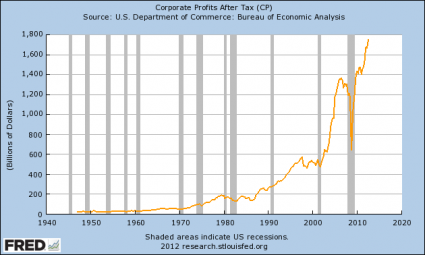
Meanwhile, wages as a percentage of GDP continue to fall rapidly…
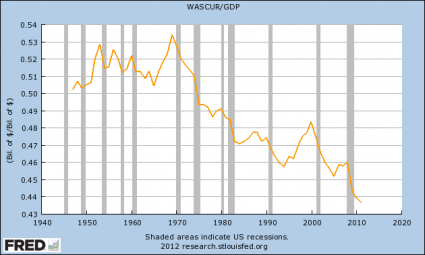
Most of the jobs being created in America today are “low wage” jobs. Tens of millions of Americans are working as hard as they can only to find that they can barely put food on the table and provide a roof over the heads of their children. The ranks of the “working poor” are exploding and the middle class continues to shrink.
Many of you that are reading this article are members of the working poor. You know what it is like to stare up at your ceiling at night wondering how you are going to pay the bills next month.
Today, most Americans are living very close to the edge financially. A recent article by NBC News staff writer Allison Linn shared some of their stories. The following is one example…
Crystal Dupont knows what it’s like to try to live on the federal minimum wage.
Dupont has no health insurance, so she hasn’t seen a doctor in two years. She’s behind on her car payments and has taken out pawn shop and payday loans to cover other monthly expenses. She eats beans and oatmeal when her food budget gets low.
When she got her tax refund recently, she used the money to get ahead on her light bill.
“I try to live within my means, but sometimes you just can’t,” said Dupont, 25. The Houston resident works 30 to 40 hours a week taking customer service calls, earning between $7.25 and $8 an hour. That came to about $15,000 last year.
It’s a wage she’s lived on for a while now, but just barely.
Sadly, the number of Americans that are “just barely” surviving continues to grow.
But if corporate profits are soaring to unprecedented heights, then who is getting all of those rewards?
The monopoly men of the global elite are.
Just check out which does a great job of illustrating how corporatism has systematically funneled all of the economic rewards in our system to the very top…
Once again, I want to make it very clear that I am not advocating socialism as the answer in any way, shape or form. Socialism takes away the incentive to create wealth and it almost always results in almost all of the economic rewards going to a very tiny elite anyway.
As I said earlier, what we need is a return to a much more pure form of capitalism, but this is so foreign to the way that most people think that most people will not be able to grasp this.
It certainly would be possible to greatly reduce the power of the federal government and greatly reduce the power of the big corporations at the same time, but this is so “outside the box” for most people that they cannot even conceive of doing such a thing.
We need to create an environment where individuals and small businesses can thrive once again. But instead, most of us are content to continue “playing the game” and getting enslaved in even more debt.
For example, according to CNBC, auto loans just continue to get larger and continue to get stretched out for longer periods of time…
American car buyers, attracted by new models and cheap financing, are taking out bigger auto loans and stretching out the terms of those loans to a new record length.
New analysis from Experian Automotive shows the average new car loan in the fourth quarter of last year was $26,691 and stretched out over an average of 65 months. The length of the average loan is one month longer than the previous record set in the third quarter of last year.
What will they think of next?
Will we eventually have auto loans that get paid off over 10 years?
By the way, that is another way that the monopoly men of the global elite get all of our money. They enslave us to debt, and we spend year after year of our lives slaving away to make them even wealthier.
They are very smart. There is a reason why they have 32 TRILLION dollars stashed away in offshore tax havens. They know how to play the game, and they are very happy that most of the rest of us are asleep.
Fortunately, it appears that an increasing number of Americans are waking up.
For example, I wanted to share with you all an excerpt from a comment that one of my readers left on one of my recent articles…
In the past year, I’ve been slowly but surely waking up to the nonsense happening around me. There’s so many things I need to simply get off my chest, so excuse the length of this post. Recently in the past two years, I’ve gotten married and have been medically discharged from the Marines after being injured in Afghanistan. Being 23 years old and married, my goal is secure a secure a future for my family, but with the way things are going, I’m not exactly sure how much of a future we’re going to have in 50 years. I can’t explain it, but I’ve felt this need to change my attitude and motivations lately.
I started by turning off the garbage music, television and other mindless entertainment that seems to plague my generation. It was easier than it looked – I don’t miss most of it really. The next order of business was to educate myself on world news, so that’s what I did. Every day, like clockwork, I check all major mainstream news feeds (NBC, Fox, Abc, CNN, Reuters, BBC, etc.) as well as not-so-mainstream news sites – yours being one of them. It’s incredible how fast our world changes and the manner in which it changes. The local 10 o’clock doesn’t show anything but local news, sports, weather, lottery #’s and whatever else they decide to throw in. It’s a night and day difference once you start to actually research and see what’s happening all over the world. Look at the number of comments about a news story on the economy and then look at a celebrity story on the “news”….People are so blind, it truly amazes me. My friends, family and classmates at college seem to be under a spell of some sort. They’re distracted – and it’s contagious. Nobody I know gives a damn about global affairs/economics. They’re more interested in the newest iPhone, cars, shows, movies, and just about anything else you can think of. I’m not saying there’s anything wrong with these things, but my friends/family/peers are CONSUMED by these distractions. When the election was taking place in 2012, every Tom, Dick and Harry on Facebook had an opinion and rant. After the circus ended however, everyone simply went back to posting about parties, kittens, Farmville etc. It’s a huge joke. For me, it’s little terrifying and exciting to see history unfolding in front of our eyes. This country of ours is going through big changes now that will most certainly affect our future, so I strive to adapt and prepare myself and my family. I’m looking at buying my first home this summer. Right now I live in an apartment right outside Philly and spend more money on rent than most pay for a mortgage. I need a house with a little land to raise chickens, grow fruits/vegetables, store canned food – and to be as independent from the system as I can. For my job, I wanted a skill/trade that people would always need, so I picked the funeral business. On the side, I work in construction and have been learning everything there is to know about building with my own two hands. I feel as though these old forgotten skills are going to be handy in a short while.
Hopefully we can get a lot more people to wake up and start breaking out of “the matrix” of control that is all around us.
Right now, the system is designed to continually funnel more money and more power to the very top of the pyramid. The global elite are becoming more dominant with each passing day. Unless something dramatic happens, at some point the American people will become so powerless that they won’t be able to do anything about it even if they wanted to.
The idea of a very tiny elite completely dominating all the rest of us goes against everything that America is supposed to stand for. In the end, it will result in absolute tyranny if it is not stopped.
Source: The Economic Collapse
The State-owned Bank of North Dakota
January 25, 2013 by Administrator · Leave a Comment

Fiscal conservatives often are blind when it comes to alternatives to the “so called” commercial banking system. Many conventional Republicans are ignorant or simply carrying the water for the crony capitalist banking establishment. The fractional reserve banking monopoly that operates under the auspices of the privately owned Federal Reserve System, despises any trace of competition. The bondage from debt created money has doomed Main Street to the fate of contrite beggars in search of securing loans. Useful purposes for business financing are not sufficient reason for the qualifying for commercial credit.
Is there an alternative to the Federal Deposit Insurance Corp. and centralized banking dominated by Wall Street investment banksters? Can state chartered commercial banks compete separate from the favoritism shown to the “Not Too Big To Fail” money centered banks? Well, Ellen Hodjson Brown JD, has popularized the subject of the state-owned bank and believes there is a better model for community banking.
“The secret of its success seems to be the state-owned Bank of North Dakota, which was established by the state legislature in 1919 specifically to free farmers and small businessmen from the clutches of out-of-state bankers and railroad men. By law, the state must deposit all its funds in the bank, and the state guarantees its deposits. The bank’s stated mission is to deliver sound financial services that promote agriculture, commerce and industry in North Dakota. The bank operates as a bankers’ bank, partnering with private banks to loan money to farmers, real estate developers, schools and small businesses. It loans money to students (over 184,000 outstanding loans), and it purchases municipal bonds from public institutions.”
The informative video, provides a comprehensive overview, well worth viewing.Such a departure from the normal coordinated federal regulation and Federal Reserve prescribes, gives pause to the plutocrats that despise any departure from the top down banking model that is based upon special treatment for the schemes of investment banking.
Bloomberg News points out the banking industry opposition to the state-own charter in the article, North Dakota’s State-Run Bank Adds Millions to Treasury, Spurs Imitators.
“The U.S. banking industry opposes the idea and is lobbying against it, saying a state-run bank would compete with commercial banks for business and politicize a state’s lending decisions.
“A state-owned bank? Why don’t we just re-label the state capitols the Kremlin?” Camden Fine, president of the Independent Community Bankers of America, a Washington-based trade group that represents more than 5,000 community banks, said in a telephone interview.
“It’s a socialistic idea,” Fine said. “If you get a state-owned bank that is allocating credit, it can slide very quickly into a situation where those in favor get credit and those not in favor don’t get credit.”
How ironic the false claim that a sparsely populated state like, North Dakota could be such a citadel of collectivist enterprise when the titans of cartel-controlled crony capitalism were the financiers of the Russian communist revolution. The new generation of algorithmic traders has no more interest in writing business commercial loans then the banker funded Lenin investment of mercy shown to the Czar.
Even more sardonic is the viewpoint that the only banking monopoly acceptable is the one designated by the barons of usury. The slogan – no small business loans, is their operative policy.
Mother Jones examines what Republicans might call an idiosyncratic bastion of socialism in their interview with Bank of North Dakota’s president; Eric Hardmeyer, . Mr. Hardmeyer explains the operation of their system thusly.
“Our funding model, our deposit model is really what is unique as the engine that drives that bank. And that is we are the depository for all state tax collections and fees. And so we have a captive deposit base, we pay a competitive rate to the state treasurer. And I would bet that that would be one of the most difficult things to wrestle away from the private sector—those opportunities to bid on public funds. But that’s only one portion of it. We take those funds and then, really what separates us is that we plow those deposits back into the state of North Dakota in the form of loans. We invest back into the state in economic development type of activities. We grow our state through that mechanism.”
The significance of the North Dakota experiment is that the dominance and control of the State/Capital cabal can be broken. Sensible banking is based upon making loans for productive enterprises, not derivative speculation. The customer of any bank is a person. Financing business growth and development is the core purpose and function of a bank.
The populist underpinnings of the independent method of funding the Bank of North Dakota provide an alternative model for depository transactions. Prosperity for local economies is an integral objective for any community interest bank. Those who profess free market enterprise principles need to adopt practical partner relationships with proponents of state charted banks.
ABC News reports the inconceivable, State-Owned Banks: The Future of Banking?
“Bank of North Dakota officials said that at least 10 states have turned to them for guidance, including some states, like Michigan, hardest hit by the financial crisis. They include California, Florida and Illinois, where a bill to create a state bank already is under consideration by the state legislature.”
Success is the best substitute to the stagnation of Wall Street greed and corporatism. Credit unions and associations provide another option for the depositor to conduct business. Loans are a way of life to most wage earners. Applying with an institution committed to their customer is rare in the era of national banking conglomerates. Trust is the basis of banking and the record of the Bank of North Dakota, compared to Bank America, demonstrates a stark difference. Register your discontent with your money stop doing business with national money-centered banks.
Sartre is the publisher, editor, and writer for Breaking All The Rules. He can be reached at:
Sartre is a regular columnist for Veracity Voice
Ron Paul’s Farewell To Congress
November 15, 2012 by Administrator · Leave a Comment

This may well be the last time I speak on the House Floor. At the end of the year I’ll leave Congress after 23 years in office over a 36-year period. My goals in 1976 were the same as they are today: promote peace and prosperity by a strict adherence to the principles of individual liberty.
It was my opinion, that the course the U.S. embarked on in the latter part of the 20th Century would bring us a major financial crisis and engulf us in a foreign policy that would overextend us and undermine our national security.
To achieve the goals I sought, government would have had to shrink in size and scope, reduce spending, change the monetary system, and reject the unsustainable costs of policing the world and expanding the American Empire.
The problems seemed to be overwhelming and impossible to solve, yet from my view point, just following the constraints placed on the federal government by the Constitution would have been a good place to start.
How Much Did I Accomplish?
In many ways, according to conventional wisdom, my off-and-on career in Congress, from 1976 to 2012, accomplished very little. No named legislation, no named federal buildings or highways – thank goodness. In spite of my efforts, the government has grown exponentially, taxes remain excessive, and the prolific increase of incomprehensible regulations continues. Wars are constant and pursued without Congressional declaration, deficits rise to the sky, poverty is rampant and dependency on the federal government is now worse than any time in our history.
All this with minimal concerns for the deficits and unfunded liabilities that common sense tells us cannot go on much longer. A grand, but never mentioned, bipartisan agreement allows for the well-kept secret that keeps the spending going. One side doesn’t give up one penny on military spending, the other side doesn’t give up one penny on welfare spending, while both sides support the bailouts and subsidies for the banking and corporate elite. And the spending continues as the economy weakens and the downward spiral continues. As the government continues fiddling around, our liberties and our wealth burn in the flames of a foreign policy that makes us less safe.
The major stumbling block to real change in Washington is the total resistance to admitting that the country is broke. This has made compromising, just to agree to increase spending, inevitable since neither side has any intention of cutting spending.
The country and the Congress will remain divisive since there’s no “loot left to divvy up.”
Without this recognition the spenders in Washington will continue the march toward a fiscal cliff much bigger than the one anticipated this coming January.
I have thought a lot about why those of us who believe in liberty, as a solution, have done so poorly in convincing others of its benefits. If liberty is what we claim it is- the principle that protects all personal, social and economic decisions necessary for maximum prosperity and the best chance for peace- it should be an easy sell. Yet, history has shown that the masses have been quite receptive to the promises of authoritarians which are rarely if ever fulfilled.
Authoritarianism vs. Liberty
If authoritarianism leads to poverty and war and less freedom for all individuals and is controlled by rich special interests, the people should be begging for liberty. There certainly was a strong enough sentiment for more freedom at the time of our founding that motivated those who were willing to fight in the revolution against the powerful British government.
During my time in Congress the appetite for liberty has been quite weak; the understanding of its significance negligible. Yet the good news is that compared to 1976 when I first came to Congress, the desire for more freedom and less government in 2012 is much greater and growing, especially in grassroots America. Tens of thousands of teenagers and college age students are, with great enthusiasm, welcoming the message of liberty.
I have a few thoughts as to why the people of a country like ours, once the freest and most prosperous, allowed the conditions to deteriorate to the degree that they have.
Freedom, private property, and enforceable voluntary contracts, generate wealth. In our early history we were very much aware of this. But in the early part of the 20th century our politicians promoted the notion that the tax and monetary systems had to change if we were to involve ourselves in excessive domestic and military spending. That is why Congress gave us the Federal Reserve and the income tax. The majority of Americans and many government officials agreed that sacrificing some liberty was necessary to carry out what some claimed to be “progressive” ideas. Pure democracy became acceptable.
They failed to recognized that what they were doing was exactly opposite of what the colonists were seeking when they broke away from the British.
Some complain that my arguments makes no sense, since great wealth and the standard of living improved for many Americans over the last 100 years, even with these new policies.
But the damage to the market economy, and the currency, has been insidious and steady. It took a long time to consume our wealth, destroy the currency and undermine productivity and get our financial obligations to a point of no return. Confidence sometimes lasts longer than deserved. Most of our wealth today depends on debt.
The wealth that we enjoyed and seemed to be endless, allowed concern for the principle of a free society to be neglected. As long as most people believed the material abundance would last forever, worrying about protecting a competitive productive economy and individual liberty seemed unnecessary.
The Age of Redistribution
This neglect ushered in an age of redistribution of wealth by government kowtowing to any and all special interests, except for those who just wanted to left alone. That is why today money in politics far surpasses money currently going into research and development and productive entrepreneurial efforts.
The material benefits became more important than the understanding and promoting the principles of liberty and a free market. It is good that material abundance is a result of liberty but if materialism is all that we care about, problems are guaranteed.
The crisis arrived because the illusion that wealth and prosperity would last forever has ended. Since it was based on debt and a pretense that debt can be papered over by an out-of-control fiat monetary system, it was doomed to fail. We have ended up with a system that doesn’t produce enough even to finance the debt and no fundamental understanding of why a free society is crucial to reversing these trends.
If this is not recognized, the recovery will linger for a long time. Bigger government, more spending, more debt, more poverty for the middle class, and a more intense scramble by the elite special interests will continue.
We Need an Intellectual Awakening
Without an intellectual awakening, the turning point will be driven by economic law. A dollar crisis will bring the current out-of-control system to its knees.
If it’s not accepted that big government, fiat money, ignoring liberty, central economic planning, welfarism, and warfarism caused our crisis we can expect a continuous and dangerous march toward corporatism and even fascism with even more loss of our liberties. Prosperity for a large middle class though will become an abstract dream.
This continuous move is no different than what we have seen in how our financial crisis of 2008 was handled. Congress first directed, with bipartisan support, bailouts for the wealthy. Then it was the Federal Reserve with its endless quantitative easing. If at first it doesn’t succeed try again; QE1, QE2, and QE3 and with no results we try QE indefinitely – that is until it too fails. There’s a cost to all of this and let me assure you delaying the payment is no longer an option. The rules of the market will extract its pound of flesh and it won’t be pretty.
The current crisis elicits a lot of pessimism. And the pessimism adds to less confidence in the future. The two feed on themselves, making our situation worse.
If the underlying cause of the crisis is not understood we cannot solve our problems. The issues of warfare, welfare, deficits, inflationism, corporatism, bailouts and authoritarianism cannot be ignored. By only expanding these policies we cannot expect good results.
Everyone claims support for freedom. But too often it’s for one’s own freedom and not for others. Too many believe that there must be limits on freedom. They argue that freedom must be directed and managed to achieve fairness and equality thus making it acceptable to curtail, through force, certain liberties.
Some decide what and whose freedoms are to be limited. These are the politicians whose goal in life is power. Their success depends on gaining support from special interests.
No More ‘isms’
The great news is the answer is not to be found in more “isms.” The answers are to be found in more liberty which cost so much less. Under these circumstances spending goes down, wealth production goes up, and the quality of life improves.
Just this recognition – especially if we move in this direction – increases optimism which in itself is beneficial. The follow through with sound policies are required which must be understood and supported by the people.
But there is good evidence that the generation coming of age at the present time is supportive of moving in the direction of more liberty and self-reliance. The more this change in direction and the solutions become known, the quicker will be the return of optimism.
Our job, for those of us who believe that a different system than the one that we have had for the last 100 years, has driven us to this unsustainable crisis, is to be more convincing that there is a wonderful, uncomplicated, and moral system that provides the answers. We had a taste of it in our early history. We need not give up on the notion of advancing this cause.
It worked, but we allowed our leaders to concentrate on the material abundance that freedom generates, while ignoring freedom itself. Now we have neither, but the door is open, out of necessity, for an answer. The answer available is based on the Constitution, individual liberty and prohibiting the use of government force to provide privileges and benefits to all special interests.
After over 100 years we face a society quite different from the one that was intended by the Founders. In many ways their efforts to protect future generations with the Constitution from this danger has failed. Skeptics, at the time the Constitution was written in 1787, warned us of today’s possible outcome. The insidious nature of the erosion of our liberties and the reassurance our great abundance gave us, allowed the process to evolve into the dangerous period in which we now live.
Dependency on Government Largesse
Today we face a dependency on government largesse for almost every need. Our liberties are restricted and government operates outside the rule of law, protecting and rewarding those who buy or coerce government into satisfying their demands. Here are a few examples:
Undeclared wars are commonplace.
Welfare for the rich and poor is considered an entitlement.
The economy is overregulated, overtaxed and grossly distorted by a deeply flawed monetary system.
Debt is growing exponentially.
The Patriot Act and FISA legislation passed without much debate have resulted in a steady erosion of our 4th Amendment rights.
Tragically our government engages in preemptive war, otherwise known as aggression, with no complaints from the American people.
The drone warfare we are pursuing worldwide is destined to end badly for us as the hatred builds for innocent lives lost and the international laws flaunted. Once we are financially weakened and militarily challenged, there will be a lot resentment thrown our way.
It’s now the law of the land that the military can arrest American citizens, hold them indefinitely, without charges or a trial.
Rampant hostility toward free trade is supported by a large number in Washington.
Supporters of sanctions, currency manipulation and WTO trade retaliation, call the true free traders “isolationists.”
Sanctions are used to punish countries that don’t follow our orders.
Bailouts and guarantees for all kinds of misbehavior are routine.
Central economic planning through monetary policy, regulations and legislative mandates has been an acceptable policy.
Questions
Excessive government has created such a mess it prompts many questions:
Why are sick people who use medical marijuana put in prison?
Why does the federal government restrict the drinking of raw milk?
Why can’t Americans manufacturer rope and other products from hemp?
Why are Americans not allowed to use gold and silver as legal tender as mandated by the Constitution?
Why is Germany concerned enough to consider repatriating their gold held by the FED for her in New York? Is it that the trust in the U.S. and dollar supremacy beginning to wane?
Why do our political leaders believe it’s unnecessary to thoroughly audit our own gold?
Why can’t Americans decide which type of light bulbs they can buy?
Why is the TSA permitted to abuse the rights of any American traveling by air?
Why should there be mandatory sentences – even up to life for crimes without victims – as our drug laws require?
Why have we allowed the federal government to regulate commodes in our homes?
Why is it political suicide for anyone to criticize AIPAC ?
Why haven’t we given up on the drug war since it’s an obvious failure and violates the people’s rights? Has nobody noticed that the authorities can’t even keep drugs out of the prisons? How can making our entire society a prison solve the problem?
Why do we sacrifice so much getting needlessly involved in border disputes and civil strife around the world and ignore the root cause of the most deadly border in the world-the one between Mexico and the US?
Why does Congress willingly give up its prerogatives to the Executive Branch?
Why does changing the party in power never change policy? Could it be that the views of both parties are essentially the same?
Why did the big banks, the large corporations, and foreign banks and foreign central banks get bailed out in 2008 and the middle class lost their jobs and their homes?
Why do so many in the government and the federal officials believe that creating money out of thin air creates wealth?
Why do so many accept the deeply flawed principle that government bureaucrats and politicians can protect us from ourselves without totally destroying the principle of liberty?
Why can’t people understand that war always destroys wealth and liberty?
Why is there so little concern for the Executive Order that gives the President authority to establish a “kill list,” including American citizens, of those targeted for assassination?
Why is patriotism thought to be blind loyalty to the government and the politicians who run it, rather than loyalty to the principles of liberty and support for the people? Real patriotism is a willingness to challenge the government when it’s wrong.
Why is it is claimed that if people won’t or can’t take care of their own needs, that people in government can do it for them?
Why did we ever give the government a safe haven for initiating violence against the people?
Why do some members defend free markets, but not civil liberties?
Why do some members defend civil liberties but not free markets? Aren’t they the same?
Why don’t more defend both economic liberty and personal liberty?
Why are there not more individuals who seek to intellectually influence others to bring about positive changes than those who seek power to force others to obey their commands?
Why does the use of religion to support a social gospel and preemptive wars, both of which requires authoritarians to use violence, or the threat of violence, go unchallenged? Aggression and forced redistribution of wealth has nothing to do with the teachings of the world great religions.
Why do we allow the government and the Federal Reserve to disseminate false information dealing with both economic and foreign policy?
Why is democracy held in such high esteem when it’s the enemy of the minority and makes all rights relative to the dictates of the majority?
Why should anyone be surprised that Congress has no credibility, since there’s such a disconnect between what politicians say and what they do?
Is there any explanation for all the deception, the unhappiness, the fear of the future, the loss of confidence in our leaders, the distrust, the anger and frustration? Yes there is, and there’s a way to reverse these attitudes. The negative perceptions are logical and a consequence of bad policies bringing about our problems. Identification of the problems and recognizing the cause allow the proper changes to come easy.
Trust Yourself, Not the Government
Too many people have for too long placed too much confidence and trust in government and not enough in themselves. Fortunately, many are now becoming aware of the seriousness of the gross mistakes of the past several decades. The blame is shared by both political parties. Many Americans now are demanding to hear the plain truth of things and want the demagoguing to stop. Without this first step, solutions are impossible.
Seeking the truth and finding the answers in liberty and self-reliance promotes the optimism necessary for restoring prosperity. The task is not that difficult if politics doesn’t get in the way.
We have allowed ourselves to get into such a mess for various reasons.
Politicians deceive themselves as to how wealth is produced. Excessive confidence is placed in the judgment of politicians and bureaucrats. This replaces the confidence in a free society. Too many in high places of authority became convinced that only they, armed with arbitrary government power, can bring about fairness, while facilitating wealth production. This always proves to be a utopian dream and destroys wealth and liberty. It impoverishes the people and rewards the special interests who end up controlling both political parties.
It’s no surprise then that much of what goes on in Washington is driven by aggressive partisanship and power seeking, with philosophic differences being minor.
Economic Ignorance
Economic ignorance is commonplace. Keynesianism continues to thrive, although today it is facing healthy and enthusiastic rebuttals. Believers in military Keynesianism and domestic Keynesianism continue to desperately promote their failed policies, as the economy languishes in a deep slumber.
Supporters of all government edicts use humanitarian arguments to justify them.
Humanitarian arguments are always used to justify government mandates related to the economy, monetary policy, foreign policy, and personal liberty. This is on purpose to make it more difficult to challenge. But, initiating violence for humanitarian reasons is still violence. Good intentions are no excuse and are just as harmful as when people use force with bad intentions. The results are always negative.
The immoral use of force is the source of man’s political problems. Sadly, many religious groups, secular organizations, and psychopathic authoritarians endorse government initiated force to change the world. Even when the desired goals are well-intentioned – or especially when well-intentioned – the results are dismal. The good results sought never materialize. The new problems created require even more government force as a solution. The net result is institutionalizing government initiated violence and morally justifying it on humanitarian grounds.
This is the same fundamental reason our government uses force for invading other countries at will, central economic planning at home, and the regulation of personal liberty and habits of our citizens.
It is rather strange, that unless one has a criminal mind and no respect for other people and their property, no one claims it’s permissible to go into one’s neighbor’s house and tell them how to behave, what they can eat, smoke and drink or how to spend their money.
Yet, rarely is it asked why it is morally acceptable that a stranger with a badge and a gun can do the same thing in the name of law and order. Any resistance is met with brute force, fines, taxes, arrests, and even imprisonment. This is done more frequently every day without a proper search warrant.
No Government Monopoly over Initiating Violence
Restraining aggressive behavior is one thing, but legalizing a government monopoly for initiating aggression can only lead to exhausting liberty associated with chaos, anger and the breakdown of civil society. Permitting such authority and expecting saintly behavior from the bureaucrats and the politicians is a pipe dream. We now have a standing army of armed bureaucrats in the TSA, CIA, FBI, Fish and Wildlife, FEMA, IRS, Corp of Engineers, etc. numbering over 100,000. Citizens are guilty until proven innocent in the unconstitutional administrative courts.
Government in a free society should have no authority to meddle in social activities or the economic transactions of individuals. Nor should government meddle in the affairs of other nations. All things peaceful, even when controversial, should be permitted.
We must reject the notion of prior restraint in economic activity just we do in the area of free speech and religious liberty. But even in these areas government is starting to use a backdoor approach of political correctness to regulate speech-a dangerous trend. Since 9/11 monitoring speech on the internet is now a problem since warrants are no longer required.
The Proliferation of Federal Crimes
The Constitution established four federal crimes. Today the experts can’t even agree on how many federal crimes are now on the books – they number into the thousands. No one person can comprehend the enormity of the legal system – especially the tax code. Due to the ill-advised drug war and the endless federal expansion of the criminal code we have over 6 million people under correctional suspension, more than the Soviets ever had, and more than any other nation today, including China. I don’t understand the complacency of the Congress and the willingness to continue their obsession with passing more Federal laws. Mandatory sentencing laws associated with drug laws have compounded our prison problems.
The federal register is now 75,000 pages long and the tax code has 72,000 pages, and expands every year. When will the people start shouting, “enough is enough,” and demand Congress cease and desist.
Achieving Liberty
Liberty can only be achieved when government is denied the aggressive use of force. If one seeks liberty, a precise type of government is needed. To achieve it, more than lip service is required.
Two choices are available.
A government designed to protect liberty – a natural right – as its sole objective. The people are expected to care for themselves and reject the use of any force for interfering with another person’s liberty. Government is given a strictly limited authority to enforce contracts, property ownership, settle disputes, and defend against foreign aggression.
A government that pretends to protect liberty but is granted power to arbitrarily use force over the people and foreign nations. Though the grant of power many times is meant to be small and limited, it inevitably metastasizes into an omnipotent political cancer. This is the problem for which the world has suffered throughout the ages. Though meant to be limited it nevertheless is a 100% sacrifice of a principle that would-be-tyrants find irresistible. It is used vigorously – though incrementally and insidiously. Granting power to government officials always proves the adage that: “power corrupts.”
Once government gets a limited concession for the use of force to mold people habits and plan the economy, it causes a steady move toward tyrannical government. Only a revolutionary spirit can reverse the process and deny to the government this arbitrary use of aggression. There’s no in-between. Sacrificing a little liberty for imaginary safety always ends badly.
Today’s mess is a result of Americans accepting option #2, even though the Founders attempted to give us Option #1.
The results are not good. As our liberties have been eroded our wealth has been consumed. The wealth we see today is based on debt and a foolish willingness on the part of foreigners to take our dollars for goods and services. They then loan them back to us to perpetuate our debt system. It’s amazing that it has worked for this long but the impasse in Washington, in solving our problems indicate that many are starting to understand the seriousness of the world -wide debt crisis and the dangers we face. The longer this process continues the harsher the outcome will be.
The Financial Crisis Is a Moral Crisis
Many are now acknowledging that a financial crisis looms but few understand it’s, in reality, a moral crisis. It’s the moral crisis that has allowed our liberties to be undermined and permits the exponential growth of illegal government power. Without a clear understanding of the nature of the crisis it will be difficult to prevent a steady march toward tyranny and the poverty that will accompany it.
Ultimately, the people have to decide which form of government they want; option #1 or option #2. There is no other choice. Claiming there is a choice of a “little” tyranny is like describing pregnancy as a “touch of pregnancy.” It is a myth to believe that a mixture of free markets and government central economic planning is a worthy compromise. What we see today is a result of that type of thinking. And the results speak for themselves.
A Culture of Violence
American now suffers from a culture of violence. It’s easy to reject the initiation of violence against one’s neighbor but it’s ironic that the people arbitrarily and freely anoint government officials with monopoly power to initiate violence against the American people – practically at will.
Because it’s the government that initiates force, most people accept it as being legitimate. Those who exert the force have no sense of guilt. It is believed by too many that governments are morally justified in initiating force supposedly to “do good.” They incorrectly believe that this authority has come from the “consent of the people.” The minority, or victims of government violence never consented to suffer the abuse of government mandates, even when dictated by the majority. Victims of TSA excesses never consented to this abuse.
This attitude has given us a policy of initiating war to “do good,” as well. It is claimed that war, to prevent war for noble purposes, is justified. This is similar to what we were once told that: “destroying a village to save a village” was justified. It was said by a US Secretary of State that the loss of 500,000 Iraqis, mostly children, in the 1990s, as a result of American bombs and sanctions, was “worth it” to achieve the “good” we brought to the Iraqi people. And look at the mess that Iraq is in today.
Government use of force to mold social and economic behavior at home and abroad has justified individuals using force on their own terms. The fact that violence by government is seen as morally justified, is the reason why violence will increase when the big financial crisis hits and becomes a political crisis as well.
First, we recognize that individuals shouldn’t initiate violence, then we give the authority to government. Eventually, the immoral use of government violence, when things goes badly, will be used to justify an individual’s “right” to do the same thing. Neither the government nor individuals have the moral right to initiate violence against another yet we are moving toward the day when both will claim this authority. If this cycle is not reversed society will break down.
When needs are pressing, conditions deteriorate and rights become relative to the demands and the whims of the majority. It’s then not a great leap for individuals to take it upon themselves to use violence to get what they claim is theirs. As the economy deteriorates and the wealth discrepancies increase – as are already occurring – violence increases as those in need take it in their own hands to get what they believe is theirs. They will not wait for a government rescue program.
When government officials wield power over others to bail out the special interests, even with disastrous results to the average citizen, they feel no guilt for the harm they do. Those who take us into undeclared wars with many casualties resulting, never lose sleep over the death and destruction their bad decisions caused. They are convinced that what they do is morally justified, and the fact that many suffer just can’t be helped.
When the street criminals do the same thing, they too have no remorse, believing they are only taking what is rightfully theirs. All moral standards become relative. Whether it’s bailouts, privileges, government subsidies or benefits for some from inflating a currency, it’s all part of a process justified by a philosophy of forced redistribution of wealth. Violence, or a threat of such, is the instrument required and unfortunately is of little concern of most members of Congress.
Some argue it’s only a matter of “fairness” that those in need are cared for. There are two problems with this. First, the principle is used to provide a greater amount of benefits to the rich than the poor. Second, no one seems to be concerned about whether or not it’s fair to those who end up paying for the benefits. The costs are usually placed on the backs of the middle class and are hidden from the public eye. Too many people believe government handouts are free, like printing money out of thin air, and there is no cost. That deception is coming to an end. The bills are coming due and that’s what the economic slowdown is all about.
Sadly, we have become accustomed to living with the illegitimate use of force by government. It is the tool for telling the people how to live, what to eat and drink, what to read and how to spend their money.
To develop a truly free society, the issue of initiating force must be understood and rejected. Granting to government even a small amount of force is a dangerous concession.
Limiting Government Excesses vs. a Virtuous Moral People
Our Constitution, which was intended to limit government power and abuse, has failed. The Founders warned that a free society depends on a virtuous and moral people. The current crisis reflects that their concerns were justified.
Most politicians and pundits are aware of the problems we face but spend all their time in trying to reform government. The sad part is that the suggested reforms almost always lead to less freedom and the importance of a virtuous and moral people is either ignored, or not understood. The new reforms serve only to further undermine liberty. The compounding effect has given us this steady erosion of liberty and the massive expansion of debt. The real question is: if it is liberty we seek, should most of the emphasis be placed on government reform or trying to understand what “a virtuous and moral people” means and how to promote it. The Constitution has not prevented the people from demanding handouts for both rich and poor in their efforts to reform the government, while ignoring the principles of a free society. All branches of our government today are controlled by individuals who use their power to undermine liberty and enhance the welfare/warfare state-and frequently their own wealth and power.
If the people are unhappy with the government performance it must be recognized that government is merely a reflection of an immoral society that rejected a moral government of constitutional limitations of power and love of freedom.
If this is the problem all the tinkering with thousands of pages of new laws and regulations will do nothing to solve the problem.
It is self-evident that our freedoms have been severely limited and the apparent prosperity we still have, is nothing more than leftover wealth from a previous time. This fictitious wealth based on debt and benefits from a false trust in our currency and credit, will play havoc with our society when the bills come due. This means that the full consequence of our lost liberties is yet to be felt.
But that illusion is now ending. Reversing a downward spiral depends on accepting a new approach.
Expect the rapidly expanding homeschooling movement to play a significant role in the revolutionary reforms needed to build a free society with Constitutional protections. We cannot expect a Federal government controlled school system to provide the intellectual ammunition to combat the dangerous growth of government that threatens our liberties.
The internet will provide the alternative to the government/media complex that controls the news and most political propaganda. This is why it’s essential that the internet remains free of government regulation.
Many of our religious institutions and secular organizations support greater dependency on the state by supporting war, welfare and corporatism and ignore the need for a virtuous people.
I never believed that the world or our country could be made more free by politicians, if the people had no desire for freedom.
Under the current circumstances the most we can hope to achieve in the political process is to use it as a podium to reach the people to alert them of the nature of the crisis and the importance of their need to assume responsibility for themselves, if it is liberty that they truly seek. Without this, a constitutionally protected free society is impossible.
If this is true, our individual goal in life ought to be for us to seek virtue and excellence and recognize that self-esteem and happiness only comes from using one’s natural ability, in the most productive manner possible, according to one’s own talents.
Productivity and creativity are the true source of personal satisfaction. Freedom, and not dependency, provides the environment needed to achieve these goals. Government cannot do this for us; it only gets in the way. When the government gets involved, the goal becomes a bailout or a subsidy and these cannot provide a sense of personal achievement.
Achieving legislative power and political influence should not be our goal. Most of the change, if it is to come, will not come from the politicians, but rather from individuals, family, friends, intellectual leaders and our religious institutions. The solution can only come from rejecting the use of coercion, compulsion, government commands, and aggressive force, to mold social and economic behavior. Without accepting these restraints, inevitably the consensus will be to allow the government to mandate economic equality and obedience to the politicians who gain power and promote an environment that smothers the freedoms of everyone. It is then that the responsible individuals who seek excellence and self-esteem by being self-reliance and productive, become the true victims.
Conclusion
What are the greatest dangers that the American people face today and impede the goal of a free society? There are five.
1. The continuous attack on our civil liberties which threatens the rule of law and our ability to resist the onrush of tyranny.
2. Violent anti-Americanism that has engulfed the world. Because the phenomenon of “blow-back” is not understood or denied, our foreign policy is destined to keep us involved in many wars that we have no business being in. National bankruptcy and a greater threat to our national security will result.
3. The ease in which we go to war, without a declaration by Congress, but accepting international authority from the UN or NATO even for preemptive wars, otherwise known as aggression.
4. A financial political crisis as a consequence of excessive debt, unfunded liabilities, spending, bailouts, and gross discrepancy in wealth distribution going from the middle class to the rich. The danger of central economic planning, by the Federal Reserve must be understood.
5. World government taking over local and US sovereignty by getting involved in the issues of war, welfare, trade, banking, a world currency, taxes, property ownership, and private ownership of guns.
Happily, there is an answer for these very dangerous trends.
What a wonderful world it would be if everyone accepted the simple moral premise of rejecting all acts of aggression. The retort to such a suggestion is always: it’s too simplistic, too idealistic, impractical, naïve, utopian, dangerous, and unrealistic to strive for such an ideal.
Source: LewRockwell.com
Next Page »

