


G 20 And BRICS Great Schism
November 22, 2014 by Administrator · Leave a Comment

Global trade relationships and agreements are moving in very different directions. The public relations press releases hide the undercurrents that are driving the formations of alternative economic alliances. While the G 20, markets its all inclusive umbrella policy forums, the mere formation of a BRICS counterweight forecasts deep and fundamental differences. So what is really behind the creation of a different approach to the post WWII dominate U.S. lead model? A clue can be found in an attempt to modify the operations and direction of IMF functions.
Announced in the Russian press, BRICS to propose IMF reform at G20 summit, is a pressure attempt to move the center of power away from current synergism.
“At the G20 summit in the Australian city of Brisbane on November 15-16, Russia and other BRICS countries (Brazil, India, China and South Africa) will propose alternative solutions concerning the reform of the International Monetary Fund, involving, in particular, gradual implementation of reforms, Russian G20 Sherpa Svetlana Lukash told reporters.
“The most important thing for us is the still unresolved G20 problem of the IMF reform,” Lukash said. She recalled the U.S. Congress has yet to ratify the 2010 resolution. “Not only does it thwart the process of renewing the IMF in accordance with the current reality where we see a big rise in the role of emerging economies. It also prevents the decisions to double the IMF capital from coming into force,” she said.”
The appearance of maintaining a working relationship among opposing interests may present an assuring PR message, but who really believes that the path to a new cold war is paved with mutual cooperation? Impetus for a parallel financial system is certainly based more on political objective than commerce or economic benefits.
The Washington Post describes What the new bank of BRICS is all about in this manner.
“Heads of state from Brazil, Russia, India, China, and South Africa (the so-called BRICS countries) agreed to establish a New Development Bank (NDB) at their summit meeting. They will have a president (an Indian for the first six years), a Board of Governors Chair (a Russian), a Board of Directors Chair (a Brazilian), and a headquarters (in Shanghai). What is the purpose of this BRICS bank? Why have these countries created it now? And, what implications does it have for the global development-finance landscape?
The “what” is relatively straightforward. The NDB has been given $50 billion in initial capital. As with similar initiatives in other regions (see below), the BRICS bank appears to work on an equal-share voting basis, with each of the five signatories contributing $10 billion. The capital base is to be used to finance infrastructure and “sustainable development” projects in the BRICS countries initially, but other low and middle-income countries will be able buy in and apply for funding. BRICS countries have also created a $100 billion Contingency Reserve Arrangement (CRA), meant to provide additional liquidity protection to member countries during balance of payments problems. The CRA—unlike the pool of contributed capital to the BRICS bank, which is equally shared—is being funded 41 percent by China, 18 percent from Brazil, India, and Russia, and 5 percent from South Africa.”
China’s motivation to participate in BRICS banking is most interesting and revealing. Since it is not absolutely essential for China to be a member of BRICS, Gudrun Wacker, from the German Institute for International and Security Affairs presents this finding in a report, China’s role in G20 / BRICS and Implications, may shed an insight on their reasoning.
“The future of BRICS depends on the future performance of the G7/8 and G20: If the G20 develops into a real coordination mechanism, there might be less Chinese interest in BRICS. The future prospects of BRICS were presented as less promising than those of the G20, since BRICS will not be able to solve global problems. It is not yet clear whether the main deliverable of BRICS will be directed at cooperation among its members or at third countries. While the idea of BRIC as a group was originally picked up by Russia (the invitation to the first summit, as a move toward “extension” of the strategic triangle Russia, China. India?), its members are now all active in certain fields. For China, it is also an important effort to emerge from its isolation (Copenhagen climate summit). Another factor shaping the future of BRICS might be the development of US-China relations: While all interview partners agreed that BRICS does not aim at creating a new, anti-Western world order, it can be seen as a response to the US-led world order.”
The methodology of Mr. Wacker’s research relied upon comments from interviews. Relying on sentiments that BRICS goal is not bent on developing a counterbalance to Western banking hegemony is poppycock. Geopolitical dimensions in international affairs have Russia as the latest bogyman. Any economic analysis that ignores power brokers desperate attempt to shift the causes of a failing world economy onto the backs of enemy nations is flawed.
Also, the notion that major economic transnational corporatists operate with altruism for third world countries is sheer lunacy. All these trade organizations are attempts to position vying interests to settle for a subservient role to a subordinate structure under a global debt creation banking system.
Attempts to scare the populist into believing that Global Warming inaction are absurd. “At the G20 summit, other nations overrode host Australia’s attempts to keep climate change off the agenda and agreed to call for strong action with the aim of adopting a binding protocol at the Paris conference.” Such initiatives are pure political “PC” orthodoxy and actually diminish prosperity.
The great schism in trade among nations is that some countries are not willing to lie down with diseased parasites. This should not be construed to favor the emergence of the BRICS union as a shining future. However, what it does purport is that the road to the NWO modeling for globalism by entrenched financial elites has produced opposition.
Conflict is the normal human condition, and especially when money is used as a medium of world control and domination is the goal. The G 20 is useless. Breaking the banking monopoly that fosters endless terror and war is the universal objective for the inhabitants of this planet. Another unsavory photo op for world leaders just produces more nausea.
Sartre is the publisher, editor, and writer for Breaking All The Rules. He can be reached at:
Sartre is a regular columnist for Veracity Voice
Murder Mystery: Who Really Runs The American Government?
November 14, 2014 by Administrator · Leave a Comment
This week I am going down to Long Beach, CA, in order to attend the world-renowned BoucherCon, a fabulous annual convention for mystery book writers and readers. You just gotta love BoucherCon.
At last year’s convention in Albany, NY, I scored 50 free books — but still haven’t finished reading them yet. However, it’s always reassuring to know that I’ll probably never run out of murder-mystery books to read ever again — especially since I’m about to score yet another 50 free books at this Long Beach convention.
But the biggest mystery of all these days seems to be “Who, exactly, is actually running the American government?” Well, here’s a big clue: “It ain’t you or me.” The fact that we ourselves definitely do not run America was clearly demonstrated once again in this last election cycle — when a huge majority of Americans either voted against their own best self-interests or didn’t even vote at all.
Apparently we Americans can just barely manage to keep the kids dressed, the dog washed, the bathroom stocked with toilet paper, the mortgage paid, the 401K alive and our own lives up and running — let alone keep a democracy alive and well. It’s definitely not like 1776 around here right now.
But not to worry. I myself have already solved the mystery of who actually does run America while most Americans are all busy doing something else.
According to political analyst Peter Dale Scott, America is actually run by a select group of people that he calls the “American Deep State”. And these guys are really bad-ass. They even have their own internet system — and probably even their own FaceBook apps too. And of course they also have their own bunkers, billionaire supporters, lobbyists and election fixers as well — and Congress, the Supreme Court and the White House all take orders from them. That’s totally scary! Makes those “October Surprise” Ebola and ISIS scares look like a walk in the park.
So. Why do I think that Peter Dale Scott is right? There just has to be a shadow government here in America — because what else could possibly explain why America continuously and consistently acts so strongly against its own best interests?
“But Jane,” you might ask, “just exactly who are these underworld shadowy cartoonish characters that you’ve just described — and exactly what are they up to?” Well, from all my recent sleuthing around, I’ve discovered that this uber-shadow government, whoever it is composed of, obviously has a soft spot in its heart for starting wars, ruining economies, and disrupting countries, regions and even whole continents whenever they possibly can. No American in his or her right mind would ever want to do that.
“But, Jane,” you might ask next, “how can you actually prove all this? Sounds rather paranoid and conspiracy-theory-ish to me.” Hey, I’m on this like Sherlock Holmes!
But even though I can’t exactly sneak into these guys’ bunkers or onto their yachts or secretly listen in on their phone conversations, I can still easily see all the footprints these hoodlums have left behind in the snow. “Means, motive and opportunity,” as Holmes would say. Just get out your magnifying glass and look at these clues:
Footprint # 1: China and Korea. Before we even knew what hit us after WWII, suddenly China had been torn up in rebellion against our corrupt man in Peking, Chaing Kai Shek. And then the whole Korean peninsula blew up. Was the loss of China and the destruction of Korea in the average American’s best interests? Totally not. So who had the motive, means and opportunity here? You tell me.
Footprint # 2: Vietnam. The whole result of that “war” was to destabilize all of Southeast Asia. Okay. You got China, Korea and Southeast Asia destabilized now. And did it benefit the average American to have Asia so broken and hateful against us? It did not. But who did it benefit?
Footprint # 3: Mexico, Central America and South America. Do Americans really benefit from having death squads and drug lords on the rampage down there? What do you think? I think not. All we got out of this deal was a whole bunch of undocumented refugees coming up here in search of their lost treasures. But then who does benefit? Those shadowy guys behind the curtain who sell arms and own banks? Yeah.
Footprint # 4: Yugoslavia. The American Deep State picked at Yugoslavia and picked at Yugoslavia until it too finally fell apart. Balkanization. How could that have possibly been good for America? It wasn’t. But who did benefit from its fall? Wall Street and War Street. Of course.
Footprint # 5: The Middle East. What a freaking mess! And who made this mess? It wasn’t the American people. We had no dog in this fight. But the American Deep State both did then and does now. Libya, Syria, Palestine, Iraq, Lebanon, Egypt, Israel? Means, motive and opportunity to make a real mess. And, yes, Israel is a hot mess too.
Footprint # 6: Africa. Africa has been fried, poached and eaten whole by the American Deep State too. From apartheid South Africa and the bloody attacks on democratic Angola to the Ebola and HIV disasters, blood diamonds, IMF loans with never-ending interest payments and rape in the Congo, Africa is now a hot mess. And who exactly benefited from this scramble for Africa? Not you and me — or our children or our dogs either.
Footprint # 7: Ukraine: You have no idea what a broken egg Ukraine has become recently as neo-Nazis kill innocent civilians right and left. Their theme song seems to be, “Party like it’s Serbia in 1995!” Plus a German company, Telefunken Racoms, is actually selling these Ukrainian neo-Nazis their weapons. “Party like it’s Leningrad in 1942!”
But have any of us average Americans actually benefited from all this world-wide chaos? No, no, no and no. So who did? The American Deep State.
Footprint # 8: America. That’s us. It should come as no surprise to anyone even semi-conscious right now that our economy has tanked, we’re at each others’ throats and Corporations are now People. The propaganda machine that the Deep State now runs here would make Hitler proud! Or happily match up with George Orwell’s prescient observation that “War is Peace.” And this is all part of a plan to make Americans as dazed and confused as, say, Africans and the folks in the Middle East are now. But who the freak benefits from all this? Definitely not us.
So then your next question should be, “How can we stop this, put an end to the American Deep State and return to being a democracy?” How can you even try to stop a shadow? It’s hard. But we could start by regulating Wall Street, limiting weapons manufacturers’ profits, making sure that our election laws never let anyone anywhere for any reason contribute more than $200 to any election campaign, having fact-checkers sort out all those blatant lies in campaign broadcasts, and fiercely guarding against election violations. Oh, and also get rid of all those Deep State bunkers, yachts and private internet rat-lines that we American taxpayers are paying for now.
Or perhaps we could just run a PowerBall lottery for every available position in Congress, on the Supreme Court and in the White House. Surely any random lottery winner would do a better job of resisting the American Deep State than those sorry wimps that we now have kissing the DS’s booties and being their gollums.
But however we go about it, we have just got to stop the American Deep State from murdering our democracy — before it’s too late and the American dream’s corpse arrives DOA at the morgue.
PS: See you at BoucherCon! It would be a mystery to me why anyone would not want to attend that.
Jane Stillwater is a regular columnist for Veracity Voice
She can be reached at:
The Fix Is In: Fed Stops Stock Slide With Talk of QE Extension
October 25, 2014 by Administrator · Leave a Comment

Unbelievable.
On Wednesday, stocks were hammered after economic data showed that the US and global economies were headed for a major slowdown. By mid-day, the Dow was down 460 points before clawing its way back to minus 173 points. It looked like the market was set for another triple-digit flogging on Thursday when the Fed stepped in and started talking-up an extension to QE3. That’s all it took to ease investors jitters, stop the meltdown and send equities rocketing back into space. By the end of Friday’s session, all the markets were back in the green with the Dow logging an impressive 263 points on the day. Here’s more background from Wolf Street:
“But just when some profusely sweating souls on Wall Street thought that the bottom was falling out, a savior appears. St. Louis Fed President James Bullard got on Bloomberg TV and pressed the red panic button (and) handed them what they wanted….That was enough.
Using declining inflation expectations as a pretext, he proposed to delay the end of QE. The Fed should continue buying $15 billion in securities a month…. it instantly turned around the markets. The spoiled brats on Wall Street were ecstatic to imagine that the Fed might continue to deliver the goodies they’ve become addicted to, and without which life seems unbearable.” (This Market is Driven by Psychology and Momentum,’ which ‘Works Really Painfully on the Way Down, Wolf Street)
For those readers who still think that the Fed doesn’t meddle in the markets: Think again. Friday’s stock surge had nothing to do with productivity, price, earnings, growth or any of the other so called fundamentals. It was all about manipulation; telling people what they want to hear, so they do exactly what you want them to do. The pundits calls this jawboning, and the Fed has turned it into an art-form. All Bullard did was assure investors that the Fed “has their back”, and , sure enough, another wild spending spree ensued. One can only imagine the backslapping and high-fives that broke out at the Central Bank following this latest flimflam.
As most people now realize, stocks haven’t tripled in the last 5 years because the economy is expanding. Heck, no. The economy is still on all-fours and everyone knows it. The reason stocks have been flying-high is because the Fed added a hefty $4 trillion in red ink to its balance sheet. Naturally, when someone buys $4 trillion in financial assets, the price of financial assets go up.
Who would’ve known?
And here’s something else to chew on: On Thursday I wrote an article titled “Stocks Plunge 460 Points on QE Exit”. Among the 2 or 3 thousand other articles on the topic in the mainstream, not one mentioned the fact that QE was set to end at the end of October. Instead, they pointed to sluggishness in Europe and China, and weaker-than-expected economic data in the US as the proximate causes of the downturn.
So let me ask you this, dear reader, if the end of QE was not the real trigger for the Dow’s 460 point bungee jump, then why did the markets do a quick 180 right after Bullard made his statement on Thursday? In fact, the media even admits that point now. Check out this article on Marketwatch on Friday titled “Bullard’s surprise suggestion of continuing QE lifts markets”:
“A comment from a hawkish Federal Reserve official on Thursday that central-bank bond buying should continue beyond its scheduled end lifted stock markets and surprised many observers.
The Federal Reserve should consider extending its bond-buying program beyond October due to the market selloff to see how the U.S. economic outlook evolves, said James Bullard, the president of the St. Louis Fed, on Thursday. …
If the economy is still as robust as I am describing it, then I think we could just end the program in December. But if the market is right, and this is portending something more serious for the U.S. economy, than the committee would have an option of ramping up QE at that point,” he said.
The S&P 500 SPX, +1.65% jumped from its session low of a 0.9% drop after Bullard’s remarks came out.” (Bullard’s surprise suggestion of continuing QE lifts markets, Marketwatch)
How do you like that? Just one word from the Fed and the markets do an immediate about-face. Now that’s power.
It’s too bad the Fed can’t put in a good word for the real economy while they’re at it. But, oh, I forgot that the real economy is stuffed with working stiffs who don’t warrant the same kind of treatment as the esteemed supermen who trade stocks for a living. Besides, the Fed doesn’t give a rip about the real economy. If it did, it would have loaded up on infrastructure bonds instead of funky mortgage backed securities (MBS). The difference between the two is pretty stark: Infrastructure bonds put people to work, circulate money, boost economic activity, and strengthen growth. In contrast, MBS purchases help to fatten the bank accounts of the fraudsters who created the financial crisis while doing bupkis for the economy. Guess who the Fed chose to help out?
Do you really want to know why the Fed isn’t going to end QE? Here’s how Nomura’s chief economist Bob Janjuah summed it up:
“I want to remind readers of a message that may be buried in the past: When QE1 ended, the S&P 500 fell just under 20% in a roughly three-month period before the QE2 recovery.
When the QE2 ended, the S&P 500 fell about 20% in a three-month period before the next Fed-inspired bounce (aided by the ECB). QE3 is ending this month…”
Is that why the Fed started jawboning QE4, to avoid the inevitable 20 percent correction?
You bet it is. But what’s odd is that stocks hadn’t even dropped 10 percent before the Fed hit the panic button. Why is that?
Could it be that they have no confidence in the market? Could it be that they know that their loosy-goosey monetary policies have inflated the biggest bubble of all time which has created a fragile, crisis prone system that can’t even withstand a measly 10 percent drop before bank balance sheets start going up in flames and the whole wobbly financial house of cards comes crashing to earth in a thud?
Of course, it is. They’re scared sh**less, which is why they dispatched bigmouth Bullard to promise investors the moon as long as they keep loading up on equities. Yellen an Co. are going to do everything in their power to keep this runaway train from going off the cliff, even if they kill us all in the process.
Now check out this blurb from Allianz ‘s chief economic adviser, Mohamed A. El-Erian, one of the few analysts who got it right:
“Due to excessive confidence in central banks, investors eagerly decoupled high market valuations from what was warranted by the sluggish fundamentals.”… That disconnect has been undermined over the last few weeks by signs that the global economy’s fundamentals are weaker than they seemed and concern that the European Central Bank will not adequately fight that continent’s economic drift…” (New York Times)
What El Erian is saying, is that, stocks are vastly overpriced given “sluggish fundamentals”. The only reason investors have been buying is because the Fed has been shoving money into the market hand-over-fist. That’s what’s kept equities airborne. But on Wednesday, investors woke up and said to themselves, “Hey, the economy’s circling the plughole, the Fed is bailing out, and I’m left with a boatload of dodgy stocks that might be worth $.30 on the dollar. Maybe I’ll get out now while I still can.” That’s why the market tanked.
So, what’s the lesson here?
The lesson is that the Fed is driving the markets. The whole “free market” trope is baloney. No one is loading up on stocks because they’re a good deal or because they think the economy is going gangbusters. Investors are buying stocks because they still believe in the power of money. They still think the Fed can pump a few more wisps of helium into the equities balloon and keep the rally going for a bit longer. And that’s why stocks surged on Friday, because, at least for now, greed still trumps fear.
But what’s the overall effect of this loony policy on the economy, or is that a fair question to ask after 6 years of falling incomes, flatlining wages, widening inequality and widespread economic stagnation?
The truth is, we already know what the impact is: The rich have gotten richer while the poor have been shunted off to tent cities, food pantries and under freeway off-ramps. Isn’t that what’s happened? Get a load of this brief summary in Friday’s WSWS:
“The richest one percent of the world’s population now controls 48.2 percent of global wealth, up from 46 percent last year, according to the most recent global wealth report issued by Credit Suisse, the Swiss-based financial services company.
Hypothetically, if the growth of inequality were to proceed at last year’s rate, the richest one percent for all intents and purposes would control all the wealth on the planet within 23 years.
The report found that the growth of global inequality has accelerated sharply since the 2008 financial crisis, as the values of financial assets have soared while wages have stagnated and declined…
The study revealed that the richest 8.6 percent of the world’s population—those with a net worth of more than $100,000—control 85 percent of the world’s wealth. Meanwhile, the bottom 70 percent of the world’s population—those with less than $10,000 in net worth—hold a mere 2.9 percent of global wealth.
The growth in inequality is bound up with a worldwide surge in paper wealth, fueled by the trillions of dollars pumped into the financial system by central banks via zero interest rate and “quantitative easing” policies…
As the report noted, “The overall global economy may remain sluggish, but this has not prevented personal wealth from surging ahead during the past year. Driven by … robust equity prices, total wealth grew by 8.3% worldwide … the first time household wealth has passed the $250 trillion threshold.” (Richest one percent controls nearly half of global wealth, Andre Damon)

That says it all, doesn’t it? The widening chasm between rich and poor is traceable to the policies that were adopted in 2008. That’s why things are so fu**ed up, it’s because the “surge in paper wealth, fueled by the trillions of dollars pumped into the financial system by central banks via zero interest rate and “quantitative easing” policies.”
In other words, it’s all deliberate. Robbing the poor and giving to the rich is all part of the plan.
That strikes me as an important point, and one that’s worth mulling over for awhile; that crushing the middle class isn’t an accident. It’s what they want. It’s the policy.
Mike Whitney is a regular columnist for Veracity Voice
Mike Whitney lives in Washington state. He can be reached at:
Stocks Plunge 460 Points On QE Exit
October 17, 2014 by Administrator · Leave a Comment

“Financial markets are faced with uncertainty that isn’t going away. The slowdown in Europe is probably in the early innings, the Fed hasn’t begun to raise interest rates, and geopolitical crises seem to pop up by the day.” Jeff Cox, Finance editor, CNBC
Six years of zero rates and trillions of dollars of asset purchases couldn’t stop stocks from falling sharply on Wednesday. All three major indices moved deep into the red, with the Dow Jones leading the pack, dropping an eye-watering 460 points before rebounding nearly 300 points by the end of the session. Risk-free assets, particularly US Treasuries, rallied hard on the flight-to-safety move with the benchmark 10-year Treasury yield slipping to a Depression era 1.87 percent before climbing back above the 2 percent mark. US financials were the worst hit sector, taking it on the chin for 9 percent by mid-day, while Brent crude was soundly walloped, falling to a 47-month low on oversupply and deflation fears. Stock market gains for the year had nearly been wiped out before a miraculous about-face turned Armageddon into a so-so day with survivable losses. Even so, analysts have already started paring back their estimates for 4th quarter growth while traders stocked up on antacid for Thursday’s opening bell.
The proximate cause of Wednesday’s bloodbath was weaker than expected economic data from Europe–which is sliding towards its third recession in five years– droopy retail sales in the US, and a report from Department of Labor showing that wholesale prices for producers are edging closer towards deflation, the opposite of what the Fed is trying to achieve via its aggressive monetary policy.
But the real trigger for the selloff was not the dismal data, but the policies that have been in place since the Financial Crisis of 2008. While the Obama administration has steadily decreased demand by shaving the deficits which provide vital fiscal stimulus for the economy, (On Wednesday, the USG announced the budget deficit fell to $483 billion, the lowest since 2008) the Federal Reserve has been providing trillions of dollars of cheap money to the banks and brokerages. The result of this one-two combo has not only been the biggest transfer of wealth in human history, but also “a fundamental breakdown in the functioning of the global capitalist economy.” As the International Monetary Fund (IMF) noted in a recent paper on the global recovery: “a pickup in investment has not yet materialized…reflecting concerns about low medium-term growth potential and subdued private consumption.” Demand shortfalls in the advanced countries “could lead to sustained global economic weakness over a five-year period.” (IMF report records global economic breakdown, Nick Beams, World Socialist Web Site)
Simply put: The Fed’s policies have made investors richer, but they haven’t created opportunities for recycling profits, which is a critical part of capitalism’s so called virtuous circle. Anemic investment, means less hiring, less spending, weaker demand and slower growth, all of which are visible in today’s sluggish, underperforming economy. Pumping money into financial assets (QE) can fatten the bank accounts of rich speculators, but it doesn’t do jack for the economy. It just creates bubbles that burst in a flurry of panic selling. Here’s more from Larry Elliot at the Guardian:
“Six years after the global banking system had its near-death experience, interest rates are still at emergency levels. Even attaining the mediocre levels of activity expected by the IMF in the developed countries requires central banks to continue providing large amounts of stimulus. The hope has been that copious amounts of dirt-cheap money will find its way into productive uses, with private investment leading to stronger and better balanced growth.
It hasn’t happened like that. Instead, as the IMF rightly pointed out, the money has not gone into economic risk-taking but into financial risk-taking. Animal spirits of entrepreneurs have remained weak but asset prices have been strong. Tighter controls on banks have been accompanied by the emergence of a powerful and largely unchecked shadow banking system. Investors have been piling into all sorts of dodgy-looking schemes, just as they did pre-2007. Recovery, such as it is, is once again reliant on rising debt levels. Central bankers know this but also know that jacking up interest rates would push their economies back into recession. They cross their fingers and hope for the best.” (World leaders play war games as the next financial crisis looms, Larry Elliot, Guardian)
The policies implemented by the Obama administration and Fed have achieved precisely what they were designed to achieve; they’ve enriched the voracious plutocrats who run the system but left everyone else scraping by on less and less. An article in the Washington Post explains what’s going on in greater detail. Here’s a short excerpt from the piece titled “Why is the recovery so weak? It’s the austerity, stupid”:
“Welcome to Austerity U.S.A., where the deficit is back below 3 percent of GDP and growth is still disappointing—which aren’t unrelated facts.
It started when the stimulus ran out. Then state and local governments had to balance their budgets amidst a still-weak economy. And finally, there was the debt ceiling deal with its staggered $2.1 trillion of cuts over the next decade. Add it all up, and there’s been a big fiscal tightening the past few years, something like 4 percent of potential GDP. Indeed, as Paul Krugman points out, real government spending per capita has been falling faster now than any time since the Korean War demobilization. (chart)

Fiscal Impact Measure
Source: Hutchins Center
And, as you can see above, all this austerity has been hurting GDP growth since 2011. It shows the Hutchins Center’s new “fiscal impact measure,” which looks at how much total government tax-and-spending decisions have helped or harmed growth. The dark blue line is what policy has actually done, and the light blue one is what a neutral policy would have done. So, in other words, if the dark blue line is below the light blue one, like it has the last three years, then policy has subtracted from growth.” (Why is the recovery so weak? It’s the austerity, stupid. Washington Post)
By cutting the deficits, Obama reduced the blood flow to the real economy and weakened demand. That’s what torpedoed the recovery. In contrast, stocks and bonds have done remarkably well, mainly because the Fed pumped $4 trillion into financial assets which was a taken as a greenlight by risk takers everywhere to load up on everything from overpriced equities to low-yield junk. Now, after more than three years without as much as a 10 percent correction, the momentum has shifted, volatility has returned, earnings are looking wobbly, and the fear is palpable. Stocks appear to be headed for a major repricing event. Here’s how investment guru John Hussman sums it up in his Weekly Market Comment:
“Our concerns at present mirror those that we expressed at the 2000 and 2007 peaks, as we again observe an overvalued, overbought, overbullish extreme that is now coupled with a clear deterioration in market internals, a widening of credit spreads, and a breakdown in our measures of trend uniformity…
…it has become urgent for investors to carefully examine all risk exposures. When extreme valuations on historically reliable measures, lopsided bullishness, and compressed risk premiums are joined by deteriorating market internals, widening credit spreads, and a breakdown in trend uniformity, it’s advisable to make certain that the long position you have is the long position you want over the remainder of the market cycle. As conditions stand, we currently observe the ingredients of a market crash.” (The Ingredients of a Market Crash, John P. Hussman, Ph.D., Hussman Funds)
Sounds ominous, doesn’t it? And Hussman is not alone either. The bearish mood on Wall Street is gaining pace even among those who focus more on geopolitical issues than fundamentals, like the Bank for International Settlements’ Guy Debelle who said in an interview on CNBC on Tuesday that he was concerned about the possibility of a “violent” market drop, particularly in bonds.
“If I had told you that there were heightened tensions in the Middle East and Eastern Europe, uncertainty about the turning point in U.S. monetary policy, a succession of strong U.S. job numbers, uncertainty about the future direction of policy in Europe and Japan, as well as increased concern about the strength of the Chinese economy, you would not be expecting that to make for a benign time in financial markets,” Guy Debelle of the BIS said. “But that is what we have seen for much of this year.” (CNBC)
But stocks aren’t cratering because of tensions in the Middle East or Eastern Europe. That’s baloney. And they’re not falling because of decelerating global growth, plunging oil prices or Ebola. They’re falling because no one knows what the heck is going to happen when QE stops at the end of October. That’s what has everyone in a lather.
Keep in mind, that 20 percent of the current market cap (more than $4 trillion) is stock buybacks, that is, corporations that have bought their own shares to juice prices. Do you really think that corporate bosses are going to play as fast and loose after the Fed stops its liquidity injections?
Not on your life. They’re going to pull in their horns and see what happens next. And if things go sideways, (which they very well could) they’re going to cash in and call it a day. That’s going to drive down stock prices and send markets reeling.
Stocks have nearly tripled since March 2009 when the Fed started this “credit easing” fiasco. So if stocks rode higher on an ocean of Fed liquidity, then how low are they going to go when the spigot is turned off? There are some, like technical strategist Abigail Doolittle, who think the S and P 500 could suffer a major heart attack, dropping as much as 60 percent before equities touch down. Check it out from CNBC:
“(Abigail) Doolittle, founder of Peak Theories Research, has made headlines lately suggesting a market correction worse than anyone thinks is ahead. The long-term possibility, she has said, is a 60 percent collapse for the S&P 500.
In early August, Doolittle was warning both of a looming “super spike” in the CBOE Volatility Index as well as a “death cross” in the 10-year Treasury note.
And so it’s come to pass at least for the VIX, which has jumped 74 percent over the past three months and crossed the 20 threshold that historically has served as a dividing line between complacency and fear. That’s its highest level in nearly two years. From Doolittle’s perspective, the spike represents a bad-news/bad-news scenario … that the near-term selling action is likely to continue and even accelerate…
…she thinks “violent waves of selling action” could send the VIX all the way to 90—even beyond its peak during the financial crisis.” (CNBC)
Now maybe Doolittle is just exaggerating or paranoid, but her conclusions do seem to square with CNN Money. Here’s a clip from yesterday’s article:
“CNNMoney’s Fear & Greed Index is a good indicator of market momentum. Today it hit zero. That’s a huge red flag and showcases extreme fear in the stock market. The only other time the index ever touched that low point is in August 2011 — shortly after Standard & Poor’s downgraded the U.S. debt.
Volatility — or what some are calling “market whiplash” — is clearly back in the market. The VIX, an index that measures volatility and is one of the factors that goes into the Fear & Greed Index — spiked again today. It’s up a whopping 60% in the past week alone.” (Extreme Fear in stock market, CNN Money)
So fear and volatility are back, but liquidity has suddenly gone missing. That sounds like a prescription for disaster to me. So what can we expect in the weeks to come?
Well, more of the same, at least that’s how Pimco’s former chief executive officer Mohamed El Erian sees it. Here’s how he summed it up on Wednesday in a Bloomberg editorial:
“Though unlikely to be as dramatic as today, market volatility can be expected to continue in the days and weeks to come as two forces compete: first, the forced deleveraging of certain investors, particularly overstretched hedge funds registering big October losses; second, central banks scrambling to say all sorts of reassuring things. All of this will serve to reinforce October’s longstanding reputation as a threatening month for investors around the world.” (October’s Wild Ride Isn’t Over Yet, Mohamed A. El-Erian, Bloomberg)
Did he say “forced deleveraging”?
Uh huh. So, after a 6 year bacchanal, the Fed is finally going to take away the punch bowl and force the revelers to pay down their debts, clean up their balance sheets, and take a few less risks. Is that it?
Yep. It sure looks like it. But, that could change in the blink of an eye, after all, the Fed has its friends to think of. Which means that Ms. Yellen could announce QE4 any day now.
Mike Whitney is a regular columnist for Veracity Voice
Mike Whitney lives in Washington state. He can be reached at:
A Caterpillar’s Life-Cycle: How The American War Machine Gets Its $$$$
September 13, 2014 by Administrator · Leave a Comment
Back when we took biology classes in high school, we all studied the life-cycle of the caterpillar, right? Where it went from being a caterpillar to spinning a cocoon to becoming a butterfly to laying its eggs to hatching back into a caterpillar again, right?
I’m thinking that this life-cycle is rather similar to the life-cycle of Wall Street & War Street’s huge, scary war machine — which started out being mostly financed by American taxpayers, right? But then as the “world’s greatest super-power” began to grow and grow, its insatiable appetite for more and more weaponization began to grow and grow too — and it started to need a whole big bunch of more “lettuce” to pay for these weapons as well.
And so even though the huge amount of taxes paid by our parents and grandparents had clearly been enough to keep the American armies of World War II afloat, the American military-industrial complex of the 21st century really couldn’t just rely on just us lowly taxpayers to keep their huge new American “peace-keeping” forces supplied — especially with so many of us now not even having any more income left to tax!
There was definitely no longer enough “lettuce” left in the United States to keep this big caterpillar fed, right?
So how is Wall Street & War Street going to continue to feed its insatiable appetite? By expanding its reach, right? By conquering other countries and then getting these new vassals to finance their own destruction — and to also finance the American weapons machine as well. Whew! Bad news for the conquered countries — but good news for American taxpayers. We don’t get stuck with the bill at the end of the meal. Maybe.
And so Africa is forced to pay for its own colonization. And the Middle East is forced to pay for its own colonization. And Europe is forced to pay for its own colonization. And so on and so forth. You get the idea, right?
So then the big fat happy American war machine caterpillar finally begins spinning its cocoon. And soon that part of its life-cycle is accomplished, thanks to tanks and guns and NATO and the World Bank and the IMF.
And then what happens next? Out pops a big beautiful butterfly, right? Well, not exactly. The butterfly then dies in the cocoon? Not that either. What actually happens next is that the butterfly goes on to lay even more eggs — but they are eggs of destruction, and soon the whole world will have been eaten up by its infinite number of baby vassals and baby wars, gobbling up everything in sight.
Just look what happened to the American war machine’s babies in Ukraine. That whole country is now toast after it let the Iron Butterfly in. And its baby, Israel? Almost every “gardener” in the world hates Israel now — because it has become yet another caterpillar pest, eating up everything in sight.
And just look at those ISIS “rebels” in Syria that the American war machine has sponsored, supported, encouraged and trained. John McCain even with some of these guys.
According to Rick Sterling, writing in Counterpunch, “The names of James Foley and Steven Sotloff can be added to those of about 200,000 Syrians who have died as a direct consequence of US policy of regime change by proxy war in Syria.”
And according to journalist Thierry Meyssan, “We know from the British news agency Reuters that, in January 2014, a secret session of Congress voted financing and arming the Free Syrian Army, the Islamic Front, and Al-Nosra Front of the Islamic Emirate until September 30, 2014…[and] finally, in mid-February, a two-day seminar at the US National Security Council was attended by heads of allied secret services involved in Syria, definitely to prepare the EIS offensive in Iraq.”
But now America’s war machine is currently bombing the crap out of ISIS, its own baby. Eating it alive too. What’s with that?
Nigeria thought it could cuddle up to this butterfly mother too. Well, Nigeria’s oil is now paying for America’s endless wars. And so is Iraq’s oil. And Syria’s oil. And Libya’s. Libyan “rebel” leaders thought they could kiss up to its mother as well — and now they also have had their heads bitten off by good old Mom.
And Saudi Arabia had better watch out. It is next. That’s all I gotta say about that.
I guess that the only difference between the life-cycle of the caterpillar and the life-cycle of the American war machine is thatcaterpillars turn into butterflies, go on to lay more eggs and so the cycle continues — whereas the American war machine just eats its young.
Calling it treason: When American leaders steal over 11 trillion dollars from US taxpayers
“None dare call it treason,” intoned various Joe McCarthy supporters back in the 1950s. But I’m daring to call it treason now — when the very people that Americans elect and trust set about to deliberately and purposely steal all our money so they can run a serial-killer torture chamber in our basement.
What red-blooded decent patriotic American has ever said, “Gee, I want to spend my tax money on Abu Ghraib and blowing up women and children and ‘full spectrum dominance’ rather than infrastructure and schools!” But yet that is where our money is now going. In my book, that is treason.
People are starving on the mean streets of New York City and Houston and Miami so that others can afford to bomb women and children in Syria, Libya, Iraq, Palestine and Ukraine. Sounds like treason to me.
We Americans have neglected our own country for far too long. And if we ourselves don’t stop the American military-industrial complex’s war machine, then we too should be tried for treason and sent to jail for forsaking the precious values of freedom and equality that this country was founded upon.
Us. Off to jail too — along with the faceless serial-killer treasonous ogres in Washington who hide behind their benevolent Jason-like masks of Patriotism and War.
Jane Stillwater is a regular columnist for Veracity Voice
She can be reached at:
NWO Enforcer: NATO Threatens WW III
September 6, 2014 by Administrator · Leave a Comment

The New World Order has been in place for centuries. Is it not time to start calling the NWO by another name? A descriptive term that encapsulates the essence of the beast would be a Nefarious Warrior Organism. Such a phrase strips away the ridiculous notion that there is any order in the malevolent organization of the parasitic global structure, based upon perpetual and permanent warfare. This depiction more closely resembles reality, even if the master mass media refuses to acknowledge How the World Really Works. Discard any condemnation that criticism of the established order rests upon conspiratorial fantasy or pre-medieval prejudices. Explaining away or ignoring basic human nature in a “PC” culture ultimately requires the adoption of a depraved Totalitarian Collectivism system.
Students of world affairs are not strangers to the practice of lies and deception. One of the grand daddies of the Nefarious Warrior Organism, and infamous war criminal, Henry Kissinger has a new book, World Order. An excerpt published in the Wall Street Journal, Henry Kissinger on the Assembly of a New World Order, spews the same poppycock that underpins the destructive policies and practices that has the world ripe for an apocalyptic conflict, needed to rescue the banksters of international finance from their derivative Ponzi scheme.
“Libya is in civil war, fundamentalist armies are building a self-declared caliphate across Syria and Iraq and Afghanistan’s young democracy is on the verge of paralysis. To these troubles are added a resurgence of tensions with Russia and a relationship with China divided between pledges of cooperation and public recrimination. The concept of order that has underpinned the modern era is in crisis.
The international order thus faces a paradox: Its prosperity is dependent on the success of globalization, but the process produces a political reaction that often works counter to its aspirations.”
How convenient to disregard the fact that incessant conflicts are direct results of policy maker schemes in Washington, London, Israel and the global sanctuaries and redoubts where the Mattoids reside. Policy objectives, invariably implemented with force, coercion and military carnage is the real reason why the NATO enforcement machine was not disbanded with the ending of the Cold War.
Over a decade ago the essay, NATO a Dinosaur Overdue for Extinction stated that national sovereignty of individual states was never an objective after the collapse of the Soviet Empire. Quite to the contrary, NATO’s expansion to accept the Czech Republic, Hungary and Poland (1999), Bulgaria, Estonia, Latvia, Lithuania, Romania, Slovakia, Slovenia (2004), and Albania and Croatia (2009) as members illustrates that the purpose of NATO clearly has a focus on becoming the global police force for the NWO.
“If the breakdown in NATO is destined to avail an opportunity to curtail the Yankee Hyperpower, the alternative need not be the formation of another suspect alliance. It is not unpatriotic to advocate the wisdom in an America First policy. NATO doesn’t secure or advance our country, but only provides the military command and enforcement that imposes the will of global masters. Resistance and opposition against an independent EU rapid defense force, comes not from the nations of Europe, but from the elites that control the mechanisms of global power. NATO is one of their tools. Alliances are one of their methods. And suppression of viable self determination is their cherished goal.”
Seasoned observers of the backstabbing game of international intrigue must love the way that The State Department’s New World Order Agenda rears its ugly head with NeoCons running U.S. foreign policy.
“That esteem champion of national sovereignty, Victoria Nuland, Assistant Secretary of State for European Affairs, is hardly a protector of the duly elected Ukrainian government. Actively working to depose that regime for one acceptable to the EU/NATO system claims such actions as legal and sound policy, for the good of the Ukrainians. When Toby Gati, the former White House senior director for Russia, defended Nuland, the futility of a joint cooperative strategy exposes the reality of blowback to the EU.”
In order to understand the true nature of the psychopathic motives and vicious tactics that threaten a global conflagration, examine Victoria Nuland’s family ties: The Permanent Government in action. Kevin MacDonald dares reveals the family tree structure of the NeoCon clan of subversive fifth column infiltrators within our own government.
“Ethnic networking and ties cemented by marriage are on display in the flap over Assistant Secretary of State Victoria Nuland’s phone conversation with Geoffrey Pyatt, U.S. Ambassador to Ukraine. As VDARE’s Steve Sailer puts it, Nuland is a member of a talented, energetic [Jewish] family that is part of the Permanent Government of the United States.”
The expected result of such treachery is that the IMF and EU Capture of Ukraine becomes the spark that ignites a fuse set to explode into an intended Ukrainian civil war.
“It should be obvious that the recent putsch and regime change in the Ukraine inspired and backed by the U.S. shadow government, benefits the international banksters. For the average EU resident, only further economic displacement and diminished prospects can be expected from any inclusion of Ukraine into the EU dictatorial structure.”
Of course, the actual target, slated for removal is Vladimir Putin Nemesis of the New World Order. Russian defiance of the Nefarious Warrior Organism cannot stand.
“The context for any serious discussion on foreign affairs must start with the admission that the New World Order is the dominant controller of political power, especially in western countries. The NeoCon/NeoLib cabal dictates worldwide compliance. Nations conform to the financial supremacy of banksters, administered by handpicked political stooges. Global governance is the end game destined for all states. Individual nations slated for extinction are doomed as long as the NWO advances their worldwide imperium.”
The terror of descending into an abyss that triggers a nuclear World War III is actually a ruse. Such a holocaust will not happen by chance. Only when the transcendent Satanist elites have all their prey in the sights of their directed fallout, will the button be pushed.
China is certainly part of the NWO gang of comrades. The prospect for their involvement seems more likely than Russian recklessness. Ready for World War III with China?, has that old black magic of Kissinger come alive with the designated strategy intended to defeat America.
“China does not want an apocalyptic war with the United States. They are content to wage economic and financial warfare. Notwithstanding the trade dependency that the globalist cabal originated by the Nixon-Kissinger tools with the Red Communists, the authoritarian People’s Republic of China, are winning the financial battle.”
NATO’s belligerent and bellicose deployments around Russia are part of a plan to isolate, marginalize and shatter the economy and influence of Putin in the region. Neutering the Russian Bear facilitates the spread of central banking direction over the natural resources and across the time zones of this dissident former commie.
Since all obedient Marxists sing the song of the Internationale as they report to the gnomes of the Bank of International Settlement, do not be duped into thinking that NATO is a force for stability and legitimate defense. Involvements from Afghanistan to Kosovo or Iraq to Libya, demonstrates there are no short list deployments. The tentacles of drone assaults have nonconforming regimes posed for eventual collateral damage. As the Nefarious Warrior Organism metastasizes, the cancer becomes terminal. Actually blowing up the planet risks the destruction of property. Just the risk of universal annihilation serves the extortionist better, by maintaining a campaign of everlasting fear. NATO becomes the strong-arm enforcer, wheeling brass knuckle punches, when tribute payments become late.
Killing hundreds of millions if not billions is far more efficient using germ warfare in a mutation of a designer pandemic. NATO’s intimidation best functions as a warning of potential incursion than an actual skirmish on a battlefield. The next arms race is to advance electronic countermeasures to protect the flow of debt collection. The NWO can encircle the few remaining enclaves of freedom, but rebel states confined to benign reservations, cannot expect much better.
Dread that World War III is on the horizon is most useful to the elites that play the puppeteer game of diversion and slide of hand. As independent countries fall into the cauldron of globalism stew, the only morsel that remains of the sweet taste of liberty resides in the memory recesses of the past.
The masters of global chaos, served well with the life work of Henry Kissinger and Zibigneiw Brzezinski, prosper on the suffering of the rest of humanity. Such megalomaniacs see the military-industrial-security complex as a continuum of a scorched earth campaign of Attila the Hun. Destruction and carnage reign, since the only empire that exists is the one that keeps the NWO elites in control.
America is long dead and the echoes of the past only serve as remembrance of the purported rendering of the NATO’s motto – ANIMUS IN CONSULENDO LIBER. Somehow, the translation, “Man’s mind ranges unrestrained in counsel”, seems only to apply inside the dementia of the Nefarious Warrior Organism.
Sartre is the publisher, editor, and writer for Breaking All The Rules. He can be reached at:
Sartre is a regular columnist for Veracity Voice
The Latest In The New Cold War
August 13, 2014 by Administrator · Leave a Comment
My Money’s On Putin…
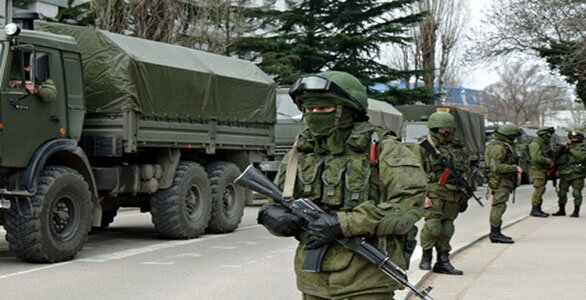
“History shows that the United States has benefited politically and economically from wars in Europe. The huge outflow of capital from Europe following the First and Second World Wars, transformed the U.S. into a superpower … Today, faced with economic decline, the US is trying to precipitate another European war to achieve the same objective.”… Sergey Glazyev,
“The discovery of the world’s largest, known gas reserves in the Persian Gulf, shared by Qatar and Iran, and new assessments which found 70 percent more gas in the Levantine in 2007, are key to understanding the dynamics of the conflicts we see today. After a completion of the PARS pipeline, from Iran, through Iraq and Syria to the Eastern Mediterranean coast, the European Union would receive more than an estimated 45 percent of the gas it consumes over the next 100 – 120 years from Russian and Iranian sources. Under non-conflict circumstances, this would warrant an increased integration of the European, Russian and Iranian energy sectors and national economies.” Christof Lehmann,Interview with Route Magazine
The United States failed operation in Syria, has led to an intensification of Washington’s proxy war in Ukraine. What the Obama administration hoped to achieve in Syria through its support of so called “moderate” Islamic militants was to topple the regime of Bashar al Assad, replace him with a US-backed puppet, and prevent the construction of the critical Iran-Iraq-Syria pipeline. That plan hasn’t succeeded nor will it in the near future, which means that the plan for the prospective pipeline will eventually go forward.
Why is that a problem?
It’s a problem because–according to Dr. Lehmann–”Together with the Russian gas… the EU would be able to cover some 50 percent of its requirements for natural gas via Iranian and Russian sources.” As the primary suppliers of critical resources to Europe, Moscow and Tehran would grow stronger both economically and politically which would significantly undermine the influence of the US and its allies in the region, particularly Qatar and Israel. This is why opponents of the pipeline developed a plan to sabotage the project by fomenting a civil war in Syria. Here’s Lehmann again:
“In 2007, Qatar sent USD 10 billion to Turkey´s Foreign Minister Davotoglu to prepare Turkey´s and Syria´s Muslim Brotherhood for the subversion of Syria. As we recently learned from former French Foreign Minister Dumas, it was also about that time, that actors in the United Kingdom began planning the subversion of Syria with the help of “rebels”’ (Christof Lehmann, Interview with Route Magazine)
In other words, the idea to arm, train and fund an army of jihadi militants, to oust al Assad and open up Syria to western interests, had its origins in an evolving energy picture that clearly tilted in the favor of US rivals in the region. (Note: We’re not sure why Lehmann leaves out Saudi Arabia, Kuwait or the other Gulf States that have also been implicated.)
Lehmann’s thesis is supported by other analysts including the Guardian’s Nafeez Ahmed who explains what was going on behind the scenes of the fake civil uprising in Syria. Here’s a clip from an article by Ahmed titled “Syria intervention plan fueled by oil interests, not chemical weapon concern”:
“In May 2007, a presidential finding revealed that Bush had authorised CIA operations against Iran. Anti-Syria operations were also in full swing around this time as part of this covert programme, according to Seymour Hersh in the New Yorker. A range of US government and intelligence sources told him that the Bush administration had “cooperated with Saudi Arabia’s government, which is Sunni, in clandestine operations” intended to weaken the Shi’ite Hezbollah in Lebanon. “The US has also taken part in clandestine operations aimed at Iran and its ally Syria,” wrote Hersh, “a byproduct” of which is “the bolstering of Sunni extremist groups” hostile to the United States and “sympathetic to al-Qaeda.” He noted that “the Saudi government, with Washington’s approval, would provide funds and logistical aid to weaken the government of President Bashir Assad, of Syria”…
According to former French foreign minister Roland Dumas, Britain had planned covert action in Syria as early as 2009: “I was in England two years before the violence in Syria on other business”, he told French television:
“I met with top British officials, who confessed to me that they were preparing something in Syria. This was in Britain not in America. Britain was preparing gunmen to invade Syria.”
… Leaked emails from the private intelligence firm Stratfor including notes from a meeting with Pentagon officials confirmed US-UK training of Syrian opposition forces since 2011 aimed at eliciting “collapse” of Assad’s regime “from within.”So what was this unfolding strategy to undermine Syria and Iran all about? According to retired NATO Secretary General Wesley Clark, a memo from the Office of the US Secretary of Defense just a few weeks after 9/11 revealed plans to “attack and destroy the governments in 7 countries in five years”, starting with Iraq and moving on to “Syria, Lebanon, Libya, Somalia, Sudan and Iran.” In a subsequent interview, Clark argues that this strategy is fundamentally about control of the region’s vast oil and gas resources.”
(“Syria intervention plan fueled by oil interests, not chemical weapon concern“, The Guardian)
Apparently, Assad was approached by Qatar on the pipeline issue in 2009, but he refused to cooperate in order “to protect the interests of [his] Russian ally.” Had Assad fallen in line and agreed to Qatar’s offer, then the effort to remove him from office probably would have been called off. In any event, it was the developments in Syria that triggered the frenzied reaction in Ukraine. According to Lehmann:
“The war in Ukraine became predictable (unavoidable?) when the great Muslim Brotherhood Project in Syria failed during the summer of 2012. …In June and July 2012 some 20,000 NATO mercenaries who had been recruited and trained in Libya and then staged in the Jordanian border town Al-Mafraq, launched two massive campaigns aimed at seizing the Syrian city of Aleppo. Both campaigns failed and the ”Libyan Brigade” was literally wiped out by the Syrian Arab Army.
It was after this decisive defeat that Saudi Arabia began a massive campaign for the recruitment of jihadi fighters via the network of the Muslim Brotherhoods evil twin sister Al-Qaeda.
The International Crisis Group responded by publishing its report ”Tentative Jihad”. Washington had to make an attempt to distance itself ”politically” from the ”extremists”. Plan B, the chemical weapons plan was hedged but it became obvious that the war on Syria was not winnable anymore.” (“The Atlantic Axis and the Making of a War in Ukraine“, New eastern Outlook)
There were other factors that pushed the US towards a conflagration with Moscow in Ukraine, but the driving force was the fact that US rivals (Russia and Iran) stood to be the dominant players in an energy war that would increasingly erode Washington’s power. Further economic integration between Europe and Russia poses a direct threat to US plans to pivot to Asia, deploy NATO to Russia’s borders, and to continue to denominate global energy supplies in US dollars.
Lehmann notes that he had a conversation with “a top-NATO admiral from a northern European country” who clarified the situation in a terse, two-sentence summary of US foreign policy. He said:
“American colleagues at the Pentagon told me, unequivocally, that the US and UK never would allow European – Soviet relations to develop to such a degree that they would challenge the US/UK’s political, economic or military primacy and hegemony on the European continent. Such a development will be prevented by all necessary means, if necessary by provoking a war in central Europe”.
This is the crux of the issue. The United States is not going to allow any state or combination of states to challenge its dominance. Washington doesn’t want rivals. It wants to be the undisputed, global superpower, which is the point that Paul Wolfowitz articulated in an early draft of the US National Defense Strategy:
“Our first objective is to prevent the re-emergence of a new rival, either on the territory of the former Soviet Union or elsewhere, that poses a threat on the order of that posed formerly by the Soviet Union. This is a dominant consideration underlying the new regional defense strategy and requires that we endeavor to prevent any hostile power from dominating a region whose resources would, under consolidated control, be sufficient to generate global power.”
So the Obama administration is going to do whatever it thinks is necessary to stop further EU-Russia economic integration and to preserve the petrodollar system. That system originated in 1974 when President Richard Nixon persuaded OPEC members to denominate their oil exclusively in dollars, and to recycle their surplus oil proceeds into U.S. Treasuries. The arrangement turned out to be a huge windfall for the US, which rakes in more than $1 billion per day via the process. This, in turn, allows the US to over-consume and run hefty deficits. Other nations must stockpile dollars to purchase the energy that runs their machinery, heats their homes and fuels their vehicles. Meanwhile, the US can breezily exchange paper currency, which it can print at no-expense to itself, for valuable imported goods that cost dearly in terms of labor and materials. These dollars then go into purchasing oil or natural gas, the profits of which are then recycled back into USTs or other dollar-denominated assets such as U.S. stocks, bonds, real estate, or ETFs. This is the virtuous circle that keeps the US in the top spot.
As one critic put it: “World trade is now a game in which the US produces dollars and the rest of the world produces things that dollars can buy.”
The petrodollar system helps to maintain the dollar’s monopoly pricing which, in turn, sustains the dollar as the world’s reserve currency. It creates excessive demand for dollars which allows the Fed to expand the nation’s credit by dramatically reducing the cost of financing. If oil and natural gas were no longer denominated in USDs, the value of the dollar would fall sharply, the bond market would collapse, and the US economy would slip into a long-term slump.
This is one of the reasons why the US invaded Iraq shortly after Saddam had switched over to the euro; because it considers any challenge to the petrodollar looting scam as a direct threat to US national security.
Moscow is aware of Washington’s Achilles’s heel and is making every effort to exploit that weakness by reducing its use of the dollar in its trade agreements. So far, Moscow has persuaded China and Iran to drop the dollar in their bilateral dealings, and they have found that other trading partners are eager to do the same. Recently, Russian economic ministers conducted a “de-dollarization” meeting in which a “currency switch executive order” was issued stating that “the government has the legal power to force Russian companies to trade a percentage of certain goods in rubles.”
Last week, according to RT:
“The Russian and Chinese central banks have agreed a draft currency swap agreement, which will allow them to increase trade in domestic currencies and cut the dependence on the US dollar in bilateral payments. “The draft document between the Central Bank of Russia and the People’s Bank of China on national currency swaps has been agreed by the parties…..The agreement will stimulate further development of direct trade in yuan and rubles on the domestic foreign exchange markets of Russia and China,” the Russian regulator said.
Currently, over 75 percent of payments in Russia-China trade settlements are made in US dollars, according to Rossiyskaya Gazeta newspaper.” (“De-Dollarization Accelerates – China/Russia Complete Currency Swap Agreement“, Zero Hedge)
The attack on the petrodollar recycling system is one of many asymmetrical strategies Moscow is presently employing to discourage US aggression, to defend its sovereignty, and to promote a multi-polar world order where the rule of law prevails. The Kremlin is also pushing for institutional changes that will help to level the playing field instead of creating an unfair advantage for the richer countries like the US. Naturally, replacing the IMF, whose exploitative loans and punitive policies, topped the list for most of the emerging market nations, particularly the BRICS (Brazil, Russia, India, China and South Africa) who, in July, agreed to create a $100 billion Development Bank that will “will counter the influence of Western-based lending institutions and the dollar. The new bank will provide money for infrastructure and development projects in BRICS countries, and unlike the IMF or World Bank, each nation has equal say, regardless of GDP size.
According to RT:
“The big launch of the BRICS bank is seen as a first step to break the dominance of the US dollar in global trade, as well as dollar-backed institutions such as the International Monetary Fund (IMF) and the World Bank, both US-based institutions BRICS countries have little influence within…
“This mechanism creates the foundation for an effective protection of our national economies from a crisis in financial markets,” Russian President Vladimir Putin said.”
(“BRICS establish $100bn bank and currency pool to cut out Western dominance“, RT)
It’s clear that Washington’s aggression in Ukraine has focused Moscow’s attention on retaliation. But rather than confront the US militarily, as Obama and Co. would prefer, Putin is taking aim at the vulnerabilities within the system. A BRICS Development Bank challenges the IMF’s dominant role as lender of last resort, a role that has enhanced the power of the wealthy countries and their industries. The new bank creates the basis for real institutional change, albeit, still within the pervasive capitalist framework.
Russian politician and economist, Sergei Glazyev, summarized Moscow’s approach to the US-Russia conflagration in an essay titled “US is militarizing Ukraine to invade Russia.” Here’s an excerpt:
“To stop the war, you need to terminate its driving forces. At this stage, the war unfolds mainly in the planes of economic, public relations and politics. All the power of US economic superiority is based on the financial pyramid of debt, and this has gone long beyond sustainability. Its major lenders are collapsing enough to deprive the US market of accumulated US dollars and Treasury bonds. Of course, the collapse of the US financial system will cause serious losses to all holders of US currency and securities. But first, these losses for Russia, Europe and China will be less than the losses caused by American geopolitics unleashing another world war. Secondly, the sooner the exit from the financial obligations of this American pyramid, the less will be the losses. Third, the collapse of the dollar Ponzi scheme gives an opportunity, finally, to reform the global financial system on the basis of equity and mutual benefit.”
Washington thinks “modern warfare” involves covert support for proxy armies comprised of Neo Nazis and Islamic extremists. Moscow thinks modern warfare means undermining the enemy’s ability to wage war through sustained attacks on it’s currency, its institutions, its bond market, and its ability to convince its allies that it is a responsible steward of the global economic system.
I’ll put my money on Russia.
Mike Whitney is a regular columnist for Veracity Voice
Mike Whitney lives in Washington state. He can be reached at:
Western Plutocracy Goes Bear Hunting
August 3, 2014 by Administrator · Leave a Comment
The post-Cold War status quo in Eastern Europe, not to mention in Western Europe, is now dead.
For Western plutocracy, that 0.00001% at the top, the real Masters of the Universe, Russia is the ultimate prize; an immense treasure of natural resources, forests, pristine water, minerals, oil and gas. Enough to drive any NSA-to-CIA Orwellian/Panopticon war game to ecstasy. How to pounce and profit from such a formidable loot?
Enter Globocop NATO. Barely out of having its collective behind unceremoniously kicked by a bunch of mountain warriors with Kalashnikovs, the North Atlantic Treaty Organization is now fast
“pivoting” – that same old Mackinder to Brzezinski game – to Russia. The road map will be put in place at the group’s summit in early September in Wales.
Meanwhile, the MH17 tragedy is undergoing a fast metamorphosis. When the on-site observations by this Canadian OSCE monitor (watch the video carefully) are compounded with this analysis by a German pilot, a strong probability points to a Ukrainian Su-25’s 30 mm auto-cannon firing at the cockpit of MH17, leading to massive decompression and the crash.
No missile – not even an air-to-air R-60M, not to mention a BUK (the star of the initial, frenetic American spin). The new possible narrative fits with on-site testimony by eyewitness in this now famously “disappeared” . Bottom line: MH17 configured as a false flag, planned by the US and botched by Kiev. One can barely imagine the tectonic geopolitical repercussions were the false flag to be fully exposed.
Malaysia has handed out the flight recorders to the UK; this means NATO, and this spells out manipulation by the CIA. Air Algerie AH5017 went down after MH17. The analysis has already been released. That begs the question of why it is taking so long for MH17’s black boxes to be analyzed/tampered with.
Then there’s the sanctions game: Russia remains guilty – with no evidence – thus it must be punished. The EU abjectly followed His Master’s Voice and adopted all the hardcore sanctions against Russia they were discussing last week.
Yet there are loopholes. Moscow will have reduced access to US dollar and euro markets. Russian state-owned banks are forbidden from selling shares or bonds in the West. Yet Sberbank, Russia’s largest, has not been sanctioned.
So Russia in the short and medium term will have to finance itself. Well, Chinese banks could easily replace that kind of lending. Don’t forget the Russia-China strategic partnership. As if Moscow needed another warning that the only way to go is to increasingly bypass the US dollar system.
EU nations will suffer. Big time. BP has a 20% stake in Rosneft, and it’s already freaking out on the record. ExxonMobil, Norway’s Statoil and Shell will also be affected. Sanctions don’t touch the gas industry; now that would have propelled the EU’s counterproductive stupidity to galactic levels. Poland – hysterically blaming Moscow for everything under the sun – gets more than 80% of its gas from Russia. The no less strident Baltic states, as well as Finland, get 100%.
The ban on dual-use goods – civilian and military applications – will badly affect Germany, the top EU exporter to Russia. On defense, the UK and France will suffer; the UK has no less than 200 licenses selling weapons and missile launching gear to Russia. Yet the French 1.2 billion euro (US$1.6 billion) sale of Mistral assault ships to Russia will go ahead.
Meanwhile, in the demonization front …
This is what Associated Press spins as “analysis” and distributes to papers around the world; a collection of cliches desperately in search of a thesis. Dmitri Trenin of the Carnegie Moscow Center, faithful to who pays his bills, gets a few things right and most things wrong. David Stockman at least has a ball deconstructing the lies of the Warfare State.
But the real thing is definitely Putin’s economic adviser Sergei Glazyev. One of his key theses is that European business must be really careful to protect their interests as the US attempts to “ignite a war in Europe and a Cold War against Russia”.
This, though, is – delivered by a cool, calm and collected Glazyev. Watch it carefully. A detailed reappraisal of what Glazyev has been saying for weeks now, mixed with some outstanding comments here leads to a inevitable conclusion: key sectors of Western plutocracy want a still ill-defined war with Russia. And journalism’s Holy Grail – never trust anything until it’s officially denied – confirms it.
NATO’s Plan A is to install missile batteries in Ukraine; that is already being discussed in detail in the run-up to NATO’s summit in Wales in early September. Needless to say, if that happens, for Moscow, that’s way beyond a red line; it implies a first strike capability at Russia’s western borderlands.
Washington’s short Plan A, meanwhile, is to organize a wedge between the federalists in Eastern Ukraine and Russia. This implies progressive, direct funding of Kiev in parallel to building up, via American advisers already on the ground, and vast weaponizing, a huge proxy army (nearly 500,000 by the end of the year, according to Glazyev’s projection). Endgame on the ground would be to seal the federalists off into a very small area. Ukrainian President Petro Poroshensko has been on the record saying this should happen by early September. If not, by the end of 2014.
In the US, and a great deal of the EU, a monstrous grotesquerie has developed, packaging Putin as the new Stalinist Osama bin Laden. So far, his strategy on Ukraine was to be patient – what I called Vlad Lao Tzu – watching the Kiev gang hang themselveswhile trying to sit down with the EU in a civilized manner working for a political solution.
Now we may be facing a game changer, because the mounting evidence, which Glazyev and Russian intel relayed to Putin, points to Ukraine as a battlefield; a concerted drive for regime change in Moscow; a concerted drive aiming for a destabilized Russia; and even the possibility of a definitive provocation.
Moscow, allied with the BRICS, is actively working to bypass the US dollar – which is the anchor of a parallel US war economy based on printing worthless pieces of green paper. Progress is slow, but tangible; not only the BRICS but BRICS aspirants, the G-77, the Non-Aligned Movement (NAM), the whole Global South is absolutely fed up with the Empire of Chaos’s non-stop bullying and want another paradigm in international relations. The US counts on NATO – which it manipulates at will – and mad dog Israel; and perhaps the GCC, the Sunni petro-monarchies partners in the Gaza carnage, which can be bought/silenced with a slap on the wrist.
The temptation for Putin to invade Eastern Ukraine in 24 hours and reduce the Kiev militias to dust must have been super-human. Especially with the mounting cornucopia of dementia; ballistic missiles in Poland and soon Ukraine; indiscriminate bombing of civilians in Donbass; the MH17 tragedy; the hysterical Western demonization.
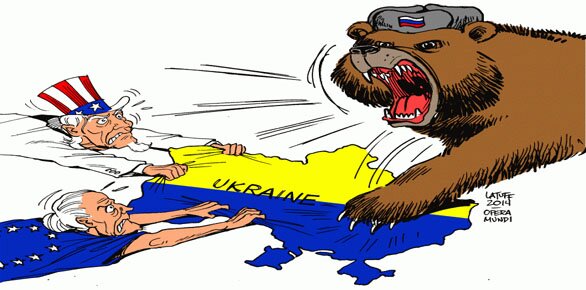
A bear with limited patience
But Putin is wired for playing the long game. The window of opportunity for a lightning strike is gone; that kung fu move would have stopped NATO in its tracks with a fait accompli, and the ethnic cleansing of 8 million Russians and Russophones in Donbass would never have developed.
Still, Putin won’t “invade” Ukraine because Russian public opinion doesn’t want him to. Moscow will keep supporting what is a de facto resistance movement in the Donbass. Remember: in give or take two months, General Winter starts to set in those broke, IMF-plundered Ukrainian pastures.
The leaked German-Russian peace plan will be implemented over Washington’s collective dead body. This New Great Game, to a great extent, is also about preventing Russia-EU economic integration via Germany, part of a full Eurasian integration including China and its myriad Silk Roads.
If Russia’s trade with the EU – about US$410 billion in 2013 – is due to take a hit because of sanctions, then that also spells out a Go East movement. Which implies a Russian fine-tuning of theEurasian Economic Union project. No more a Greater Europe from Lisbon to Vladivostok – Putin’s original idea. Enter the Eurasian Union as a brother in arms of China’s myriad Silk Roads. Still, this spells out a strong Russia-China partnership at the heart of Eurasia – and still this is absolute anathema to the Masters of the Universe.
Make no mistake, the Russia-China strategic partnership will keep evolving very fast – with Beijing in symbiosis with Moscow’s immense natural and military-technological resources. Not to mention the strategic benefits. A case could be made this has not happened since Genghis Khan. But it’s not like Xi Jinping is pulling a Khan to subdue Siberia and beyond.
Cold War 2.0 is now inevitable because the Empire of Chaos will never accept Russia’s sphere of influence in parts of Eurasia (as it doesn’t accept China’s). It will never accept Russia as an equal partner (exceptionalists don’t do equality). And it will never forgive Russia – alongside China – for openly defying the creaking, exceptionalist, American-imposed order.
If the US deep state, guided by those nullities who pass for leadership, in desperation, goes one step beyond – it could be a genocide in Donbass; a NATO attack on Crimea; or worst case scenario, an attack against Russia itself – watch out. The Bear will strike.
Pepe Escobar is the author of (Nimble Books, 2007), (Nimble Books, 2007), and (Nimble Books, 2009).
He may be reached at .
Source: Asia Times Online
Internationalists Are Pushing The World Towards Globally Engineered Economic Warfare
August 2, 2014 by Administrator · Leave a Comment

Over a year ago I published an essay entitled ‘The Linchpin Lie: How Global Collapse Will Be Sold To The Masses’. This essay addressed efforts by the ever malicious Rand Corporation to create a false narrative surrounding the possibility of global collapse. Linchpin Theory, as it was named by it’s originator and Rand Corp. employee, John Casti, is I believe the very future of propaganda. Every engineered crisis needs a clever cover story, and in Linchpin Theory, we are told that all human catastrophe is a mere natural product of the “overcomplexity” within various systems. Yes, there is no accounting of false flag geopolitics or elitist conspiracy, no acknowledgment of deliberately initiated chaos; such things do not exist in the world of “linchpins”. Rather, the Rand Corporation would have us believe that the world is a massive game of Jenga, and the supporting pieces just remove themselves from the teetering structure by magical and coincidental causality.
Today, the linchpin lie is now being carefully inserted into the mainstream narrative. I can’t say I was shocked to hear Alan Greenspan use its basic premise when he recently stated that:
“I have come to the conclusion that bubbles…are a function of human nature. We don’t have enough observations, but my tentative hypothesis to what we’re dealing with is that both a necessary and sufficient condition for the emergence of a bubble is a protracted period of stable economic activity at low inflation. So it is a very difficult policy problem. I do believe that central banks that believe they can quell bubbles are living in a state of unrealism.”
It is important that we understand what Greenspan is actually doing here. The former Fed chairman is asserting that economic bubbles like the derivatives bubble of 2008 are a “natural function”, like the seasons, and are out of the control of central bankers. The truth is that central bankers have never tried to “quell” economic bubbles, they have been deliberately creating them in order to position the global economy into a crisis which they can then exploit. Greenspan is not only diverting blame for all the past and future economic crashes central banks have engineered, he is also setting the propaganda stage for a great change in the dynamic of the central banking concept – what the IMF’s Christine Lagarde calls the “global economic reset”.
The current central banking structure gives the illusion of separation and sovereignty. Most people who have not researched the nature of the international banking cartel believe that the Federal Reserve, for instance, is a separate national entity from the Central Bank of Russia, or the Central Bank of China. They believe that these institutions act of their own accord rather than in concert with each other. The reality is, there is no Federal Reserve. There is no Central Bank of Russia. There are no separate entities. There are no Western banks and there are no BRICS. All of these banking edifices are merely front organizations for global financiers, as Council on Foreign Relations insider (and friend to the Rockefellers) Carroll Quigley made clear in his book, Tragedy And Hope:
“It must not be felt that the heads of the world’s chief central banks were themselves substantive powers in world finance. They were not. Rather they were the technicians and agents of the dominant investment bankers of their own countries, who had raised them up, and who were perfectly capable of throwing them down. The substantive financial powers of the world were in the hands of these investment bankers who remained largely behind the scenes in their own unincorporated private banks. These formed a system of international cooperation and national dominance which was more private, more powerful, and more secret than that of their agents in the central banks. “
A “global economic reset”, I suspect, will consist of a grand shift away from covert cooperation between central banks to an OPENLY centralized one world banking system, predicated on the concepts put forward by the IMF and led by the Bank of International Settlements, which has always been behind the scenes handing down commandments to the seemingly separate central banks of nations.
In order for this “reset” to be achieved, however, the establishment needs a historically monumental distraction. A distraction so confounding and terrifying that by the time the public has a chance to examine the situation rationally, the elites have already tightened the noose.
I have been warning ever since the beginning of the derivatives/debt collapse of 2007/2008 that the international financiers and globalists who created the artificially low interest rates and fiat lending bonanza would one day be required to fashion a considerably dangerous event in orderto trigger the final collapse of the dollar based monetary system and replace it with a new currency (or basket of currencies), along with a new centralized financial authority.
This distracting event would have to rely on three very important strategies in order to succeed –
1) The use of what I call the “scattershot effect”; a swarm of smaller crises growing exponentially until it blurs together to create one dynamic calamity.
2) The use of multiple false paradigms in order to confuse the masses and pit them against one another in an absurd fight over fake and meaningless causes.
3) The use of deceptive benevolence on the part of the financial elite as they tap dance in to act as global “mediators”, ready to save the public from itself.
The end result would be a new brand of “world war” rather unique to history.
When most people imagine WWIII, they immediately envision images of nuclear bombs and mushroom clouds, however, I believe that when world war erupts, it may progress far differently from our cinematic assumptions. Regional conflicts are very likely, there is no doubt, but if one places himself in the shoes of the elites, one realizes that all out mechanized nuclear Armageddon is not really necessary to achieve the desired result of global governance.
Economic warfare alone could be extremely effective in initiating full spectrum fiscal implosion as well as mass starvation, mass panic, and mass desperation. All the signs lead me to believe that financial combat and 4th generation warfare will be used in the place of large armies and missiles.
The Scattershot Effect
Consider the sheer scope and number of crisis situations that have reached explosive proportions just in the past six months.
Syria continues to destabilize due to ISIS insurgents supported by the U.S., Saudi Arabia, and Israel; it is a horrifying storm which is now bleeding into other nations such as Iraq.
Iraq is on the verge of complete disintegration as the same western organized ISIS movestowards the outskirts of Baghdad.
Libya has imploded, with the American embassy evacuated, as well as the French and British, as various militias battle for supremacy.
The Ukraine crisis is nearing mutation into another beast entirely after the attack on Malaysian flight MH17. In just the past week, the EU has instituted sanctions against Russia, fighting has become even more fierce around Donetsk, Russia has been accused of firing artillery into Ukraine, and the U.S. now claims that Russia has violated the terms of the Intermediate Range Nuclear Forces treaty.
In the meantime, the Federal Reserve continues to taper QE3 while ignoring the unprecedented equities bubble they have birthed in the stock market, as well as refusing to answer the question as to who will actually buy U.S. Treasury debt if they do not? Our secret friend from Belgium? And what if this secret friend is, as I suspect, actually the IMF/BIS global loan shark duo? What then? Do we become yet another third world African-style debtor owing our very infrastructure to a financial bureaucracy on the other side of the world?
And what about the Baltic Dry Index, one of the few measures of global shipping demand that cannot be manipulated by outside money interests? Well, the BDI is back down to historic lows,falling 65% since January, signaling that the so-called “economic recovery” is not at all what it is cracked up to be.
Add to this the deluge of illegal immigration on the southern border, aided by the Obama Administration, as well as possible presidential impeachment and lawsuit proceedings, and you have a recipe for total chaos of the fiscal variety.
If the first six to seven months of 2014 have been this frenetic, how bad will the next six months be?
False Paradigms
We are all aware of the prevalence of the false Left/Right paradigm in American politics. Hopefully most people in the Liberty Movement understand, for example, that any impeachment or lawsuit proceedings against Barack Obama will be nothing more than a crafted circus designed to accomplish nothing – a con game to placate conservatives with useless top-down solutions while the country burns around their ears.
There are other false paradigms that are not so clear to some, though…
The false Israel/Hamas paradigm has certainly duped a particular subsection of Americans and even a few patriots, even though it is historical fact that the creation of Hamas itself wasfunded and supported by the Israeli government. Why do Israeli politicians put money and arms at the disposal of Muslim extremist groups like Hamas and ISIS, only to enter into brutal conflict with them later? Could it be that the Israeli government does not have the best interests of the Israeli people at heart? Could it be that Israel is being used by internationalists as a catalyst for chaos? It is vital that we question the intentions behind such contrary actions in the Middle East.
Why has the U.S. government , Saudi Arabia, and Israel put support behind the ISIS caliphate in Iraq after spending decades of time, billions in resources, and thousands of lives, attempting to overrun and dominate the region? Why are these governments creating enemies that will later try to harm us?
It is all about false paradigms; dividing the masses into numerous conflicting sides and pitting them against each other when they should be fighting against the elites.
The false East/West paradigm is perhaps the most dangerous lie facing free men today. It is a lie that may very well define our generation if not our century. I have outlined in multiple articlesthe substantial evidence that proves beyond a doubt that Russia and China are members of the globalist agenda, and that the tensions between our two hemispheres are completely fabricated.
The latest announcement of a BRICS bank to rival the IMF is yet another scheme to perpetuate the illusion that the elites of these nations are at odds. In fact, the BRICS conference mission statement makes it clear that developing nations have no intention of breaking from the IMF (and certainly not the BIS). Instead, the BRICS bank is meant to provide “leverage” to “force” the IMF to become more inclusive, and hand over more power and participation. Vladimir Putin had this to say at the latest summit:
“In the BRICS case we see a whole set of coinciding strategic interests. First of all, this is the common intention to reform the international monetary and financial system. In the present form it is unjust to the BRICS countries and to new economies in general. We should take a more active part in the IMF and the World Bank’s decision-making system. The international monetary system itself depends a lot on the US dollar, or, to be precise, on the monetary and financial policy of the US authorities. The BRICS countries want to change this.”
Brazilian President Dilma Rousseff insisted that from the Washington-based International Monetary Fund:
“On the contrary, we wish to democratize it and make it as representative as possible…”
Putin and the BRICS commonly rail against the “unipolar” financial system revolving around the U.S. dollar, but in the end they are only controlled opposition, and their solution is to place even more power into the hands of the IMF (a supposedly U.S. government controlled institution), creating a truly unipolar world order. If the U.S. loses its IMF veto status this year due to lack of allocated funds, and the BRICS dump the dollar as world reserve, this may very well happen.
As sanctions between Russia and the U.S. snowball, a perfect rationalization for a dollar decoupling will be created that very few people would have believed possible only a few years ago. It is only a matter of time before fiscal warfare escalates to destructive levels. Russia will inevitably cut off gas exports to the EU, and the BRICS will inevitably drop the U.S. dollar as a world reserve standard.
The U.S. relationship to the EU is also currently being presented as dubious, and this is not by accident. Failing relations between America and Germany are yet more theater for the masses to chew on. Western allies have been spying on each other for decades, but somehow the exposure of CIA activities in Germany is shocking news? The NY Fed suddenly attacks Deutsche Bank, seeking expanded monitoring and regulation? Germany’s business interests are highly damaged by U.S. sanctions against Russia? It would seem as though someone is trying to create an artificial divide between elements of the EU and the U.S.
I believe that the narrative is being prepared for a faked financial breakup between the U.S. and many of its former allies, isolating the U.S., and destroying the dollar, but to what end? To answer that question, we must ask WHO ultimately benefits from these actions?
The Rise Of The Hero Bankers
In June of last year, the Bank of International Settlements, the central bank of central banks whose history began with the financial support of the Third Reich, released a statementwarning that “easy money” from central banks was creating a dangerous bubble in stock markets around the world.
The IMF too has been pushing warnings of stock bubble collapse into the mainstream.
In June of this year, the BIS, a normally obscure and secretive organization, released another statement pronouncing that government had been led into a “false sense of security” by easy monetary policy and low interest rates, making the world economy perpetually unstable.
For an organization so covert and occult, the BIS sure has become rather candid lately. Frankly, I agree with everything they have said. However, I do not agree with the hypocrisy of the BIS, which dominates the decisions of all of its member banks, publicly criticizing policies which it most likely scripted itself. Why would the BIS suddenly denounce fiscal methods it used to promote? Because the BIS is setting itself up as the great prognosticator of a collapse that IT HELPED ENGINEER.
After the great financial war has subsided, and the people are suitably poverty stricken and desperate, it will be institutions like the BIS and IMF that swoop in to “save the day”. Their offer will be to consolidate economic control into the hands of an elite group of bankers “not affiliated” with any particular nation state, thereby insulating them from “political concerns”. The argument will be that national sovereignty is a bane on the back of humanity. They will claim that the catastrophe will continue until we “simplify” and streamline our economic and political systems. They will present themselves as the heroes of the age; the ones who predicted the crisis would occur, and the ones who had a solution ready to save the day (after sufficient death and destruction, of course).
As long as people remain obsessed with false paradigms and faux enemies, the establishment’s goal of complete centralized dominance will be predictably attainable. If we change our focus to the internationalists as the true danger instead of playing their game by their rules, then things will become far more interesting…
Source: Brandon Smith | Alt-Market
Russian Sanctions Backfire
July 26, 2014 by Administrator · Leave a Comment

The belief that calling for and instituting sanctions against Russia is a sound policy, illustrates the economic disconnect of the Obama administration. With the fervor for starting a new cold war, the propaganda machine is working overtime to paint a picture that ignores real economic synergism. Note the conflicting reports regarding the EU. Nine EU countries ready to block economic sanctions against Russia, quotes a diplomatic source to ITAR-TASS:
“France, Germany, Luxembourg, Austria, Bulgaria, Greece, Cyprus, Slovenia, and EU President Italy see no reason in the current environment for the introduction of sectorial trade and economic sanctions against Russia and at the summit, will block the measure.”
“According to the source, the US sees slapping Russia with sanctions as a way to promote its own trade agenda with Europe, a side rarely explored in mainstream media. The Transatlantic Trade and Investment Partnership (TTIP) between the US and Europe would create the world’s largest free trade zone, but some worry it could balloon into an “economic NATO” or could end up putting corporation interest above national.”
An article, reports that the European Council has agreed to extend the restrictive measures for the entities in the Russian Federation. Romanian president Traian Basescu believes the EU needs to adopt tougher sanctions against Russia.
“My point of view was that unless the European Union takes tougher actions and moves on to the third stage of these sanctions, Ukraine might no longer be ready to move towards the European Union and would end up in a situation like that in the Republic of Moldova, currently facing the breakaway tendencies of the region of Transdniester, only with a greater impact for the EU, because Ukraine is a bigger country.”
This contradiction between individual national economic interests and the quest for a technocrat administered system of trade that fosters and facilitates an internationalist foreign policy under NATO and EU rule, is the actual objective of Washington and Brussels interventionism. This arrogance and self-delusion treats economic commerce as conducted in a vacuum. As The Hill article cites Putin. “Sanctions are “driving into a corner” relations between the two countries and will damage the interests of U.S. companies and “the long-term national interests of the U.S. government and people.”
Russian warns that the US campaign will have consequences as the Alliance News writes, that Moscow Blasts US Sanctions As “Primitive,” Promises Retaliation.
“Sergei Ryabkov, a deputy Foreign Minister, told the Interfax news agency that Moscow will hit back with measures that “will be felt in Washington painfully and sharply.”
The Russian Foreign Ministry said US measures against a number of state corporations are “a primitive attempt at revenge because events in Ukraine are not developing according to Washington’s scenario,” and added that it reserves the right to retaliate.”
The preposterous strategy that international finance can force a country like Russia, with the world’s largest energy resources, into a capitulation dependent status is absurd. The minimal effect according to Russia’s Finance Ministry, Says Harsher Sanctions Would Cost Russia 0.3% of GDP, does not sound like much of a threat. Then consider the counter response of Russian Sanctions Retaliation Escalates: Dumps Intel/AMD And Now Foreign Cars.
 The cavalier and condescending manner by which the Western central banks assist the New World Order’s goal of global dominance has fortified opposition with the emergence of theBRICS Development Bank. Use your common sense, when Putin Wants Measures to Protect BRICS Nations From U.S. Sanctions, much of the rest of the world is listening.
“In an interview published as a two-day BRICS summit got under way in Brazil on Tuesday, Putin said he would urge Brazil, China, India and South Africa to draw “substantive conclusions” from sanctions imposed on Russia over its actions in the Ukraine crisis, and said it was time to dilute the dominance of the U.S.-led West and the U.S. dollar by boosting the role of the BRICS on the global stage.”
The American press and media, especially is fueling the fires to demonize Putin’s Russia as a resurrected Stalinist Soviet belligerent. Absent in this narrative is an honest chronicle of NATO’s expansion to encircle the Russian Federation. At what point will Western journalists and academic scholars admit that the convergence of EU authoritarianism and American hegemony propagates an internationalist foreign policy, designed to isolate and destroy any opposition to this New World Order.
The lesson of these failed attempts for economic bullying a country, with real weapons of mass destruction, has the potential of starting a hot war. The essay, IMF and EU Capture of Ukraine, explains the circumstances and false justification of initiating “regime change“. This Ukraine flashpoint may well commence a tangible economic union among countries, who recognize that American sanctions are nothing more than a desperate attempt to prop up a decaying globalist economic structure.
EU antagonism towards the citizens of their member countries is growing expediently. Within this context, US sanctions hurt Europe more than America.
“The Association of European Businesses (AEB), a Moscow-based business lobby, said that new US sanctions against Russia have a more severe effect on European than on American business.
The AEB says it “regrets” the US sanctions, and warns that they will stunt economic growth “not only in Russia“.
“These sanctions are more focused on the partners of European businesses than on the partners of American companies,” the group said in a statement on Thursday.”
Obama’s State Department bears a heavy responsibility for promoting a civil war in Ukraine. Using sanctions to push Russia into accelerating a BRICS economic block will have far more adverse effects than can be envisioned by the lunatic proponents of “selective” Free Trade. The moneychanger’s financial system is imploding and their rescue plan requires a massive global crisis to bail out their “To Big to Fail” model. Mutually productive commerce will be among the first causalities of the prelude to World War III. Soon clamors for sanctions against American companies will begin, as the blame game diverts the real cause of this fabricated debacle.
Sartre is the publisher, editor, and writer for Breaking All The Rules. He can be reached at:
Sartre is a regular columnist for Veracity Voice
Class Warfare Saps The Economy: Why Abenomics Flopped
July 5, 2014 by Administrator · Leave a Comment
By every objective standard, Abenomics has been a complete flop. Household spending has plunged, wages have dropped for 23 months in a row, inflation is on the rise, the number of workers who can only find part-time jobs has ballooned to 38 percent, and most economists now expect 2nd quarter GDP to shrink to minus 4 percent or worse. So where’s the silver lining?
There isn’t one. It’s all hype. In fact, the only part of Prime Minister’s Shinzo Abe’s economic strategy that has succeeded has been the public relations campaign, which has bamboozled the Japanese people into believing that pumping trillions of yen into financial assets will lead to widespread prosperity. Good luck with that. We can see how well that worked in the US where stock prices have nearly tripled in the last five years, but the real economy is still flat on its back. So why would quantitative easing (QE) work in Japan when it hasn’t worked in the US?
It hasn’t, and it won’t. The whole thing is a farce. But political leaders like Prime Minister Shinzo Abe and their central bank lackeys continue to promote this absurd flimflam because it boosts profits for their constituents. That’s what this nonsense is all about; trying to find new ways to enrich the parasite class during a “self induced” long-term slump. The only problem is that everyone else is worse off than before, mainly because the silver spoon slackers at the top of the heap are getting a bigger and bigger share of the pie. That just leaves a few crumbs for everyone else, which is why economic activity has slowed to a crawl. It’s because the people who typically spend money and rev up the economy, have no money to spend. It’s that simple. Check out this blurb from the Testosterone Pit:
“The Abe administration is doing everything in the book to bolster the fortunes of Japan Inc.: offering tax cuts, more public works, and stimulus packages, snatching the Olympics by hook or crook, and cranking up inflation. In April, prices for all items soared 3.4% from a year earlier, and goods prices a confiscatory 5.2%. Yet wages were stuck in the mire, and adjusted for inflation, they plunged…
Then came the consumption tax hike, a broad-based tax that impacts consumers and businesses across the economy. The months before the effective date of April 1, consumers and businesses binged to save that extra 3% in taxes on big-ticket items, and businesses rang up sales faster than they could count.” Japan Inc.’s Worst Quarterly Outlook Since The 2011 Earthquake, Testosterone Pit
How do you like that? So, with the economy already on the ropes, class warrior Abe decided to squeeze working people even more by pushing through a regressive sales tax that put household spending into a nosedive. (Get a load of this ski-jump chart of household spending)
But while Abe has been raising taxes on the workerbees, he’s cutting them for his crooked corporate buddies. As part of his dubious “growth strategy” the Japanese PM has promised to slash corporate taxes from 35 percent to 29 percent, a move that will reduce revenues and increase Japan’s humongous public debt even more. (Japan’s debt is already a gargantuan 240 percent of GDP.) Many analysts think that Abe’s move could trigger a panic in the bond market if investors start to think he’s not serious about addressing the debt. Even so, that’s a risk that Abe’s willing to take as long as it saves his cheesy corporate friends a few shekels.
Of course the best way to pay down the debt, is through economic growth. But that can’t be done when wages are either stagnant or dropping as they are in Japan. Check this out from mni market news:
“Base wages, the key to a recovery in cash earnings, fell 0.2% on year, marking the 23rd consecutive decrease…. In real terms, total wages slumped 3.1% in April, showing the annual inflation rate above 1% is hurting household income in the absence of substantial wage growth and in light of the sales tax hike to 8% from 5% on April 1″. (Japan Apr Total Wages Post 2nd Straight Rise; Base Wages Down, MNI Market News)
The economy can’t grow when demand is weak, and demand is perennially weak in Japan because wages and incomes are shriveling. That means less personal consumption, less economic activity, and smaller GDP. Recently, the situation has gotten worse due to the Bank of Japan’s money printing operations which have increased inflation which has reduced worker’s buying power. Check this out form the Japan Times:
“Consumer prices climbed in May at their fastest pace in 32 years, swelled by the hike in the consumption tax and higher utility charges that are squeezing Japanese budgets as wage gains remain limited.
Consumer prices excluding fresh food but not energy, rose 3.4 percent from a year earlier, the Statistics Bureau said Friday…Household spending subsequently sank 8 percent, more than the forecast fall of 2.3 percent, separate data showed…
All 14 major gas and electricity companies raised prices from May to the highest level since the current pricing system began in May 2009, according to the Asahi Shimbun. Tokyo Electric Power Co. announced a price hike of 5.3 percent in May for households, reflecting the higher tax, rising energy costs and other factors.” (Prices climb most in 32 years as wages limp along, Japan Times)
So, with prices rising and wages stagnant, Japan is experiencing what most analysts anticipated when Abe first announced his plan to hike the sales tax, that is, household spending has dropped precipitously increasing the likelihood of another recession. Abe decided that pushing more of the government’s operating costs onto working people was more important than the health of the economy.
Naturally, Abe’s policies have had a catastrophic effect on the working poor. As we noted earlier, the number of part-time workers in Japan has grown dramatically over the last few years. According to Reuters,
“part-time, temporary and other non-regular workers who typically make less than half the average pay has jumped 70 percent from 1997 to 19.7 million today — 38 percent of the labor force.”
Abenomics has made life considerably harder for these people due to the higher taxes, soaring prices, and reduced welfare benefits. The data show that Japan’s poverty rate is “the sixth-worst among the 34 OECD countries” while “child poverty in working, single-parent households is by far the worst at over 50 percent, making Japan the only country where having a job does not reduce the poverty rate for that group.” (Japan’s working poor left behind by Abenomics, Reuters)
Abe’s attack on working people has intensified in the last few weeks as he’s unveiled parts of his “third arrow” of structural reforms. Along with cutting corporate taxes, Abe wants to take the Government Pension Investment Fund (GPIF), “the world’s deepest pot of savings”, and shove it in the stock market. George W. Bush wanted to do the same thing with Social Security but abandoned the idea after Lehman Brothers collapsed and the economy tanked. Now Abe is pushing the same loony plan which will put the long-term security of Japan’s elderly at risk just to boost profits for his voracious plutocrat friends.
Abe also wants to eliminate overtime pay, make it easier for corporate bosses to fire workers, and allow foreign workers to care for children and the elderly in a series of “special economic zones”. All of the so called “reforms” are just ways of extracting more wealth from labor by loosening regulations. None of them have anything to do with increasing productivity, boosting capital investment or sparking more innovation. They’re all about wringing every last dime out of the people who are already so broke they can barley keep their heads above water.
On top of it all, Abe’s easy money policies have ignited the same flurry of “irrational exuberance” they have in the US. As Marketwatch notes, “A greater number of investors are demanding increased dividends and share buybacks than (ever) before.”
Stock buybacks are a particularly execrable activity that pumps up stock prices without adding anything to productivity. It’s pure-unalloyed asset inflation prompted by insanely loose monetary policies. Here’s more from Marketwatch:
“Japanese companies … are sitting on a record amount of cash: about $3 trillion at the end of March …
A number of large Japanese companies, including Toyota, NTT Docomo and Mitsubishi Corp., have announced plans for big stock buybacks, which improve shareholder returns by increasing the value of the remaining shares outstanding.” (In Japan, dividends, buybacks take the stage, Marketwatch)
Yipee! Shareholders are getting richer on Abe’s idiot programs. Too bad they’ll be gone when the bubble bursts and the system plunges back into crisis.
What a screwball system.
Abenomics has nothing to do with prosperity, growth or even deflation. That’s all BS. The policy is designed to do exactly what it does, generate hefty profits for slacker speculators and corporate muck-a-mucks while everyone else faces higher prices, lower wages and a dimmer future.
If that’s not class warfare, then what is it?
Mike Whitney is a regular columnist for Veracity Voice
Mike Whitney lives in Washington state. He can be reached at:
Central Bank Stock Buying Binge
June 29, 2014 by Administrator · Leave a Comment
Central banks have shifted into stocks and are buying up everything that isn’t bolted to the floor.
That’s the gist of the story that breathlessly appeared in the Financial Times about a week ago and swept across the blogosphere like a Santa Anna brushfire. And there’s some truth to it too, if taken with a large grain of salt. Here’s a clip from the Omfif’s report the FT’s cites in the article:
“A cluster of central banking investors has become major players on world equity markets,” says a report to be published this week by the Official Monetary and Financial Institutions Forum (Omfif), a central bank research and advisory group. The trend “could potentially contribute to overheated asset prices”, it warns.” (Financial Times)
So, there you have it; stocks are rising, central banks are buying stocks like mad, therefore, central banks are driving the market. That’s all there is to it, right?
And we’re not talking chump change here either. According to the Omfif”s press release “global central banks and public sector institutions now account for an eye-watering “$29.1tn worth of investments … in 162 countries.”
Hmm. It’s easy to read that statement and assume that central banks have purchased $29 trillion in stocks, isn’t it? That’s what the folks over at Zero Hedge did. Check out the headline they ran shortly after the story appeared in the FT: “Cluster Of Central Banks” Have Secretly Invested $29 Trillion In The Market” (Zero Hedge)
But that’s not what the press release says, is it? It says “global central banks and public sector institutions”. There’s a big difference between the stocks a bank buys and all the investments in public pension funds, 401Ks, sovereign wealth funds etc. A huge difference. It looks like someone might be engaging in a bit of fear-mongering to get a rise out of readers.
That’s not to downplay the fact that CB’s are distorting prices by playing the market. They are. No one disputes that. Just like no one disputes that central banks should limit their activities to doing their job, which is maintaining price stability. (We’re deliberately omitting “full employment” since the Fed thinks it’s a big joke anyway.) But, hey, everyone knows these guys are a dodgy lot to begin with, so it’s hard to get whipped up into a lather every time they get caught in some new flimflam. Besides CB stock purchases are likely insignificant compared to corporate stock buybacks which are presently just-south of $600 billion per year. CB stock purchases are no where near that, regardless of what you read at Zero Hedge. Check this out in the Wall Street Journal:
“Last year, the corporations in the Russell 3000, a broad U.S. stock index, repurchased $567.6 billion worth of their own shares—a 21% increase over 2012, calculates Rob Leiphart, an analyst at Birinyi Associates, a research firm in Westport, Conn. That brings total buybacks since the beginning of 2005 to $4.21 trillion—or nearly one-fifth of the total value of all U.S. stocks today.” (Will Stock Buybacks Bite Back?, Wall Street Journal)
Yikes. “$4.21 trillion”! Now that’s what you call froth.
Anyway, the reason CBs are buying equities is to hedge their losses on the mountain of low-yielding bonds they purchased in their effort to recapitalize the insolvent banking system. They’re already taking it in the shorts for an estimated $250 billion per year, and when rates start marching upward, (as they inevitably will) they’re going to be bleeding red ink from both eyeballs. That’s why they want to diversify their portfolio; to staunch the hemorrhaging. Even so, the whole matter looks shabby and underhanded, which of course it is. It also calls into question present stock valuations which have been soaring with the zero rates, QE and positive earnings reports, the trifecta which pushes equities into the stratosphere regardless of the shitty condition of the underlying “real” economy. So–just like everyone else–the banks want to get on the winning side of the trade. But what a firestorm they’ve set off with these latest shenanigans! Here’s a sample of the outrage you’ll find on the Internet. This is from a Bill Bonner article titled “Proof the Stock Market Is Being Rigged”:
“We are still reeling.
Yesterday, we reported that central banks are major buyers of stocks…
We hardly know where to begin…Outraged, we sputter and spit… we search for words… we look for metaphors and narratives… anything that will put this extraordinary situation in the right light…
Ah yes… central banks create new money… it gets passed around the financial community in many ways… and ultimately ends up in the equity markets…
In short, a grand slam of deceit. The World Series of financial catastrophe will follow. But that could be a long way off.” (Proof the Stock Market Is Being Rigged, Bonner and Partners)
“A grand slam of deceit”?
Fair enough. A little hyperbolic, but that’s to be expected, right? But, c’mon now, given the long list of scandals in the last few years–High-Frequency Trading (HFT), “toxic” mortgage-backed securities, Libor, London Whale, Robo-signing, structured finance, Madoff etc etc–it’s hard not to be little blasé about the whole deal, isn’t it? I’m not sure where Bonner’s been, but if you were to ask Joe Blow on the street, whether he thought the “market was rigged or not”, he’d undoubtedly nod his head affirmatively as if it was the most obvious thing in the world. Because it is the most obvious thing in the world. Heidi Moore summed it up pretty well in a recent article at the Gurdian. She said:
“Most Americans don’t think much about the stock market, and that’s just fine with Wall Street. Because once you wake up to how screwed up the stock market really is, the financial industry knows you’re likely to get very nervous and take your money out.
Many are catching on: between 2007 and 2014, investors pulled $345bn from the stock market. E-Trades are down and worries are up, with 73% of Americans still not inclined to buy stocks, five years after the financial crisis…
Let’s get one thing straight: Investor confidence is not the problem. The screwed-up stock market is the problem. It’s time to break down the polite fiction that investing in the stock market is something that sane, rational, sensible people do. It is a high-risk contact sport for your money…
The US stock market depends entirely on the ignorance of regular people who are supposed to just shovel their money into retirement funds and 401(k)s, pay a whopping one-third of your retirement in fees to high-priced managers, and never whisper a complaint.
It’s a wonder that anyone (trusts the market) at all.” (Wall Street and Washington want you to believe the stock market isn’t rigged. Guess what? It still is, Heidi Moore, Guardian)
The market is totally rigged from stem to stern, which is why it is so hard to feign outrage at this latest sign of corruption. It’s just par for the course. What we found more interesting, was the OMFIF’s contention that the experimental monetary policies, the centrals banks initiated to deal with the Financial Crisis, have changed the system to what the author calls “state capitalism”.
“Whether or not this trend is a good thing”, he opines, “may be open to question. What is incontestable is that it has happened”.
While you can’t expect the media to cover something like this, it’s certainly worth mulling over. The fact is, CBs have taken over economic policy altogether. They’re running the whole shooting match. The various congresses and parliaments across the western world now merely act as a rubber stamp for the austerity measures demanded by their corporate bosses. Fiscal policy is a dead letter in the US, Japan, Australia, Canada, UK and the Eurozone. Everywhere the bank cartel has extended it’s grip, fiscal policy has been jettisoned altogether. It’s bailouts and lavish subsidies for the 1 percenters and belt-tightening, shock therapy for everyone else. Isn’t that how it works? State Capitalism isn’t a conspiracy theory. It’s just class warfare taken to the next level. Check this out from Dave Marsh at Marketwatch:
“Central banks’ foreign-exchange reserves have grown unprecedentedly fast, especially in the developing world. The same authorities that are responsible for maintaining financial stability are often the owners of the large funds that add to liquidity in many markets…
Evidence of an increase in equity-buying by central banks and other public-sector investors has emerged from a survey of publicly owned or managed investments compiled by the Official Monetary and Financial Institutions Forum (OMFIF)… There are worries that central banks may be over-stretching themselves by operating in too many areas.
Jens Weidmann, president of Germany’s Bundesbank — spoke yearningly last week of the need for “central banks to shed their role as decision-makers of last resort and, thus, to return to their normal business.”
He said this “would help to preserve the independence of central banks, which is a key precondition to maintaining price stability in the long run.” (Central banks becoming major investors in stock markets, Dave Marsh, Marketwatch)
You might want to read that first part over again to savor what the author is saying. Here it is: “The same authorities that are responsible for maintaining financial stability are often the owners of the large funds that add to liquidity in many markets.”
That’s what you call corruption with a capital “C”. But then the author does a 180 and waxes-on about “preserving the independence of central banks, which is a key precondition to maintaining price stability in the long run.”
Right. The whole independence thing is a big joke. Why would anyone in their right mind bestow such extraordinary powers (“independence”) on a group of voracious, cutthroat bankers who have repeatedly shown that they can’t be trusted?
Huh?
It’s insanity. This latest outrage just proves that the central bank system needs to be either reformed or terminated. Preferably, terminated.
Mike Whitney is a regular columnist for Veracity Voice
Mike Whitney lives in Washington state. He can be reached at:
Dispatching B-2 Stealth Bombers To Europe: Obama’s Attempt At Intimidating Russia
June 11, 2014 by Administrator · Leave a Comment

“This deployment of strategic bombers provides an invaluable opportunity to strengthen and improve interoperability with our allies and partners.”
– Admiral Cecil Haney, commander, US Strategic Command on the deployment of B-2 stealth bombers to Europe.
“Against stupidity, no amount of planning will prevail.” – Carl von Clausewitz
Less than 24 hours after Ukraine’s new president Petro Poroshenko announced his determination to retake Crimea from Russia, US Admiral Cecil Haney confirmed that the US Air Force had deployed two B-2 stealth bombers to Europe to conduct military exercises. The addition of the multipurpose B-2, which is capable of delivering nuclear weapons, is intended to send a message to Moscow that the United States is prepared to provide backup for Ukraine’s fledgling government and to protect its interests in Central Asia. News of the deployment was reported in the Russian media, but was excluded by all the western news outlets.
The B-2 announcement was preceded by an inflammatory speech by Poroshenko at the presidential “swearing in” ceremony in Kiev. In what some analysts have called a “declaration of war”, Poroshenko promised to wrest control of Crimea from Russia which annexed the region just months earlier following a public referendum that showed 90 percent support for the measure. Here’s part of what Poroshenko said:
“The issue of territorial integrity of Ukraine is not subject to discussion…I have just sworn ‘with all my deeds to protect the sovereignty and independence of Ukraine,’ and I will always be faithful to this sacred promise…
“Russia occupied Crimea, which was, is and will be Ukrainian soil…Yesterday, in the course of the meeting in Normandy, I told this to President Putin: Crimea is Ukraine soil. Period. There can be no compromise on the issues of Crimea, European choice and state structure…” (New York Times)
On Thursday, the day before Poroshenko was sworn in, “President Obama and British Prime Minister David Cameron set a deadline for Russia to comply with its demands or face harsher economic sanctions that would be imposed by members of the G-7. Once again, the threat of new sanctions was largely ignored by the western media but was reported in the Israeli newspaper Haaretz. Here’s an excerpt from the article:
“To avoid even harsher sanctions.. Putin must meet three conditions: Recognize Petro Poroshenko’s election as the new leader in Kiev; stop arms from crossing the border; and cease support for pro-Russian separatist groups concentrated in eastern Ukraine.
“If these things don’t happen, then sectoral sanctions will follow…”
Obama said the G-7 leaders unanimously agree with the steps Cameron outlined.” (Haaretz)
The United States is ratcheting up the pressure in order to widen the conflict and force Russian president Vladimir Putin to meet their demands. It’s clear that the threat of sanctions, Poroshenko’s belligerent rhetoric, and the steady buildup of military assets and troops in the region, that Obama and Co. still think they can draw Putin into the conflict and make him look like a dangerous aggressor who can’t be trusted by his EU partners. Fortunately, Putin has not fallen into the trap. He’s resisted the temptation to send in the tanks to put an end to the violence in Donetsk, Lugansk and Slavyansk. This has undermined Washington’s plan to deploy NATO to Russia’s western border, assert control over the “bridgehead” between Europe and Asia, and stop the further economic integration between Russia and the EU. So far, Putin has out-witted his adversaries at every turn, but there are still big challenges ahead, particularly the new threats from Poroshenko.
If Poroshenko is determined to take Crimea back from Moscow, then there’s going to be a war. But there are indications that he is more pragmatic than his speeches would suggest. In a private meeting with Putin at the D-Day ceremonies in France, the Ukrainian president said he had a plan to “immediately stop the bloodshed”
Here’s how Putin summarized his meeting with Poroshenko:
“Poroshenko has a plan in this respect; it is up to him to say what kind of plan it is… I cannot say for sure how these plans will be implemented, but I liked the general attitude, it seemed right to me, so, if it happens this way, there will be conditions to develop our relations, in other areas, including economy.
“It’s important to stop the punitive actions in the southeast without a delay. That’s the only way to create conditions for the start of a real process of negotiations with the supporters of federalization. No one has yet said anything concrete to the people (living in the southeast of Ukraine) and nothing practical has been offered to them. People there simply don’t understand how they’ll live in the future and what the parameters of the new Constitution will look like.” (Poroshenko tells Putin of plan to immediately stop bloodshed in Ukraine, Itar-Tass)
If the report is accurate, then there’s reason to hope that Poroshenko is moving in Russia’s direction on most of the key issues which are; greater autonomy for the people in East Ukraine, Constitutional provisions that will protect them from future abuse by Kiev, and an immediate end to the violence. Putin has sought assurances on these issues from the very beginning of the crisis. Now it looks like he might get his way. Of course, it is impossible to know, since Poroshenko is sending mixed messages.
So why is Poroshenko sounding so conciliatory in his private meetings with Putin, but so belligerent in public?
It could be any number of things, but it probably has a lot to do with Monday’s scheduled tripartite meetings of representatives from the European Union, Ukraine and Russia. These meetings will have incalculable impact of Ukriane’s economic future. They will resolve the issues of price for future gas purchases as well as a plan for settling all previous claims. (Russia says that Ukraine owes $3.5 billion in back payments for natural gas.)
On April 1, Gazprom cancelled Ukraine’s discount and raised the price of gas to 485.5 dollars per 1,000 cubic meters nearly doubling the rate of payment. (It had been $268.5 per 1,000 cubic meters) It is impossible to overstate the impact this will have Ukraine’s economy. Even Ukrainian hardline Prime Minister Arseniy Yatsenyuk was candid in his dire assessment of the situation. He said, “I could have made a populist statement but it is not true. We cannot refrain from using Russian gas.”
If Poroshenko sounds conciliatory, this is why.
Putin refused to discuss the gas issue with the media, but implied that political developments in Ukraine would factor heavily into any decision by Gazprom.
“Russia will be compelled to enact economic protection measures to defend its market if Ukraine signs the association agreement with the EU. “As soon as that accord is signed, we’ll start taking measures to defend our economy,” Putin said. (Itar-Tass)
In other words, if Ukraine doesn’t play ball, it’s going to have to go-it-alone. Kiev cannot expect “most favored trade partner-status”, gas discounts, or other perks if they’re going to stab Moscow in the back and jump into bed with the EU. That’s just not the way things work. Putin is merely warning Poroshenko to think about what he’s about to do before taking the plunge. ( “Average gas prices for Ukrainian households began rising by more than 50 percent in May, and heating prices are expected to climb by about 40 percent, starting in July.” World Socialist Web Site)
This is a much more important issue that most analysts seem to grasp. Many seem to think that IMF, EU and US loans and other assistance can buoy Ukraine’s sinking economy and restore it to health. But that’s a pipedream. In a “must read” report by the Brookings Institute, authors Clifford G. Gaddy and Barry W. Ickes spell it out in black and white, that is, that “Ukraine is a prize that neither Russia nor the West can afford to win.” Here’s a clip from the text:
“It is clear to most observers that the West would not be able to defend Ukraine economically from a hostile Russia…The simple fact is that Russia today supports the Ukrainian economy to the tune of at least $5 billion, perhaps as much as $10 billion, each year…
When we talk about subsidies, we usually think of Russia’s ability to offer Ukraine cheap gas — which it does when it wants to. But there are many more ways Russia supports Ukraine, only they are hidden. The main support comes in form of Russian orders to Ukrainian heavy manufacturing enterprises. This part of Ukrainian industry depends almost entirely on demand from Russia. They wouldn’t be able to sell to anyone else…
If the West were somehow able to wrest full control of Ukraine from Russia, could the United States, the other NATO nations, and the EU replace Russia’s role in eastern Ukraine? The IMF, of course, would never countenance supporting these dinosaurs the way the Russians have. So the support would have to come in the way of cash transfers to compensate for lost jobs. How much are we talking about? The only known parallel for the amount of transfer needed is the case of German reunification. The transfer amounted to 2 trillion euros, or $2.76 trillion, over 20 years. If Ukraine has per capita income equal to one-tenth of Germany’s, then a minimum estimate is $276 billion to buy off the east. (In fact, since the population size of eastern Ukraine is larger than East Germany’s, this is an underestimate.) It is unthinkable that the West would pay this amount.” (Ukraine: A Prize Neither Russia Nor the West Can Afford to Win, Brookings)
The authors go on to show that “a NATO-affiliated Ukraine — is simply impossible under any real-world conditions” because it assumes that Russia will either “become an enthusiastic EU and NATO member itself” (or) “will it return to being the bankrupt, dependent, and compliant Russia of the 1990s.” In other words, the Obama administration’s strategic objectives in Ukraine do not jibe with economic reality. The US cannot afford to win in Ukraine, that’s the bottom line. Even so, we are convinced the aggression will persist regardless of the presumed outcome. The train has already left the station.
At the D-Day ceremonies, Putin and Poroshenko also met briefly with German Chancellor Angela Merkel and French President Francois Hollande although the content of their discussions was not revealed. Public support for the two leaders’ Ukraine policy is gradually withering as the fighting continues in the East without any end in sight. An article in the popular German newspaper Die Zeit indicates that elite opinion in Europe is gradually shifting and no longer sees Washington’s Ukraine policy as being in its interests.
Here’s a brief summary from the WSWS: “It goes on to argue that Washington’s aggression is laying the foundations for a Chinese-Russian-Iranian axis that “would force the West to pursue a more aggressive foreign policy to secure its access to important but dwindling raw materials such as oil.” In opposition to this, the commentary insists that Germany’s independent interests lie “with preserving and deepening Europe’s relations with Russia,” while pursuing similar ties with Iran.” (D-Day anniversary: Commemorating the Second World War and preparing the Third, World Socialist Web Site)
This is an important point and one that could put a swift end to US aggression in Ukraine. Washington’s objectives are at cross-purposes with those of the EU. The EU needs a reliable source of energy and one, like Russia, that will set its prices competitively without resorting to coercion or blackmail. Washington, on the other hand, intends to situate itself in this century’s most prosperous region, Eurasia, in order to control the flow of oil from East to West. This is not in Europe’s interests, but promises to be a source of conflict for the foreseeable future. Case in point: Just last week Bulgaria’s prime minister, Plamen Oresharski, “ordered a halt to work on Russia’s South Stream pipeline, on the recommendation of the EU. The decision was announced after his talks with US senators.”
According to RT News, Oresharski stopped construction after meeting with John McCain, Chris Murphy and Ron Johnson during their visit to Bulgaria on Sunday.
McCain, commenting on the situation, said that “Bulgaria should solve the South Stream problems in collaboration with European colleagues,” adding that in the current situation they would want “less Russian involvement” in the project.
“America has decided that it wants to put itself in a position where it excludes anybody it doesn’t like from countries where it thinks it might have an interest, and there is no economic rationality in this at all. Europeans are very pragmatic, they are looking for cheap energy resources – clean energy resources, and Russia can supply that. But the thing with the South Stream is that it doesn’t fit with the politics of the situation,” Ben Aris, editor of Business New Europe told RT.” (Bulgaria halts Russia’s South Stream gas pipeline project, RT)
Once again, we can see how US meddling is damaging to Europe’s interests.
Western elites want to control the flow of gas and oil from East to West. This is why they’ve installed their puppet in Kiev, threatened to levy more sanctions on Moscow, and moved B-2 stealth bombers into the European theater. They are determined to succeed in their plan even if it triggers a Third World War.
Mike Whitney is a regular columnist for Veracity Voice
Mike Whitney lives in Washington state. He can be reached at:
The New World Order And The Rise Of The East
June 4, 2014 by Administrator · Leave a Comment

“Actually, as Winston well knew, it was only four years since Oceania had been at war with Eastasia and in alliance with Eurasia. But that was merely a piece of furtive knowledge, which he happened to possess because his memory was not satisfactorily under control. Officially the change of partners had never happened. Oceania was at war with Eurasia: therefore Oceania had always been at war with Eurasia. The enemy of the moment always represented absolute evil, and it followed that any past or future agreement with him was impossible…” – George Orwell, 1984
Nations, cultures and populations are best controlled through the use of false paradigms. This is a historically proven tactic exploited for centuries by oligarchs around the world. Under the Hegelian dialectic (the very foundation of the Marxist and collectivist ideology), one could summarize the trap of false paradigms as follows:
If (A) my idea of freedom conflicts with (B) your idea of freedom, then (C) neither of us can be free until everyone agrees to be a slave.
In other words: problem, reaction, solution. Two sides are pitted against each other in an engineered contest. Each side is led to believe that its position is the good and right position. Neither side questions the legitimacy of the conflict, because each side fears this will lead to ideological weakness and disunity.
The two sides go to war, sometimes economically, sometimes militarily. Both governments demand that individuals relinquish freedom, independence and self-reliance, a sacrifice that “must be made” so that victory can be achieved. In the end, neither nation nor society has truly won. The only winners are the oligarchs, who sing words of loyalty to their respective camps, while acting in league from the very beginning. The oligarchs, who never intended to target each other in the first place. Their target, their ONLY target, was the citizenry itself — the dumbfounded masses now mesmerized with shock, awe and terror.
The false paradigm method and the Hegelian dialectic are in full force today. Only a few years ago, Russia, China and the United States were considered close economic and political allies. Today, those alliances are being quickly scrapped in order to make room for conflict, a conflict useful only to a select international elite. As I have outlined in numerous articles, includingRussia Is Dominated By Global Banks, Too and False East/West Paradigm Hides The Rise Of Global Currency, when one looks beyond all the theatrical rhetoric being thrown around between Barack Obama and Vladimir Putin, the ultimate reality is that the relationship of both governments to the global banking elite is the same.
During both of Obama’s Presidential terms, he has flooded his cabinet with current and formeremployees of Goldman Sachs, a longtime proving ground for elitist financiers with globalist aspirations.
And who is the primary economic adviser to Vladimir Putin and the Russian state? WhyGoldman Sachs, of course!
U.S. and European elites have been calling for a centralization of economic power under the control of the International Monetary Fund, as a well as a new global currency.
Not surprisingly, Putin also wants a new global currency under the control of the IMF.
Obama is closely advised by globalists like Zbigniew Brzezinski, a member of the Council on Foreign Relations and cofounder of the Trilateral Commission, who in his book Between Two Ages: America’s Role In The Technetronic Era states:
“The nation-state is gradually yielding its sovereignty …[F]urther progress will require greater American sacrifices. More intensive efforts to shape a new world monetary structure will have to be undertaken, with some consequent risk to the present relatively favorable American position…”
As long as he has been in power, Putin has been closely advised by Henry Kissinger, yet another member of the CFR and proponent of the Trilateral Commission, who has said:
“In the end, the political and economic systems can be harmonized in only one of two ways: by creating an international political regulatory system with the same reach as that of the economic world; or by shrinking the economic units to a size manageable by existing political structures, which is likely to lead to a new mercantilism, perhaps of regional units. A new Bretton Woods kind of global agreement is by far the preferable outcome…”
Both Kissinger and Brzezinski refer to this harmonized global economic and political structure as the “New World Order.” The fact that the political leaders of Russia and the United States are clearly being directed by such men should not be taken lightly.
China, too, has made demands for a restructuring of the global monetary system into acentralized currency basket under the dominance of the IMF.
China’s ties to the banking elite of London are well documented.
The call on both sides for a new monetary system and the end of the dollar as world reserve seems to greatly contradict the fantasy that the East and West are fundamentally at odds. The progression towards a world currency and/or economic governance also appears to be growing along with the consolidation of economic and military ties between Eastern nations. This would suggest that the rise of the East and the crippling of Western elements is actually advantageous to global bankers in the long term.
While disinformation agents and media shills have attempted to downplay any danger to the strength of America and the dollar, Eastern governments have been swiftly establishing alliances and decoupling from U.S. influence.
The historic 30-year Russia/China gas deal has, of course, been finalized. This deal is already eating up market space and influencing the way in which the energy trade traditionally behaves.
China and Russia have also expanded on their bilateral agreements made in 2010, which remove the dollar as the reserve currency in transactions between the two nations.
China’s thirst for gold continues, while the country is now building its own gold exchange to rival the U.S. Comex.
Russia has recently established what Putin calls the “Eurasian Economic Union,” a deal which includes Kazakhstan and Belarus, two countries that hold large, freshly discovered oil fields.
In response to the engineered conflict over Ukraine, as well as the “Asian-Pacific Pivot” by the U.S., China has openly called for a new security pact with Russia and Iran.
Let’s also not forget that China is set to surpass the U.S. as the world’s largest economy by 2016, according to the Organization for Economic Co-operation and Development (OECD).
While the rise of the East is being painted in Western circles as a threat to U.S. and NATO dominance, the bigger picture is being hidden from view. Yes, indeed, the consolidation of the East is a considerable threat to the dollar and the U.S. economy — most importantly in the event that China refuses to accept dollars as payment on exports and debts. With the world’s largest exporter/importer refusing to take dollars as a reserve, most nations will inevitably follow their lead. The argument against this development is, of course, that there is no rational trigger for such a violent fiscal attack. I would remind skeptics that there was no rational trigger for the current strengthened relations between Russia and China until the Ukraine crisis. Is anyone really foolish enough to bet against another direct or indirect conflict between NATO and the East? And is anyone really ignorant enough to assume that said event would not be used as an excuse to cut the legs out from under the dollar completely?
The New World Order players have positioned the East and West for just such a scenario. Why? In my article Who Is The New Secret Buyer Of U.S. Debt?, I give evidence indicating that the Bank of International Settlements and the IMF are preparing the financial world for a new global monetary system, brought into existence by a second Bretton Woods conference. The debasement of the dollar and the rise of the East are NOT obstacles to this plan. Rather, they are required factors. There can be no truly global economic system without “harmonization”, the demise of the dollar’s world reserve status, and the end of sovereign economic governance.
For those who doubt this scenario, read Paul Volcker’s latest statement, as reported by Zero Hedge.
Volcker, the same man who was directly involved in the destruction of the first Bretton Woods agreement and the final death rattle of the gold standard, is now promoting a NEW Bretton Woods-style agreement in which currencies are pegged to a controlled market system — in essence, a centralized international monetary system. Volcker also suggests that a single nation-based reserve currency like the dollar may be a danger to overall fiscal health.
Volcker is right. The dollar-dominated forex casino and fiat fraud is a danger to the world. Volcker helped make it that way! And what a surprise, the former Federal Reserve chairman has a solution on a silver platter for the American people — all we need is GLOBALcentralization and bureaucratic oversight.
The propaganda is being carefully planted within the mainstream. Christine Lagarde of the IMF now spends the whole of her media interviews inserting the phrase “global economic reset” without explaining exactly what that would entail, while central banking elites like Volcker suggest a Bretton Woods II conference leading to a global monetary authority. In the meantime, Russian government-funded media outlets like RT produce pieces while we Americans get to watch manipulative Hollywood films like “Jack Ryan: Shadow Recruit,” which depicts a Russian plot to collapse the U.S. economy. China and U.S. representatives squabble with each other at geopolitical meetings fueling fears of diplomatic breakdown, while the Pentagon “suggests” they may have to revamp their military strategies in . Just as in Orwell’s book, 1984, old enemies become allies and then enemies once again, and at the top of the pyramid, it’s all a farce.
The best lies contain elements of truth. The truth here is that the East is forming alliances in opposition to the West, the West is involved in underhanded covert operations all over the planet, and both “sides” are in fact on the verge of a catastrophic battle for supremacy. The great lie is that important details have been left out of our little story. Both sides are merely puppet pieces in a grand game of global chess, and any conflict will ultimately benefit the small group of men standing over the board. They include the international financiers who have influenced the very policy fabric of each government toward a climactic crisis which they hope will finally give them the “New World Order” they have always dreamed of.
Source: Brandon Smith | Alt-Market
Back In The Red
May 30, 2014 by Administrator · Leave a Comment
“I liken the economy to a car on a flat road that has no momentum. When you take your foot off the gas, the car just stops moving.” — Stephanie Pomboy, Interview Barron’s

If you follow the stock market, you probably think the economy is sizzling. But if bonds are your thing, then you probably think we’re still in recession.
So which is the better gauge of what’s going on in the real economy; stocks or bonds?
The bond market is more accurate. And recently, long-term yields have been dropping like a stone which is not a good sign for the economy. Investors seem to think that slow growth and low inflation are here to stay, and they could be right. According to Bloomberg, “Falling yields on longer-term Treasuries historically reflect periods of lackluster growth. Since 1960, they have predicted seven of the last eight recessions when 10-year yields fell below 3-month bill rates.” As of today, the benchmark 10-year UST is a dismal 2.44 percent.
The reason investors have been piling back into Treasuries is because is the labor market is weak and there’s no sign of inflation anywhere. When wages stagnate and incomes drop–as they have since the slump ended– then there’s no upward pressure on prices because everyone is making less dough, so there’s less demand, less growth and, hence, less inflation. Of course, Obama could have fixed the situation by holding off on slashing the deficits or by increasing the amount of stimulus in his fiscal package. That would have circulated more money into the economy boosting employment and revving up growth. But that would have put the economy back on its feet again which was not what he wanted. What he wanted was to grind working people into the ground by keeping the economy on life-support while his chiseling Wall Street buddies made out like bandits on the latest stock market bubble. The Wall Street Journal explains what’s going on:
“Bond yields are – once again – plunging worldwide. The reason for this revived buying among fixed-income investors is that central banks are – once again – signaling their intent to ease monetary conditions in yet another bid to kick-start sluggish economies and forestall a downward spiral in prices, or deflation. The prospect that central banks will continue to inject money into the world’s bond markets…has acted as a green light for the world’s bond buyers.”
So investors think the Fed will have to taper the “Taper” and start buying more government paper. But why?
Because they have no choice. Many of the usual buyers of US Treasuries have cut back on their monthly purchases or stopped buying altogether. That means that rates will have to rise to attract more buyers unless the Fed makes up the difference. Check out this blurb from Barron’s interview with Stephanie Pomboy:
“Foreigners are buying about $10 billion a month of Treasuries. This compares with deficit financing needs for the U.S. government of roughly $40 billion a month, based on this year’s deficit. So the Fed needs to pick up roughly $30 billion a month in slack. When the Fed slashed its buying to $25 billion, effective this month, it for the first time opened up a demand deficit for Treasuries. If they continue to taper, that gap will expand, and things could get bumpy in the Treasury market. Rates won’t go up five basis points before the Fed would start talking about more QE.” (Barrons Interview Posits Weak US Economy, Barron’s)
It’ll get bumpy alright, real bumpy. Higher rates will send housing and stocks into freefall. The Fed will have no choice but to step in to stop the bleeding.
The economy is already suffering from chronic lack of demand. Add higher rates to the mix, and cost-conscious consumers are going to cut back on everything from auto loans to nights-on-the-town. Yellen’s not going to let that happen. She’s going to come up with some cockamamie excuse for buying more USTs and hope-like-hell that wages and incomes rebound so she can start tapering again.
This illustrates the conceptual flaw in Central Bank policy. QE and zero rates are supposed to reduce the price of money, thereby enticing consumers to take out loans and spend like crazy. That, in turn, is supposed to generate more activity and stronger growth. But there’s a slight glitch to this theory, that is, consumers aren’t the brain-dead lab rats the Fed thinks they are. Most people don’t base their spending decisions on price alone. Sometimes, for example, it doesn’t make sense to borrow money no matter how cheap it is. The average working stiff doesn’t give a rip if he can get a loan at 3.5 percent when his credit card is already maxed out and the only job he can find is working graveyard at Jack in the Box. That guy doesn’t need more debt, he needs a decent paying job. Here’s how the managing partner of MBMG Group, Paul Gambles explained the phenom in an interview on CNBC:
“People and businesses are not inclined to borrow money during a downturn purely because it is made cheaper to do so. Consumers also need a feeling of job security and confidence in the economy before taking on additional borrowing commitments.” (Washington’s blog via Zero Hedge)
Bingo. Of course, the members of the Fed know that this whole “cheap money” thing is bogus, but they keep reiterating the same blather so they can keep the wampum flowing to their crooked friends on Wall Street. It’s worth noting that: since the end of the recession, “one-third of all income increases in this country went to just 16,000 households, 95 percent of it went to the top 1 percent, and the bottom 90 percent’s incomes fell, and they fell by 15 percent.”
In other words, the Fed knows exactly how QE works, (and who benefits) and it has nothing to do with extending credit to working people. That’s malarkey. It’s all about providing limitless liquidity for financial speculators so they can send stocks into the stratosphere and rake in record profits. Here’s a blurb from a piece by Zero Hedge that helps to illustrate what’s going on:
“According to the most recent CapitalIQ data, the single biggest buyer of stocks in the first quarter were none other than the companies of the S&P500 itself, which cumulatively repurchased a whopping $160 billion of their own stock in the first quarter!
Should the Q1 pace of buybacks persist into Q2 which has just one month left before it too enters the history books, the LTM period as of June 30, 2014 will be the greatest annual buyback tally in market history.” (Here Is The Mystery, And Completely Indiscriminate, Buyer Of Stocks In The First Quarter, Zero Hedge)
Why are companies buying shares of their own stock, you ask, when buybacks add no productive value to a company at all?
It’s because it gooses stock prices which makes shareholders happy. It’s a complete scam. And it’s a huge scam, too. Currently, total stock buybacks represent a whopping $4 trillion or 20 percent of the total stock market value. Just think of the walloping prices are going to take when these same shareholders decide it’s time to bail out? Look out below!
Now get a load of this clip from Action Forex:
“Disappointment over the pace of economic growth explains at least some of the downturn in yields. The U.S. economy very likely contracted in the first quarter of the year, perhaps by as much as 1.0% annualized … Even with a strong bounce back in the second quarter … – the average pace of growth in the first half of the year will be a tepid 2.0%, about the pace it’s been since the end of the recession…
The retrenchment in yields also reflects events abroad … However, there is perhaps another reason for the decline in yields that is more pernicious. There is the realization that even after the recovery has run its course, economic growth is likely to be slower than it has been in the past. Slower growth means that as the fed funds rate eventually moves off the floor, it will not go back to the 5.25% it was prior to the Great Recession or even the 4.0% it averaged over the quarter of a decade prior. Expectations of “lower forever”…increasingly appear to be built into longer-term interest rates.” (A year in the bond market, Action Forex)
Did you catch that part about “lower forever”?
What the author means is that the economy has reset at a lower level of activity and will not return to normal. This is an admission that the managers of the system have no intention of fixing what’s wrong; cleaning up the banks, writing down the debts, regulating the system, increasing workers buying power (boosting demand) or providing sustained fiscal stimulus until unemployment and growth are back where they should be. Instead, basic macro has been replaced with public relations, that is, a swindle that’s spearheaded by faux-liberal icons Krugman and Summers who are pushing the “secular stagnation” folderol which is just a lame excuse for maintaining the status quo plus a few anemic add-ons, like infrastructure projects. Big whoop. It’s all a fig leaf for maintaining the same wealth shifting monetary policies that are in place today.
So this is it? Are we really doomed to a future of high unemployment and slow growth?
The IMF seems to think so. Here’s an excerpt from an article by Nick Beams which gives a rundown on a recent IMF report that was ignored by the media. The article is titled “No end to economic breakdown”:
“Almost six years after the eruption of the global financial crisis, the International Monetary Fund has effectively ruled out any return to the economic growth rates that preceded September 2008.
Two major chapters of the IMF’s World Economic Outlook … provide a gloomy assessment of the state of the world economy. In the advanced economies, investment is falling as a proportion of gross domestic product (GDP), while in the “emerging markets,” there is no prospect for growth rates to return to pre-2007 levels.
The IMF notes that real interest rates have been declining since the 1980s and are “now in slightly negative territory.” But this has failed to boost productive investment. On the contrary, what it calls “scars” from the global financial crisis “have resulted in a sharp and persistent decline in investment in advanced economies.” Between 2008 and 2013, there was a two-and-a-half percentage point decline in the investment to GDP ratio in these countries. The report adds that ratios “in many advanced economies are unlikely to recover to pre-crisis levels in the next five years.”
This conclusion is of immense significance given the critical role of investment in the functioning of the capitalist economy … Investment…is the key driving force of capitalist economic growth … But if investment stagnates or declines, the circle turns vicious. This is what is now taking place.” IMF report: No end to economic breakdown (april), wsws
So no return to normal, after all. The American people are now facing a long period of high unemployment and slow growth that will shrink the middle class and change the country in ways we can hardly imagine. It’s unavoidable. It’s the policy.
NOTE: As this piece was going to press, the Wall Street Journal announced that “revised” First Quarter GDP contracted at a 0.6% annual rate. So while stocks have been setting records almost daily due to the massive injections of money from the Fed, the economy is steadily sliding towards recession.
Mike Whitney is a regular columnist for Veracity Voice
Mike Whitney lives in Washington state. He can be reached at:
Who Is The New Secret Buyer of U.S. Debt?
May 21, 2014 by Administrator · Leave a Comment

On the surface, the economic atmosphere of the U.S. has appeared rather calm and uneventful. Stocks are up, employment isn’t great but jobs aren’t collapsing into the void (at least not openly), and the U.S. dollar seems to be going strong. Peel away the thin veneer, however, and a different financial horror show is revealed.
U.S. stocks have enjoyed unprecedented crash protection due to a steady infusion of fiat money from the Federal Reserve known as quantitative easing. With the advent of the “taper”, QE is now swiftly coming to a close (as is evident in the overall reduction in treasury market purchases), and is slated to end by this fall, if not sooner.
Employment has been boosted only in statistical presentation, and not in reality. The Labor Department’s creative accounting of job numbers omits numerous factors, the most important being the issue of long term unemployed. Millions of people who have been jobless for so long they no longer qualify for benefits are being removed from the rolls. This quiet catastrophe has the side bonus of making it appear as though unemployment is going down.
U.S. Treasury bonds, and by extension the dollar, have also stayed afloat due to the river of stimulus being introduced by the Federal Reserve. That same river, through QE, is now drying up.
In my article The Final Swindle Of Private American Wealth Has Begun, I outline the data which leads me to believe that the Fed taper is a deliberate action in preparation for an impending market collapse. The effectiveness of QE stimulus has a shelf-life, and that shelf life has come to an end. With debt monetization no longer a useful tool in propping up the ailing U.S. economy, central bankers are publicly stepping back. Why? If a collapse occurs while stimulus is in full swing, the Fed immediately takes full blame for the calamity, while being forced to admit that central banking as a concept serves absolutely no meaningful purpose.
My research over many years has led me to conclude that a collapse of the American system is not only expected by international financiers, but is in fact being engineered by them. The Fed is an entity created by globalists for globalists. These people have no loyalties to any one country or culture. Their only loyalties are to themselves and their private organizations.
While many people assume that the stimulus measures of the Fed are driven by a desire to save our economy and currency, I see instead a concerted program of destabilization which ismeant to bring about the eventual demise of our nation’s fiscal infrastructure. What some might call “kicking the can down the road,” I call deliberately stretching the country thin over time, so that any indirect crisis can be used as a trigger event to bring the ceiling crashing down.
In the past several months, the Fed taper of QE and subsequently U.S. bond buying has coincided with steep declines in purchases by China, a dump of one-fifth of holdings by Russia, and an overall decline in new purchases of U.S. dollars for FOREX reserves.
With the Ukraine crisis now escalating to fever pitch, BRIC nations are openly discussing the probability of “de-dollarization” in international summits, and the ultimate dumping of the dollaras the world reserve currency.
The U.S. is in desperate need of a benefactor to purchase its ever rising debt and keep the system running. Strangely, a buyer with apparently bottomless pockets has arrived to pick up the slack that the Fed and the BRICS are leaving behind. But, who is this buyer?
At first glance, it appears to be the tiny nation of Belgium.
While foreign investment in the U.S. has sharply declined since March, Belgium has quickly become the third largest buyer of Treasury bonds, just behind China and Japan, purchasing more than $200 billion in securities in the past five months, adding to a total stash of around $340 billion. This development is rather bewildering, primarily because Belgium’s GDP as of 2012 was a miniscule $483 billion, meaning, Belgium has spent nearly the entirety of its yearly GDP on our debt.
Clearly, this is impossible, and someone, somewhere, is using Belgium as a proxy in order to prop up the U.S. But who?
Recently, a company based in Belgium called Euroclear has come forward claiming to be the culprit behind the massive purchases of American debt. Euroclear, though, is not a direct buyer. Instead, the bank is a facilitator, using what it calls a “collateral highway” to allow central banks and international banks to move vast amounts of securities around the world faster than ever before.
Euroclear claims to be an administrator for more than $24 trillion in worldwide assets and transactions, but these transactions are not initiated by the company itself. Euroclear is a middleman used by our secret buyer to quickly move U.S. Treasuries into various accounts without ever being identified. So the question remains, who is the true buyer?
My investigation into Euroclear found some interesting facts. Euroclear has financial relationships with more than 90 percent of the world’s central banks and was once partly owned and run by 120 of the largest financial institutions back when it was called the “Euroclear System”. The organization was consolidated and operated by none other than JP Morgan Bank in 1972. In 2000, Euroclear was officially incorporated and became its own entity. However, one must remember, once a JP Morgan bank, always a JP Morgan bank.
Another interesting fact – Euroclear also has a strong relationship with the Russian government and is a primary broker for Russian debt to foreign investors. This once again proves my ongoing point that Russia is tied to the global banking cabal as much as the United States. The East vs. West paradigm is a sham of the highest order.
Euroclear’s ties to the banking elite are obvious; however, we are still no closer to discovering the specific groups or institution responsible for buying up U.S. debt. I think that the use of Euroclear and Belgium may be a key in understanding this mystery.
Belgium is the political center of the EU, with more politicians, diplomats and lobbyists than Washington D.C. It is also, despite its size and economic weakness, a member of an exclusive economic club called the “Group Of Ten” (G10).
The G10 nations have all agreed to participate in a “General Arrangement to Borrow” (GAB) launched in 1962 by the International Monetary Fund (IMF). The GAB is designed as an ever cycling fund which members pay into. In times of emergency, members can ask the IMF’s permission for a release of funds. If the IMF agrees, it then injects capital through Treasury purchases and SDR allocations. Essentially, the IMF takes our money, then gives it back to us in times of desperation (with strings attached). A similar program called ‘New Arrangements To Borrow’ (NAB) involves 38 member countries. This fund was boosted to approximately 370 billion SDR (or $575 billion dollars U.S.) as the derivatives crisis struck markets in 2008-2009. Without a full and independent audit of the IMF, however, it is impossible to know the exact funds it has at its disposal, or how many SDR’s it has created.
It should be noted the Bank of International Settlements is also an overseer of the G10. If you want to learn more about the darker nature of globalist groups like the IMF and the BIS, read my articles, Russia Is Dominated By Global Banks, Too, and False East/West Paradigm Hides The Rise Of Global Currency.
The following article from Harpers titled “Ruling The World Of Money,” was published in 1983 and boasts about the secrecy and “ingenuity” of the Bank Of International Settlements, an unaccountable body of financiers that dominates the very course of economic life around the world.
It is my belief that Belgium, as a member of the G10 and the GAB/NAB agreements, is being used as a proxy by the BIS and the IMF to purchase U.S. debt, but at a high price. I believe that the banking elite are hiding behind their middleman, Euroclear, because they do not want their purchases of Treasuries revealed too soon. I believe that the IMF in particular is accumulating U.S. debt to be used later as leverage to absorb the dollar and finalize the rise of their SDR currency basket as the world reserve standard.
Imagine what would happen if all foreign creditors abandoned U.S. debt purchases because the dollar was no longer seen as viable as a world reserve currency. Imagine that the Fed’s efforts to stimulate through fiat printing became useless in propping up Treasuries, serving only to devalue the domestic buying power of our currency. Imagine that the IMF swoops in as the lender of last resort; the only entity willing to service our debt and keep the system running. Imagine what kind of concessions America would have to make to a global loan shark like the IMF.
Keep in mind, the plan to replace the dollar is not mere “theory”. In fact, IMF head Christine Lagarde has openly called for a “global financial system” to take over in the place of the current dollar based system.
The Bretton Woods System, established in 1944, was used by the United Nations and participating governments to form international rules of economic conduct, including fixed rates for currencies and establishing the dollar as the monetary backbone. The IMF was created during this shift towards globalization as the BIS slithered into the background after its business dealings with the Nazis were exposed. It was the G10, backed by the IMF, that then signed the Smithsonian Agreement in 1971 which ended the Bretton Woods system of fixed currencies, as well as any remnants of the gold standard. This led to the floated currency system we have today, as well as the slow poison of monetary inflation which has now destroyed more than 98 percent of the dollar’s purchasing power.
I believe the next and final step in the banker program is to reestablish a new Bretton Woods style system in the wake of an engineered catastrophe. That is to say, we are about to go full circle. Perhaps Ukraine will be the cover event, or tensions in the South China Sea. Just as Bretton Woods was unveiled during World War II, Bretton Woods redux may be unveiled during World War III. In either case, the false East/West paradigm is the most useful ploy the elites have to bring about a controlled decline of the dollar.
The new system will reintroduce the concept of fixed currencies, but this time, all currencies will be fixed or “pegged” to the value of the SDR global basket. The IMF holds a global SDR summit every five years, and the next meeting is set for the beginning of 2015.
If the Chinese yuan is brought into the SDR basket next year, if the BRICS enter into a conjured economic war with the West, and if the dollar is toppled as the world reserve, there will be nothing left in terms of fiscal structure in the way of a global currency system. If the public does not remove the globalist edifice by force, the IMF and the BIS will then achieve their dream – the complete dissolution of economic sovereignty, and the acceptance by the masses of global financial governance. The elites don’t want to hide behind the curtain anymore. They want recognition. They want to be worshiped. And, it all begins with the secret buyout of America, the implosion of our debt markets, and the annihilation of our way of life.
Source: Brandon Smith | Alt-Market
Next Page »

