


Ruble Takedown Exposes Cracks In Putin’s Defense
December 20, 2014 by Administrator · Leave a Comment
Putin’s Next Move Is Crucial…

The plunge of the Russian currency this week is the drastic outcome of policies implemented by the major imperialist powers to force Russia to submit to American and European imperialism’s neo-colonial restructuring of Eurasia. Punishing the Putin regime’s interference with their plans for regime change in countries such as Ukraine and Syria, the NATO powers are financially strangling Russia.” Alex Lantier, Imperialism and the ruble crisis, WSWS
“The struggle for world domination has assumed titanic proportions. The phases of this struggle are played out upon the bones of the weak and backward nations.” Leon Trotsky, 1929
Russian President Vladimir Putin suffered a stunning defeat on Tuesday when a US-backed plan to push down oil prices sent the ruble into freefall. Russia’s currency plunged 10 percent on Monday followed by an 11 percent drop on Tuesday reducing the ruble’s value by more than half in less than a year. The jarring slide was assisted by western sympathizers at Russia’s Central Bank who, earlier in the day, boosted interest rates from 10.5 percent to 17 percent to slow the decline. But the higher rates only intensified the outflow of capital which put the ruble into a tailspin forcing international banks to remove pricing and liquidity from the currency leading to the suspension of trade. According to Russia Today:
“Russian Federation Council Chair Valentina Matviyenko has ordered a vote on a parliamentary investigation into the recent activities of the Central Bank and its alleged role in the worst-ever plunge of the ruble rate…
“I suggest to start a parliamentary investigation into activities of the Central Bank that has allowed violations of the citizens’ Constitutional rights, including the right for property,” the RIA Novosti quoted Tarlo as saying on Wednesday.
The senator added that according to the law, protecting financial stability in the country is the main task of the Central Bank and its senior management. However, the bank’s actions, in particular the recent raising of the key interest rate to 17 percent, have so far yielded the opposite results.” (Upper House plans probe into Central Bank role in ruble crash, RT)
The prospect that there may be collaborators and fifth columnists at Russia’s Central Bank should surprise no one. The RCB is an independent organization that serves the interests of global capital and regional oligarchs the same as central banks everywhere. This is a group that believes that humanity’s greatest achievement is the free flow of privately-owned capital to markets around the world where it can extract maximum value off the sweat of working people. Why would Russia be any different in that regard?
It isn’t. The actions of the Central Bank have cost the Russian people dearly, and yet, even now the main concern of RCB elites is their own survival and the preservation of the banking system. An article that appeared at Zero Hedge on Wednesday illustrates this point. After ruble trading was suspended, the RCB released a document with “7 new measures” all of which were aimed at protecting the banking system via moratoria on securities losses, breaks on interest rates, additional liquidity provisioning, easier credit and accounting standards, and this gem at the end:
“In order to maintain the stability of the banking sector in the face of increased interest rate and credit risks of a slowdown of the Russian economy the Bank of Russia and the Government of the Russian Federation prepare measures to recapitalize credit institutions in 2015.” (Russian Central Bank Releases 7 Measures It Will Take To Stabilize The Financial Sector, Zero Hedge)
Sound familiar? It should. You see, the Russian Central Bank works a lot like the Fed. At the first sign of trouble they build a nice, big rowboat for themselves and their dodgy bank buddies and leave everyone else to drown. That’s what these bullet points are all about. Save the banks, and to hell the people who suffer from their exploitative policies.
Here’s more from RT:
“Earlier this week a group of State Duma MPs from the Communist Party sent an official address to Putin asking him to sack (Central Bank head, Elvira) Nabiullina, and all senior managers of the Central Bank as their current policies are causing the rapid devaluation of ruble and impoverishment of the majority of the Russian population.
In their letter, the Communists also recalled Putin’s address to the Federal Assembly in which he said that control over inflation must not be in the way of the steady economic growth.
“They listen to your orders and then do the opposite,” the lawmakers complained.” (RT)
In other words, the RCB enforces its own “austerity” policy in Russia just as central bankers do everywhere. There’s nothing conspiratorial about this. CBs are owned and controlled by the big money guys which is why their policies invariably serve the interests of the rich. They might not call it “trickle down” or “structural adjustment” (as they do in the US), but it amounts to the same thing, the inexorable shifting of wealth from working class people to the parasitic plutocrats who control the system and its political agents. Same old, same old.
Even so, the media has pinned the blame for Tuesday’s ruble fiasco on Putin who, of course, has nothing to do with monetary policy. That said, the ruble rout helps to draw attention to the fact that Moscow is clearly losing its war with the US and needs to radically adjust its approach if it hopes to succeed. First of all, Putin might be a great chess player, but he’s got a lot to learn about finance. He also needs a crash-course in asymmetrical warfare if he wants to defend the country from more of Washington’s stealth attacks.
In the last 10 months, the United States has executed a near-perfect takedown of the Russian economy. Following a sloppy State Department-backed coup in Kiev, Washington has consolidated its power in the Capital, removed dissident elements in the government, deployed the CIA to oversee operations, launched a number of attacks on rebel forces in the east, transferred ownership of Ukraine’s vital pipeline system to US puppets and foreign corporations, created a tollbooth separating Moscow from the lucrative EU market, foiled a Russian plan to build an alternate pipeline to southern Europe (South Stream), built up its military assets in the Balkans and Black Sea and, finally–the cherry on the cake–initiated a daring sneak attack on Russia’s currency by employing its Saudi-proxy to flood the market with oil, push prices off a cliff, and trigger a run on the ruble which slashed its value by more than half forcing retail currency platforms to stop trading the battered ruble until prices stabilized.
Like we said, Putin might be a great chess player, but in his battle with the US, he’s getting his clock cleaned. So far, he’s been no match for the maniacal focus and relentless savagery of the Washington powerbrokers. Yes, he’s formed critical alliances across Asia and the world. He’s also created competing institutions (like the BRICS bank) that could break the imperial grip on global finance. And, he’s also expounded a vision of a new world in which “one center of power” does not dictate the rules to everyone else. That’s all great, but he’s losing the war, and that’s what counts. Washington doesn’t care about peoples’ dreams or aspirations. What they care about is ruling the world with an iron fist, which is precisely what they intend to do for the next century or so unless someone stops them. Putin’s actions, however admirable, have not yet changed that basic dynamic. In fact, this latest debacle (authored by the RCB) is a severe setback for the country and could impact Russia’s ability to defend itself against US-NATO aggression.
So what does Putin need to do to reverse the current trend?
The first order of business should be a fundamental change in approach followed by a quick switch from defense to offense. There should be no doubt by now, that Washington is going for the jugular. The attack on the ruble provides clear evidence that the US will not be satisfied until Russia has been decimated and reduced to “a permanent state of colonial dependency.” (Chomsky) The United States has launched a full-blown economic war on Russia and yet the Kremlin is still acting like Washington’s punching bag. You can’t win a war like that. You have to take the initiative; take chances, be bold, think outside the box. That’s what Washington is doing. The rout of the ruble is perhaps the most astonishingly-successful asymmetrical attack in recent memory. It involved tremendous risks and costs on the part of the perpetrators. For example, the lower oil prices have ravaged important domestic industries, created widespread financial instability, and sent markets across the planet into a nosedive. Even so, Washington persevered with its audacious strategy, undeterred by the vast collateral damage, never losing sight of its ultimate objective; to deprive Moscow of crucial oil revenues, to crash the ruble, and to open up Central Asia for imperial expansion and US military bases. (The pivot to Asia)
This is how the US plays the game, by keeping its “eyes on the prize” at all times, and by rolling roughshod over anyone or anything that gets in its way. That is why the US is the world’s only superpower, because the voracious oligarchs who run the country will stop at nothing to get what they want.
Does Putin have the grit to match that kind of venomous determination? Has he even adjusted to the fact that WW3 will be unlike any conflict in the past, that jihadi-proxies and Neo Nazi-proxies will be employed as shock troops for the empire clearing the way for US special forces and foot soldiers who will hold ground and establish the new order? Does he even realize that Barbarossa 2 is already underway, but that the Panzer divisions and 2 million German regulars have been replaced with high-powered computers, covert ops, color-coded revolutions, currency crises, capital flight, cyber attacks and relentless propaganda. That’s 4th Generation (4-G) warfare in a nutshell. And, guess what? The US attack on the ruble has shown that it is the undisputed master of this new kind of warfare. More important, Washington has just prevailed in a battle that could prove to be a critical turning point if Putin doesn’t get his act together and retaliate.
Retaliate?!?
You mean nukes?
Heck no. But, by the same token, you can’t expect to win a confrontation with the US by rerouting gas pipelines to Turkey or by forming stronger coalitions with other BRICS countries or by ditching the dollar. Because none of that stuff makes a damn bit of difference when your currency is in the toilet and the US is making every effort to grind your face into the pavement.
Capisce?
There’s an expression is football that goes something like this: The best defense is a good offense. You can’t win by sitting on the sidelines and hoping your team doesn’t lose. You must engage your adversary at every opportunity never giving ground without a fight. And when an opening appears where you can take the advantage, you must act promptly and decisively never looking back and never checking your motives. That’s how you win.
Washington only thinks in terms winning. It expects to win, and will do whatever is necessary to win. In fact, the whole system has been re-geared for one, sole purpose; to beat the holy hell out of anyone who gets out of line. That’s what we do, and we’ve gotten pretty good at it. So, if you want to compete at that level, you’ve got to have “game”. You’re going to have to step up and prove that you can run with the big kids.
And that’s what makes Putin’s next move so important, crucial really. Because whatever he does will send a message to Washington that he’s either up to the challenge or he’s not. Which is why he needs to come out swinging and do something completely unexpected. The element of surprise, that’s the ticket. And we’re not talking about military action either. That just plays to Uncle Sam’s strong hand. Putin doesn’t need another Vietnam. He needs a coherent gameplan. He needs a winning strategy. He needs to takes risks, put it all on the line and roll the freaking dice. You can’t lock horns with the US and play it safe. That’s a losing strategy. This is smash-mouth, steelcage smackdown, a scorched-earth event where winner takes all. You have to be ready to rumble.
Putin needs to think asymmetrically. What would Obama do if he was in Putin’s shoes?
You know what he’d do: He’d send military support to Assad. He’d arm rebel factions in Saudi Arabia, Somalia, Nigeria and elsewhere. He’d strengthen ties with Venezuela, Bolivia, Ecuador providing them with military, intelligence and logistical support. He’d deploy his NGOs and Think Tank cronies to foment revolution wherever leaders refused to follow Moscow’s directives. He would work tirelessly to build the economic, political, media, and military institutions he needed to impose his own self-serving version of snatch-and-grab capitalism on every nation on every continent in the world. That’s what Obama would do, because that’s what his puppetmasters would demand of him.
But Putin must be more discreet, because his resources are more limited. But he still has options, like the markets, for example. Let’s say Putin announces that creditors in the EU (particularly banks) won’t be paid until the ruble recovers. How does that sound?
Putin: “We’re really sorry about the inconvenience, but we won’t be able to make those onerous principle payments for a while. Please accept our humble apologies.” End of statement.
Moments later: Global stocks plunge 350 points on the prospect of a Russian default and its impact on the woefully-undercapitalized EU banking system.
Get the picture? That’s what you call an asymmetrical attack. The idea was even hinted at in a piece on Bloomberg News. Here’s an excerpt from the article:
“Sergei Markov, a pro-Putin academic, wrote in a column on Vzglyad.ru. “Since the reasons for the ruble’s fall are political, the response should be political, too. For example, a law that would ban Russian companies from repaying debts to Western counterparties if the ruble has dropped more than 50 percent in the last year. That will immediately lower the pressure on the ruble, many countries have done this, Malaysia is one example. It’s in great economic shape now.” ( Chicago Tribune)
Here’s more background from RT:
“Major banks across Europe, as well as the UK, US, and Japan, are at major risk should the Russian economy default, according to a new study by Capital Economics. The ING Group in the Netherlands, Raiffeisen Bank in Austria, Societe General in France, UniCredit in Italy, and Commerzbank in Germany, have all faced significant losses in the wake of the ruble crisis…
Overall Societe General, known as Rosbank in the Russian market, has the most exposure at US$31 billion, or €25 billion, according to Citigroup Inc. analysts. This is equivalent to 62 percent of the Paris-based bank’s tangible equity, Bloomberg News reported.
Following the drop, Raiffeisen, which has €15 billion at risk in Russia, saw its stocks plummeted more than 10 percent. Raiffeisen also has significant exposure in Ukraine, which is facing a similar currency sell-off as Russia.” (Russia crisis leaves banks around the world exposed by the billions, RT)
So Putin defaults which nudges the EU banking system down the stairwell. So what? What does that prove?
It proves that Russia has the tools to defend itself. It proves that Putin can disrupt the status quo and spread the pain a bit more equitably. “Spreading the pain” is a tool the US uses quite frequently in its dealings with other countries. Maybe Putin should take a bite of that same apple, eh?
Another option would be to implement capital controls to avoid ruble-dollar conversion and further capital flight. The beauty of capital controls is that they take power away from the big money guys who run the world and hand it back to elected officials. Leaders like Putin are then in a position to say, “Hey, we’re going to take a little break from the dollar system for while until we get caught up. I hope you’ll understand our situation.”
Capital controls are an extremely effective of avoiding capital flight and minimizing the impact of a currency crisis. Here’s a short summary of how these measures helped Malaysia muddle through in 1998:
“When the Asian financial crisis hit, Malaysia’s position looked a lot like Russia’s today: It had big foreign reserves and a low short-term debt level, but relatively high general indebtedness if households and corporations were factored in. At first, to bolster the ringgit, Deputy Prime Minister Anwar Ibrahim pushed through a market-based policy with a flexible exchange rate, rising interest rates and cuts in government spending. It didn’t work: Consumption and investment went down, and pessimism prevailed, exerting downward pressure on the exchange rate.
So, in June 1998, Prime Minister Mahathir Mohammad… appointed a different economic point man, Daim Zainuddin. In September, on Daim’s urging, Malaysia introduced capital controls. It banned offshore operations in ringgit and forbade foreign investors to repatriate profits for a year. Analysts at the time were sharply critical of the measures, and Malaysia’s reputation in the global financial markets inevitably suffered.
According to Kaplan and Rodrik, however, the capital controls were ultimately effective. The government was able to lower interest rates, the economy recovered, the controls were relaxed ahead of time, and by May 1999 Malaysia was back on the international capital markets with a $1 billion bond issue.” (, Chicago Tribune)
Sure they were effective, but they piss off the slacker class of oligarchs who think the whole system should be centered on their “inalienable right” to move capital from one spot to another so they can rake-off hefty profits at everyone else’s expense. Capital controls push those creeps to the back of the line so the state can do what it needs to do to preserve the failing economy from the attack of speculators. Here’s a clip from a speech Joseph Stiglitz gave in 2014 at the Atlanta Fed’s 2014 Financial Markets Conference. He said:
“When countries do not impose capital controls and allow exchange rates to vary freely, this can give rise to high levels of exchange rate volatility. The consequence can be high levels of economic volatility, imposing great costs on workers and firms throughout the economy. Even if they can lay off some of the risk, there is a cost to doing so. The very existence of this volatility affects the structure of the economy and overall economic performance.”
That sums it up pretty well. Without capital controls, the deep-pocket Wall Street banks and speculators can simply vacuum the money out of an economy leaving the country broken and penniless. This nihilistic decimation of emerging markets via capital flight is what the kleptocracy breezily refers to as “free markets”, the unwavering plundering of civilization to fatten the coffers of the swinish few at the top of the foodchain. That’s got to stop.
Putin needs to put his foot down now; stop the outflow of cash, stop the conversion of rubles to dollars, force investors to recycle their money into the domestic economy, indict the central bank governors and trundle them off to the hoosegow, and reassert the power of the people over the markets. If he doesn’t, then the speculators will continue to peck away until Russia’s reserves are drained-dry and the country is pushed back into another long-term slump. Who wants that?
And don’t think that Putin’s only problem is Washington either, because it isn’t. He’s got an even bigger headache in his own country with the morons who still buy the hogwash that “the market knows best.” These are the fantasists, the corporate toadies, and the fifth columnists, some of whom hold very high office. Here’s a clip I picked up at the Vineyard of the Saker under the heading “Medvedev declares: more of the same”:
(Russian Prime Minister) “Medvedev has just called a government meeting with most of the directors of top Russian corporations and the director of the Russian Central Bank. He immediately announced that he will not introduce any harsh regulatory measures and that he will let the market forces correct the situation. As for the former Minister of Finance, the one so much beloved in the West, Alexei Kudrin, he expressed his full support for the latest increase in interest rates.”
This is lunacy. The US has just turned Russia’s currency into worthless fishwrap, and bonehead Medvedev wants to play nice and return to “business as usual”??
No thanks. Maybe Medvedev wants to be a slave to the market, but I’ll bet Putin is smarter than that.
Putin’s not going to roll over and play dead for these vipers. He’s got to much on the ball for that. He’s going to beat them at their own game, fair and square. He’s going to implement capital controls, restructure the economy away from the west, and aggressively look for ways to deter Washington from spreading its heinous resource war to Central Asia and beyond.
He’s not going to give an inch. You’ll see.
Mike Whitney is a regular columnist for Veracity Voice
Mike Whitney lives in Washington state. He can be reached at:
Uncle Sam Does Ukraine
September 13, 2014 by Administrator · Leave a Comment
U.S. Meddling Dims Prospects for Peace…
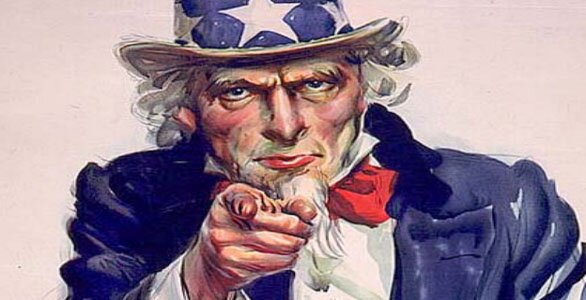
“It’s Uncle Sam who’s pushing us into this slaughter. And let’s be frank, many politicians in Ukraine are just following his orders.”
– Belarusian President Alexander Lukashenko
The Minsk Ceasefire Protocol has very little chance of succeeding. In fact, the meeting between the warring parties was not convened to stop the violence as much as it was to buy time for the Armed Forces of Ukraine (AFU) to retreat and regroup. In the last two weeks, the junta’s army has suffered “catastrophic” losses leaving President Petro Poroshenko with the choice of either calling for a truce or facing the unpleasant prospect of complete annihilation. Poroshenko wisely chose to withdraw under cover of the ceasefire agreement. But let’s not kid ourselves, Poroshenko only accepted that humiliation because he had no other choice. Once he gathers his forces and rearms, he’ll be back with a vengeance.
A recent survey found that 57 percent of the Ukrainian people oppose Poroshenko’s so-called “antiterror operation”. Even so, the fratricidal campaign will continue for the foreseeable future because it’s all part of Washington’s grand plan for the region. What the Obama administration is trying to do, is draw Russia into a costly and protracted conflagration in Ukraine to prove to its European allies that Russian President Vladimir Putin is a dangerous aggressor and a serious threat to global security. The US needs this justification to move ahead with its plan of establishing NATO forward-bases on Russia’s western border where they’ll pose an existential threat to Moscow’s survival. The puppet Poroshenko’s role in this bloody farce is to exacerbate the humanitarian catastrophe, crush the resistance, and try to provoke Putin into sending in the tanks. So far, the bumbling “Chocolate King” has only made matters worse by destroying his army and sabotaging US plans for NATO intervention. Obama’s frustration was apparent in the speech he gave at the NATO summit in Wales last weekend. Here’s a clip:
“Russia must stop its violations of Ukraine’s sovereignty and territorial integrity.” Russia’s “brazen assault” on Ukraine “challenges the most basic of principles of our international system – that borders cannot be redrawn at the barrel of a gun; that nations have the right to determine their own future. It undermines an international order where the rights of peoples and nations are upheld and can’t simply be taken away by brute force.”
Obama’s fulminations were meant to torpedo the ceasefire by poisoning the atmosphere and inflaming passions. Even while the negotiations were underway, the US and NATO were busy rattling sabers trying to derail the process. The summit in Wales was not so much a conference on regional defense as it was a platform for slinging mud at Russia and denouncing its “evil dictator” Putin. Like we said, Obama and Co. are getting frustrated by the fact that Putin has out maneuvered them at every turn. Here’s a clip from the New York Times with some details about the truce:
“The cease-fire agreement called for amnesty for all those who disarm and who did not commit serious crimes; the release of all hostages; the disbanding of militias; and the establishment of a 10-kilometer buffer zone (about six miles) along the Russian-Ukrainian border, with compliance overseen by international monitors.
It also points the way to a possible political solution to the conflict. Mr. Putin, insistent that Ukraine be tied to Russia instead of the West, has pressed for regional autonomy for the southeastern regions, while the Ukrainian government has so far been open only to the idea of decentralization.” (“A Cease-Fire in Ukraine”, New York Times).
Naturally, one would expect NATO and the US to tone down the rhetoric and postpone further escalation in order to show their support for the fragile ceasefire. But that hasn’t happened.
On Sunday, two NATO warships entered the Black Sea through the Bosporus joining French and US destroyers already located in the area. According to Itar Tass:
“The NATO ships’ crews will conduct the Sea Breeze exercises from September 8 to September 10. It is expected that along with the four abovementioned ships the drills will involve Turkey’s frigate Oruc Reis, Romania’s frigate Regele Ferdinand and Georgia’s patrol boat Sukhumi,” the source added.” (“Two NATO warships enter Black Sea – source“, Itar Tass)
The Sea Breeze exercises will be conducted at the same time as NATO military drills in Latvia that will involve more than “2,000 soldiers from nine different countries…(and which) ” simulate the deployment of NATO soldiers and equipment during a crisis situation.”
“We want to send a clear message to everyone who wants to threaten NATO, that it’s not a thing you should do,” General Hans-Lothar Domrose, commander of the NATO military command in Brunssum, Netherlands, told reporters.” (“NATO stages massive military drills in Latvia.”)
The drills have nothing to do protecting civilians from foreign aggression. They’re a blatant attempt to intimidate Putin and show that the western alliance is willing to risk a Third World War to achieve its objectives in Ukraine. The same could be said about NATO’s new Rapid Reaction Force, which is a 4,000-man combat group that will be deployable to any place in Europe within 48 hours. The new “Spearhead” force creates the dangerous precedent of a NATO standing army which will be used by the same reckless organization that assisted in the destruction of Serbia, Afghanistan and Libya. NATO’s interventions have been nearly as disastrous as those of the United States.
Aside from the additional troop deployments, warships to the Black Sea, and Rapid Reaction Force; we should not forget that the US Air Force deployed two B-2 stealth bombers to be stationed in east Europe earlier in the year. The B-2′s, which are capable of delivering nuclear weapons to their targets, are a clear message to Moscow that Washington will take whatever steps it deems necessary to defend its interests in Eurasia.
Also, Poroshenko announced on Friday that he reached an agreement with a number of western governments on the delivery of lethal weapons. (Officials from the US have since denied that they will send arms to Kiev.)
In any event, the pattern is clear: Escalate, escalate, escalate. The United States is determined to establish a NATO beachhead in Ukraine consistent with its plan to pivot to Asia. The alarming buildup of military assets in the Balkans and the Black Sea, as well as the steady drumbeat of anti-Russia propaganda in the media, suggests that Washington is embarking on a major operation that could explode into a full-blown war.
Europeans Oppose Arming Ukraine
Despite the nonstop demonization of Russia in the media, there’s no indication that the European people support the current policy in Ukraine. Check this out:
“The Journal du dimanche reported yesterday that the German Marshall Fund think-tank is preparing to release a poll showing that 81 percent of Frenchmen and 85 percent of Germans oppose arming the Ukrainian regime. The same poll found that in every European country except Poland, a majority of the population opposes the entry of Ukraine into either NATO or the European Union.”…..(“Fighting flares in eastern Ukraine despite ceasefire”, Johannes Stern and Alex Lantier, WSWS)
Finally, after 13 years of continuous warfare, the people have lost their appetite for US-NATO adventurism. Maybe there’s reason for hope, after all.
SANCTIONS: No Proof Needed
On Monday, the EU stepped up its economic war on Moscow by announcing a forth round of sanctions that could go into effect as early as Thursday. (The sanctions have been temporarily delayed so EU members can judge the effectiveness of the ceasefire.) The new measures will be the most painful to date and are aimed primarily at “three major state-run oil companies – Rosneft, Transneft and Gazprom Neft, as well as several companies of the military industrial sector.” The objective is to inflict maximum damage on the Russian economy by cutting off access to the capital markets, pushing the economy into recession, and triggering political instability. (The ultimate goal is regime change.) Not surprisingly, there won’t be any sanctions on the gas sector, particularly, Gazprom, which is Europe’s biggest gas supplier. EU leaders have shown repeatedly that they are only too willing to stand on principal as long as their own interests aren’t effected.
It’s worth noting that the new sanctions will be imposed without any evidence of wrongdoing and without any legal process for Russia to defend itself. The US and EU cannot be bothered with anything as trivial as due process or the presumption of innocence, which are the cornerstones upon which English Law rests dating back 500 years. Simply put: Russia is guilty because, well, because we say so.
There’s only the slimmest chance that the ceasefire in Ukraine will last, mainly because Washington needs a war to achieve its broader strategic objectives. What Obama and his lieutenants really want is “to break up Russia, subjugate its economic space, and establish control over the resources of the giant Eurasian continent. They believe that this is the only way they can maintain their hegemony and beat China.” (Quote: Sergei Glaziev, Putin’s economic advisor) That means, there won’t be peace in Ukraine until Washington’s puppets in Kiev are removed and Ukrainian sovereignty is restored.
Mike Whitney is a regular columnist for Veracity Voice
Mike Whitney lives in Washington state. He can be reached at:
Russian Sanctions Backfire
July 26, 2014 by Administrator · Leave a Comment

The belief that calling for and instituting sanctions against Russia is a sound policy, illustrates the economic disconnect of the Obama administration. With the fervor for starting a new cold war, the propaganda machine is working overtime to paint a picture that ignores real economic synergism. Note the conflicting reports regarding the EU. Nine EU countries ready to block economic sanctions against Russia, quotes a diplomatic source to ITAR-TASS:
“France, Germany, Luxembourg, Austria, Bulgaria, Greece, Cyprus, Slovenia, and EU President Italy see no reason in the current environment for the introduction of sectorial trade and economic sanctions against Russia and at the summit, will block the measure.”
“According to the source, the US sees slapping Russia with sanctions as a way to promote its own trade agenda with Europe, a side rarely explored in mainstream media. The Transatlantic Trade and Investment Partnership (TTIP) between the US and Europe would create the world’s largest free trade zone, but some worry it could balloon into an “economic NATO” or could end up putting corporation interest above national.”
An article, reports that the European Council has agreed to extend the restrictive measures for the entities in the Russian Federation. Romanian president Traian Basescu believes the EU needs to adopt tougher sanctions against Russia.
“My point of view was that unless the European Union takes tougher actions and moves on to the third stage of these sanctions, Ukraine might no longer be ready to move towards the European Union and would end up in a situation like that in the Republic of Moldova, currently facing the breakaway tendencies of the region of Transdniester, only with a greater impact for the EU, because Ukraine is a bigger country.”
This contradiction between individual national economic interests and the quest for a technocrat administered system of trade that fosters and facilitates an internationalist foreign policy under NATO and EU rule, is the actual objective of Washington and Brussels interventionism. This arrogance and self-delusion treats economic commerce as conducted in a vacuum. As The Hill article cites Putin. “Sanctions are “driving into a corner” relations between the two countries and will damage the interests of U.S. companies and “the long-term national interests of the U.S. government and people.”
Russian warns that the US campaign will have consequences as the Alliance News writes, that Moscow Blasts US Sanctions As “Primitive,” Promises Retaliation.
“Sergei Ryabkov, a deputy Foreign Minister, told the Interfax news agency that Moscow will hit back with measures that “will be felt in Washington painfully and sharply.”
The Russian Foreign Ministry said US measures against a number of state corporations are “a primitive attempt at revenge because events in Ukraine are not developing according to Washington’s scenario,” and added that it reserves the right to retaliate.”
The preposterous strategy that international finance can force a country like Russia, with the world’s largest energy resources, into a capitulation dependent status is absurd. The minimal effect according to Russia’s Finance Ministry, Says Harsher Sanctions Would Cost Russia 0.3% of GDP, does not sound like much of a threat. Then consider the counter response of Russian Sanctions Retaliation Escalates: Dumps Intel/AMD And Now Foreign Cars.
 The cavalier and condescending manner by which the Western central banks assist the New World Order’s goal of global dominance has fortified opposition with the emergence of theBRICS Development Bank. Use your common sense, when Putin Wants Measures to Protect BRICS Nations From U.S. Sanctions, much of the rest of the world is listening.
“In an interview published as a two-day BRICS summit got under way in Brazil on Tuesday, Putin said he would urge Brazil, China, India and South Africa to draw “substantive conclusions” from sanctions imposed on Russia over its actions in the Ukraine crisis, and said it was time to dilute the dominance of the U.S.-led West and the U.S. dollar by boosting the role of the BRICS on the global stage.”
The American press and media, especially is fueling the fires to demonize Putin’s Russia as a resurrected Stalinist Soviet belligerent. Absent in this narrative is an honest chronicle of NATO’s expansion to encircle the Russian Federation. At what point will Western journalists and academic scholars admit that the convergence of EU authoritarianism and American hegemony propagates an internationalist foreign policy, designed to isolate and destroy any opposition to this New World Order.
The lesson of these failed attempts for economic bullying a country, with real weapons of mass destruction, has the potential of starting a hot war. The essay, IMF and EU Capture of Ukraine, explains the circumstances and false justification of initiating “regime change“. This Ukraine flashpoint may well commence a tangible economic union among countries, who recognize that American sanctions are nothing more than a desperate attempt to prop up a decaying globalist economic structure.
EU antagonism towards the citizens of their member countries is growing expediently. Within this context, US sanctions hurt Europe more than America.
“The Association of European Businesses (AEB), a Moscow-based business lobby, said that new US sanctions against Russia have a more severe effect on European than on American business.
The AEB says it “regrets” the US sanctions, and warns that they will stunt economic growth “not only in Russia“.
“These sanctions are more focused on the partners of European businesses than on the partners of American companies,” the group said in a statement on Thursday.”
Obama’s State Department bears a heavy responsibility for promoting a civil war in Ukraine. Using sanctions to push Russia into accelerating a BRICS economic block will have far more adverse effects than can be envisioned by the lunatic proponents of “selective” Free Trade. The moneychanger’s financial system is imploding and their rescue plan requires a massive global crisis to bail out their “To Big to Fail” model. Mutually productive commerce will be among the first causalities of the prelude to World War III. Soon clamors for sanctions against American companies will begin, as the blame game diverts the real cause of this fabricated debacle.
Sartre is the publisher, editor, and writer for Breaking All The Rules. He can be reached at:
Sartre is a regular columnist for Veracity Voice
A Russophobic, Failed State Ruled By Fascists Obama’s New Ukraine
May 3, 2014 by Administrator · 30 Comments

“While Russia has been making efforts to de-escalate and resolve the crisis, the Kiev regime has chosen to launch airstrikes on peaceful residential areas, literally destroying the last hope for preserving the Geneva accords.” Dmitry Peskov, Putin’s spokesman
“The crisis in Ukraine is not the result of ‘Russian aggression,’ but of a criminal strategy by the US and its European allies to install a hostile regime on Russia’s borders in Ukraine and, ultimately, dismember Russia itself.” Johannes Stern, NATO boosts military build-up against Russia as protests spread in east Ukraine, WSWS
Fighting broke out on Friday in the eastern Ukrainian city of Slavyansk when Kiev’s coup government deployed military helicopters to fire on the city while troops and armored vehicles stormed checkpoints. At the time this article went to press, two helicopters had been shot down killing at least two pilots while one was captured. In an impassioned statement on Russian TV, Kremlin spokesman, Dmitry Peskov, appealed to allies in the EU to do whatever they could to persuade Ukrainian authorities to call off the operation and stop the violence.
“We are calling on the European capitals, the United States of America to give an assessment of the current events and are of course calling on those carrying out airstrikes on residential areas to…immediately end the punitive operation and any violence against its own people…”
So far, there has been no response from Washington although it’s clear that the Obama administration had a hand in organizing the crackdown. Not only were the State Department and CIA directly involved in the putsch that removed democratically-elected president Viktor Yanukovych from office, but Washington has also been implicated in punitive operations directed against ethnic Russian protestors in east Ukraine. Both CIA Director John Brennan and Vice President Joe Biden visited Kiev just hours before two previous crackdowns were ordered by imposter-Prime Minister Arseniy Yatsenyuk. As Foreign Minister Sergei Lavrov blandly noted, It’s clear that Washington is “calling the shots”.
On Thursday, it looked like violence might be avoided when coup-President Oleksandr Turchynov said that he had lost control of the situation. In an exasperated message to the media, Turchnov said, “It is hard to accept but it’s the truth, but the majority of law enforcers in the east are incapable of performing their duties.”
Turchynov was referring to the fact that Ukrainian troops have refused to attack their own countrymen. The mutiny has reportedly spread from elite airborne units to local police who sympathize with the protestors. The only group that’s willing to carry out Washington’s proxy war is the Right Sector neo-Nazis who helped topple the Yanukovych government. Just last week, members of this openly fascist party, commemorated “the perpetrators of the massacre of Yanova Dolina,” where “600 Poles were murdered by the Ukrainian Insurgent Army (UPA) in what is now Bazaltovoye. The massacre marked the beginning of ethnic cleansing in what is now western Ukraine, where tens of thousands of Poles were killed within a few months.” (World Socialist Web Site)
These are Obama’s new allies in America’s war against Russia. Now check this out from Reuters:
“The International Monetary Fund warned that if Ukraine lost territory in the east it would have to redesign a $17 billion bailout of the country, probably requiring additional financing.” (Ukraine attacks rebel city, helicopter shot down, Reuters)
Tell me, dear reader, when was the last time you heard of the IMF threatening to withhold funds if a political leader didn’t wage war on his own people? Anyone with half a brain can see that the IMF is just acting on orders from the White House. This is Obama’s war. His fingerprints are all over the policy. Obama is determined to draw Russia into a bloody guerilla war that leaves Ukraine in the same condition as Iraq, Afghanistan, Libya, and now Syria.
Here’s a clip from the New York Times:
“Through stealth and misdirection, and in defiance of Western sanctions, Russia has managed to achieve its immediate goal of what Western and Ukrainian officials believe is rendering Ukraine so chaotic that it cannot guarantee order, mend its teetering economy or elect new leaders to replace Mr. Turchynov.” (Not Getting Through to Mr. Putin, New York Times)
Putin wants a “chaotic” failed state on Russia’s border? Have you ever read such nonsense in your life?
Putin didn’t topple the Ukrainian government. The US State Department did. (Victoria Nuland’s hacked phone calls prove it.) And Putin didn’t violate the Geneva agreement less than 24 hours after the deal was signed by launching a crackdown on civilian protestors in the east. That was US-puppet Yatsenyuk. Nor did Putin deploy the military to surround cities, cut off their water supplies and deploy helicopter gunships to fire missiles at civilian infrastructure and terrorize the local population. That was the work of Obama’s fascist junta in Kiev. Putin had nothing to do with any of the trouble in Ukraine. It’s all part of the US “pivot to Asia” strategy to encircle and (eventually) dismember Russia in order to seize vital resources and control the flow of energy to China. Washington wants to reduce Ukraine to Mad Max-type pandemonium to justify establishing NATO bases on Russia’s perimeter. It’s all part of the plan to control Central Asia and rule the world.
Putin has acted as peacemaker throughout the crisis, but Obama is determined to provoke the Russian president by attacking and killing ethnic Russians. Consider the statement by Russia’s Foreign Ministry following the helicopter incident on Friday morning:
“As we have warned many times before, the use of the army against its own people is a crime and is leading Ukraine to catastrophe…By supporting the organizers of the Kiev coup in their strategy of violently putting down protests, the US and EU are taking on a huge responsibility, essentially closing the door to a peaceful solution to the crisis.” (Putin says Geneva agreement no longer viable after Ukrainian military action, Guardian)
It’s clear now that Obama merely used the Geneva agreement to buy time to move troops and military hardware to Poland and the Balkans. It’s also clear that Obama invited German Chancellor Angela Merkel to Washington so that it would appear that Europe is united behind the US in its proxy war on Russia. But what does Obama hope to achieve by stirring up this hornet’s nest? He knows that Putin cannot afford to back down on Crimea, so what’s the point? And, more importantly, what is Ukraine going to look like when Washington is finished using it as a staging-ground for its geopolitical landgrab? Here’s an insightful piece by Russian academic, Andrei Fursov, who thinks he knows what Obama wants and explains the impact the policy is going to have on Ukraine for years to come.
“The Americans need controlled chaos and civil war…Moreover, it is clear that this country (post-coup Ukraine) is intended to be absolutely anti-Russian, nationalist, Banderite and neo-Nazi. So the dual goal of establishing this anti-Russian state is to constantly apply pressure on the Russian Federation…
As Bismarck (said) ‘We must cultivate among the Ukrainians, a people whose consciousness is altered to such an extent, that they begin to hate everything Russian.’ …
Thus we are talking about a historical psy-op, an information-psychological sabotage, whose purpose is to establish Russophobic Slavs… They are the means to separate Ukraine from Russia and to oppose Russia as a kind … totalitarian empire. This was all devised under the Galician Project, on which the intelligence services of Austro-Germany and Kaiser German worked, followed by the intelligence service of the Third Reich, later – CIA and BND…
Banderastan, if that’s what Ukraine is fated to become, as designed by the puppet-masters across the ocean, is to be an oligarchic, terroristic, Russophobic state…An oligarchic Banderite…oligarchy is the ideal vehicle for external control. Clearly, this will suit both the oligarchs and the West.” (Battleground Ukraine: A Comprehensive Summary, Zero Hedge)
So, there it is: Divide and rule. We saw the Bush administration pull it off with the Shia and Sunnis in Iraq, and now Obama wants to do the same with the Ukrainians and Russians. Same strategy, different continent.
This is Obama’s plan for the “New Ukraine” a fascist-ruled failed state that follows Washington’s directives and puts pressure on Russia thorough endless provocations, belligerence, and war. Ukraine will be Washington’s pit bull in the East, separating Moscow from crucial sources of revenue and thwarting efforts at greater EU-Russia economic integration. This is how Washington hopes to insert itself into Eurasia, to improve its prospects in the Great Game, and to establish global hegemony into the next century.
(Note: “Banderite” refers to Stepan Bandera, who was a Ukrainian nationalist leader who collaborated with the Nazis. Bandera headed the Organization of Ukrainian Nationalists (OUN) According to the World Socialist Web Site: “The Ukrainian Insurgent Army (UPA) carried out numerous massacres of the Polish population in western Ukraine…The UPA served as a military executive organ of the OUN. It was founded in the spring of 1943 and recruited primarily from Nazi collaborators who were previously active in the SS.”)
Mike Whitney is a regular columnist for Veracity Voice
Mike Whitney lives in Washington state. He can be reached at:
History Arrives Late – Asymmetric War & The New Geopolitics
January 25, 2014 by Administrator · Leave a Comment

New and Old…
Even the definition of “asymmetric war” is controversial, because it can concern at least three drivers and methods of conflict, usually between large organized fighting forces and the opposite. Firstly there is the political-economic or other motivation, second the tactics, and thirdly the weapons utilised in asymmetric war – which itself is usually defined by the negative. Some writers say the term was first used by Andrew J. Mack in a 1975 book titled “Why Big Nations Lose Small Wars”. Some military historians conversely say asymmetric war dates from Antiquity, and included the surprise outcome of larger fighting forces losing an asymmetric war with smaller insurgent, militia, terrorist or tight knit politically motivated forces and entities in specific theaters of conflict.
Other than wars of Antiquity like the Ancient Greek Pelopennesian war series which lasted about 30 years in the 5th century BC, and certainly included asymmetric war and “surprise defeats” for larger forces, the 200-year Crusader war series (about 1095-1299) had recurring battles and campaigns where asymmetric war featured, and sometimes dominated. Our problem is that certainly for a near-century from the late 19th century to about 1980-2000, the Clausewitz doctrine of “God is with the big battalions” held firm. This in turn can be traced to the nature as well as the goals of war following the Industrial Revolution. Drivers of change included European nationbuilding, colonialism, mass migration and by 1948 the later “bipolar world” of the so-called Soviet Empire opposing the Western liberal-capitalist democracies. The collapse of the USSR was naively believed to mean “the end of history and of warfare itself”.
Although not defined as an asymmetric war campaign leading to total victory, by historians like Andrew Mack, the Long March of Mao Zedong culminating in total victory in 1949 was for most of its time called “terror war” by external major powers, including the US, Japan, the UK and other European nations. This only underlines the fact that asymmetric war for losers is often called terrorism, but also underlines the wider tactics and strategy, and weapons used by smaller insurgent forces during an asymmetric war campaign or series. It also underlines that like the asymmetric wars of the distant past, these are generally long series of wars, not setpiece short-term frontline battlefield warfare.
Strategy and Tactics
Strategy above all means command and control because decisive gains and losses need close combat at some stage for any type of war excluding setpiece formal warfare of the pre-Cold War type or paradigm. The Cold War “bipolar paradigm”, we should note, was not for nothing subtitled Mutually Assured Destruction because a charred, radioactive wasteland was the booty or logical peace dividend for any hypothetical “winner”. Also, the MAD paradigm more subtly underlined the role of economic and military infrastructures, which as they become more sophisticated, become more vulnerable. Often scenarized by US and Soviet military strategists during the Cold War, the utilization of a small number of missile-launched airburst nuclear weapons would instantly paralyse the enemy’s command and control infrastructure, electric power and telephone systems, water supplies, fuel supplies, road transport and so on. There could be no winner, only two losers.
Discussion of military infrastructure, and its fragility, however shifts the spotlight away from a key element of asymmetric war the role of ideology and personal commitment. Command and control operated by for example Mao Zedong in his Long March war campaign, was primarily ideological at its beginnings. Conversely in nearly all conventional setpiece wars, which are now likely a thing of the past, the belligerents deployed forces that were essentially of similar type. The war’s outcome could normally be predicted by the physical size, quantity and control of the forces in play. Where the forces are essentially equal, with access to the same technology, the outcome is usually stalemate. The Iran-Iraq war of 1980-88 was a classic example.
This already makes it possible to define probably the most decisive motivating role for asymmetric fighting forces technological superiority is canceled by infrastructure fragility. Alternately stated technological inferiority is often canceled by the enemy’s vulnerable military, ideological and economic infrastructures. The Afghan war of 1979-88 was a classic example.
Including vulnerable economic infrastructures, asymmetric wars such as this Afghan war (and the US-Afghan war of 2001-2014) will heavily feature urban insurgency and the destruction of economic infrastructures, which either directly support the more-powerful enemy’s military capability or provide indirect aid to the enemy’s ideological action, attempting to maintain a semblance of “normal life”. Asymmetric wars, we can again note, are often very long and measured in decades, not years, and in part due to this can include a major element of attrition, both economic and ideological.
Terrain and Proxies
Certainly the case in asymmetric wars of Antiquity, small inferior forces fighting the opposite can “trump the enemy” using terrain which today includes and features urban areas. As I have noted in recent articles concerning Syrian war geopolitics, one basic reason why “Syria” is a non-nation or a geopolitical metastase of the Sykes-Picot era of Great Power diplomacy, is the extreme geological folding of the mountainous coastal strip with peaks higher than 2000 meters, where more than 90% of the population lives. This rough, hilly terrain has always favored small autonomous or semi-autonomous population groupings, all of them with a long tradition of conflict including “asymmetric” combat. Ideological differences are often extreme, for example the age-old conflict between traditional Alawites and the Assassin heretic sect of the Alawites.
During the long Crusader war series, for example, the Assassins turned their fighting skills against the invading European crusaders. After this 200-year war series, they returned to fighting any centralising power based in Damascus. The same applies to the Druzes, and to other “mountain fighters”. On numerous occasions, often for decades, fighting groups in what is called “Syria” served as proxies in and for highly complex military campaigns. One examples was the period through about 1204-1260 when a loose alliance of southern powers or “statelets” opposed the larger, better armed Latin Empire of the Byzantines.
No power, either great or small can change geology and geomorphology. To be sure, Stalin-era Soviet campaigns against Chechens, Daghestanis and other small, ideologically tight-knit “mountain fighters”, and the campaign waged in this geopolitical rimland or shatterbelt since the 1990s by Russia, have attempted their eradication. In Afghanistan, as the USSR and later the US found out, so-called mountain fighters can easily urbanize and rapidly shift to urban theater conflict, broadening their warfare tactics with ease.
The major and increasing role of proxy fighting itself favors a shift to asymmetric war. Since the end of World War II, some military historians claim the majority of wars on a numerical basis fought since 1945 have either included, or been dominated by proxy fighters. This in turn means more belligerants, with usually different motivations, staying power, weapons and tactics, will be operating in any warfare. This also means that “surprise outcomes” become more commonplace, for example when proxies turn against their original partners or actively side with their former enemy or enemies.
Deed Horses and Stynking Beestes
Widely used in the Crusader war series, and imported back to Europe with returning Crusaders by the start of the 14th century, early biological warfare featured the catapulting of diseased putrefying corpses, often of horses or other animals, sometimes of humans into castle moats. By the time of the so-called Hundred Years War starting about 1340, biological war was commonplace in siege warfare. With the Black Death (bubonic plague) epidemic which spread from the western Balkans and killed an estimated 25%-33% of the total population of Europe in the late 14th and early 15th centuries, bodies of bubonic plague victims were utilised as weapons as commonly as munitions, arrows and other weapons in the majority of European wars. Death rates obtained using these “asymmetric weapons”, according to military historians could often exceed 950 killed for every 1000 enemy attacked.
Today we hear about the Syrian regime of Bashr al-Assad, and-or rebel forces, utilizing chemical weapons, but chemical weapons akin to napalm were utilized on a common basis in warfare opposing the Byzantime Empire and sometimes-insurgent, often small scale Muslim forces, by 670 AD. These early chemical weapons increasingly used additives including chalk powder, arsenic sulfide, copper oxides and other toxic suffocants to increase lethality.
By the early 18th century, the UK Royal Society was theater to recurring debates on how to protect land armies against biological warfare, in particular protection against smallpox bacteria due to smallpox being already known as a biological weapon. By about 1715, the technique of variolation, or immunization against smallpox was developed, firstly with a view to protecting British fighting forces despite early immunization by variolation causing an estimated 2%-3% mortality of treated soldiers. As we know, the conquest of the US Wild West in the 18th-19th centuries made frequent use of smallpox bacteria to kill Indian fighters and peoples who were not immunized. Historians contend that General George Washington who had warned his troops that English forces might use smallpox as a weapon in the Battle of Quebec (1775) which was lost by the Americans, was himself killed by smallpox poisoning in 1776.
It is therefore either by hypocrisy, ignorance or blindness that mainstream media and many politicians pretend that CBW (chemical and biological weapons) are both strange and repulsive. For numerically inferior forces, they can provide a decisive advantage similar to the historical role of crossbows, in the Middle Ages. Their utilization in asymmetric war has been more the rule, than exception. This logic certainly extends to the broad group of asymmetric arms called NBC (nuclear, biological, chemical) weapons – the arsenals held by the small nations North Korea and Israel reflect their political rulers’ fear of numerically superior enemy forces. As we know, both mass-produced pesticides and relatively abundant nuclear wastes, among others, are major potential asymmetric weapons.
The Coming Global Asymmetric War
Andrew J. Mack made the point that big nations can easily lose small wars. He did not add that due to weapons technology and MAD, they can only lose big wars. This standoff or new weakness – of the great powers whether they describe themselves as “great” or not, has certainly been observed and noted by the large number of their asymmetric war-oriented opponents and rivals.
When added to the impacts of economic and industrial technology change, described in other recent articles by myself, the concept of either one or a select few hegemonic powers dominating world political-strategic relations is consigned to trashcan of History. Probably since as early as 1980, certainly in the coming decades from today, this observation will be put to the test.
The Syrian civil war which is a showcase of asymmetric war and proxy war could be taken as an example. Neither Russia nor the US can win this war. Iran’s supposed interest in this war can be questioned. European influence in any outcome to this war is small and weak. Chinese, Indian and other Asian interest in this war is very low. Only extremely massive and sustained, therefore very expensive military occupation on a long-term basis could create or restore any simulacre or surrogate for “the nation state of Syria”. No major external power has any interest in this outcome. The staying power of KSA, Qatar, UAE and other sunni-minority small states paying for Syrian theatre proxy fighters, called “djihadis”, despite the petrodollars and the Wahabism, can easily be questioned.
What was called “Syria” therefore become a shatterbelt zone in modern geopolitical parlance, very comparable with the pre-1914 Balkan states, and pre-1917 Middle Eastern and North African states. Formerly called “rimland states”, shatterbelt zones can also be called the Funeral Pyres of Empire due to these intrinsically volatile and ungovernable zones often being gateways to larger zones of major economic significance, drawing repeated attempts at dominance by the great powers.
Multiple examples exist outside the zone including southern Russia, the Balkans (of 2014), western Asia, and the MENA. Under certain hypotheses, zones like the Europe of the EU28, engaged in an undeclared power struggle with Russia to win power over the Ukraine, may be an example.
More important for this article, most definitely intensified by asymmetric war ideology, tactics and weapons, world shatterbelt zones of “permanent instability” are growing and they are necessarily growing. Sometimes called “multipolarity” and presented as the positive spinoff from economic globalisation, and above all presented as consensual by the great powers (and would-be great powers), the loss of centre and the growth of periphery is a stark fact of the coming world.
This stark fact is of course denied by the so-called great powers. However, when there is no longer a ruling centre and the central power or Hegemon, there is only periphery and no Hegemon in a series of complex rimlands and shatterbelts.
Source: Andrew McKillop
Paid Hypocrites
January 2, 2014 by Administrator · Leave a Comment

Most “NGOs” fomenting regime-changes and color-coded revolutions, promoting “pride marches” and similar “human rights issues,” are in reality Western (mostly U.S.) funded conspiracies pursuing the agenda of their paymasters. That much has been known for years, but in recent days we have witnessed a particularly egregious example of their politically-motivated duplicity.
On December 17 Egypt’s military-backed government filed additional criminal charges against former president Mohamed Morsi, accusing him of being a party to a major terrorist plot that involved killing demonstrators and leaking state secrets to Iran. The authorities described the case against Morsi and several of his close advisors as the biggest of its kind in Egyptian history. Prosecutors additionally accused the former Muslim Brotherhood leader of having made illegal arrangements with the Hezbollah in Iran, with Hamas in Gaza, and with extremists whose goal is to establish an Islamic emirate in Sinai. The scheme allegedly involved smuggling arms into the country and arranging for Brotherhood activists to obtain military training from Hamas in Gaza, Hezbollah in Lebanon and the Revolutionary Guards in Iran.
Human rights groups were quick to condemn the charges, calling them preposterous “because of their vast scale and complexity,” The New York Times reported a day later. “They are pretty fantastical, to say the least,” the NYT duly quoted one Sarah Leah Whitson, the North African Programs Director for Human Rights Watch, as saying of the accusations. “Through both legal processes and their control of the media, the government has been trying to generate this notion that the Muslim Brotherhood is a terrorist organization carrying out violent acts, with the absence of any evidence, and these charges really underscore the extent to which the government is focused on exterminating the Muslim Brotherhood as a political opposition. It is an all-out campaign to destroy it.” Two weeks earlier, the same HRW official complained that the military in Egypt was illegally holding members of Morsi’s government in secret locations.
By contrast, the arrest, trial, and sentencing of hundreds of Turkish military officers on dozens of far more preposterous charges in recent years has passed almost unnoticed in the Western media, and was barely commented upon by the “human rights community.” They were accused of involvement in the Ergenekon and Sledgehammer plots, dating back to 2003-4. The result was the largest show trial ever in the non-Communist world. The charges, too, were worthy of Moscow 1937.
The Sledgehammer plot, the government alleged, was a military conspiracy which should have included bombings of historic mosques in Istanbul, an attack on a museum, and the provocation of military tensions with neighboring Greece, including air attacks on Greek islands by Turkish planes. Such acts of terrorism and outright military aggression were supposedly designed to plunge Turkey into utter chaos and provide an opportunity for the military to step in and remove the Islamist AKP government from power.
The Sledgehammer was connected to the earlier Ergenekon conspiracy, supposedly the Mother of All Plots, the mega-conspiracy in which the “Deep State”—a shadowy coalition of senior military officers, the intelligence services, the judiciary, and organized crime—allegedly planned terrorist attacks to foment unrest, also leading to a military takeover. Arch-secular nationalists, the prosecutors said, had been in bed with the Maoist PKK, the extreme-left Revolutionary People’s Liberation Party, the Islamist Hizbullah and Milli Görüþ, the ultranationalist Turkish Revenge Brigades, the Turkish Workers’ and Peasants’ Liberation Army, and the Marxist-Leninist Communist Party of Turkey.
Prime Minister Erdogan and other AKP leaders provided political support for the prosecutions. There were countless inconsistencies in the accusations, however. Dozens of entities—hospitals, NGOs, companies, and even military units—were referred to by names or acronyms which they acquired many years after the dates cited, in some cases as late as August 2009. The Ergenekon and Sledgehammer cases were no “cases” at all, but a brazen attempt by the AKP regime to neutralize Turkey’s once-powerful military once and for all. The government’s specific objective was to discredit the officer corps, and thus facilitate the abolition of the Army’s traditional role as the guardian of the country’s secular political system.
In 2012, after what amounted to a show trial, over 300 of the 365 “Sledgehammer” suspects were sentenced to prison terms, and 34 suspects were acquitted. (The case is being appealed.) On 5 August 2013, final verdicts were announced in the Ergenekon case. A dozen “consecutive” or “aggravated” life sentences were passed, as well as over two hundred lengthy prison sentences. Only 21 of the 275 defendants were acquitted. All told, 640 were charged, 55 acquitted—impressive even by Soviet standards.
In view of its concern for Morsi and his cohorts, the reaction from Human Rights Watch to the spectacle in Turkey could not have been more different. In 2009, with the trial just starting, it announced that the Ergenekon case “gives Turkey a chance to make clear that it will hold security forces accountable for abuse, but that can only happen if the investigation follows the evidence wherever—and to whomever—it leads.” It did not comment on the course of the trial or the sentences. Remarkably, it did not comment on the “Sledgehammer Case” charges, trial, or sentences at all.
As for The New York Times, last August 6 it commented that “the Ergenekon trial played an important role in efforts to lay to rest a history of military meddling in democratic politics. Much of Turkey’s modern history has been dominated by a secularist military-bureaucratic alliance that regularly derailed the democratic process when confronted with governments or political movements that threatened its political control.” “Some saw the trial as no more than a witch hunt by the governing A.K.P. against its political opponents,” it noted curtly, and added, in sorrow more than anger, that an opportunity was missed “to prove those critics wrong by ensuring a scrupulous commitment to fairness throughout the process.”
As it happens, the Open Society Foundation—belonging to that noted philanthropist George Soros—is the primary donor of the Human Rights Watch, contributing $100 million of $128 million of contributions and grants received by the HRW in the 2011 financial year. And The New York Times is the flagship of America’s journalism.
Srdja (Serge) Trifkovic, author, historian, foreign affairs analyst, and foreign affairs editor of “Chronicles.” He has a BA (Hon) in international relations from the University of Sussex (UK), a BA in political science from the University of Zagreb (Croatia), and a PhD in history from the University of Southampton (UK).
Dr. Srdja Trifkovic is a regular columnist for Veracity Voice
Armistice Day, 95 Years Later
November 13, 2013 by Administrator · Leave a Comment

After four years and three months of unprecedented carnage, the Great War ended 95 years ago on November, 11th 1918. The most tragic event in the history of mankind, that war destroyed a vibrant, magnificently creative civilization. A fundamentally decent and well-ordered world was shattered forever. The floodgates of hell in which we live now were opened.
It was truly the first global war—la Grande Guerre, der grosse Krieg. Tens of millions of men were mobilized. In France and Germany four fifths of all men between 18 and 50 donned the uniform. The entire human, physical and moral resources of Europe’s major powers and a host of smaller nations were strained like never before in history. The weapons were deployed on a massive scale, killing machines that only a generation earlier did not exist: airplanes, tanks, poison gasses, submarines. The lethal mix of the machine gun and barbed wire made “going over the top” tantamount to a death sentence.
The war claimed close to 20 million lives, soldiers and civilians in roughly equal proportion. Millions of young men were maimed and damaged forever. Epidemics during and immediately after the war claimed millions more. Even more horrendous are that war’s moral and spiritual consequences. Bolshevism, Fascism, Nazism, the sequel known as the Second World War, and the wounded civilization we now live in, are its poisoned fruits.
How it actually happened, or, as Ranke would put it, wie es eigentlich gewesen?
As we near the centennial of its outbreak, it is not uncommon for educated non-historians who think about such matters to assume that the war in 1914 was the result of a series of blunders and miscalculations in various Great Power courts, foreign offices, and chancelleries. The key interwar American text on the subject, Sidney B. Fay’s Origins of the World War, suggested that nobody wanted the war but—like in a Greek drama—forces beyond the actors’ control and understanding drove everyone into the maelstrom. Implicit in this narrative was the view that the European system was so inherently unstable that a single terrorist act by a troubled Serb adolescent in a troubled Balkan city could fatally disrupt it.
That view was wrong. As one of the most prominent German historians of the 20th century, Fritz Fischer, demonstrated in his masterly Griff nach der Weltmacht (Germany’s Bid for Global Dominance), the Kaiserreich military and political elite welcomed the prospect of war resulting from the attentat in Sarajevo as an opportunity to make Germany the hegemon of the Old Continent. Fischer established beyond reasonable doubt that Berlin manipulated the July crisis in 1914 to revise her 1871 borders and establish dominance in Europe, whereby France and Russia would be degraded to powerlessness and territorial insignificance.
To that end, after Sarajevo Germany encouraged Austria to pursue what Vienna believed would be a local war against Serbia in order to engineer a wider European conflagration which would eliminate France and Russia from the scene for decades. The record is clear: as (by then former) German chief of general staff Moltke confided to his friend Colmar von der Goltz as early as 1915, it was the war of Germany’s making, “this war that I prepared and initiated.” Had the murdered Archduke Francis Ferdinand—who did not want war—been alive, Austria’s Chief of Staff Konrad von Hetzendorf mused when the war started going badly for the Dual Monarchy, “he would have had me shot.”
Moltke and other Junkers were not acting alone. Having betrayed Bismarck’s legacy by tying Germany to the decaying Habsburg Monarchy and by conducting a reckless foreign policy in the early years of the 20th century, having alienated Britain by building an unnecessary and ultimately useless high seas fleet, the Wilhelmine establishment found itself in the encirclement of its own making. That establishment blundered to the point of prompting Britain and Russia to become de facto (albeit not as yet formal) allies in 1907—unthinkable in the days of the Iron Chancellor. At times Germany acted on the global stage like a bunch of McCains with manners: when Berlin got needlessly involved in Morocco in 1911, even Vienna withdrew support.
A “preventive” war against Russia and France, based on the Schlieffen Plan, was seen as a way out of Germany’s chronic diplomatic isolation and as a means of preempting Russia’s economic, demographic and military rise, which obsessed Chancellor Theobald von Bethmann-Hollweg, who complained that it was useless to plant oaks on his Brandenburg estate since some Cossacks would rest in their shade. To that end Germany encouraged Austria-Hungary to issue an impossible ultimatum to Serbia blaming her for Sarajevo—the famous blank check of July 5, 1914—with both Central Powers knowing full well that this would lead to an all-out war unless Russia climbed down at the last minute and thus abdicated her role as a great power. As David Fromkin concluded in his excellent Europe’s Last Summer, it takes two or more to keep the peace but only one to start the war: “The international conflict in the summer of 1914 consisted of two wars, not one. Both were started deliberately.” One was Austria’s war against Serbia, the other Germany’s war against France and Russia. Britain inevitably and predictably entered the fray when Germany violated Belgium’s neutrality—as postulated by the Schlieffen Plan—thus making the war global. It was frivolously assumed in Berlin that in any event the British could not field an army capable of affecting the outcome until it was too late.
It was not possible for German politicians and soldiers simply to declare the European system created by Bismarck null and void. They could not admit that they wanted to revise it by force in favor of an extended Mitteleuropa, dominated by Germany, with an emaciated France to the west and a humbled Russia—minus the Ukraine and the Baltic provinces—to the east. The Prussian elite needed a seemingly righteous cause, the latter-day Ems Telegram, to unite the nation and, in particular, to persuade its millions of Social Democrats and Roman Catholics that the coming war was just, and the Vaterland’s cause worth dying for. The scenario was simple, mendacious, and effective: encourage Austria to present Serbia with an outrageous ultimatum that had to be rejected; let Russia threaten Austria in Serbia’s defense; present Germany’s subsequent move against Russia as a gallant and selfless rescue of Germany’s aggrieved Danubian ally; and attack France first, on whatever grounds, in order to kick her out of the war before turning the might of the entire army against the slow-mobilizing Russians.
This was a reckless scenario full of incalculable risks. The British duly declared war when Liege was attacked and the Schlieffen Plan collapsed with the Miracle on the Marne. But in July 1914 both military planning and the political rationale behind it reflected Berlin’s establishment’s obsession with the notion of “encirclement.” Just as the political paradigm was unduly pessimistic, its military “solution” was based on an optimistic scenario that had many elements that could, and did, go wrong. Determined to break out of this self-imposed, intellectually wanting and largely imagined “encirclement,” the Second Reich discarded Bismarck’s flexibility of external liaisons in favor of an implacable hostility to France, a self-generated sense of existential danger from Russia, and—perhaps worst of all—an alliance with Austria-Hungary that was debilitating in its implications and disastrous in its consequences.
The Iron Chancellor would never have allowed the worn-out Viennese tail to wag the dynamic German dog, and in the 1880s and 90s he repeatedly warned that the Balkans must never be allowed to release its potential as Europe’s proverbial powder keg. His successors of 1914 disregarded that advice on both counts. In this they encountered no effective opposition, and even the seemingly middle-of-the-road Chancellor, Bethmann-Hollweg, joined the fray with an air of fatalistic determination, only once or twice interrupted by pangs of fearful lucidity.
By 1914 Germany’s ruling stratum’s understanding of the State reason was fatally corrupted by a host of ideological mantras which were Wilhelmine Germany’s equivalent of America’s global interventionists today: the naval lobby, the colonial lobby, the annexationist lobby, the Voelkisch lobby. Like the proponents of the war against Iran, they branded all moderation weakness and all doubt treason. Germany’s criminal blunder of 1914 was a sinister precursor of her crime of 1939. As per Fischer, these are the “ideologies, values, and ambitions that led our country to destruction in the space of two generations.”
In addition to being gripped by a self-fulfilling and gloomy Weltanschauung that demanded aggressively proactive policies, the Central Powers’ political elites were unable and unwilling to question the dictates of military planning. As Fischer’s old foe, conservative German historian Gerhard Ritter, readily admitted, a desperate gamble, va-banque Spiel, replaced policy making: in Vienna Conrad presented the Cabinet with a rosy and unrealistic assessment of Austria’s military capabilities that were soon demolished in a series of humiliating defeats in Serbia. In Berlin the German plan of campaign—which relied on a great Austrian offensive in the East which never happened—suffered from an over-estimation of German capability. Mobilization schedules and railway timetables took over. The lights went out all over Europe, never to be lit again.
Four awful years later President Wilson’s Fourteen Points—the device that was allegedly meant to end the war—espoused the principle of self-determination. It threw a revolutionary doctrine thrown at an already exhausted Europe, a doctrine almost on par with Bolshevism in its destabilizing effect. It unleashed competing aspirations among the smaller nations of Central Europe and the Balkans that not only hastened the collapse of transnational empires, but also gave rise to a host of intractable ethnic conflicts and territorial disputes that remain unresolved to this day. Wilson’s notions of an “enlarging democracy” and “collective security” signaled the birth of a view of America’s role in world affairs which has created—and is still creating—endless problems for both America and the world. It was Wilson, speaking through President George W. Bush a decade ago, who declared that America not only “created the conditions in which new democracies could flourish” but “also provided inspiration for oppressed peoples.”
Two decades after the Armistice, burdened by Clemenceau’s harsh revenge at Versailles, Europe staggered into a belated sequel in September 1939. After 1918 it was very badly wounded; after 1945, mortally so. The result is a civilization that is aborting and birth-controlling itself to death, a civilization that is morally bankrupt, culturally spent, and spiritually comatose. Ninety five years later we are living—if life it is—with the consequences, and on the ruins, of the Great War.
Srdja (Serge) Trifkovic, author, historian, foreign affairs analyst, and foreign affairs editor of “Chronicles.” He has a BA (Hon) in international relations from the University of Sussex (UK), a BA in political science from the University of Zagreb (Croatia), and a PhD in history from the University of Southampton (UK).
Dr. Srdja Trifkovic is a regular columnist for Veracity Voice
The Revolutionaries In Our Midst
November 13, 2013 by Administrator · Leave a Comment
New York – Jeremy Hammond sat in New York’s Metropolitan Correctional Center last week in a small room reserved for visits from attorneys. He was wearing an oversized prison jumpsuit. The brown hair of the lanky 6-footer fell over his ears, and he had a wispy beard. He spoke with the intensity and clarity one would expect from one of the nation’s most important political prisoners.
On Friday the 28-year-old activist will appear for sentencing in the Southern District Court of New York in Manhattan. After having made a plea agreement, he faces the possibility of a 10-year sentence for hacking into the Texas-based private security firm Strategic Forecasting Inc., or Stratfor, which does work for the Homeland Security Department, the Marine Corps, the Defense Intelligence Agency and numerous corporations including Dow Chemical and Raytheon.
Four others involved in the hacking have been convicted in Britain, and they were sentenced to less time combined—the longest sentence was 32 months—than the potential 120-month sentence that lies before Hammond.
Hammond turned the pilfered information over to the website WikiLeaks and and other publications. The 3 million email exchanges, once

Jeremy Hammond is shown in this March 5, 2012 booking photo from the Cook County Sheriff’s Department in Chicago
made public, exposed the private security firm’s infiltration, monitoring and surveillance of protesters and dissidents, especially in the Occupy movement, on behalf of corporations and the national security state. And, perhaps most important, the information provided chilling evidence that anti-terrorism laws are being routinely used by the federal government to criminalize nonviolent, democratic dissent and falsely link dissidents to international terrorist organizations. Hammond sought no financial gain. He got none.The email exchanges Hammond made public were entered as evidence in my lawsuitagainst President Barack Obama over Section 1021 of the National Defense Authorization Act (NDAA). Section 1021 permits the military to seize citizens who are deemed by the state to be terrorists, strip them of due process and hold them indefinitely in military facilities. Alexa O’Brien, a content strategist and journalist who co-founded US Day of Rage, an organization created to reform the election process, was one of my co-plaintiffs. Stratfor officials attempted, we know because of the Hammond leaks, to falsely link her and her organization to Islamic radicals and websites as well as to jihadist ideology, putting her at risk of detention under the new law. Judge Katherine B. Forrest ruled, in part because of the leak, that we plaintiffs had a credible fear, and she nullified the law, a decision that an appellate court overturned when the Obama administration appealed it.
Freedom of the press and legal protection for those who expose government abuses and lies have been obliterated by the corporate state. The resulting self-exile of investigative journalists such as Glenn Greenwald, Jacob Appelbaum and Laura Poitras, along with the indictment of Barret Brown, illustrate this. All acts of resistance—including nonviolent protest—have been conflated by the corporate state with terrorism. The mainstream, commercial press has been emasculated through the Obama administration’s repeated use of the Espionage Act to charge and sentence traditional whistle-blowers. Governmental officials with a conscience are too frightened to reach out to mainstream reporters, knowing that the authorities’ wholesale capturing and storing of electronic forms of communication make them easily identifiable.
Elected officials and the courts no longer impose restraint or practice oversight. The last line of defense lies with those such as Hammond, Julian Assange, Edward Snowden and Chelsea Manning who are capable of burrowing into the records of the security and surveillance state and have the courage to pass them on to the public. But the price of resistance is high.
“In these times of secrecy and abuse of power there is only one solution—transparency,” wrote Sarah Harrison, the British journalist who accompanied Snowden to Russia and who also has gone into exile, in Berlin. “If our governments are so compromised that they will not tell us the truth, then we must step forward to grasp it. Provided with the unequivocal proof of primary source documents people can fight back. If our governments will not give this information to us, then we must take it for ourselves.”
“When whistleblowers come forward we need to fight for them, so others will be encouraged,” she went on. “When they are gagged, we must be their voice. When they are hunted, we must be their shield. When they are locked away, we must free them. Giving us the truth is not a crime. This is our data, our information, our history. We must fight to own it. Courage is contagious.”
Hammond knows this contagion. He was living at home in Chicago in 2010 under a 7-a.m.-to-7-p.m. curfew for a variety of acts of civil disobedience when Chelsea (formerly Bradley) Manning was arrested for giving WikiLeaks secret information about military war crimes and government lies. Hammond at the time was running social aid programs to feed the hungry and send books to prisoners. He had, like Manning, displayed a remarkable aptitude for science, math and computer languages at a young age. He hacked into the computers at a local Apple store at 16. He hacked into the computer science department’s website at the University of Illinois-Chicago as a freshman, a prank that saw the university refuse to allow him to return for his sophomore year. He was an early backer of “cyber-liberation” and in 2004 started an “electronic-disobedience journal” he named Hack This Zine. He called on hackers in a speech at the 2004 DefCon convention in Las Vegas to use their skills to disrupt that year’s Republican National Convention. He was, by the time of his 2012 arrest, one of the shadowy stars of the hacktivist underground, dominated by groups such as Anonymous and WikiLeaks in which anonymity, stringent security and frequent changes of aliases alone ensured success and survival. Manning’s courage prompted Hammond to his own act of cyber civil disobedience, although he knew his chances of being caught were high.
“I saw what Chelsea Manning did,” Hammond said when we spoke last Wednesday, seated at a metal table. “Through her hacking she became a contender, a world changer. She took tremendous risks to show the ugly truth about war. I asked myself, if she could make that risk shouldn’t I make that risk? Wasn’t it wrong to sit comfortably by, working on the websites of Food Not Bombs, while I had the skills to do something similar? I too could make a difference. It was her courage that prompted me to act.”
Hammond—who has black-inked tattoos on each forearm, one the open-source movement’s symbol known as the “glider” and the other the shi hexagram from the I Ching—is steeped in radical thought. As a teenager, he swiftly migrated politically from the liberal wing of the Democratic Party to the militancy of the Black Bloc anarchists. He was an avid reader in high school of material put out by CrimethInc, an anarchist collective that publishes anarchist literature and manifestos. He has molded himself after old radicals such as Alexander Berkman and Emma Goldman and black revolutionaries such as George Jackson, Elaine Brown and Assata Shakur, as well as members of the Weather Underground. He said that while he was in Chicago he made numerous trips to Waldheim Cemetery to visit the Haymarket Martyrs Monument, which honors four anarchists who were hanged in 1887 and others who took part in the labor wars. On the 16-foot-high granite monument are the final words of one of the condemned men, August Spies. It reads: “The day will come when our silence will be more powerful than the voice you are throttling today.” Emma Goldman is buried nearby.
Hammond became well known to the government for a variety of acts of civil disobedience over the last decade. These ranged from painting anti-war graffiti on Chicago walls to protesting at the 2004 Republican National Convention in New York to hacking into the right-wing website Protest Warrior, for which he was sentenced to two years in the Federal Correctional Institute at Greenville, Ill.
He said he is fighting as “an anarchist communist” against “centralized state authority” and “exploitative corporations.” His goal is to build “leaderless collectives based on free association, consensus, mutual aid, self-sufficiency and harmony with the environment.” It is essential, he said, that all of us work to cut our personal ties with capitalism and engage in “mass organizing of protests, strikes and boycotts.” Hacking and leaking, he said, are part of this resistance—“effective tools to reveal ugly truths of the system.”
Hammond spent months within the Occupy movement in Chicago. He embraced its “leaderless, non-hierarchical structures such as general assemblies and consensus, and occupying public spaces.” But he was highly critical of what he said were the “vague politics” in Occupy that allowed it to include followers of the libertarian Ron Paul, some in the tea party, as well as “reformist liberals and Democrats.” Hammond said he was not interested in any movement that “only wanted a ‘nicer’ form of capitalism and favored legal reforms, not revolution.” He remains rooted in the ethos of the Black Bloc.
“Being incarcerated has really opened my eyes to the reality of the criminal justice system,” he said, “that it is not a criminal justice system about public safety or rehabilitation, but reaping profits through mass incarceration. There are two kinds of justice—one for the rich and the powerful who get away with the big crimes, then for everyone else, especially people of color and the impoverished. There is no such thing as a fair trial. In over 80 percent of the cases people are pressured to plea out instead of exercising their right to trial, under the threat of lengthier sentences. I believe no satisfactory reforms are possible. We need to close all prisons and release everybody unconditionally.”
He said he hoped his act of resistance would encourage others, just as Manning’s courage had inspired him. He said activists should “know and accept the worst possible repercussion” before carrying out an action and should be “aware of mass counterintelligence/surveillance operations targeting our movements.” An informant posing as a comrade, Hector Xavier Monsegur, known online as “Sabu,” turned Hammond and his co-defendants in to the FBI. Monsegur stored data retrieved by Hammond on an external server in New York. This tenuous New York connection allowed the government to try Hammond in New York for hacking from his home in Chicago into a private security firm based in Texas. New York is the center of the government’s probes into cyber-warfare; it is where federal authorities apparently wanted Hammond to be investigated and charged.
Hammond said he will continue to resist from within prison. A series of minor infractions, as well as testing positive with other prisoners on his tier for marijuana that had been smuggled into the facility, has resulted in his losing social visits for the next two years and spending “time in the box [solitary confinement].” He is allowed to see journalists, but my request to interview him took two months to be approved. He said prison involves “a lot of boredom.” He plays chess, teaches guitar and helps other prisoners study for their GED. When I saw him, he was working on the statement, a personal manifesto, that he will read in court this week.
He insisted he did not see himself as different from prisoners, especially poor prisoners of color, who are in for common crimes, especially drug-related crimes. He said most inmates are political prisoners, caged unjustly by a system of totalitarian capitalism that has snuffed out basic opportunities for democratic dissent and economic survival.
“The majority of people in prison did what they had to do to survive,” he said. “Most were poor. They got caught up in the war on drugs, which is how you make money if you are poor. The real reason they get locked in prison for so long is so corporations can continue to make big profits. It is not about justice. I do not draw distinctions between us.”
“Jail is essentially enduring harassment and dehumanizing conditions with frequent lockdowns and shakedowns,” he said. “You have to constantly fight for respect from the guards, sometimes getting yourself thrown in the box. However, I will not change the way I live because I am locked up. I will continue to be defiant, agitating and organizing whenever possible.”
He said resistance must be a way of life. He intends to return to community organizing when he is released, although he said he will work to stay out of prison. “The truth,” he said, “will always come out.” He cautioned activists to be hyper-vigilant and aware that “one mistake can be permanent.” But he added, “Don’t let paranoia or fear deter you from activism. Do the down thing!”
Chris Hedges, whose column is published Mondays on Truthdig, has previously spent nearly two decades as a foreign correspondent in Central America, the Middle East, Africa and the Balkans. He has reported from more than 50 countries and has worked for The Christian Science Monitor, National Public Radio, The Dallas Morning News and The New York Times, for which he was a foreign correspondent for 15 years.
Source: Truthdig
The US Uses Cancer As A Weapon
November 9, 2013 by Administrator · Leave a Comment
Radioactive Warfare in Iraq and the Balkans…
 At the close of the first Gulf War, Saddam Hussein was denounced as a ferocious villain for ordering his retreating troops to destroy Kuwaiti oil fields, clotting the air with poisonous clouds of black smoke and saturating the ground with swamps of crude. It was justly called an environmental war crime.
But months of bombing of Iraq by US and British planes and cruise missiles has left behind an even more deadly and insidious legacy: tons of shell casings, bullets and bomb fragments laced with depleted uranium. In all, the US hit Iraqi targets with more than 970 radioactive bombs and missiles.
It took less than a decade for the health consequences from this radioactive bombing campaign to begin to coming into focus. And they are dire, indeed. Iraqi physicians call it “the white death” — leukemia. Since 1990, the incident rate of leukemia in Iraq has grown by more than 600 percent. The situation is compounded by Iraq’s forced isolations and the sadistic sanctions regime, recently described by UN secretary general Kofi Annan as “a humanitarian crisis”, that makes detection and treatment of the cancers all the more difficult.
“We have proof of traces of DU in samples taken for analysis and that is really bad for those who assert that cancer cases have grown for other reasons,” said Dr. Umid Mubarak, Iraq’s health minister.
Mubarak contends that the US’s fear of facing the health and environmental consequences of its DU bombing campaign is partly behind its failure to follow through on its commitments under a deal allowing Iraq to sell some of its vast oil reserves in return for food and medical supplies.
“The desert dust carries death,” said Dr. Jawad Al-Ali, an oncologist and member England’s Royal Society of Physicians. “Our studies indicate that more than forty percent of the population around Basra will get cancer. We are living through another Hiroshima.”
Most of the leukemia and cancer victims aren’t soldiers. They are civilians. And many of them are children. The US-dominated Iraqi Sanctions Committee in New York has denied Iraq’s repeated requests for cancer treatment equipment and drugs, even painkillers such as morphine. As a result, the overflowing hospitals in towns such as Basra are left to treat the cancer-stricken with aspirin.
This is part of a larger horror inflicted on Iraq that sees as many as 180 children dying every day, according to mortality figures compiled by UNICEF, from a catalogue of diseases from the 19th century: cholera, dysentery, tuberculosis, e. coli, mumps, measles, influenza.
Iraqis and Kuwaitis aren’t the only ones showing signs of uranium contamination and sickness. Gulf War veterans, plagued by a variety of illnesses, have been found to have traces of uranium in their blood, feces, urine and semen.
Depleted uranium is a rather benign sounding name for uranium-238, the trace elements left behind when the fissionable material is extracted from uranium-235 for use in nuclear reactors and weapons. For decades, this waste was a radioactive nuisance, piling up at plutonium processing plants across the country. By the late 1980s there was nearly a billion tons of the material.
Then weapons designers at the Pentagon came up with a use for the tailings: they could be molded into bullets and bombs. The material was free and there was plenty at hand. Also uranium is a heavy metal, denser than lead. This makes it perfect for use in armor-penetrating weapons, designed to destroy tanks, armored-personnel carriers and bunkers.
When the tank-busting bombs explode, the depleted uranium oxidizes into microscopic fragments that float through the air like carcinogenic dust, carried on the desert windsfor decades. The lethal dust is inhaled, sticks to the fibers of the lungs, and eventually begins to wreck havoc on the body: tumors, hemorrhages, ravaged immune systems, leukemias.
In 1943, the doomsday men associated with the Manhattan Project speculated that uranium and other radioactive materials could be spread across wide swaths of land to contain opposing armies. Gen. Leslie Grove, head of the project, asserted that uranium weapons could be expected to cause “permanent lung damage.” In the late, 1950s Al Gore’s father, the senator from Tennessee, proposed dousing the demilitarized zone in Korea with uranium as a cheap failsafe against an attack from the North Koreans.
After the Gulf War, Pentagon war planners were so delighted with the performance of their radioactive weapons that ordered a new arsenal and under Bill Clinton’s orders fired them at Serb positions in Bosnia, Kosovo and Serbia. More than a 100 of the DU bombs have been used in the Balkans over the last six years.
Already medical teams in the region have detected cancer clusters near the bomb sites. The leukemia rate in Sarajevo, pummeled by American bombs in 1996, has tripled in the last five years. But it’s not just the Serbs who are ill and dying. NATO and UN peacekeepers in the region are also coming down with cancer. As of January 23, eight Italian soldiers who served in the region have died of leukemia.
The Pentagon has shuffled through a variety of rationales and excuses. First, the Defense Department shrugged off concerns about Depleted Uranium as wild conspiracy theories by peace activists, environmentalists and Iraqi propagandists. When the US’s NATO allies demanded that the US disclose the chemical and metallic properties of its munitions, the Pentagon refused. It has also refused to order testing of US soldiers stationed in the Gulf and the Balkans.
If the US has kept silent, the Brits haven’t. A 1991 study by the UK Atomic Energy Authority predicted that if less than 10 percent of the particles released by depleted uranium weapons used in Iraq and Kuwait were inhaled it could result in as many as “300,000 probable deaths.”
The British estimate assumed that the only radioactive ingredient in the bombs dropped on Iraq was depleted uranium. It wasn’t. A new study of the materials inside these weapons describes them as a “nuclear cocktail,” containing a mix of radioactive elements, including plutonium and the highly radioactive isotope uranium-236. These elements are 100,000 times more dangerous than depleted uranium.
Typically, the Pentagon has tried to dump the blame on the Department of Energy’s sloppy handling of its weapons production plants. This is how Pentagon spokesman Craig Quigley described the situation in chop-logic worthy of the pen of Joseph Heller:
“The source of the contamination as best we can understand it now was the plants themselves that produced the Depleted uranium during the 20 some year time frame when the DU was produced.”
Indeed, the problems at DoE nuclear sites and the contamination of its workers and contractors have been well-known since the 1980s. A 1991 Energy Department memo reports:
“during the process of making fuel for nuclear reactors and elements for nuclear weapons, the Paducah gaseous diffusion plant… created depleted uranium potentially containing neptunium and plutonium”
But such excuses in the absence of any action to address the situation are growing very thin indeed. Doug Rokke, the health physicist for the US Army who oversaw the partial clean up of depleted uranium bomb fragments in Kuwait, is now sick. His body registers 5,000 times the level of radiation considered “safe”. He knows where to place the blame.
“There can be no reasonable doubt about this,” Rokke told Australian journalist John Pilger. “As a result of heavy metal and radiological poison of DU, people in southern Iraq are experiencing respiratory problems, kidney problems, cancers. Members of my own team have died or are dying from cancer.”
Depleted uranium has a half-life of more than 4 billion years, approximately the age of the Earth. Thousand of acres of land in the Balkans, Kuwait and southern Iraq have been contaminated forever. If George Bush Sr., Dick Cheney, Colin Powell and Bill Clinton are still casting about for a legacy, there’s a grim one that will stay around for an eternity.
Jeffrey St. Clair is the editor of CounterPunch and the author of Been Brown So Long It Looked Like Green to Me: the Politics of Nature, and Born Under a Bad Sky. This essay is adapted from a chapter in his latest book, Hopeless: Barack Obama and the Politics of Illusion. He can be reached at: .
Source: Jeffrey St. Clair | CounterPunch
The War On Terrorism … Or Whatever
October 8, 2013 by Administrator · Leave a Comment

“U.S. hopes of winning more influence over Syria’s divided rebel movement faded Wednesday after 11 of the biggest armed factions repudiated the Western-backed political opposition coalition and announced the formation of an alliance dedicated to creating an Islamist state. The al-Qaeda-affiliated Jabhat al-Nusra, designated a terrorist organization by the United States, is the lead signatory of the new group.” 1
Pity the poor American who wants to be a good citizen, wants to understand the world and his country’s role in it, wants to believe in the War on Terrorism, wants to believe that his government seeks to do good … What is he to make of all this?
For about two years, his dear American government has been supporting the same anti-government side as the jihadists in the Syrian civil war; not total, all-out support, but enough military hardware, logistics support, intelligence information, international political, diplomatic and propaganda assistance (including the crucial alleged-chemical-weapons story), to keep the jihadists in the ball game. Washington and its main Mideast allies in the conflict – Turkey, Jordan, Qatar and Saudi Arabia – have not impeded the movement to Syria of jihadists coming to join the rebels, recruited from the ranks of Sunni extremist veterans of the wars in Chechnya, Iraq, Afghanistan, and Libya, while Qatar and the Saudis have supplied the rebels with weapons, most likely bought in large measure from the United States, as well as lots of of what they have lots of – money.
This widespread international support has been provided despite the many atrocities carried out by the jihadists – truck and car suicide bombings (with numerous civilian casualties), planting roadside bombs à la Iraq, gruesome massacres of Christians and Kurds, grotesque beheadings and other dissections of victims’ bodies (most charming of all: a Youtube video of a rebel leader cutting out an organ from the chest of a victim and biting into it as it drips with blood). All this barbarity piled on top of a greater absurdity – these Western-backed, anti-government forces are often engaged in battle with other Western-backed, anti-government forces, non-jihadist. It has become increasingly difficult to sell this war to the American public as one of pro-democracy “moderates” locked in a good-guy-versus-bad-guy struggle with an evil dictator, although in actuality the United States has fought on the same side as al Qaeda on repeated occasions before Syria. Here’s a brief survey:
Afghanistan, 1980-early 1990s: In support of the Islamic Moujahedeen (“holy warriors”), the CIA orchestrated a war against the Afghan government and their Soviet allies, pouring in several billions of dollars of arms and extensive military training; hitting up Middle-Eastern countries for donations, notably Saudi Arabia which gave hundreds of millions of dollars in aid each year; pressuring and bribing Pakistan to rent out its country as a military staging area and sanctuary.
It worked. And out of the victorious Moujahedeen came al Qaeda.
Bosnia, 1992-5: In 2001 the Wall Street Journal declared:
It is safe to say that the birth of al-Qaeda as a force on the world stage can be traced directly back to 1992, when the Bosnian Muslim government of Alija Izetbegovic issued a passport in their Vienna embassy to Osama bin Laden. … for the past 10 years, the most senior leaders of al Qaeda have visited the Balkans, including bin Laden himself on three occasions between 1994 and 1996. The Egyptian surgeon turned terrorist leader Ayman Al-Zawahiri has operated terrorist training camps, weapons of mass destruction factories and money-laundering and drug-trading networks throughout Albania, Kosovo, Macedonia, Bulgaria, Turkey and Bosnia. This has gone on for a decade. 2
A few months later, The Guardian reported on “the full story of the secret alliance between the Pentagon and radical Islamist groups from the Middle East designed to assist the Bosnian Muslims – some of the same groups that the Pentagon is now fighting in “the war against terrorism”. 3
In 1994 and 1995 US/NATO forces carried out bombing campaigns over Bosnia aimed at damaging the military capability of the Serbs and enhancing that of the Bosnian Muslims. In the decade-long civil wars in the Balkans, the Serbs, regarded by Washington as the “the last communist government in Europe”, were always the main enemy.
Kosovo, 1998-99: Kosovo, overwhelmingly Muslim, was a province of Serbia, the main republic of the former Yugoslavia. In 1998, Kosovo separatists – The Kosovo Liberation Army (KLA) – began an armed conflict with Belgrade to split Kosovo from Serbia. The KLA was considered a terrorist organization by the US, the UK and France for years, with numerous reports of the KLA having contact with al-Qaeda, getting arms from them, having its militants trained in al-Qaeda camps in Pakistan, and even having members of al-Qaeda in KLA ranks fighting against the Serbs. 4
However, when US-NATO forces began military action against the Serbs the KLA was taken off the US terrorist list, it “received official US-NATO arms and training support” 5 , and the 1999 US-NATO bombing campaign eventually focused on driving Serbian forces from Kosovo.
In 2008 Kosovo unilaterally declared independence from Serbia, an independence so illegitimate and artificial that the majority of the world’s nations still have not recognized it. But the United States was the first to do so, the very next day, thus affirming the unilateral declaration of independence of a part of another country’s territory.
The KLA have been known for their trafficking in women, heroin, and human body parts (sic). The United States has naturally been pushing for Kosovo’s membership in NATO and the European Union.
Nota bene: In 1992 the Bosnian Muslims, Croats, and Serbs reached agreement in Lisbon for a unified state. The continuation of a peaceful multi-ethnic Bosnia seemed assured. But the United States sabotaged the agreement. 6
Libya, 2011: The US and NATO to the rescue again. For more than six months, almost daily missile attacks against the government and forces of Muammar Gaddafi as assorted Middle East jihadists assembled in Libya and battled the government on the ground. The predictable outcome came to be – the jihadists now in control of parts of the country and fighting for the remaining parts. The wartime allies showed their gratitude to Washington by assassinating the US ambassador and three other Americans, presumably CIA, in the city of Benghazi.
Caucasus (Russia), mid-2000s to present: The National Endowment for Democracy and Freedom House have for many years been the leading American “non-government” institutions tasked with destabilizing, if not overthrowing, foreign governments which refuse to be subservient to the desires of US foreign policy. Both NGOs have backed militants in the Russian Caucasus area, one that has seen more than its share of terror stretching back to the Chechnyan actions of the 1990s. 7
“Omission is the most powerful form of lie.” – George Orwell
I am asked occasionally why I am so critical of the mainstream media when I quote from them repeatedly in my writings. The answer is simple. The American media’s gravest shortcoming is much more their errors of omission than their errors of commission. It’s what they leave out that distorts the news more than any factual errors or out-and-out lies. So I can make good use of the facts they report, which a large, rich organization can easier provide than the alternative media.
A case in point is a New York Times article of October 5 on the Greek financial crisis and the Greeks’ claim for World War Two reparations from Germany.
“Germany may be Greece’s stern banker now, say those who are seeking reparations,” writes theTimes, but Germany “should pay off its own debts to Greece. … It is not just aging victims of the Nazi occupation who are demanding a full accounting. Prime Minister Antonis Samarass government has compiled an 80-page report on reparations and a huge, never-repaid loan the nation was forced to make under Nazi occupation from 1941 to 1945. … The call for reparations has elicited an emotional outpouring in Greece, where six years of brutal recession and harsh austerity measures have left many Greeks hostile toward Germany. Rarely does a week go by without another report in the news about, as one newspaper put it in a headline, ‘What Germany Owes Us’.”
“The figure most often discussed is $220 billion, an estimate for infrastructure damage alone put forward by Manolis Glezos, a member of Parliament and a former resistance fighter who is pressing for reparations. That amount equals about half the country’s debt. … Some members of the National Council on Reparations, an advocacy group, are calling for more than $677 billion to cover stolen artifacts, damage to the economy and to the infrastructure, as well as the bank loan and individual claims.”
So there we have the morality play: The evil Germans who occupied Greece and in addition to carrying out a lot of violence and repression shamelessly exploited the Greek people economically.
Would it be appropriate for such a story, or an accompanying or follow-up story, to mention the civil war that broke out in Greece shortly after the close of the world war? On one side were the neo-fascists, many of whom had cooperated with the occupying Germans during the war, some even fighting for the Nazis. Indeed, the British Foreign Secretary, Ernest Bevin, acknowledged in August 1946 that there were 228 ex-members of the Nazi Security Battalions – whose main task had been to track down Greek resistance fighters and Jews – on active service in the new Greek army. 8
On the other side was the Greek left who had fought the Nazis courageously, even forcing the German army to flee the country in 1944.
So guess which side of the civil war our favorite military took? … That’s right, the United States supported the neo-fascists. After all, an important component of the Greek left was the Communist Party, although it wouldn’t have mattered at all if the Greek left had not included any Communists. Support of the left (not to be confused with liberals of course) anywhere in the world, during and since the Cold War, has been verboten in US foreign policy.
The neo-fascists won the civil war and instituted a highly brutal regime, for which the CIA created a suitably repressive internal security agency, named and modeled after itself, the KYP. For the next 15 years, Greece was looked upon much as a piece of real estate to be developed according to Washington’s political and economic needs. One document should suffice to capture the beauty of Washington’s relationship to Athens – a 1947 letter from US Secretary of State George Marshall to Dwight Griswold, the head of the American Mission to Aid Greece, said:
During the course of your work you and the members of your Mission will from time to time find that certain Greek officials are not, because of incompetence, disagreement with your policies, or for some other reason, extending the type of cooperation which is necessary if the objectives of your Mission are to be achieved. You will find it necessary to effect the removal of these officials. 9
Where is the present-day Greek headline: “What The United States Owes Us”? Where is the New York Times obligation to enlighten its readers?
The latest step in the evolution of America’s Police State
“If you’ve got nothing to hide, you’ve got nothing to fear.”
So say many Americans. And many Germans as well.
But one German, Ilija Trojanow, would disagree. He has lent his name to published documents denouncing the National Security Agency (NSA), and was one of several prominent German authors who signed a letter to Chancellor Angela Merkel urging her to take a firm stance against the mass online surveillance conducted by the NSA. Trojanow and the other authors had nothing to hide, which is why the letter was published for the public to read. What happened after that, however, was that Trojanow was refused permission to board a flight from Salvador da Bahia, Brazil, to Miami on Monday, September 30. Without any explanation.
Trojanow, who was on his way to speak at a literary conference in Denver, told the Spiegel magazine online website that the denial of entry might be linked to his criticism of the NSA. Germany’s Foreign Ministry says it has contacted US authorities “to resolve this issue”. 10
In an article published in a German newspaper, Trojanow voiced his frustration with the incident: “It is more than ironic if an author who raises his voice against the dangers of surveillance and the secret state within a state for years, will be denied entry into the ‘land of the brave and the free’.”11
Further irony can be found in the title of a book by Trojanow: “Attack on freedom. Obsession with security, the surveillance state and the dismantling of civil rights.”
Director of National Intelligence James R. Clapper Jr., who oversees the NSA and other intelligence agencies, said recently that the intelligence community “is only interested in communication related to valid foreign intelligence and counterintelligence purposes.” 12
It’s difficult in the extreme to see how this criterion would apply in any way to Ilija Trojanow.
The story is a poignant caveat on how fragile is Americans’ freedom to criticize their Security State. If a foreigner can be barred from boarding a flight merely for peaceful, intellectual criticism of America’s Big Brother (nay, Giant Brother), who amongst us does not need to pay careful attention to anything they say or write.
Very few Americans, however, will even be aware of this story. A thorough search of the Lexis-Nexis media database revealed a single mention in an American daily newspaper (The St. Louis Post-Dispatch), out of 1400 daily papers in the US. No mention on any broadcast media. A single one-time mention in a news agency (Associated Press), and one mention in a foreign English-language newspaper (New Zealand Herald).
Notes
- Washington Post, September 26, 2013 ↩
- Wall Street Journal, November 1, 2001 ↩
- The Guardian (London), April 22, 2002 ↩
- RT TV (Moscow), May 4, 2012 ↩
- Wall Street Journal, November 1, 2001 ↩
- New York Times, June 17, 1993, buried at the very end of the article on an inside page ↩
- Sibel Edmonds’ Boiling Frogs Post, “Barbarians at the Gate: Terrorism, the US, and the Subversion of Russia”, August 30, 2012 ↩
- Parliamentary Debates, House of Commons, October 16, 1946, column 887 (reference is made here to Bevin’s statement of August 10, 1946) ↩
- Foreign Relations of the United States, 1947, Vol. V (U.S. Government Printing Office, 1971), pp. 222-3. See William Blum, Killing Hope: US Military and CIA Interventions Since World War II, chapter 3 for further details of the US role in postwar Greece. ↩
- Associated Press, October 2, 2013 ↩
- Huffington Post, “Ilija Trojanow, German Writer, Banned From US For Criticizing NSA”, October 1, 2013 ↩
- Washington Post, October 5, 2013 ↩
William Blum is the author of:
- Killing Hope: US Military and CIA Interventions Since World War 2
- Rogue State: A Guide to the World’s Only Superpower
- West-Bloc Dissident: A Cold War Memoir
- Freeing the World to Death: Essays on the American Empire
Portions of the books can be read, and signed copies purchased, at www.killinghope.org
Email to
Website: WilliamBlum.org
William Blum is a regular columnist for Veracity Voice
Obama Set For Holy Tomahawk War
August 27, 2013 by Administrator · Leave a Comment
 The ”responsibility to protect” (R2P) doctrine invoked to legitimize the 2011 war on Libya has just transmogrified into ”responsibility to attack” (R2A) Syria. Just because the Obama administration says so.
On Sunday, the White House said it had ”very little doubt” that the Bashar al-Assad government used chemical weapons against its own citizens. On Monday, Secretary of State John Kerry ramped it up to ”undeniable” – and accused Assad of ”moral obscenity”.
So when the US bombed Fallujah with white phosphorus in late 2004 it was just taking the moral high ground. And when the US helped Saddam Hussein to gas Iranians in 1988 it was also taking the moral high ground.
The Obama administration has ruled that Assad allowed UN chemical weapons inspectors into Syria, and to celebrate their arrival unleashed a chemical weapons attack mostly against women and children only 15 kilometers away from the inspectors’ hotel. If you don’t believe it, you subscribe to a conspiracy theory.
Evidence? Who cares about evidence? Assad’s offer of access for the inspectors came ”too late”. Anyway, the UN team is only mandated to determine whether chemical weapons were deployed – but not by who, according to UN secretary-general Ban Ki-moon’s spokesman.
As far as the Obama administration and UK Prime Minister David ”of Arabia” Cameron are concerned – supported by a barrage of corporate media missiles – that’s irrelevant; Obama’s ”red line” has been crossed by Assad, period. Washington and London are in no-holds-barred mode to dismiss any facts contradicting the decision. Newspeak – of the R2A kind – rules. If this all looks like Iraq 2.0 that’s because it is. Time to fix the facts around the policy – all over again. Time for weapons of mass deception – all over again.
The Saudi-Israeli axis of fun
The window of opportunity for war is now. Assad’s forces were winning from Qusayr to Homs; pounding ”rebel” remnants out of the periphery of Damascus; deploying around Der’ah to counterpunch CIA-trained ”rebels” with advanced weapons crossing the Syrian-Jordanian border; and organizing a push to expel ”rebels” and jihadis from suburbs of Aleppo.
Now, Israel and Saudi Arabia are oh so excited because they are getting exactly what they dream just by good ol’ Wag the Dog methods. Tel Aviv has even telegraphed how it wants it: this Monday, the Yedioth Ahronoth newspaper headlined with ”On the Way to Attack” and even printed the ideal Order of Battle. (see photo)

Months ago, even AMAN, the Intelligence Directorate of the Israeli Defense Forces (IDF) concluded that Assad was not a fool to cross Obama’s chemical weapon ”red line”. So they came up with the concept of ”two entwined red lines”, the second line being the Syrian government ”losing control of its chemical weapons depots and production sites”. AMAN then proposed different strategies to Washington, from a no-fly zone to actually seizing the weapons (implying a ground attack).
It’s now back to the number one option – air strikes on the chemical weapons depots. As if the US – and Israel – had up-to-the-minute intelligence on exactly where they are.
The House of Saud had also telegraphed its wishes – after Prince Bandar bin Sultan, aka Bandar Bush, was appointed by King Abdullah as head of Saudi General Intelligence. Abdullah’s hard on is explained by his mother and two of his wives coming from an influential, ultra-conservative Sunni tribe in Syria. As for Bandar Bush, he has more longevity than Rambo or the Terminator; he’s back in the same role he played in the 1980s Afghan jihad, when he was the go-to guy helping the CIA to weaponize president president Ronald Reagan’s ”freedom fighters”.
Jordan – a fiction of a country totally dependent on the Saudis – was easily manipulated into becoming a ”secret” war operation center. And who’s in charge? No less than Bandar’s younger half-brother, and deputy national security adviser, Salman bin Sultan, also known as ”mini-Bandar”. Talk about an Arab version of Dr Evil and Mini Me.
Still, there are more CIA assets than Saudis in the Jordanian front.
The importance of this report cannot be overstated enough. It was initially leaked to Lebanon’s Al-Safir newspaper. Here’s Bandar’s whole strategy, unveiled in his meeting with Russian President Vladimir Putin, already reported by Asia Times Online. After trying – for four hours – to convince Putin to drop Syria, Bandar is adamant: ”There is no escape from the military option.”
Mix Kosovo with Libya and voila!
Former president Bill Clinton resurfaced with perfect timing to compare Obama’s options in Syria to Reagan’s jihad in Afghanistan. Bubba was right in terms of positioning Bandar’s role. But he must have inhaled something if he was thinking in terms of consequences – which include everything from the Taliban to that mythical entity, ”al-Qaeda”. Well, at least al-Qaeda is already active in Syria; they don’t need to invent it.
As for that bunch of amateurs surrounding Obama – including R2P groupies such as Susan Rice and new Ambassador to the UN Samantha Power, all of them liberal hawks – they are all suckers for Kosovo. Kosovo – with a Libya add-on – is being spun as the ideal model for Syria; R2P via (illegal) air strikes. Right on cue, the New York Times is already frantically parroting the idea.
Facts are, of course, absent from the narrative – including the blowing up of the Chinese embassy in Belgrade (a remix in Syria with the Russian embassy?) and getting to the brink of a war with Russia.
Syria has nothing to do with the Balkans. This is a civil war. Arguably the bulk of the Syrian urban population, not the country bumpkins, support Damascus – based on despicable ”rebel” behavior in places they control; and the absolute majority wants a political solution, as in the now near-totally torpedoed Geneva II conference.
The Jordanian scheme – inundating southern Syria with heavily weaponized mercenaries – is a remix of what the CIA and the Saudis did to AfPak; and the only winner will be Jabhat al-Nusra jihadis. As for the Israeli solution for Obama – indiscriminate bombing of chemical weapons depots – it will certainly result in horrendous collateral damage, as in R2A killing even more civilians.
The prospects remain grim. Damn another coalition of the willing; Washington already has the British and French poodles in the bag, and full support – in air-con safety – from the democratic Gulf Cooperation Council petro-monarchies, minion Jordan and nuclear power Israel. This is what passes for ”international community” in the newspeak age.
The Brits are already heavily spinning that no UN Security Council resolution is needed; who cares if we do Iraq 2.0? For the War Party, the fact that Chairman of the Joint Chiefs of Staff General Martin Dempsey said Syrian ”rebels” could not promote US interests seems to be irrelevant.
Washington already has what it takes for the Holy Tomahawks to start flying; 384 of them are already positioned in the Eastern Mediterranean. B-1 bombers can be deployed from Al Udeid Air Base in Qatar. And bunker-busting bombs will certainly be part of the picture.
What happens next requires concentric crystal balls – from Tomahawks to a barrage of air strikes to Special Ops commandos on the ground to a sustained air campaign lasting months. In his long interview to Izvestia, Assad gives the impression he thinks Obama is bluffing.
What’s certain is that Syria won’t be a ”piece of cake” like Libya; even depleted on all fronts, Gaddafi resisted for eight long months after NATO started its humanitarian bombing. Syria has a weary but still strong army of 200,000; loads of Soviet and Russian weapons; very good antiaircraft systems; and full support from asymmetrical warfare experts Iran and Hezbollah. Not to mention Russia, which just needs to forward a few S-300 air defense batteries and relay solid intelligence.
So get used to how international relations work in the age of newspeak. General Abdel Fattah al-Sisi’s army in Egypt can kill hundreds of his own people who were protesting against a military coup. Washington couldn’t care less – as in the coup that is not a coup and the bloodbath that is not a bloodbath.
No one knows for sure what exactly happened in the chemical weapons saga near Damascus. But that’s the pretext for yet another American war – just a few days before a Group of 20 summit hosted by Putin in St Petersburg. Holy Tomahawk! R2A, here we go.
Source: Pepe Escobar | Asia Times
The United States Government Runs Al-Qaeda
June 5, 2013 by Administrator · 1 Comment
 Why does it cause such a disturbance for most comatose Americans, in the inconvenient truth that the US government has run various types of terror groups for decades? It is an established fact, even in the mainstream media; any honest person must come to the conclusion that the United States has run terror groups from South America to Southeast Asia, from the Balkans to the Middle East. US financed terror groups have operated in the past and in the present, including the wicked al-Qaeda.
During the 1980s American foreign policy consisted of funding and training terrorist organizations such as the Contras in Central America, and the Mujahadeen in Afghanistan which included Osama bin Laden’s al-Qaeda. Osama bin Laden was a well documented CIA asset known as “Tim Osman”, and his farcical death by the Obamanoids only served to mesmerize further a placid populace to the contrived illusion that there really was a bogyman called Osama bin Laden, and that there is in fact a real “war on terror”. Most of the personnel of Navy Seal Team Six that participated in the Bin Laden operation are now conveniently dead.
The Balkans
Americans need to realize that the only real terror currently being perpetrated throughout the world is primarily orchestrated by the globalists in Washington and London. In the Yugoslavian wars of the 1990s al-Qaeda was operating in Bosnia, and in Kosovo. Clinton’s cooperation with Balkan Islamists in the 1990s clearly revealed that the United States government was using Islamic terrorist organizations such as al-Qaeda to destabilize nations that were not under the direct influence of Western financiers.
The New World Order is real; it is being orchestrated not by governments but by central banks. Today governments do not run the world, .
The Serbs lost their war against the globalists, and are now set to enslave themselves into the European Union and its debt based fiat system, an unfortunate result to their unsuccessful stand against the Western money changers.
Libya
Who were the rebels that were fighting to overthrow Colonel Muammar Gaddafi in Libya? As early as 1996 British Intelligence paid large sums of money to an al-Qaeda cell in Libya in a failed assassination attempt on Gadaffi. The Observer reported that:
the MI6 officers involved in the alleged plot were Richard Bartlett, who has previously only been known under the codename PT16 and had overall responsibility for the operation; and David Watson, codename PT16B. As Shayler’s opposite number in MI6, Watson was responsible for running a Libyan agent, ‘Tunworth’, who was providing information from within the cell. According to Shayler, MI6 passed £100,000 to the al-Qaeda plotters.
The assassination attempt on Gadaffi was planned for early 1996 in the Libyan coastal city of Sirte. It is thought that an operation by the Islamic Fighting Group in the city was foiled in March 1996 and in the gun battle that followed several militants were killed.
One of the largest rebel groups that fought to overthrow Gaddafi was the Libyan Islamic Fighting Group (LIFG). LIFG was founded in 1995 by Libyans who had fought against Soviet forces in Afghanistan. LIFG links to al-Qaeda hail from that war in Afghanistan. The Telegraph reported that senior al-Qaeda members Abu Yahya al-Libi and Abu Laith al-Libi were LIFG members. One of al-Qaeda’s most senior members, Atiyah Abdul-Rahman, was purportedly a member of LIFG as well.
These are the so called rebels that the Obama administration along with bloodthirsty Senators like John McCain and Lindsay Graham supported in their illegal war of aggression on Libya, signifying further evidence that the United States government runs al-Qaeda worldwide.
Syria
The Obama administration took full advantage of the chaos they created in Libya, Obama and his al-Qaeda allies accumulated large caches of Libyan armaments. As a result, a flood of weapons out of Libya is currently providing serious firepower to al-Qaeda militias across northern Africa and Syria.
Former U.S. Ambassador J. Christopher Stevens in Benghazi was coordinating the funneling of Libyan arms to al-Qaeda units fighting in Syria. These arms also included shoulder-fired anti-aircraft missiles forcing the Syrian air force to conduct bombings from higher altitudes. How long will it be before we hear of a western jetliner being shot down by one of these missiles? Who will be blamed?
The Clarian Project reported that:
During the 2011 Libyan revolt against Muammar Qaddafi, reckless U.S. policy flung American forces and money into the conflict on the side of the rebels, who were known at the time to include Al Qaeda elements. Previously the number two official at the U.S. Embassy in Tripoli, Christopher Stevens was named as the official U.S. liaison to the Libyan opposition in March, 2011.
Stevens was tasked with helping to coordinate U.S. assistance to the rebels, whose top military commander, Abdelhakim Belhadj, was the leader of the Al Qaeda affiliate, the Libyan Islamic Fighting Group (LIFG). That means that Stevens was authorized by the U.S. Department of State and the Obama administration to aid and abet individuals and groups that were, at a minimum, allied ideologically with Al Qaeda.
Ambassador Stevens’s coordination with al-Qaeda did not stop with the downfall of Qaddafi, by direction of the U.S. State Department it expanded to supply weapons and resources to Islamic terrorist organizations fighting the Assad government in Syria. This is of course highly illegal and an obvious ‘act of war’ by the Obama administration against the Syrian people. This is the real Benghazi cover-up and scandal. It clearly exposes Obama as a war criminal and al-Qaeda as a vital instrument to that criminality.
Senator John McCain recently visited his al-Qaeda friends for a photo op with the terrorists. The Al-Nusra Front or Jabhat al-Nusra (Front of Defence for the People of Greater Syria”), is an Al Qaida associate operating in Syria. They were previously in Iraq killing American soldiers; they are responsible for many atrocities against Christian Syrians and other minorities. The Al-Nusra Front along with the Farouq Brigade are also responsible for chemical attacks and gruesome body mutilations against Syrian soldiers and civilians. These are the people Senator McCain calls friends, something he has done before in his nefarious past.
In the 1990s McCain associated himself with KLA terrorists who are now engaged in human trafficking, drug and organ dealing in the Balkans. The murderous sex trade under KFOR supervision(pdf) that has inundated Europe can find its modern roots in the Balkan wars, and it seems that McCain never met bloodthirsty psychopaths he did not like in the past, and in the present.
Senator McCain illegally entered Syrian territory and vowed to continue the globalist onslaught against the people of Syria. Why are they so intent on destroying Syria’s sovereignty? Soon after the fall of Libya, Western money changers installed a central bank controlled by them; if Syria falls the same fate awaits the Syrians.
At this point in time, the Syrian Army has the advantage militarily on the ground, and nothing short of NATO getting involved with a no-fly zone will be able to change that reality in the Syrian conflict. The terrorists are loosing the war, and the vast majority of the Syrian people support the Syrian Army not the terrorists, an inconvenient truth that infuriates the global elite like John McCain.
The battle over Syria has become the front line against the NWO, and the globalists see Syria as a mere stepping stone to Iran. The road to Iran is through Damascus, and in geostrategic terms Iran is already fighting for its survival in Syria, the only real ally it has left in the region.
Global Larceny
The banksters want to enslave all non-compliant sovereign nations, establishing neo-serfdom for the occupied peons like they have managed to do in the West. It is wealth confiscation on a global scale, bankrupting all that they touch through flagrant larceny. They use the bogeyman al-Qaeda effectively, too frighten people into submission so they can invade one country after another, from Afghanistan too Mali.
Real Americans no longer control the United States government; a criminal class of kleptocratic authoritarians has brought the United States to the brink of moral and financial bankruptcy. The illusion that al-Qaeda is coming to take your piece of the apple pie is what the globalists want you to believe, in the meantime they stick their hands down your pants looking for their friends, and you do nothing. You submit like Pavlovian lap dogs to the police state thinking that you will be safe and free, but you have been chemically castrated, and are already chained in the brain. So go to the mailbox and get your next batch of food stamps like a good obedient dog.
Novak Eo is a regular and exclusive columnist for Veracity Voice
He can be reached at
The EU’s Iffy Eastern Partners
March 28, 2013 by Administrator · Leave a Comment
 One variant of a well-known law of bureaucracy says that the amount of time spent discussing a budgetary decision is inversely proportional to the magnitude of the budget in question. Judging by what I witnessed on March 20 at the European Parliament—at the Committee on Budgets’ hearing on the “Financing of the Eastern Partnership”—the Brussels machine functions entirely in accordance with this adage.
The money involved is substantial: 2.8 billion euros ($3.6 billion) over 5 years. The project’s stated purpose is to promote “shared values”—democracy, human rights and the rule of law—in six former Soviet states deemed to be of “strategic importance” to the European Union: Armenia, Azerbaijan, Belarus, Georgia, Moldova, andUkraine. Promoting the principles of market economy, sustainable development, civic society and “good governance” is also among the objectives.
In their opening remarks, the officials involved in running the Eastern Partnership Program were self-congratulatory about its alleged achievements. That much was to be expected: lots of sinecures, cushy jobs and expense-padded missions can be extracted from a few billion. Nevertheless, the entire construct’s numerous problems and shortcomings could not be concealed:
- Conceptually, there is no clear consensus within the EU on what exactly it is trying to promote in its eastern neighborhood under the bombastic slogans of “shared values, collective norms and joint ownership.” What does it all mean, if anything, in the real world?
- Empirically, the program has followed, and still follows, a “top-down” approach of deciding in Brussels what are the goals, then telling the eastern “partners” what they need to do, and finally rewarding them accordingly—rather than developing genuine partnerships based on those countries’ real needs and attainable objectives.
- Managerially, in order for the funds allocated to the “Partnership” to be optimally utilized, they would require elaborate apparatuses of deployment, supervision and evaluation. On the basis of the presentations last Wednesday, it is clear that the EU has neither the institutional mechanisms nor the supervisory bodies capable of insuring that this is the case.
- Substantially, the elephant in the room was the issue of EU enlargement—or, rather, the extreme unlikelihood of further enlargement after Croatia’s accession next July. Without the realistic prospect of an eventual path to full membership, the EU lacks meaningful leverage over the political elites in the six eastern countries to make them change their ways.
Far from being addressed, these problems are bypassed by the tendency of the EU bureaucracy to close its eyes to the reality on the ground in the countries concerned—or, worse, still, to misrepresent that reality for reasons of institutional self-preservations. The result, to put it succinctly, is that billions of European taxpayers’ cash are poured into a bottomless pit of post-Soviet corruption, graft, and pork-barrel politics. “We pretend to work, and they pretend to pay us,” went the old Soviet joke. Its modern-day “Eastern” equivalent should be “We pretend to reform, and they pretend that we are doing a good job.” Instead of being properly perceived as part of the problem, terminally corrupt political “elites” are treated as partners in finding solutions.
Moldova is the prime example. On per-capita basis, this backwater squeezed between Romania and Ukraine—the poorest country in Europe—has received far more money than the other five “partners,” and the EU pretends that its objectives are being met. While I was at the European Parliament, the European Commission presented its own regional report on the implementation of the Eastern Partnership. It asserted that “significant progress was made in the implementation of the Eastern Partnership” and singled out Moldova for “showing significant progress,” “stepping up efforts to implement judicial and law enforcement reform,” and “continuing to implement reforms in the areas of social assistance, health and education, energy, competition, state aid and regulatory approximation to the EU acquis.” Moldova’s government was asked to “continue to vigorously advance reforms in the justice and law enforcement systems” as well as intensify the fight against corruption.
This is surreal, on par with the Soviet Communist Party congresses exalting the great and glorious achievements of socialism in the years of terminal decline under Brezhnev. In reality, Moldova is one of the most corrupt countries in Europe, according to independent analysts, who also claim that the majority of EU assistance is being misused by local officials. The Warsaw-based EaP Institute warns that the EU is devoting considerable sums to Moldova for very little return in terms of progress in the country’s reform process: “It begs the question: Why is the EU throwing money like this at a black hole of corruption, when there is so much to do in the EU’s own member states?”
It does, indeed. Moldova has already received some €482m from the EU Eastern Partnership, which is about 110 euros ($145) for every man, woman and child in the dirt-poor country—the equivalent of an average two-weekly wage. Nobody knows for certain where it went, but we have a fair idea. Recent opinion polls say that the majority of citizens of Moldova consider their current coalition government as “totally corrupt.” According to the Transparency International 2012 report, Moldova is among the most corrupt places in Europe, with Kosovo, Albania and Bosnia topping the list. But the EU says it is doing well, because an unhealthy symbiotic relationship has been developed between the unelected and mostly unaccountable bureaucrats managing enormous funds earmarked for nebulous purposes and their foreign “clients” who gloat at the mouth-watering prospect of placing a major portion of those funds into their own pockets.
After last Wednesday’s introductory presentations, several experts and members of European Parliament (MEPs) expressed misgivings about the Eastern Partnership policy. Olaf Osica, director of the centre for eastern studies in Warsaw, declared that “in four years the policy had failed to produce any tangible political or social results.” A prominent Polish MEP and former senior government minister, Jacek Saryusz-Wolski, said the entire edifice should be “completely revised”:
There are a whole multitude of projects which, as we have heard at the hearing, no one seems able to follow or understand… What we are doing is creating the illusion that the EU is helping to transform these eastern European countries when, in fact, the naked truth is that the EU is losing its eastern neighbors. What is actually needed is for the EU—and that means both the Commission and Parliament—to totally revise and revisit its Eastern Partnership policy.
All this was in stark contrast to the earlier assurances by senior officials that the current picture was “confused,” but the EU was nevertheless “doing quite well” in addressing concerns about the transparency and accountability of its funding for the six countries (Marcus Cornaro); or that the EU was determined to push ahead with closer cooperation with those countries that have “demonstrated a commitment to the reform process” (Richard Tibbels).
The lenient attitude of EU officials regarding the patchy record of their “Eastern partners” on corruption, democratisation, and the rule of law is in stark contrast with the ever-moving goal posts for a half-dozen aspiring EU members in the Western Balkans. None of them will join the EU for a decade at least, of course, and a realistic reassessment of their political and economic policies is long overdue. The EU is in a state of chronic institutional and financial crisis, and trying to get on board at this point is equal to betting on Romney last November 5. Alternatives do exist, but they call for the cold-blooded diversification of long-term strategies. Belgrade and Kiev in particular should take note.
Srdja (Serge) Trifkovic, author, historian, foreign affairs analyst, and foreign affairs editor of “Chronicles.” He has a BA (Hon) in international relations from the University of Sussex (UK), a BA in political science from the University of Zagreb (Croatia), and a PhD in history from the University of Southampton (UK).
Dr. Srdja Trifkovic is a regular columnist for Veracity Voice
The Day That TV News Died
March 26, 2013 by Administrator · Leave a Comment
 I am not sure exactly when the death of television news took place.
The descent was gradual—a slide into the tawdry, the trivial and the inane, into the charade on cable news channels such as Fox and MSNBC in which hosts hold up corporate political puppets to laud or ridicule, and treat celebrity foibles as legitimate news. But if I had to pick a date when commercial television decided amassing corporate money and providing entertainment were its central mission, when it consciously chose to become a carnival act, it would probably be Feb. 25, 2003, when MSNBC took Phil Donahue off the air because of his opposition to the calls for war in Iraq
Donahue and Bill Moyers, the last honest men on national television, were the only two major TV news personalities who presented the viewpoints of those of us who challenged the rush to war in Iraq. General Electric and Microsoft—MSNBC’s founders and defense contractors that went on to make tremendous profits from the war—were not about to tolerate a dissenting voice. Donahue was fired, and at PBS Moyers was subjected to tremendous pressure. An internal MSNBC memo leaked to the press stated that Donahue was hurting the image of the network. He would be a “difficult public face for NBC in a time of war,” the memo read. Donahue never returned to the airwaves.
The celebrity trolls who currently reign on commercial television, who bill themselves as liberal or conservative, read from the same corporate script. They spin the same court gossip. They ignore what the corporate state wants ignored. They champion what the corporate state wants championed. They do not challenge or acknowledge the structures of corporate power. Their role is to funnel viewer energy back into our dead political system—to make us believe that Democrats or Republicans are not corporate pawns. The cable shows, whose hyperbolic hosts work to make us afraid self-identified liberals or self-identified conservatives, are part of a rigged political system, one in which it is impossible to vote against the interests of Goldman Sachs, Bank of America, General Electric or ExxonMobil. These corporations, in return for the fear-based propaganda, pay the lavish salaries of celebrity news people, usually in the millions of dollars. They make their shows profitable. And when there is war these news personalities assume their “patriotic” roles as cheerleaders, as Chris Matthews—who makes an estimated $5 million a year—did, along with the other MSNBC and Fox hosts.
It does not matter that these celebrities and their guests, usually retired generals or government officials, got the war terribly wrong. Just as it does not matter that Francis Fukuyama and Thomas Friedman were wrong on the wonders of unfettered corporate capitalism and globalization. What mattered then and what matters now is likability—known in television and advertising as the Q score—not honesty and truth. Television news celebrities are in the business of sales, not journalism. They peddle the ideology of the corporate state. And too many of us are buying.
The lie of omission is still a lie. It is what these news celebrities do not mention that exposes their complicity with corporate power. They do not speak about Section 1021 of the National Defense Authorization Act, a provision that allows the government to use the military to hold U.S. citizens and strip them of due process. They do not decry the trashing of our most basic civil liberties, allowing acts such as warrantless wiretapping and executive orders for the assassination of U.S. citizens. They do not devote significant time to climate scientists to explain the crisis that is enveloping our planet. They do not confront the reckless assault of the fossil fuel industry on the ecosystem. They very rarely produce long-form documentaries or news reports on our urban and rural poor, who have been rendered invisible, or on the wars in Iraq and Afghanistan or on corporate corruption on Wall Street. That is not why they are paid. They are paid to stymie meaningful debate. They are paid to discredit or ignore the nation’s most astute critics of corporatism, among them Cornel West, Medea Benjamin, Ralph Nader and Noam Chomsky. They are paid to chatter mindlessly, hour after hour, filling our heads with the theater of the absurd. They play clips of their television rivals ridiculing them and ridicule their rivals in return. Television news looks as if it was lifted from Rudyard Kipling’s portrait of the Bandar-log monkeys in “The Jungle Book.” The Bandar-log, considered insane by the other animals in the jungle because of their complete self-absorption, lack of discipline and outsized vanity, chant in unison: “We are great. We are free. We are wonderful. We are the most wonderful people in all the jungle! We all say so, and so it must be true.”
When I reached him by phone recently in New York, Donahue said of the pressure the network put on him near the end, “It evolved into an absurdity.” He continued: “We were told we had to have two conservatives for every liberal on the show. I was considered a liberal. I could have Richard Perle on alone but not Dennis Kucinich. You felt the tremendous fear corporate media had for being on an unpopular side during the ramp-up for a war. And let’s not forget that General Electric’s biggest customer at the time was Donald Rumsfeld [then the secretary of defense]. Elite media features elite power. No other voices are heard.”
Donahue spent four years after leaving MSNBC making the movie documentary “Body of War” with fellow director/producer Ellen Spiro, about the paralyzed Iraq War veteran Tomas Young. The film, which Donahue funded himself, began when he accompanied Nader to visit Young in the Walter Reed National Military Medical Center in Washington, D.C.
“Here is this kid lying there whacked on morphine,” Donahue said. “His mother, as we are standing by the bed looking down, explained his injuries. ‘He is a T-4. The bullet came through the collarbone and exited between the shoulder blades. He is paralyzed from the nipples down.’ He was emaciated. His cheekbones were sticking out. He was as white as the sheets he was lying on. He was 24 years old. … I thought, ‘People should see this. This is awful.’ ”
Donahue noted that only a very small percentage of Americans have a close relative who fought in Iraq or Afghanistan and an even smaller number make the personal sacrifice of a Tomas Young. “Nobody sees the pain,” he said. “The war is sanitized.”
“I said, ‘Tomas, I want to make a movie that shows the pain, I want to make a movie that shows up close what war really means, but I can’t do it without your permission,’ ” Donahue remembered. “Tomas said, ‘I do too.’ ”
But once again Donahue ran into the corporate monolith: Commercial distributors proved reluctant to pick up the film. Donahue was told that the film, although it had received great critical acclaim, was too depressing and not uplifting. Distributors asked him who would go to see a film about someone in a wheelchair. Donahue managed to get openings in Chicago, Seattle, Palm Springs, New York, Washington and Boston, but the runs were painfully brief.
“I didn’t have the money to run full-page ads,” he said. “Hollywood often spends more on promotion than it does on the movie. And so we died. What happens now is that peace groups are showing it. We opened the Veterans for Peace convention in Miami. Failure is not unfamiliar to me. And yet, I am stunned at how many Americans stand mute.”
Chris Hedges, whose column is published Mondays on Truthdig, spent nearly two decades as a foreign correspondent in Central America, the Middle East, Africa and the Balkans. He has reported from more than 50 countries and has worked for The Christian Science Monitor, National Public Radio, The Dallas Morning News and The New York Times, for which he was a foreign correspondent for 15 years.
Source: Truthdig
We Might Be Muslim Today If
March 9, 2013 by Administrator · Leave a Comment
 The year is 632 A.D., and Muslim hordes have set their sights on the Mideast and North Africa — the old Christian world. And the Caliphate, as the Islamic realm is called, will not be denied. Syria and Iraq fall in 636. Palestine is next in 638. And Byzantine Egypt and North Africa, not even Arab lands, are conquered by 642 and 709, respectively. Then, just two years later, the Muslims cross the Strait of Gibraltar and enter Iberia (now Spain and Portugal). The invasion of Europe has begun.
And the new continent seems no impediment to Islam. After vanquishing much of Visigothic Iberia by 718, the Muslims cross the Pyrenees Mountains into Gaul (now France) and move northward. Now it is 732, and they are approaching Tours, a mere 126 miles from Paris. The Western world — what’s left of Christendom — could very well be on its way to extinction.
Europe is currently easy prey, comprising disunited, often belligerent kingdoms and duchies recently decimated by plague. In contrast, the Islamic world is a burgeoning civilization; so much so, in fact, that it views the Europeans as barbarians. The Muslims also command enormous battle-hardened military forces and have enjoyed almost unparalleled breadth and rapidity of conquest, while Europe no longer has standing armies. It largely relies on peasants to do its fighting, men available only when crops aren’t beckoning. Yet the Christian Europeans do have one great asset: Charles of Herstal, grandfather of Charlemagne.
Sensing the coming storm as early as 721, Charles realized he was going to need a professional, well-oiled fighting force if he was to tackle the Moorish wave washing across Christendom. So, using Catholic Church resources, he set out to train just such an army. And now, 11 years later, it will be put to the ultimate test.
With a horde of 80,000 men, the Muslims once again start moving north in 732 under the leadership of Emir Abdul Rahman Al Ghafiqi. And after defeating Odo the Great and sacking his Duchy of Aquitaine, there is nothing standing between Al Ghafiqi and Paris — except Charles of Herstal and his Frankish and Burgundian army. The two leaders would lock horns in October, on a battlefield between the towns of Tours and Poitier.
When the fateful day arrives, Al Ghafiqi is shocked by what lies before him. The “barbarians” have mustered a force the size of which he isn’t used to seeing in these European backwaters. He nonetheless enjoys a great advantage, outnumbering the Christians by perhaps as much as two to one and possessing heavy cavalry, while his adversaries are limited to infantry. The outcome should still be favorable. And it is.
Charles routs the Muslim forces, stopping their advance into Europe cold. He will eventually chase them back across the Pyrenees Mountains, saving Gaul — and perhaps all of Western civilization— from the sword of Islam. His miraculous 732 victory becomes known as the Battle of Tours (or Poitiers), and it wins him the moniker “Martellus.” Thus do we now know him as Charles Martel, which translates into Charles the Hammer.
Yet the Abode of Islam would not stop hammering Christendom. It is now 1095, and the Muslims are threatening Europe from the east. After seizing most of the Byzantine Empire’s territory 400 years prior, they have now, just recently, subdued Anatolia (most of modern Turkey), thus robbing the Byzantines of the majority of their remaining land. The Muslims are now poised to move west into Greece itself or perhaps north into the Balkans — Europe’s “back door.” And Byzantine emperor Alexius I in Constantinople knows that his realm is too weak to resist. What is he to do?
Alexius decides to approach the Church. Although he and current pope Urban II have been rivals, the pontiff recognizes Islamic expansion to be a clear and present danger. So he decides to address the matter at the Council of Clermont in 1095. In a rousing sermon in front of more than 650 clerics and Christian nobles, he appeals to Europeans to stop bickering amongst themselves and rally to the aid of their eastern brothers. What follows is an excerpt of his words as recorded by the Fulcher of Chartres:
Your brethren who live in the east are in urgent need of your help, and you must hasten to give them the aid which has often been promised them. For, as the most of you have heard, the Turks and Arabs have attacked them and have conquered the territory of Romania [the Greek empire] as far west as the shore of the Mediterranean and the Hellespont, which is called the Arm of St. George. They have occupied more and more of the lands of those Christians, and have overcome them in seven battles. They have killed and captured many, and have destroyed the churches and devastated the empire. If you permit them to continue thus for awhile with impunity, the faithful of God will be much more widely attacked by them. On this account I, or rather the Lord, beseech you as Christ’s heralds to publish this everywhere and to persuade all people of whatever rank, foot-soldiers and knights, poor and rich, to carry aid promptly to those Christians….
And thus was born the 11th-century Hammer writ large: the Crusades.
Like Martel’s campaigns before them, the Crusades were defensive actions designed to stave off Muslim aggression. Oh, this isn’t what you learned in college, I know. It’s not what we hear from the media. It isn’t what’s portrayed by Hollywood. But it is the truth. And it was explained well by Thomas Madden, Chair of the History Department at Saint LouisUniversity. In “The Real History of the Crusades” he :
The Crusades are generally portrayed as a series of holy wars against Islam led by power-mad popes and fought by religious fanatics. They are supposed to have been the epitome of self-righteousness and intolerance, a black stain on the history of the Catholic Church in particular and Western civilization in general. A breed of proto-imperialists, the Crusaders introduced Western aggression to the peaceful Middle East and then deformed the enlightened Muslim culture, leaving it in ruins.
… [But] Christians in the eleventh century were not paranoid fanatics. Muslims really were gunning for them. While Muslims can be peaceful, Islam was born in war and grew the same way. From the time of Mohammed, the means of Muslim expansion was always the sword. Muslim thought divides the world into two spheres, the Abode of Islam and the Abode of War…. In the eleventh century, the Seljuk Turks conquered Asia Minor (modern Turkey), which had been Christian since the time of St. Paul. The old Roman Empire, known to modern historians as the Byzantine Empire, was reduced to little more than Greece.
… [The Crusades] were not the brainchild of an ambitious pope or rapacious knights but a response to more than four centuries of conquests in which Muslims had already captured two-thirds of the old Christian world. At some point, Christianity as a faith and a culture had to defend itself or be subsumed by Islam. The Crusades were that defense.
And that is why I defend them today. No, they weren’t perfectly executed, nor could they achieve all their objectives any more than the Cold War truly vanquished the left. Evil is always afoot. But note that the Mideast and North Africa had more Christians than did Europe at the time of the early Muslim invasions — but no one to Crusade for them. Thus, it’s easy to imagine that, were it not for our hammering medieval heroes, we could well be what the Mideast is today. And unless we shelve multiculturalism and become what those crusaders were yesterday, we may not have a tomorrow.
Selwyn Duke is a writer, columnist and public speaker whose work has been published widely online and in print, on both the local and national levels. He has been featured on the Rush Limbaugh Show and has been a regular guest on the award-winning Michael Savage Show. His work has appeared in Pat Buchanan’s magazine The American Conservative and he writes regularly for The New American and Christian Music Perspective.
He can be reached at:
Selwyn Duke is a regular columnist for Veracity Voice
Climate Change, Economic Crisis And The Violence of War
December 11, 2012 by Administrator · Leave a Comment
“Nuclear, ecological, chemical, economic — our arsenal of Death by Stupidity is impressive for a species as smart as Homo sapiens” 1
 The hurricanes, the typhoons, the heat waves … the droughts, the heavy rains, the floods … ever more powerful, ever new records being set. Something must be done of course. Except if you don’t believe at all that it’s man-made. But if there’s even a small chance that the greenhouse effect is driving the changes, is it not plain that, at a minimum, we have to err on the side of caution? There’s too much at stake. Like civilization as we know it. Carbon dioxide emissions into the atmosphere must be greatly curtailed.
The three greatest problems facing the beleaguered, fragile inhabitants of this lonely planet are climate change, economic crisis, and the violence of war. It is my sad duty to report that the United States of America is the main culprit in each case. Is that not remarkable?
Why does Barack Obama not pursue the battle against climate change with the same intensity he pursues war? Why does he not seek to punish the American bankers and stockbrokers responsible for the financial calamity as much as he seeks to punish Julian Assange and Bradley Manning?
In both cases he’s putting the interests of the corporate world before anything else. No amount of fines or penalties will induce corporate leaders to modify their behavior. Only spending some hard time in a prison cellblock might cause the growth in them of their missing part, the part that’s shaped like a social conscience.
Only prosecuting George W. Bush, Dick Cheney, and their partners in bombing and torture will discourage future American war lovers from following in their bloody footsteps.
The recent election result can only embolden Obama. He likely took it as an affirmation of his policies, although only 29.3% of those eligible to vote actually voted for him. And an unknown, but certainly significant, number of those who did so held their nose while voting for the supposed lesser of two evils. Hardly indicative of impassioned support for his policies.
Last week the United Nations Climate Summit was held in Doha, Qatar. The comments which came from many of the activists (as opposed to various government officials) were doomsdayish … “Time is running out … time has already run out … the climate has already changed … Hurricane Sandy, rising sea levels, the worst is yet to come.” The Kyoto protocol is still the only international treaty stipulating cuts in greenhouse gas emissions. It’s a touchstone for many environmentalists. But the United States has never ratified it. At the previous conferences in Copenhagen and Durban, the US blocked important global action and failed to honor vital pledges.
At the Doha conference the US was acutely criticized for failing to take the lead on planet protection, especially in light of its standing as the largest historic contributor to the current levels of greenhouse gasses in the atmosphere. (“The most obdurate bully in the room”, declared the Indian environmentalist, Sunita Narain. 2)
What motivates the American representatives, now as before, as ever, is concern about corporate profits. Cutting back on greenhouse gas emissions can hurt the bottom line. A suitable epitaph for the earth’s tombstone. Shamus Cooke, writing on ZSpace, sums it up well: “Thus, if renewable energy is not as profitable as oil — and it isn’t — then the majority of capitalist investing will continue to go towards destroying the planet. It really is that simple. Even the best-intentioned capitalists do not throw their money away on non-growth investments.”
A brief history of Superpowers
From the Congress of Vienna of 1815 to the Congress of Berlin in 1878 to the “Allies” invasion of Russia in 1918 to the formation of what became the European Union in the 1950s, the great powers of Europe and the world have gotten together in grand meeting halls and on the field of battle to set the ground rules for imperialist exploitation of Latin America, Africa, Asia, and Australasia, to Christianize and ‘civilize’, to remake the maps, and to suppress revolutions and other threats to great-power hegemony. They have been deadly serious. In 1918, for example, some 13 nations, including France, Great Britain, Rumania, Italy, Serbia, Greece, Japan, and the United States, combined in a military invasion of Russia to “strangle at its birth” the nascent Bolshevik state, as Winston Churchill so charmingly put it.
And following World War 2, without any concern about who had fought and died to win that war, the Western powers, sans the Soviet Union, moved to create the North Atlantic Treaty Organization. NATO, along with the European Union, then joined the United States in carrying out the Cold War and preventing the Communists and their allies from coming to power legally through elections in France and Italy. That partnership continued after the formal end of the Cold War. The United States, the European Union, and NATO are each superpowers, with extensive military, as well as foreign policy integration — almost all EU members are also members of NATO; almost all NATO members in Europe are in the EU; almost all NATO members have had a military contingent serving under NATO and/or the US in Iraq, Afghanistan, the Balkans and elsewhere.
Together, this Holy Triumvirate has torn apart Yugoslavia, invaded and devastated Afghanistan and Iraq, crippled Iran, Cuba and others with sanctions, overthrown the Libyan government, and are on the verge now of the same in Syria. Much of what the Triumvirate has told the world to justify this wanton havoc has concerned Islamic terrorism, but it should be noted that prior to the interventions in Iraq, Libya and Syria all three countries were secular and modern. Will the people of those sad lands ever see that life again?
In suppressing the left in France and Italy, and later in destabilizing the governments of Libya and Syria, the Holy Triumvirate has closely aligned itself with terrorists and terrorist methods to a remarkable extent. 3 In Syria alone, it would be difficult to name any Middle East terrorist group associated with al Qaeda — employing their standard car bombings and suicide bombers — that is not taking part in the war against President Assad with the support of the Triumvirate. Is there anything — legally or morally — the Triumvirate regards as outside its purview? Any place not within its geographical mandate? Britain and France have now joined Turkey and Arabian Peninsula states in recognizing a newly formed opposition bloc as the sole representative of the Syrian people. “From the point of view of international law, this is absolutely unacceptable,” Russian Prime Minister Dmitry Medvedev declared. “A desire to change the political regime of another state by recognizing a political force as the sole carrier of sovereignty seems to me to be not completely civilised.” France was the first Western state to recognize the newly-formed Syrian National Coalition and was swiftly joined by Britain, Italy and the European Union. 4 The neck irons tighten.
The European Union in recent years has been facing a financial crisis, where its overriding concern has been to save the banks, not its citizens, inspiring calls from the citizenry of some member states to leave the Union. I think the dissolution of the European Union would benefit world peace by depriving the US/NATO mob of a guaranteed partner in crime by returning to the Union’s members their individual discretion in foreign policy.
And then we can turn to getting rid of NATO, an organization that not only has a questionable raison d’être in the present, but never had any good reason-to-be in the past other than serving as Washington’s hit man. 5
The United Nations vote on the Cuba embargo — 21 years in a row
For years American political leaders and media were fond of labeling Cuba an “international pariah”. We don’t hear that any more. Perhaps one reason is the annual vote in the United Nations General Assembly on the resolution which reads: “Necessity of ending the economic, commercial and financial embargo imposed by the United States of America against Cuba”. This is how the vote has gone (not including abstentions):
| Year | Votes (Yes-No) | No Votes |
|---|---|---|
| 1992 | 59-2 | US, Israel |
| 1993 | 88-4 | US, Israel, Albania, Paraguay |
| 1994 | 101-2 | US, Israel |
| 1995 | 117-3 | US, Israel, Uzbekistan |
| 1996 | 138-3 | US, Israel, Uzbekistan |
| 1997 | 143-3 | US, Israel, Uzbekistan |
| 1998 | 157-2 | US, Israel |
| 1999 | 155-2 | US, Israel |
| 2000 | 167-3 | US, Israel, Marshall Islands |
| 2001 | 167-3 | US, Israel, Marshall Islands |
| 2002 | 173-3 | US, Israel, Marshall Islands |
| 2003 | 179-3 | US, Israel, Marshall Islands |
| 2004 | 179-4 | US, Israel, Marshall Islands, Palau |
| 2005 | 182-4 | US, Israel, Marshall Islands, Palau |
| 2006 | 183-4 | US, Israel, Marshall Islands, Palau |
| 2007 | 184-4 | US, Israel, Marshall Islands, Palau |
| 2008 | 185-3 | US, Israel, Palau |
| 2009 | 187-3 | US, Israel, Palau |
| 2010 | 187-2 | US, Israel |
| 2011 | 186-2 | US, Israel |
| 2012 | 188-3 | US, Israel, Palau |
Each fall the UN vote is a welcome reminder that the world has not completely lost its senses and that the American empire does not completely control the opinion of other governments.
How it began: On April 6, 1960, Lester D. Mallory, US Deputy Assistant Secretary of State for Inter-American Affairs, wrote in an internal memorandum: “The majority of Cubans support Castro … The only foreseeable means of alienating internal support is through disenchantment and disaffection based on economic dissatisfaction and hardship. … every possible means should be undertaken promptly to weaken the economic life of Cuba.” Mallory proposed “a line of action which … makes the greatest inroads in denying money and supplies to Cuba, to decrease monetary and real wages, to bring about hunger, desperation and overthrow of government.” 6 Later that year, the Eisenhower administration instituted the suffocating embargo against its eternally-declared enemy.
Placing American presidents in their proper context
“Once upon a time there was a radical president who tried to remake American society through government action. In his first term he created a vast network of federal grants to state and local governments for social programs that cost billions. He set up an imposing agency to regulate air and water emissions, and another to regulate workers’ health and safety. Had Congress not stood in his way he would have gone much further. He tried to establish a guaranteed minimum income for all working families and, to top it off, proposed a national health plan that would have provided government insurance for low-income families, required employers to cover all their workers and set standards for private insurance. Thankfully for the country, his second term was cut short and his collectivist dreams were never realize.
His name was Richard Nixon.” 7
Films on US foreign policy
The Power Principle is a series of three films by Scott Noble. Part one, “Empire”, is the only one I’ve seen completely so far and I can say that it’s great stuff. The three parts, with their times, are:
- Part 1: Empire (1h 35m)
- Part 2: Propaganda (1h 38m)
- Part 3: Apocalypse (1h 10m)
Featured in the films are Noam Chomsky, Michael Parenti, John Stockwell, Christopher Simpson, Ralph McGehee, Philip Agee, Nafeez Ahmed, John Perkins, James Petras, John Stauber, Russ Baker, Howard Zinn, William Blum, Nancy Snow, William I. Robinson, Morris Berman, Peter Phillips, Michael Albert, and others of the usual suspects.
To comment about these films or others by Scott Noble, write to him at .
Much more publicized is the new film and book by Oliver Stone and Peter Kuznick. Entitled The Untold History of the United States, it is a 10-part series appearing on Showtime. Only Stone’s name could get this dark side of US history and foreign policy on mainstream television. It will be interesting to observe what the mass media has to say about this challenge to some of America’s most cherished beliefs about itself.
Notes
- Jeanette Winterson, The New York Times, September 17, 2009 ↩
- Democracy Now!, December 7, 2012 ↩
- For France and Italy, see Operation Gladio Wikipedia; and Daniele Ganser, Operation Gladio: NATO’s Top Secret Stay-Behind Armies and Terrorism in Western Europe (2005) ↩
- Agence France Presse, November 26, 2012↩
- For the best coverage of the NATO monolith, sign up with StopNATO. To get on the mailing list write to Rick Rozoff at . To see back issues at ↩
- Department of State, Foreign Relations of the United States, 1958-1960, Volume VI, Cuba (1991), p.885 ↩
- From the review of the book: I am the change: Barack Obama and the Crisis of Liberalism by Charles Kesler. Review by Mark Lilla, The New York Times Book Review, September 30, 2012, p.1 ↩
William Blum is the author of:
- Killing Hope: US Military and CIA Interventions Since World War 2
- Rogue State: A Guide to the World’s Only Superpower
- West-Bloc Dissident: A Cold War Memoir
- Freeing the World to Death: Essays on the American Empire
Portions of the books can be read, and signed copies purchased, at www.killinghope.org
Email to
William Blum is a regular columnist for Veracity Voice
Next Page »


