


Ruble Takedown Exposes Cracks In Putin’s Defense
December 20, 2014 by Administrator · Leave a Comment
Putin’s Next Move Is Crucial…

The plunge of the Russian currency this week is the drastic outcome of policies implemented by the major imperialist powers to force Russia to submit to American and European imperialism’s neo-colonial restructuring of Eurasia. Punishing the Putin regime’s interference with their plans for regime change in countries such as Ukraine and Syria, the NATO powers are financially strangling Russia.” Alex Lantier, Imperialism and the ruble crisis, WSWS
“The struggle for world domination has assumed titanic proportions. The phases of this struggle are played out upon the bones of the weak and backward nations.” Leon Trotsky, 1929
Russian President Vladimir Putin suffered a stunning defeat on Tuesday when a US-backed plan to push down oil prices sent the ruble into freefall. Russia’s currency plunged 10 percent on Monday followed by an 11 percent drop on Tuesday reducing the ruble’s value by more than half in less than a year. The jarring slide was assisted by western sympathizers at Russia’s Central Bank who, earlier in the day, boosted interest rates from 10.5 percent to 17 percent to slow the decline. But the higher rates only intensified the outflow of capital which put the ruble into a tailspin forcing international banks to remove pricing and liquidity from the currency leading to the suspension of trade. According to Russia Today:
“Russian Federation Council Chair Valentina Matviyenko has ordered a vote on a parliamentary investigation into the recent activities of the Central Bank and its alleged role in the worst-ever plunge of the ruble rate…
“I suggest to start a parliamentary investigation into activities of the Central Bank that has allowed violations of the citizens’ Constitutional rights, including the right for property,” the RIA Novosti quoted Tarlo as saying on Wednesday.
The senator added that according to the law, protecting financial stability in the country is the main task of the Central Bank and its senior management. However, the bank’s actions, in particular the recent raising of the key interest rate to 17 percent, have so far yielded the opposite results.” (Upper House plans probe into Central Bank role in ruble crash, RT)
The prospect that there may be collaborators and fifth columnists at Russia’s Central Bank should surprise no one. The RCB is an independent organization that serves the interests of global capital and regional oligarchs the same as central banks everywhere. This is a group that believes that humanity’s greatest achievement is the free flow of privately-owned capital to markets around the world where it can extract maximum value off the sweat of working people. Why would Russia be any different in that regard?
It isn’t. The actions of the Central Bank have cost the Russian people dearly, and yet, even now the main concern of RCB elites is their own survival and the preservation of the banking system. An article that appeared at Zero Hedge on Wednesday illustrates this point. After ruble trading was suspended, the RCB released a document with “7 new measures” all of which were aimed at protecting the banking system via moratoria on securities losses, breaks on interest rates, additional liquidity provisioning, easier credit and accounting standards, and this gem at the end:
“In order to maintain the stability of the banking sector in the face of increased interest rate and credit risks of a slowdown of the Russian economy the Bank of Russia and the Government of the Russian Federation prepare measures to recapitalize credit institutions in 2015.” (Russian Central Bank Releases 7 Measures It Will Take To Stabilize The Financial Sector, Zero Hedge)
Sound familiar? It should. You see, the Russian Central Bank works a lot like the Fed. At the first sign of trouble they build a nice, big rowboat for themselves and their dodgy bank buddies and leave everyone else to drown. That’s what these bullet points are all about. Save the banks, and to hell the people who suffer from their exploitative policies.
Here’s more from RT:
“Earlier this week a group of State Duma MPs from the Communist Party sent an official address to Putin asking him to sack (Central Bank head, Elvira) Nabiullina, and all senior managers of the Central Bank as their current policies are causing the rapid devaluation of ruble and impoverishment of the majority of the Russian population.
In their letter, the Communists also recalled Putin’s address to the Federal Assembly in which he said that control over inflation must not be in the way of the steady economic growth.
“They listen to your orders and then do the opposite,” the lawmakers complained.” (RT)
In other words, the RCB enforces its own “austerity” policy in Russia just as central bankers do everywhere. There’s nothing conspiratorial about this. CBs are owned and controlled by the big money guys which is why their policies invariably serve the interests of the rich. They might not call it “trickle down” or “structural adjustment” (as they do in the US), but it amounts to the same thing, the inexorable shifting of wealth from working class people to the parasitic plutocrats who control the system and its political agents. Same old, same old.
Even so, the media has pinned the blame for Tuesday’s ruble fiasco on Putin who, of course, has nothing to do with monetary policy. That said, the ruble rout helps to draw attention to the fact that Moscow is clearly losing its war with the US and needs to radically adjust its approach if it hopes to succeed. First of all, Putin might be a great chess player, but he’s got a lot to learn about finance. He also needs a crash-course in asymmetrical warfare if he wants to defend the country from more of Washington’s stealth attacks.
In the last 10 months, the United States has executed a near-perfect takedown of the Russian economy. Following a sloppy State Department-backed coup in Kiev, Washington has consolidated its power in the Capital, removed dissident elements in the government, deployed the CIA to oversee operations, launched a number of attacks on rebel forces in the east, transferred ownership of Ukraine’s vital pipeline system to US puppets and foreign corporations, created a tollbooth separating Moscow from the lucrative EU market, foiled a Russian plan to build an alternate pipeline to southern Europe (South Stream), built up its military assets in the Balkans and Black Sea and, finally–the cherry on the cake–initiated a daring sneak attack on Russia’s currency by employing its Saudi-proxy to flood the market with oil, push prices off a cliff, and trigger a run on the ruble which slashed its value by more than half forcing retail currency platforms to stop trading the battered ruble until prices stabilized.
Like we said, Putin might be a great chess player, but in his battle with the US, he’s getting his clock cleaned. So far, he’s been no match for the maniacal focus and relentless savagery of the Washington powerbrokers. Yes, he’s formed critical alliances across Asia and the world. He’s also created competing institutions (like the BRICS bank) that could break the imperial grip on global finance. And, he’s also expounded a vision of a new world in which “one center of power” does not dictate the rules to everyone else. That’s all great, but he’s losing the war, and that’s what counts. Washington doesn’t care about peoples’ dreams or aspirations. What they care about is ruling the world with an iron fist, which is precisely what they intend to do for the next century or so unless someone stops them. Putin’s actions, however admirable, have not yet changed that basic dynamic. In fact, this latest debacle (authored by the RCB) is a severe setback for the country and could impact Russia’s ability to defend itself against US-NATO aggression.
So what does Putin need to do to reverse the current trend?
The first order of business should be a fundamental change in approach followed by a quick switch from defense to offense. There should be no doubt by now, that Washington is going for the jugular. The attack on the ruble provides clear evidence that the US will not be satisfied until Russia has been decimated and reduced to “a permanent state of colonial dependency.” (Chomsky) The United States has launched a full-blown economic war on Russia and yet the Kremlin is still acting like Washington’s punching bag. You can’t win a war like that. You have to take the initiative; take chances, be bold, think outside the box. That’s what Washington is doing. The rout of the ruble is perhaps the most astonishingly-successful asymmetrical attack in recent memory. It involved tremendous risks and costs on the part of the perpetrators. For example, the lower oil prices have ravaged important domestic industries, created widespread financial instability, and sent markets across the planet into a nosedive. Even so, Washington persevered with its audacious strategy, undeterred by the vast collateral damage, never losing sight of its ultimate objective; to deprive Moscow of crucial oil revenues, to crash the ruble, and to open up Central Asia for imperial expansion and US military bases. (The pivot to Asia)
This is how the US plays the game, by keeping its “eyes on the prize” at all times, and by rolling roughshod over anyone or anything that gets in its way. That is why the US is the world’s only superpower, because the voracious oligarchs who run the country will stop at nothing to get what they want.
Does Putin have the grit to match that kind of venomous determination? Has he even adjusted to the fact that WW3 will be unlike any conflict in the past, that jihadi-proxies and Neo Nazi-proxies will be employed as shock troops for the empire clearing the way for US special forces and foot soldiers who will hold ground and establish the new order? Does he even realize that Barbarossa 2 is already underway, but that the Panzer divisions and 2 million German regulars have been replaced with high-powered computers, covert ops, color-coded revolutions, currency crises, capital flight, cyber attacks and relentless propaganda. That’s 4th Generation (4-G) warfare in a nutshell. And, guess what? The US attack on the ruble has shown that it is the undisputed master of this new kind of warfare. More important, Washington has just prevailed in a battle that could prove to be a critical turning point if Putin doesn’t get his act together and retaliate.
Retaliate?!?
You mean nukes?
Heck no. But, by the same token, you can’t expect to win a confrontation with the US by rerouting gas pipelines to Turkey or by forming stronger coalitions with other BRICS countries or by ditching the dollar. Because none of that stuff makes a damn bit of difference when your currency is in the toilet and the US is making every effort to grind your face into the pavement.
Capisce?
There’s an expression is football that goes something like this: The best defense is a good offense. You can’t win by sitting on the sidelines and hoping your team doesn’t lose. You must engage your adversary at every opportunity never giving ground without a fight. And when an opening appears where you can take the advantage, you must act promptly and decisively never looking back and never checking your motives. That’s how you win.
Washington only thinks in terms winning. It expects to win, and will do whatever is necessary to win. In fact, the whole system has been re-geared for one, sole purpose; to beat the holy hell out of anyone who gets out of line. That’s what we do, and we’ve gotten pretty good at it. So, if you want to compete at that level, you’ve got to have “game”. You’re going to have to step up and prove that you can run with the big kids.
And that’s what makes Putin’s next move so important, crucial really. Because whatever he does will send a message to Washington that he’s either up to the challenge or he’s not. Which is why he needs to come out swinging and do something completely unexpected. The element of surprise, that’s the ticket. And we’re not talking about military action either. That just plays to Uncle Sam’s strong hand. Putin doesn’t need another Vietnam. He needs a coherent gameplan. He needs a winning strategy. He needs to takes risks, put it all on the line and roll the freaking dice. You can’t lock horns with the US and play it safe. That’s a losing strategy. This is smash-mouth, steelcage smackdown, a scorched-earth event where winner takes all. You have to be ready to rumble.
Putin needs to think asymmetrically. What would Obama do if he was in Putin’s shoes?
You know what he’d do: He’d send military support to Assad. He’d arm rebel factions in Saudi Arabia, Somalia, Nigeria and elsewhere. He’d strengthen ties with Venezuela, Bolivia, Ecuador providing them with military, intelligence and logistical support. He’d deploy his NGOs and Think Tank cronies to foment revolution wherever leaders refused to follow Moscow’s directives. He would work tirelessly to build the economic, political, media, and military institutions he needed to impose his own self-serving version of snatch-and-grab capitalism on every nation on every continent in the world. That’s what Obama would do, because that’s what his puppetmasters would demand of him.
But Putin must be more discreet, because his resources are more limited. But he still has options, like the markets, for example. Let’s say Putin announces that creditors in the EU (particularly banks) won’t be paid until the ruble recovers. How does that sound?
Putin: “We’re really sorry about the inconvenience, but we won’t be able to make those onerous principle payments for a while. Please accept our humble apologies.” End of statement.
Moments later: Global stocks plunge 350 points on the prospect of a Russian default and its impact on the woefully-undercapitalized EU banking system.
Get the picture? That’s what you call an asymmetrical attack. The idea was even hinted at in a piece on Bloomberg News. Here’s an excerpt from the article:
“Sergei Markov, a pro-Putin academic, wrote in a column on Vzglyad.ru. “Since the reasons for the ruble’s fall are political, the response should be political, too. For example, a law that would ban Russian companies from repaying debts to Western counterparties if the ruble has dropped more than 50 percent in the last year. That will immediately lower the pressure on the ruble, many countries have done this, Malaysia is one example. It’s in great economic shape now.” ( Chicago Tribune)
Here’s more background from RT:
“Major banks across Europe, as well as the UK, US, and Japan, are at major risk should the Russian economy default, according to a new study by Capital Economics. The ING Group in the Netherlands, Raiffeisen Bank in Austria, Societe General in France, UniCredit in Italy, and Commerzbank in Germany, have all faced significant losses in the wake of the ruble crisis…
Overall Societe General, known as Rosbank in the Russian market, has the most exposure at US$31 billion, or €25 billion, according to Citigroup Inc. analysts. This is equivalent to 62 percent of the Paris-based bank’s tangible equity, Bloomberg News reported.
Following the drop, Raiffeisen, which has €15 billion at risk in Russia, saw its stocks plummeted more than 10 percent. Raiffeisen also has significant exposure in Ukraine, which is facing a similar currency sell-off as Russia.” (Russia crisis leaves banks around the world exposed by the billions, RT)
So Putin defaults which nudges the EU banking system down the stairwell. So what? What does that prove?
It proves that Russia has the tools to defend itself. It proves that Putin can disrupt the status quo and spread the pain a bit more equitably. “Spreading the pain” is a tool the US uses quite frequently in its dealings with other countries. Maybe Putin should take a bite of that same apple, eh?
Another option would be to implement capital controls to avoid ruble-dollar conversion and further capital flight. The beauty of capital controls is that they take power away from the big money guys who run the world and hand it back to elected officials. Leaders like Putin are then in a position to say, “Hey, we’re going to take a little break from the dollar system for while until we get caught up. I hope you’ll understand our situation.”
Capital controls are an extremely effective of avoiding capital flight and minimizing the impact of a currency crisis. Here’s a short summary of how these measures helped Malaysia muddle through in 1998:
“When the Asian financial crisis hit, Malaysia’s position looked a lot like Russia’s today: It had big foreign reserves and a low short-term debt level, but relatively high general indebtedness if households and corporations were factored in. At first, to bolster the ringgit, Deputy Prime Minister Anwar Ibrahim pushed through a market-based policy with a flexible exchange rate, rising interest rates and cuts in government spending. It didn’t work: Consumption and investment went down, and pessimism prevailed, exerting downward pressure on the exchange rate.
So, in June 1998, Prime Minister Mahathir Mohammad… appointed a different economic point man, Daim Zainuddin. In September, on Daim’s urging, Malaysia introduced capital controls. It banned offshore operations in ringgit and forbade foreign investors to repatriate profits for a year. Analysts at the time were sharply critical of the measures, and Malaysia’s reputation in the global financial markets inevitably suffered.
According to Kaplan and Rodrik, however, the capital controls were ultimately effective. The government was able to lower interest rates, the economy recovered, the controls were relaxed ahead of time, and by May 1999 Malaysia was back on the international capital markets with a $1 billion bond issue.” (, Chicago Tribune)
Sure they were effective, but they piss off the slacker class of oligarchs who think the whole system should be centered on their “inalienable right” to move capital from one spot to another so they can rake-off hefty profits at everyone else’s expense. Capital controls push those creeps to the back of the line so the state can do what it needs to do to preserve the failing economy from the attack of speculators. Here’s a clip from a speech Joseph Stiglitz gave in 2014 at the Atlanta Fed’s 2014 Financial Markets Conference. He said:
“When countries do not impose capital controls and allow exchange rates to vary freely, this can give rise to high levels of exchange rate volatility. The consequence can be high levels of economic volatility, imposing great costs on workers and firms throughout the economy. Even if they can lay off some of the risk, there is a cost to doing so. The very existence of this volatility affects the structure of the economy and overall economic performance.”
That sums it up pretty well. Without capital controls, the deep-pocket Wall Street banks and speculators can simply vacuum the money out of an economy leaving the country broken and penniless. This nihilistic decimation of emerging markets via capital flight is what the kleptocracy breezily refers to as “free markets”, the unwavering plundering of civilization to fatten the coffers of the swinish few at the top of the foodchain. That’s got to stop.
Putin needs to put his foot down now; stop the outflow of cash, stop the conversion of rubles to dollars, force investors to recycle their money into the domestic economy, indict the central bank governors and trundle them off to the hoosegow, and reassert the power of the people over the markets. If he doesn’t, then the speculators will continue to peck away until Russia’s reserves are drained-dry and the country is pushed back into another long-term slump. Who wants that?
And don’t think that Putin’s only problem is Washington either, because it isn’t. He’s got an even bigger headache in his own country with the morons who still buy the hogwash that “the market knows best.” These are the fantasists, the corporate toadies, and the fifth columnists, some of whom hold very high office. Here’s a clip I picked up at the Vineyard of the Saker under the heading “Medvedev declares: more of the same”:
(Russian Prime Minister) “Medvedev has just called a government meeting with most of the directors of top Russian corporations and the director of the Russian Central Bank. He immediately announced that he will not introduce any harsh regulatory measures and that he will let the market forces correct the situation. As for the former Minister of Finance, the one so much beloved in the West, Alexei Kudrin, he expressed his full support for the latest increase in interest rates.”
This is lunacy. The US has just turned Russia’s currency into worthless fishwrap, and bonehead Medvedev wants to play nice and return to “business as usual”??
No thanks. Maybe Medvedev wants to be a slave to the market, but I’ll bet Putin is smarter than that.
Putin’s not going to roll over and play dead for these vipers. He’s got to much on the ball for that. He’s going to beat them at their own game, fair and square. He’s going to implement capital controls, restructure the economy away from the west, and aggressively look for ways to deter Washington from spreading its heinous resource war to Central Asia and beyond.
He’s not going to give an inch. You’ll see.
Mike Whitney is a regular columnist for Veracity Voice
Mike Whitney lives in Washington state. He can be reached at:
The Oil Coup
December 20, 2014 by Administrator · Leave a Comment
US-Saudi Subterfuge Send Stocks and Credit Reeling…

U.S. powerbrokers have put the country at risk of another financial crisis to intensify their economic war on Moscow and to move ahead with their plan to “pivot to Asia”.
Here’s what’s happening: Washington has persuaded the Saudis to flood the market with oil to push down prices, decimate Russia’s economy, and reduce Moscow’s resistance to further NATO encirclement and the spreading of US military bases across Central Asia. The US-Saudi scheme has slashed oil prices by nearly a half since they hit their peak in June. The sharp decline in prices has burst the bubble in high-yield debt which has increased the turbulence in the credit markets while pushing global equities into a tailspin. Even so, the roiled markets and spreading contagion have not deterred Washington from pursuing its reckless plan, a plan which uses Riyadh’s stooge-regime to prosecute Washington’s global resource war. Here’s a brief summary from an article by F. William Engdahl titled “The Secret Stupid Saudi-US Deal on Syria”:
“The details are emerging of a new secret and quite stupid Saudi-US deal on Syria and the so-called IS. It involves oil and gas control of the entire region and the weakening of Russia and Iran by Saudi Arabian flooding the world market with cheap oil. Details were concluded in the September meeting by US Secretary of State John Kerry and the Saudi King…
..the kingdom of Saudi Arabia, has been flooding the market with deep discounted oil, triggering a price war within OPEC… The Saudis are targeting sales to Asia for the discounts and in particular, its major Asian customer, China where it is reportedly offering its crude for a mere $50 to $60 a barrel rather than the earlier price of around $100. That Saudi financial discounting operation in turn is by all appearance being coordinated with a US Treasury financial warfare operation, via its Office of Terrorism and Financial Intelligence, in cooperation with a handful of inside players on Wall Street who control oil derivatives trading. The result is a market panic that is gaining momentum daily. China is quite happy to buy the cheap oil, but her close allies, Russia and Iran, are being hit severely…
According to Rashid Abanmy, President of the Riyadh-based Saudi Arabia Oil Policies and Strategic Expectations Center, the dramatic price collapse is being deliberately caused by the Saudis, OPEC’s largest producer. The public reason claimed is to gain new markets in a global market of weakening oil demand. The real reason, according to Abanmy, is to put pressure on Iran on her nuclear program, and on Russia to end her support for Bashar al-Assad in Syria….More than 50% of Russian state revenue comes from its export sales of oil and gas. The US-Saudi oil price manipulation is aimed at destabilizing several strong opponents of US globalist policies. Targets include Iran and Syria, both allies of Russia in opposing a US sole Superpower. The principal target, however, is Putin’s Russia, the single greatest threat today to that Superpower hegemony. (The Secret Stupid Saudi-US Deal on Syria, F. William Engdahl, BFP)
The US must achieve its objectives in Central Asia or forfeit its top-spot as the world’s only superpower. This is why US policymakers have embarked on such a risky venture. There’s simply no other way to sustain the status quo which allows the US to impose its own coercive dollar system on the world, a system in which the US exchanges paper currency produced-at-will by the Central Bank for valuable raw materials, manufactured products and hard labor. Washington is prepared to defend this extortionist petrodollar recycling system to the end, even if it means nuclear war.
How Flooding the Market Adds to Instability
The destructive and destabilizing knock-on effects of this lunatic plan are visible everywhere. Plummeting oil prices are making it harder for energy companies to get the funding they need to roll over their debt or maintain current operations. Companies borrow based on the size of their reserves, but when prices tumble by nearly 50 percent–as they have in the last six months– the value of those reserves falls sharply which cuts off access to the market leaving CEO’s with the dismal prospect of either selling assets at firesale prices or facing default. If the problem could be contained within the sector, there’d be no reason for concern. But what worries Wall Street is that a surge in energy company failures could ripple through the financial system and wallop the banks. Despite six years of zero rates and monetary easing, the nation’s biggest banks are still perilously undercapitalized, which means that a wave of unexpected bankruptcies could be all it takes to collapse the weaker institutions and tip the system back into crisis. Here’s an excerpt from a post at Automatic Earth titled “Will Oil Kill the Zombies?”:
“If prices fall any further, it would seem that most of the entire shale edifice must of necessity crumble to the ground. And that will cause an absolute earthquake in the financial world, because someone supplied the loans the whole thing leans on. An enormous amount of investors have been chasing high yield, including many institutional investors, and they’re about to get burned something bad….. if oil keeps going the way it has lately, the Fed may instead have to think about bailing out the big Wall Street banks once again.” (Will Oil Kill the Zombies?, Raúl Ilargi Meijer, Automatic Earth)
The problem with falling oil prices is not just mounting deflation or droopy profits; it’s the fact that every part of the industry–exploration, development and production — is propped atop a mountain of red ink (junk bonds). When that debt can no longer be serviced or increased, then the primary lenders (counterparties and financial institutions) sustain heavy losses which domino through the entire system. Take a look at this from Marketwatch:
“There’s ‘no question’ that for energy companies with a riskier debt profile the high-yield debt market “is essentially shut down at this stage,” and there are signs that further pain could hit the sector, ” senior fixed-income strategist at U.S. Bank Wealth Management, Dan Heckman told Marketwatch. “We are getting to the point that it is becoming very concerning.” (Marketwatch)
When energy companies lose access to the market and are unable to borrow at low rates, it’s only a matter of time before they trundle off to extinction.
On Friday, the International Energy Agency (IEA) renewed pressure on prices by lowering its estimate for global demand for oil in 2015. The announcement immediately sent stocks into a nosedive. The Dow Jones Industrial Average (DJIA) lost 315 points by the end of the day, while, according to Bloomberg, more than “$1 trillion was erased from the value of global equities in the week”.
The world is awash in cheap petroleum which is wreaking havoc on domestic shale producers that need prices of roughly $70 per barrel to break-even. With West Texas Intermediate (WTI) presently headed south of 60 bucks–and no bottom in sight–these smaller producers are sure to get clobbered. Pension funds, private equity, banks, and other investors who gambled on these dodgy energy-related junk bonds are going to get their heads handed to them in the months ahead.
The troubles in the oil patch are mainly attributable to the Fed’s easy money policies. By dropping rates to zero and flooding the markets with liquidity, the Fed made it possible for every Tom, Dick and Harry to borrow in the bond market regardless of the quality of the debt. No one figured that the bottom would drop out leaving an entire sector high and dry. Everyone thought the all-powerful Fed could print its way out of any mess. After last week’s bloodbath, however, they’re not nearly as confident. Here’s how Bloomberg sums it up:
“The danger of stimulus-induced bubbles is starting to play out in the market for energy-company debt….Since early 2010, energy producers have raised $550 billion of new bonds and loans as the Federal Reserve held borrowing costs near zero, according to Deutsche Bank AG. With oil prices plunging, investors are questioning the ability of some issuers to meet their debt obligations…
The Fed’s decision to keep benchmark interest rates at record lows for six years has encouraged investors to funnel cash into speculative-grade securities to generate returns, raising concern that risks were being overlooked. A report from Moody’s Investors Service this week found that investor protections in corporate debt are at an all-time low, while average yields on junk bonds were recently lower than what investment-grade companies were paying before the credit crisis.” (Fed Bubble Bursts in $550 Billion of Energy Debt: Credit Markets, Bloomberg)
The Fed’s role in this debacle couldn’t be clearer. Investors piled into these dodgy debt-instruments because they thought Bernanke had their back and would intervene at the first sign of trouble. Now that the bubble has burst and the losses are piling up, the Fed is nowhere to be seen.
In the last week, falling oil prices have started to impact the credit markets where investors are ditching debt on anything that looks at all shaky. The signs of contagion are already apparent and likely to get worse. Investors fear that if they don’t hit the “sell” button now, they won’t be able to find a buyer later. In other words, liquidity is drying up fast which is accelerating the rate of decline. Naturally, this has affected US Treasuries which are still seen as “risk free”. As investors increasingly load up on USTs, long-term yields have been pounded into the ground like a tentpeg. As of Friday, the benchmark 10-year Treasury checked in at a miniscule 2.08 percent, the kind of reading one would expect in the middle of a Depression.
The Saudi-led insurgency has reversed the direction of the market, put global stocks into a nosedive and triggered a panic in the credit markets. And while the financial system edges closer to a full-blown crisis every day, policymakers in Washington have remained resolutely silent on the issue, never uttering as much as a peep of protest for a Saudi policy that can only be described as a deliberate act of financial terrorism.
Why is that? Why have Obama and Co. kept their mouths shut while oil prices have plunged, domestic industries have been demolished, and stocks have gone off a cliff? Could it be that they’re actually in cahoots with the Saudis and that it’s all a big game designed to annihilate enemies of the glorious New World Order?
It certainly looks that way.
Mike Whitney is a regular columnist for Veracity Voice
Mike Whitney lives in Washington state. He can be reached at:
Talking Turkey
December 6, 2014 by Administrator · Leave a Comment
Putin Gobsmacks Obama and Euro-Leaders with Surprise Gas Deal…

On Monday, Russian President Vladimir Putin clinched a groundbreaking deal with Turkish President Recep Tayyip Erdoğan that will strengthen economic ties between the two nations and make Turkey the major hub for Russian gas in the region. Under the terms of the agreement, Russia will pump additional natural gas to locations in central Turkey and to a “hub at the Turkish-Greek border” which will eventually provide Putin with backdoor access to the lucrative EU market, although Turkey will serve as the critical intermediary. The move creates a de facto Russo-Turkey alliance that could shift the regional balance of power decisively in Moscow’s favor, thus creating another formidable hurtle for Washington’s “pivot to Asia” strategy. While the media is characterizing the change in plans (Putin has abandoned the South Stream pipeline project that would have transported gas to southern Europe) as a “diplomatic defeat” for Russia, the opposite appears to be the case. Putin has once again outmaneuvered the US on both the energy and geopolitical fronts adding to his long list of policy triumphs. Here’s a brief summary from Andrew Korybko at Sputnik News:
“Russia has abandoned the troubled South Stream project and will now be building its replacement with Turkey. This monumental decision signals that Ankara has made its choice to reject Euro-Atlanticsm and embrace Eurasian integration.
In what may possibly be the biggest move towards multipolarity thus far,..Turkey, has done away with its former Euro-Atlantic ambitions. A year ago, none of this would have been foreseeable, but the absolute failure of the US’ Mideast policy and the EU’s energy one made this stunning reversal possible in under a year. Turkey is still anticipated to have some privileged relations with the West, but the entire nature of the relationship has forever changed as the country officially engages in pragmatic multipolarity.
Turkey’s leadership made a major move by sealing such a colossal deal with Russia in such a sensitive political environment, and the old friendship can never be restored…The reverberations are truly global.” (“Cold Turkey: Ankara Buckles Against Western Pressure, Turns to Russia”, Sputnik News)
Korybko seems to be alone in grasping the magnitude of what happened in Ankara on Monday, although –judging by the Obama administration’s silence on the topic–the gravity of the transaction is beginning to sink in. Grandmaster Vlad’s latest move has caught US powerbrokers flat-footed and left them speechless. This is a scenario that no one had anticipated and, if it’s not handled correctly, could turn out to be a real nightmare. Here’s more on Monday’s press conference from Russia Today:
“Putin said that Russia is ready to build a new pipeline to meet Turkey’s growing gas demand, which may include a special hub on the Turkish-Greek border for customers in southern Europe.
For now, the supply of Russian gas to Turkey will be raised by 3 billion cubic meters via the already operating Blue Stream pipeline…Moscow will also reduce the gas price for Turkish customers by 6 percent from January 1, 2015, Putin said.
“We are ready to further reduce gas prices along with the implementation of our joint large-scale projects,” he added.” (“Putin: Russia forced to withdraw from S. Stream project due to EU stance”, RT)
How can this happen? How can Putin waltz into Ankara, scribble his name on a few sheets of paper, and abscond with a key US ally right under Washington’s nose? Isn’t there anyone at the White House who’s smart enough to anticipate a scenario like this or have they all been replaced with warmongering ding-dongs like Susan Rice and Samantha Powers?
The Obama administration has been doing everything in its power to control the flow of gas from east to west and to undermine Russian-EU economic integration. Now it looks like the nimble Putin has found a way to avoid the economic sanctions, (Turkey rejected sanctions on Russia) avoid US coercion and blackmail (which was used on Bulgaria, Hungary, and Serbia), and avoid Washington’s endless belligerence and hostility, and achieve his objectives at the same time. But– then again– isn’t that what you’d expect from a level-headed martial arts pro like Putin?
“I won’t beat you,” says Bad Vlad. “I’ll let you to beat yourself.”
And, so he has. Just ask the befuddled Obama who has yet to prevail in any of his encounters with Putin.
But why the silence? Why hasn’t the White House issued a statement about the big Russian-Turkey gas deal that everyone’s talking about?
I’ll tell you why. It’s because they don’t know what the hell just hit them, that’s why. They were completely blindsided by the announcement and can’t quite figure out what it means for the issues that are on the very top of their foreign policy agenda, like the pivot to Asia, or the wars in Syria and Ukraine, or the much-ballyhooed gas pipeline from Qatar to the EU, that was supposed to transit– you guessed it– Turkey. Is that plan still in the works or has the Putin-Erdogan alliance put the kibosh on that gem too? Let’s face it, Putin has really knocked it out of the park this time. Team Obama is clearly out of its league and has no idea of what’s going on. If Turkey turns eastward and joins the growing Russian bloc, US policymakers are going to have to scrap the better part of their strategic plans for the coming century and go back to Square 1. What a headache.
There’s a good article in Wednesday’s New York Times that summarizes Washington’s ambivalence towards South Stream perfectly. Here’s an excerpt:
“Moscow has long presented the project, proposed in 2007, as making good business sense because it would provide a new route for Russian gas to reach Europe. Washington and Brussels have opposed the project on the grounds that it was a vehicle for cementing Russian influence over southern Europe and for bypassing Ukraine, whose price disputes with Gazprom twice interrupted supplies to Europe in recent years.”
Putin’s Surprise Call to Scrap South Stream Gas Pipeline Leaves Europe Reeling”, New York Times)
This has been the argument from the get-go, that selling gas to people in the EU somehow strengthens Putin’s maniacal grip on the continent. What a joke. Would you, dear reader, be willing turn off the heat, tear up your energy bill, and freeze to death in the dark to prove to your gas company that you’re not willing to capitulate to their tyrannical rule?
Of course not, because the idea is ridiculous. Just like blocking South Stream is ridiculous. Putin is selling gas, not tyranny. He doesn’t want people clicking their heels and goosestepping to work. That’s just propaganda from the people in the oil industry who lost the competition for supplying fuel to the EU. Call it sour grapes if you want, because that’s what it is. Their pipeline failed, (Nabucco) and Putin’s won. End of story. It’s called capitalism. Deal with it.
And here’s another thing: The countries that South Stream would have served, do not have a back-up supplier to meet their growing gas needs. So by following Washington’s lead, they’ve basically shot themselves in the foot. Analysts figure that any replacement for Russian gas will probably be 30 percent more expensive then they would have paid Gazprom.
Hurrah for the US! Hurrah for stupidity!
The US has been determined to sabotage South Stream from the very beginning, mainly because Washington wants its corporations and banks to control the flow of gas to the EU market through privately-owned pipelines in Ukraine. That way they can rake in bigger profits for their moneybags shareholders. Without going into too much detail about the various methods the US has used to torpedo the project, there’s one story that’s worth a look. This is from Zero Hedge:
“…two months before the Ukraine government was overthrown the prime minister of Bulgaria, Plamen Oresharski, ordered a halt to work on the South Stream on the recommendation of the EU. The decision was announced after his talks with US senators.
“At this time there is a request from the European Commission, after which we’ve suspended the current works, I ordered it,” Oresharski told journalists after meeting with John McCain, Chris Murphy and Ron Johnson during their visit to Bulgaria on Sunday. “Further proceedings will be decided after additional consultations with Brussels.”
At the time McCain, commenting on the situation, said that “Bulgaria should solve the South Stream problems in collaboration with European colleagues,” adding that in the current situation they would want “less Russian involvement” in the project.
“America has decided that it wants to put itself in a position where it excludes anybody it doesn’t like from countries where it thinks it might have an interest, and there is no economic rationality in this at all,” (said)Ben Aris, editor of Business New Europe told RT.” (“Europe Gives Bulgaria A Bank System Lifeline As Battle Over “South Stream” Pipeline Heats Up”, Zero Hedge)
Let me get this straight: Madman McCain strolls into town and immediately starts ordering people around telling them he wants “less Russian involvement”, and that’s enough to bring South Stream to a screeching halt? Is that what you’re telling me?
Yep. Sure sounds like it.
Does that help you see what’s really going here? This isn’t about Putin. It’s about gas, and who’s going to profit from that gas, and in whose currency that gas will be denominated. That’s what it’s about. The rest of the nonsense about “Russian involvement” or terrorism or human rights or national sovereignty is just gibberish. The people who run this country (like McCain), don’t care about that kind of stuff. What they care about is money; money and power. That’s it.
So what are they going to do now? How are the big powerboys in Washington going to express their rage over this new threat created by Putin and Erdogan?
It doesn’t take a genius to figure that one out, after all, we’ve seen it a million times before.
They’re going to go after Erdogan hammer and tongs. That’s what they always do, isn’t it?
The only reason they haven’t started in already is because they’re getting their propaganda ducks in a row, which usually takes a day or two. But as soon as that’s taken care of, they’ll start dismantling old Recep one excruciating headline at a time. Erdogan is going to be the new Hitler and the greatest threat to humanity the world has ever seen. You can bet on it.
Whistleblower Sibel Edmonds thinks that Washington has had-it-in for Erdogan a long time now, dating back to a dust up he had with the CIA a few years back. In any event, she gives a pretty good account of what we can expect now that Erdogan is on Washington’s enemies list. Here’s a clip from her post at Boiling Frogs:
“We all know what happens to those puppets when they end up in a rift with the CIA. Don’t we? The rift always brings expiration. Once a puppet is considered expired, then lo and behold, all of a sudden, the reversal branding and marketing begins: All old skeletons are dug out of the deep closets and leaked to the media. His previously overlooked human rights violations are looked at and scrutinized under a microscope. The terrorist card is brought into the equation. And the list goes on…
… All Empire-installed puppets and regimes must commit to the Empire’s commandments….Thou shall not violate the Imperial commandments. Because if you do, thou shall be disgraced, exposed, uninstalled, and may even be given death. All you have to do is look at the past century’s history. See what happens when an installed puppet gets too confident and inflicted with hubris, and ignores one or more commandments. This is when they are reborn as dictators, despots, torturers, and yes, terrorists. This is when their backyards get dug up to find a few grams of weapons of mass destruction.”…
No matter how we look at it Erdogan’s days are numbered … Anyone who ever dares to be this reckless will be punished and made an example for all other installed-puppets…” (“Turkish PM Erdogan: The Speedy Transformation of an Imperial Puppet”, BFP)
So there it is. That’s what you can expect by the end of the week when the media starts their full-throttle demonizing of Erdogan, the man who dared to act independently and put the interests of his own people above those of the Washington mob bosses. As anyone who’s followed US foreign policy for the last 60 years will tell you; that’s a big no-no.
Mike Whitney is a regular columnist for Veracity Voice
Mike Whitney lives in Washington state. He can be reached at:
Anti-Putin Propaganda Not Working
November 27, 2014 by Administrator · Leave a Comment

Anyone who follows the news regularly, knows that the media has done everything in its power to smear Vladimir Putin and to demonize him as a tyrant and a thug. Fortunately, most people aren’t buying it.
Yes, I’ve seen the polls that say that Putin and Russia are viewed “less favorably” than they were prior to the crisis in Ukraine. In fact, here’s a clip from a recent PEW survey which seems to prove that I’m wrong:
“Across the 44 countries surveyed, a median percentage of 43% have unfavorable opinions of Russia, compared with 34% who are positive.
Negative ratings of Russia have increased significantly since 2013 in 20 of the 36 countries surveyed…
Americans and Europeans in particular have soured on Russia over the past 12 months. More than six-in-ten in Poland, Germany, Italy, Spain, France, the U.S. and the UK have an unfavorable image of Russia. And in all but one of these countries negative reviews are up by double digits since last year, including by 29 percentage points in the U.S., 27 points in Poland, 24 points in the UK and 23 points in Spain.” (Russia’s Global Image Negative amid Crisis in Ukraine: Americans’ and Europeans’ Views Sour Dramatically, PEW Research)
These results strongly suggest that the public blames Moscow for the fighting in Ukraine and (presumably)agrees with the prevailing storyline that Putin is a vicious aggressor who seized Crimea in order to rebuild the Soviet Empire. The problem with the PEW survey is that the results are based random samples of nationwide face-to-face or telephone interviews.
Why is that a problem?
It’s a problem because the man-on-the-street hasn’t the foggiest idea of what’s going on in Ukraine. All he knows is what he’s heard on TV. So, naturally, when he’s asked to offer his opinion on the matter, he’s going to regurgitate some variation of the official version, which is that Putin is responsible.
But try asking someone who’s actually been following events in Ukraine that same question, and you’re going to get an entirely different answer. Among the people who follow the daily developments in Ukraine, roughly two out of three support the Russian position. This isn’t something you’re going to find in the survey data, but if you take the time to comb the comments lines in the international media, you’ll see what I’m saying is true.
I hadn’t figured this out until last week’s G-20 Summit in Brisbane when Canada’s PM Stephen Harper brusquely greeted Putin saying, “I guess I’ll shake your hand, but I only have one thing to say to you: you need to get out of Ukraine.”
The incident immediately became headline news around the world as journalists for all the major media heaped praise on Harper for courageously “shirt-fronting” the dastardly Putin. What was left out in the media’s account of the exchange, was Putin’s crisp retort, which was, “Unfortunately it is impossible, (for us to leave Ukraine) because we are not there.”
Touché. As you might expect, Putin’s response did not fit with the media’s narrative, so it was scrubbed from the coverage altogether.
The Harper incident was a particularly big deal in Canada where all the newspapers ran gushing articles lauding the prime minister for his righteousness and fortitude. Oddly enough, however, only a small percentage of the people who commented on the dust-up, saw Harper as the hero. Here’s a few samples of what ordinary people had to say. This is from BobsOpinion:
“Harper embarrasses Canadians again on the international stage. It will take years for Canadians to re-build our international relationships and to re-build our reputation.”
This comment is from redondex:
“Harper made a childish and baseless remark to Putin and walked off with a grin of a proud five year old spoilt kid. All Harper achieved was to ridicule himself in front of the rest of the world. That is our leaders usual behavior.”
This is from Makman1:
“I was under the impression that a proper democracy would first use negotiating as a way to understand the divergent groups involved in the Ukrainian revolution and then apply a political solution, if possible. The present Ukrainian government immediately used force. PERIOD! The Harper government, instead of using its “influence” to attempt to defuse a complex situation blindly followed the actions of the USA. If Harper really cared at all he would ask his foreign minister to get directly involved with Russian and Ukrainian counterparts and help reach a compromise…. Hopefully, Harper is not supporting Ukrainian right wing fascists?”
This is from Jörð:
“It’s not wise for Harper to follow America’s lead on every foreign policy. The USA government has a terrible track record when it comes to getting things right in foreign lands. Also Putin was correct when he responded to Harper’s comment by saying “It’s impossible, we are not there.” Technically Russia is not “In” the Ukraine.”
This is Time4Change:
“This is another example of Harper BLUSTERING backed with NO SUBSTANCE! Why are there NO SANCTIONS on the Russian Energy Giants Rosneft and Rostec? Could it be the hundreds of billions of $s the Russians have invested in the tar sands have caused Harper to be the SOFTEST on ACTIONS while shouting the loudest.”
And this is from Mt Athabaska:
” …one day Harper will reach puberty on global affairs.”
It’s worth noting that these comments were lifted from article that was published by the Canadian Broadcasting Corporation. I was shocked at how harshly Harper was criticized by his own countrymen. I was also surprised that the author’s obvious anti-Putin bias had virtually no impact on the opinions of the people who commented on the incident. In fact, it appeared to make many of them mad.
I should also mention that I omitted all of the comments that lambasted Harper for hiding in a broom closet “while a gun battle ensued in a nearby hallway of the Parliament building in Ottawa” in early October. (See here: Needless to say, Harper’s comical performance at the G-20 hasn’t convinced anyone that he’s the courageous leader he imagines himself to be.)
The media is increasingly worried that it’s losing its ability to persuade people to support policies that only serve the interests of elites. The media has rolled out all the heavy artillery in its campaign to demonize Putin, but the strategy hasn’t worked. In fact, it’s backfired quite badly leading some publications to cancel their comments section altogether.
And the response from readers has been huge too, mainly because the standoff between two nuclear-armed adversaries has galvanized the publics’ attention. For example, in the CBC article I cited above, more than 2,500 comments have been posted already, while many of the other articles on Ukraine or Putin have exceeded 6,000 comments. This just shows how closely people are following events and how passionate they feel about the policy.
And, as we said earlier, this isn’t just a Canadian phenom either. For example, here are a few of the comments I picked up from an article in the conservative UK Telegraph in an article titled Global economy to suffer as Putin quits G20 early.
Zeug Gezeugt:
“The US supports the neo-Nazi ethnic cleansing campaign in east Ukraine, Russia supports the Russian speaking Ukrainian majority in the east against it. Pretty simple really, and the US enforced sanctions can only harm EU Russian relations, a win-win all round for the neoconservative hawks.”
Pamela Cohen:
“So, the media tells us in the Title that Putin is to blame when the Global economy suffers, because he left the G20 early. What stupidity. And what a statement in bringing warships as their targeted President attends yet another meeting. Good for Putin. Blame the US-backed coup and looting and 4000 deaths on Putin, and blame the Ukrainian plane that shot down a passenger flight on him, too. Then shun him at a world meeting, as if he doesn’t have the right and responsibility to defend his country’s borders, Naval base, pipeline and brothers in the Ukraine as they are shelled and killed by US manipulation.
Instead of shock and awe and intruding where they didn’t belong like the US in all the Mid-Eastern countries according to long-ago made plans, Putin sends humanitarian aid and the people vote in Donetsk and Luhansk.
Putin-not all Americans are stupid sheep. My apologies for the onslaught of ignorance and imperialism. You are standing up to bullies of the worst kind. The world needs peaceful solutions to restore the harm of NWO fanaticism and corrupt bankers. Hold the line.”
MP Jones: “The US never ended the cold war and the ‘useful idiots’ in this context are us in Europe and the UK.”
Richard N:
“Most British people are deeply unconvinced by the flood of US and EU propaganda over Ukraine, trying to cast Russia as the villain – when the civil war there was caused directly by the US and their EU side kicks backing a coup to overthrow the elected government of a sovereign country, Ukraine.”
timepass:
“With due respect to the author, you say that his (Putin’s) popularity will rise at home as a consequence of this. Please read the message boards North American and European, you will find his popularity seems to have increased everywhere.
Guess the Brains behind 5 eyes and snooping will now have to move into the new reality of the power of the internet to provide information which they would not like others to get. Just a question of time before they make their next move – Censorship!”
Busufi:
“If, the ‘Seven Dwarfs’ (US, UK, EU, Japan, Australia, Canada, and South Africa) like bullies, weren’t so obsessed with beating Russia or China into a corner, rather than bringing Russia or China into their corner; the world would be a better place. Co-operation works better than devastation.”
John Derbyshire :
“Why all this Anti Russian propaganda. The fools who run the West keep creating bogeymen Bin Laden, ISIS, oddly both had connections to Western Powers. So as we face an economic down in the world economy we need another bogeyman, and up pops Putin in the Capitalist controlled media!
People seem to have short memories of pre Putin era, when Yeltsin backed by the West led the country to economic meltdown. Maybe he has scant regard for democratic institutions, but do Western governments support the views of the people!
All of this came about when the United States pushed Nato’s borders eastward and involved themselves in the Ukraine, particularly Mr Kerry. Russia felt itself threatened not by demands of democracy a device used by the worlds superpower, but the growing influence of the United States in the region. The fact that the USA exploited ethnic tensions only shows what was their intention in the region.”
petergardener:
“If the objective is to make Mr Putin appear isolated on the world stage in order to make him less popular at home, it isn’t working and also shows a profound misunderstanding of the Russian mind-set. ‘
Our Western political leaders also have a profound misunderstanding of strategy. Just about everything they do in relation to Russia is wrong and gains the West nothing. But they do like willy waving. Just a pity they do so much damage while they are at it.”
RedBaron9495: “With the public, the effect is rebounding and probably starting to gain Putin more support and worldwide sympathy. This British news forum is good example of that. They made the mistake of going into overkill…..and the public are wising up to the propaganda. They seen this all before prior to Iraq 2003 invasion…and again with Gaddafi.”
Circle of DNA :
“Well, the lives of average folks in Russia has been drastically improved since Putin took the reins of power. He defends Russian interests, fights the empire of chaos, and is massively supported by his people. He is also well educated and a first class statesmen. What is there not to like about him?”
Alltaxationistheft: “The Russian people appreciate how lucky they’ve been for Vladimir Putin to be around at the right time to resist the Neocon supremacist Wolfowitz doctrine…
Since the 1990s , the war mongering maniacs in the West have been planning to asset strip, and plunder Russia via ”liberal democracy”, claiming its natural resources while funding serial inter-ethnic tribal wars via US allies Qatar and Saudi Arabia…
In the 1990s, Russian people were driven into starvation ,prostitution and suicide under pro American ”Liberal” US corporate puppet Yeltsin… but Putin kicked the CIA EU Mossad lunatics out and has been re-building a Russia into a world power ever since.”
anonymous:
“The classless western free (loading) world that produces very little except paper currency, lies and bullshit. I am surprised Mr. Putin came and surrounded himself with such low life scum.
When all the western oligarchs hate someone as much as they hate President Putin, you know he has to be doing something right.”
There’s no need to be selective. Curious readers should go to any editorial platform that covers the crisis in Ukraine and judge for themselves if what I’m saying is true or not. The comments above are in no way extraordinary. What they do show, however, is that the media is losing the propaganda war in pretty stunning fashion, and that’s a huge victory for ordinary people. It’s very difficult for elites to prosecute their criminal wars or implement their rip-off economic policies when people can clearly see what they’re up to.
Now check out this article in the German paper Zeit Online where the author bemoans the media’s loss of influence. The article is titled “How Putin Divides”:
“Why do so many German citizens judge the crisis in Crimea in a completely different way than politicians and the media?
In my 30 years of experience with debates, I have never seen anything like what is now happening in Germany in the dispute over Russia and Crimea….
Unless surveys are misleading, two-thirds of German citizens, voters and readers stand opposed to four-fifths of the political class – in other words, to the government, to the overwhelming majority of members of parliament and to most newspapers and broadcasters. But what does “stand” mean? Many are downright up in arms. And from what one can gauge from letters to the editor, the share of critics seems significantly higher now than what was triggered by Sarrazin’s inflammatory book back then.” (Zeit Online)
Did you catch that part about the “two-thirds of German citizens.. stand opposed to four-fifths of the political class…and to most newspapers and broadcasters”?
That’s a triumph in itself, isn’t it? And what is the issue they disagree about?
They disagree “about the conflict between an aggressive autocrat (Bad Vlad) and Western democracies.”(the Washington-led troublemakers)
Here’s more from the same article:
“…the legitimacy of international law is being questioned in an offensive manner, while the legitimacy of Putin’s nationalist-imperialist ideology is being seriously considered….. It doesn’t do any good to accuse the majority of sheepishness or base economic selfishness, even if that seems to be the driving motive of some business leaders… The issue goes deeper, much deeper.” (How Putin Divides, Von Bernd Ulrich, Zeit Online)
“The legitimacy of international law is being questioned”?!?
Have you ever read such crybaby gibberish in your life?
Why is “the legitimacy of international law is being questioned”? Because people don’t accept blindly what they read the papers and hear on the news anymore? Because corporate editors no longer control how people think about issues? Because people are using their critical thinking skills to see through the lies and bullshit that idiots like the author ladle out in heaping doses every day? Is that why?
It seems to me that that’s a positive development, that people should question whatever they read in the papers and look for other sources of information before they form an opinion.
The bottom line is that no one believes the goofy propaganda the western media is trying to ram down the everyone’s throat anymore.
As kyle555 at Zero Hedge says: “India, China, Brazil and a host of other countries, representing more than half the world’s population, aren’t buying the western imperialist narrative on Ukraine. Nor are major segments of the domestic populations of the countries that are warmongering against Russia.”
Nor do they believe that US wars are a force for good in the world. Here’s strannick at Zero Hedge:
“Russia has seen firsthand the American dream for other nations, as American backed Oligarchs pillaged Russia while it’s people starved and were impoverished. Putin loves his country, and won’t sit on his thumbs while America attempts to encircle it through proxies while rationalizing its actions through corrupt MSMedia propaganda.”
Nor are they buying the “Putin is Hitler” crappola.
This is from smacker:
“People see in Putin a proud national leader who has the guts to stand up to our own criminals and who has over 80% support from his own population. That is enough to admire the guy, whatever else he might be.”
This is from Gaius frakkin':
“A lot of the hatred from the political puppets in the West is due to Putin’s popularity. They’re jealous sociopaths who yearn to be respected and admired as much as him. The fact that Putin’s popularity is never mentioned is the key tell.”
And this from Joe Tierney:
“Vladdy-Poot is hammering home the point that the euros need to stop being America’s bitches, think for themselves, consider the terrible “costs” accruing to them for “wearing the blue dress” for America.
…America’s “global chaos ploy” is failing. Its cynical, “throw everyone under the bus” strategy just to cut across the rise of Russia-China is exposed for what it is – America cares nothing about the euros or anyone else. All it cares about is its own global dominance in perpetuity, no matter the “costs” to the rest of the world, including its friends and allies.
Putin has balls the size of the moon, and you can damn well bet that right now Russia and Putin are secretly being cheered on a grand scale around the globe.”
There’s a reason why, according to Gallup, Trust in Media (is at an) All-Time Low. It’s because the corporate media is the most perfidious, double-dealing, hypocritical institution in the country today. That’s why the anti-Putin propaganda has fallen on deaf ears. It’s because most people know you can’t believe anything you read in the news.
Mike Whitney is a regular columnist for Veracity Voice
Mike Whitney lives in Washington state. He can be reached at:
Russia Invades Ukraine. Again. And Again. And Yet Again… Using Saddam’s WMD
November 22, 2014 by Administrator · Leave a Comment
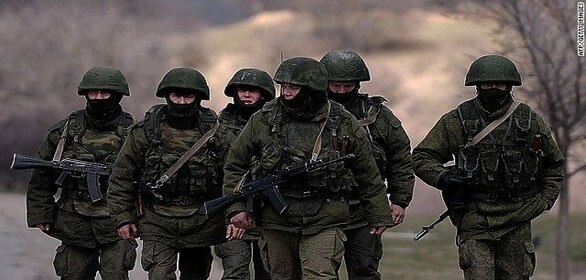
“Russia reinforced what Western and Ukrainian officials described as a stealth invasion on Wednesday [August 27], sending armored troops across the border as it expanded the conflict to a new section of Ukrainian territory. The latest incursion, which Ukraine’s military said included five armored personnel carriers, was at least the third movement of troops and weapons from Russia across the southeast part of the border this week.”
None of the photos accompanying this New York Times story online showed any of these Russian troops or armored vehicles.
“The Obama administration,” the story continued, “has asserted over the past week that the Russians had moved artillery, air-defense systems and armor to help the separatists in Donetsk and Luhansk. ‘These incursions indicate a Russian-directed counteroffensive is likely underway’, Jen Psaki, the State Department spokeswoman, said. At the department’s daily briefing in Washington, Ms. Psaki also criticized what she called the Russian government’s ‘unwillingness to tell the truth’ that its military had sent soldiers as deep as 30 miles inside Ukraine territory.”
Thirty miles inside Ukraine territory and not a single satellite photo, not a camera anywhere around, not even a one-minute video to show for it. “Ms. Psaki apparently [sic] was referring to videos of captured Russian soldiers, distributed by the Ukrainian government.” The Times apparently forgot to inform its readers where they could see these videos.
“The Russian aim, one Western official said, may possibly be to seize an outlet to the sea in the event that Russia tries to establish a separatist enclave in eastern Ukraine.”
This of course hasn’t taken place. So what happened to all these Russian soldiers 30 miles inside Ukraine? What happened to all the armored vehicles, weapons, and equipment?
“The United States has photographs that show the Russian artillery moved into Ukraine, American officials say. One photo dated last Thursday, shown to a New York Times reporter, shows Russian military units moving self-propelled artillery into Ukraine. Another photo, dated Saturday, shows the artillery in firing positions in Ukraine.”
Where are these photographs? And how will we know that these are Russian soldiers? And how will we know that the photos were taken in Ukraine? But most importantly, where are the fucking photographs?
Why am I so cynical? Because the Ukrainian and US governments have been feeding us these scare stories for eight months now, without clear visual or other evidence, often without even common sense. Here are a few of the many other examples, before and after the one above:
- The Wall Street Journal (March 28) reported: “Russian troops massing near Ukraine are actively concealing their positions and establishing supply lines that could be used in a prolonged deployment, ratcheting up concerns that Moscow is preparing for another [sic] major incursion and not conducting exercises as it claims, US officials said.”
- “The Ukrainian government charged that the Russian military was not only approaching but had actually crossed the border into rebel-held regions.” (Washington Post, November 7)
- “U.S. Air Force Gen. Philip M. Breedlove told reporters in Bulgaria that NATO had observed Russian tanks, Russian artillery, Russian air defense systems and Russian combat troops enter Ukraine across a completely wide-open border with Russia in the previous two days.” (Washington Post, November 13)
- “Ukraine accuses Russia of sending more soldiers and weapons to help rebels prepare for a new offensive. The Kremlin has repeatedly denied aiding the separatists.” (Reuters, November 16)
Since the February US-backed coup in Ukraine, the State Department has made one accusation after another about Russian military actions in Eastern Ukraine without presenting any kind of satellite imagery or other visual or documentary evidence; or they present something that’s very unclear and wholly inconclusive, such as unmarked vehicles, or unsourced reports, or citing “social media”; what we’re left with is often no more than just an accusation. The Ukrainian government has matched them.
On top of all this we should keep in mind that if Moscow decided to invade Ukraine they’d certainly provide air cover for their ground forces. There has been no mention of air cover.
This is all reminiscent of the numerous stories in the past three years of “Syrian planes bombing defenseless citizens”. Have you ever seen a photo or video of a Syrian government plane dropping bombs? Or of the bombs exploding? When the source of the story is mentioned, it’s almost invariably the rebels who are fighting against the Syrian government. Then there’s the “chemical weapon” attacks by the same evil Assad government. When a photo or video has accompanied the story I’ve never once seen grieving loved ones or media present; not one person can be seen wearing a gas mask. Is it only children killed or suffering? No rebels?
And then there’s the July 17 shootdown of Malaysia Flight MH17, over eastern Ukraine, taking 298 lives, which Washington would love to pin on Russia or the pro-Russian rebels. The US government – and therefore the US media, the EU, and NATO – want us all to believe it was the rebels and/or Russia behind it. The world is still waiting for any evidence. Or even a motivation. Anything at all. President Obama is not waiting. In a talk on November 15 in Australia, he spoke of “opposing Russia’s aggression against Ukraine – which is a threat to the world, as we saw in the appalling shoot-down of MH17”. Based on my reading, I’d guess that it was the Ukranian government behind the shootdown, mistaking it for Putin’s plane that reportedly was in the area.
Can it be said with certainty that all the above accusations were lies? No, but the burden of proof is on the accusers, and the world is still waiting. The accusers would like to create the impression that there are two sides to each question without actually having to supply one of them.
The United States punishing Cuba
For years American political leaders and media were fond of labeling Cuba an “international pariah”. We haven’t heard that for a very long time. Perhaps one reason is the annual vote in the United Nations General Assembly on the resolution which reads: “Necessity of ending the economic, commercial and financial embargo imposed by the United States of America against Cuba”. This is how the vote has gone (not including abstentions):
| Year | Votes (Yes-No) | No Votes |
|---|---|---|
| 1992 | 59-2 | US, Israel |
| 1993 | 88-4 | US, Israel, Albania, Paraguay |
| 1994 | 101-2 | US, Israel |
| 1995 | 117-3 | US, Israel, Uzbekistan |
| 1996 | 138-3 | US, Israel, Uzbekistan |
| 1997 | 143-3 | US, Israel, Uzbekistan |
| 1998 | 157-2 | US, Israel |
| 1999 | 155-2 | US, Israel |
| 2000 | 167-3 | US, Israel, Marshall Islands |
| 2001 | 167-3 | US, Israel, Marshall Islands |
| 2002 | 173-3 | US, Israel, Marshall Islands |
| 2003 | 179-3 | US, Israel, Marshall Islands |
| 2004 | 179-4 | US, Israel, Marshall Islands, Palau |
| 2005 | 182-4 | US, Israel, Marshall Islands, Palau |
| 2006 | 183-4 | US, Israel, Marshall Islands, Palau |
| 2007 | 184-4 | US, Israel, Marshall Islands, Palau |
| 2008 | 185-3 | US, Israel, Palau |
| 2009 | 187-3 | US, Israel, Palau |
| 2010 | 187-2 | US, Israel |
| 2011 | 186-2 | US, Israel |
| 2012 | 188-3 | US, Israel, Palau |
| 2013 | 188-2 | US, Israel |
| 2014 | 188-2 | US, Israel |
This year Washington’s policy may be subject to even more criticism than usual due to the widespread recognition of Cuba’s response to the Ebola outbreak in Africa.
Each fall the UN vote is a welcome reminder that the world has not completely lost its senses and that the American empire does not completely control the opinion of other governments.
Speaking before the General Assembly before last year’s vote, Cuban Foreign Minister Bruno Rodriguez declared: “The economic damages accumulated after half a century as a result of the implementation of the blockade amount to $1.126 trillion.” He added that the blockade “has been further tightened under President Obama’s administration”, some 30 US and foreign entities being hit with $2.446 billion in fines due to their interaction with Cuba.
However, the American envoy, Ronald Godard, in an appeal to other countries to oppose the resolution, said:
The international community … cannot in good conscience ignore the ease and frequency with which the Cuban regime silences critics, disrupts peaceful assembly, impedes independent journalism and, despite positive reforms, continues to prevent some Cubans from leaving or returning to the island. The Cuban government continues its tactics of politically motivated detentions, harassment and police violence against Cuban citizens.
So there you have it. That is why Cuba must be punished. One can only guess what Mr. Godard would respond if told that more than 7,000 people were arrested in the United States during the Occupy Movement’s first 8 months of protest in 2011-12 ; that many of them were physically abused by the police; and that their encampments were violently destroyed.
Does Mr. Godard have access to any news media? Hardly a day passes in America without a police officer shooting to death an unarmed person.
As to “independent journalism” – What would happen if Cuba announced that from now on anyone in the country could own any kind of media? How long would it be before CIA money – secret and unlimited CIA money financing all kinds of fronts in Cuba – would own or control most of the media worth owning or controlling?
The real reason for Washington’s eternal hostility toward Cuba has not changed since the revolution in 1959 – The fear of a good example of an alternative to the capitalist model; a fear that has been validated repeatedly over the years as many Third World countries have expressed their adulation of Cuba.
How the embargo began: On April 6, 1960, Lester D. Mallory, US Deputy Assistant Secretary of State for Inter-American Affairs, wrote in an internal memorandum: “The majority of Cubans support Castro … The only foreseeable means of alienating internal support is through disenchantment and disaffection based on economic dissatisfaction and hardship. … every possible means should be undertaken promptly to weaken the economic life of Cuba.” Mallory proposed “a line of action which … makes the greatest inroads in denying money and supplies to Cuba, to decrease monetary and real wages, to bring about hunger, desperation and overthrow of government.”
Later that year, the Eisenhower administration instituted its suffocating embargo against its everlasting enemy.
The United States judging and punishing the rest of the world
In addition to Cuba, Washington currently is imposing economic and other sanctions against Burma, Democratic Republic of the Congo, Iran, China, North Korea, South Korea, United Arab Emirates, Pakistan, Sri Lanka, Switzerland, Turkey, Germany, Malaysia, South Africa, Mexico, South Sudan, Sudan, Russia, Syria, Venezuela, India, and Zimbabwe. These are sanctions mainly against governments, but also against some private enterprises; there are also many other sanctions against individuals not included here.
Imbued with a sense of America’s moral superiority and “exceptionalism”, each year the State Department judges the world, issuing reports evaluating the behavior of all other nations, often accompanied by sanctions of one kind or another. There are different reports rating how each lesser nation has performed in the previous year in areas such as religious freedom, human rights, the war on drugs, trafficking in persons, and sponsors of terrorism. The criteria used in these reports are often political. Cuba, for example, is always listed as a sponsor of terrorism whereas anti-Castro exile groups in Florida, which have committed literally hundreds of terrorist acts over the years, are not listed as terrorist groups or supporters of such.
Cuba, which has been on the sponsor-of-terrorism list longer (since 1982) than any other country, is one of the most glaring anomalies. The most recent State Department report on this matter, in 2012, states that there is “no indication that the Cuban government provided weapons or paramilitary training to terrorist groups.” There are, however, some retirees of Spain’s Basque terrorist group ETA (which appears on the verge of disbanding) in Cuba, but the report notes that the Cuban government evidently is trying to distance itself from them by denying them services such as travel documents. Some members of the Revolutionary Armed Forces of Colombia (FARC) have been allowed into Cuba, but that was because Cuba was hosting peace talks between the FARC and the Colombian government, which the report notes.
The US sanctions mechanism is so effective and formidable that it strikes fear (of huge fines) into the hearts of banks and other private-sector organizations that might otherwise consider dealing with a listed state.
Some selected thoughts on American elections and democracy
In politics, as on the sickbed, people toss from one side to the other, thinking they will be more comfortable.
– Johann Wolfgang von Goethe (1749-1832)
- 2012 presidential election:
223,389,800 eligible to vote
128,449,140 actually voted
Obama got 65,443,674 votes
Obama was thus supported by 29.3% of eligible voters - There are 100 million adults in the United States who do not vote. This is a very large base from which an independent party can draw millions of new votes.
- If God had wanted more of us to vote in elections, he would give us better candidates.
- “The people can have anything they want. The trouble is, they do not want anything. At least they vote that way on election day.” – Eugene Debs, American socialist leader (1855-1926)
- “If persons over 60 are the only American age group voting at rates that begin to approximate European voting, it’s because they’re the only Americans who live in a welfare state – Medicare, Social Security, and earlier, GI loans, FHA loans.” – John Powers
- “The American political system is essentially a contract between the Republican and Democratic parties, enforced by federal and state two-party laws, all designed to guarantee the survival of both no matter how many people despise or ignore them.” – Richard Reeves (1936- )
- The American electoral system, once the object of much national and international pride, has slid inexorably from “one person, one vote”, to “one dollar, one vote”.
- Noam Chomsky: “It is important to bear in mind that political campaigns are designed by the same people who sell toothpaste and cars. Their professional concern in their regular vocation is not to provide information. Their goal, rather, is deceit.”
- If the Electoral College is such a good system, why don’t we have it for local and state elections?
- “All the props of a democracy remain intact – elections, legislatures, media – but they predominantly function at the service of the oligarchy.” – Richard Wolff
- The RepDem Party holds elections as if they were auctions; indeed, an outright auction for the presidency would be more efficient. To make the auction more interesting we need a second party, which must at a minimum be granted two privileges: getting on the ballot in all 50 states and taking part in television debates.
- The US does in fact have two parties: the Ins and the Outs … the evil of two lessers.
- Alexander Cockburn: “There was a time once when ‘lesser of two evils’ actually meant something momentous, like the choice between starving to death on a lifeboat, or eating the first mate.”
- Cornel West has suggested that it’s become difficult to even imagine what a free and democratic society, without great concentrations of corporate power, would look like, or how it would operate.
- The United States now resembles a police state punctuated by elections.
- How many voters does it take to change a light bulb? None. Because voters can’t change anything.
- H.L. Mencken (1880-1956): “As democracy is perfected, the office represents, more and more closely, the inner soul of the people. We move toward a lofty ideal. On some great and glorious day the plain folks of the land will reach their heart’s desire at last, and the White House will be adorned by a downright moron.”
- “All elections are distractions. Nothing conceals tyranny better than elections.” – Joel Hirschhorn
- In 1941, one of the country’s more acerbic editors, a priest named Edward Dowling, commented: “The two greatest obstacles to democracy in the United States are, first, the widespread delusion among the poor that we have a democracy, and second, the chronic terror among the rich, lest we get it.”
- “Elections are a necessary, but certainly not a sufficient, condition for democracy. Political participation is not just a casting of votes. It is a way of life.” – UN Human Development Report, 1993
- “If you don’t vote, you can’t complain!” I reply, “You have it backwards. If you DO vote, you can’t complain. You asked for it, and they’re going to give it to you, good and hard.”
- “How to get people to vote against their interests and to really think against their interests is very clever. It’s the cleverest ruling class that I have ever come across in history. It’s been 200 years at it. It’s superb.” – Gore Vidal
- We can’t use our democracy/our vote to change the way the economy functions. This is very anti-democratic.
- What does a majority vote mean other than that the sales campaign was successful?
- Roman Emperor Marcus Aurelius: “The opinion of 10,000 men is of no value if none of them know anything about the subject.”
- We do have representative government. The question is: Who does our government represent?
- “On the day after the 2002 election I watched a crawl on the bottom of the CNN news screen. It said, ‘Proprietary software may make inspection of electronic voting systems impossible.’ It was the final and absolute coronation of corporate rights over democracy; of money over truth.” – Mike Ruppert, RIP
- “It’s not that voting is useless or stupid; rather, it’s the exaggeration of the power of voting that has drained the meaning from American politics.” – Michael Ventura
- After going through the recent national, state and local elections, I am now convinced that taxation without representation would have been a much better system.
- “Ever since the Constitution was illegally foisted on the American people we have lived in a blatant plutocracy. The Constitution was drafted in secret by a self-appointed elite committee, and it was designed to bring three kinds of power under control: Royalty, the Church, and the People. All were to be subjugated to the interests of a wealthy elite. That’s what republics were all about. And that’s how they have functioned ever since.” – Richard K. Moore
- “As demonstrated in Russia and numerous other countries, when faced with a choice between democracy without capitalism or capitalism without democracy, Western elites unhesitatingly embrace the latter.” – Michael Parenti
- “The fact that a supposedly sophisticated electorate had been stampeded by the cynical propaganda of the day threw serious doubt on the validity of the assumptions underlying parliamentary democracy as a whole.” – British Superspy for the Soviets Kim Philby (1912-1988), explaining his reasons for becoming a Communist instead of turning to the Labour Party
- US Supreme Court Justice Louis Brandeis (1856-1941): “We may have democracy in this country, or we may have wealth concentrated in the hands of a few, but we cannot have both.”
- “We don’t need to run America like a business or like the military. We need to run America like a democracy.” – Jill Stein, Green Party presidential candidate 2012
Notes
- Democracy Now!, October 30, 2013
- Huffingfton Post, May 3, 2012
- Department of State, Foreign Relations of the United States, 1958-1960, Volume VI, Cuba(1991), p.885 (online here)
- For the complete detailed list, see U.S. Department of State, Nonproliferation Sanctions
- U.S. Department of State, “Country Reports on Terrorism 2012, Chapter 3: State Sponsors of Terrorism,” May 20, 2013
William Blum is the author of:
- Killing Hope: US Military and CIA Interventions Since World War 2
- Rogue State: A Guide to the World’s Only Superpower
- West-Bloc Dissident: A Cold War Memoir
- Freeing the World to Death: Essays on the American Empire
Portions of the books can be read, and signed copies purchased, at www.killinghope.org
Email to
Website: WilliamBlum.org
William Blum is a regular columnist for Veracity Voice
America’s “Terrorist Academy” In Iraq Produced ISIS Leaders
October 11, 2014 by Administrator · Leave a Comment
The University of Al-Qaeda?

“Since 2003, Anglo-American power has secretly and openly coordinated direct and indirect support for Islamist terrorist groups linked to al-Qaeda across the Middle East and North Africa. This ill-conceived patchwork geostrategy is a legacy of the persistent influence of neoconservative ideology, motivated by longstanding but often contradictory ambitions to dominate regional oil resources, defend an expansionist Israel, and in pursuit of these, re-draw the map of the Middle East.” Nafeez Ahmed, “How the West Created the Islamic State“, CounterPunch
“The US created these terrorist organizations. America does not have the moral authority to lead a coalition against terrorism.” Hassan Nasralla, Secretary General of Hezbollah
October 06, 2014 “ICH” – “Counterpunch” – The Obama administration’s determination to topple Syrian President Bashar al-Assad is pushing the Middle East towards a regional war that could lead to a confrontation between the two nuclear-armed rivals, Russia and the United States.
Last week, Turkey joined the US-led coalition following a vote in parliament approving a measure to give the government the authority to launch military action against Isis in Syria. Turkish President Recep Tayyip Erdogan made it clear that Turkish involvement would come at a price, and that price would be the removal of al Assad. According to Turkey’s Hurriyet Daily News:
“Turkey will not allow coalition members to use its military bases or its territory in the fight against the Islamic State of Iraq and the Levant (ISIL) if the objective does not also include ousting the Bashar al-Assad regime, President Recep Tayyip Erdoğan hinted on Oct. 1…
“We are open and ready for any cooperation in the fight against terrorism. However, it should be understood by everybody that Turkey is not a country in pursuit of temporary solutions, nor will Turkey allow others to take advantage of it,” Erdoğan said in his lengthy address to Parliament.”..
“Turkey cannot be content with the current situation and cannot be a by-stander and spectator in the face of such developments.” (“Turkey will fight terror but not for temporary solutions: Erdoğan“, Hurriyet)
Officials in the Obama administration applauded Turkey’s decision to join the makeshift coalition. U.S. Secretary of Defense Chuck Hagel hailed the vote as a “very positive development” while State Department spokeswoman Jen Psaki said, “We welcome the Turkish Parliament’s vote to authorize Turkish military action…We’ve had numerous high-level discussions with Turkish officials to discuss how to advance our cooperation in countering the threat posed by ISIL in Iraq and Syria.”
In the last week, “Turkish tanks and other military units have taken position on the Syrian border.” Did the Obama administration strike a deal with Turkey to spearhead an attack on Syria pushing south towards Damascus while a small army of so called “moderate” jihadis– who are presently on the Israeli border– move north towards the Capital? If that is the case, then the US would probably deploy some or all of its 15,000 troops currently stationed in Kuwait “including an entire armored brigade” to assist in the invasion or to provide backup if Turkish forces get bogged down. The timeline for such an invasion is uncertain, but it does appear that the decision to go to war has already been made.
Turkish involvement greatly increases the chances of a broader regional war. It’s unlikely that Syria’s allies, Russia and Iran, will remain on the sidelines while Turkish tanks stream across the country on their way to Damascus. And while the response from Tehran and Moscow may be measured at first, it is bound to escalate as the fighting intensifies and tempers flare. The struggle for Syria will be a long, hard slog that will probably produce no clear winner. If Damascus falls, the conflict will morph into a protracted guerilla war that could spill over borders engulfing both Lebanon and Jordan. Apparently, the Obama administration feels the potential rewards from such a reckless and homicidal gambit are worth the risks.
No-Fly Zone Fakery
The Obama administration has made little effort to conceal its real objectives in Syria. The fight against Isis is merely a pretext for regime change. The fact that Major General Martin Dempsey, chairman of the Joint Chiefs of Staff, and Chuck Hagel are angling for a no-fly zone over Syria exposes the “war against Isis” as a fraud. Why does the US need a no-fly zone against a group of Sunni militants who have no air force? The idea is ridiculous. The obvious purpose of the no-fly zone is to put Assad on notice that the US is planning to take control of Syrian airspace on its way to toppling the regime. Clearly, Congress could have figured this out before rubber stamping Obama’s request for $500 million dollars to arm and train “moderate” militants. Instead, they decided to add more fuel to the fire. If Congress seriously believes that Assad is a threat to US national security and “must go”, then they should have the courage to vote for sending US troops to Syria to do the heavy lifting. The idea of funding shadowy terrorist groups that pretend to be moderate rebels is lunacy in the extreme. It merely compounds the problem and increases the prospects of another Iraq-type bloodbath. Is it any wonder why Congress’s public approval rating is stuck in single digits?
TURKEY: A Major Player
According to many sources, Turkey has played a pivotal role in the present crisis, perhaps more than Saudi Arabia or Qatar. Consider the comments made by Vice President Joe Biden in an exchange with students at the John F. Kennedy Jr. Forum at the Institute of Politics at Harvard University last week. Biden was asked: “In retrospect do you believe the United States should have acted earlier in Syria, and if not why is now the right moment?” Here’s part of what he said:
“…my constant cry was that our biggest problem is our allies – our allies in the region were our largest problem in Syria. The Turks were great friends – and I have the greatest relationship with Erdogan, which I just spent a lot of time with – the Saudis, the Emiratis, etc. What were they doing? They were so determined to take down Assad and essentially have a proxy Sunni-Shia war, what did they do? They poured hundreds of millions of dollars and tens, thousands of tons of weapons into anyone who would fight against Assad except that the people who were being supplied were Al Nusra and Al Qaeda and the extremist elements of jihadis coming from other parts of the world…
So now what’s happening? All of a sudden everybody’s awakened because this outfit called ISIL which was Al Qaeda in Iraq, which when they were essentially thrown out of Iraq, found open space in territory in eastern Syria, work with Al Nusra who we declared a terrorist group early on and we could not convince our colleagues to stop supplying them. So what happened? Now all of a sudden – I don’t want to be too facetious – but they had seen the Lord. Now we have – the President’s been able to put together a coalition of our Sunni neighbors, because America can’t once again go into a Muslim nation and be seen as the aggressor – it has to be led by Sunnis to go and attack a Sunni organization.”
Biden apologized for his remarks on Sunday, but he basically let the cat out of the bag. Actually, what he said wasn’t new at all, but it did lend credibility to what many of the critics have been saying since the very beginning, that Washington’s allies in the region have been arming and funding this terrorist Frankenstein from the onset without seriously weighing the risks involved. Here’s more background on Turkey’s role in the current troubles from author Nafeez Ahmed:
“With their command and control centre based in Istanbul, Turkey, military supplies from Saudi Arabia and Qatar in particular were transported by Turkish intelligence to the border for rebel acquisition. CIA operatives along with Israeli and Jordanian commandos were also training FSA rebels on the Jordanian-Syrian border with anti-tank and anti-aircraft weapons. In addition, other reports show that British and French military were also involved in these secret training programmes. It appears that the same FSA rebels receiving this elite training went straight into ISIS – last month one ISIS commander, Abu Yusaf, said, “Many of the FSA people who the west has trained are actually joining us.” (“How the West Created the Islamic State“, Nafeez Ahmed, CounterPunch
Notice how the author points out the involvement of “CIA operatives”. While Biden’s comments were an obvious attempt to absolve the administration from blame, it’s clear US Intel agencies knew what was going on and were at least tangentially involved. Here’s more from the same article:
“Classified assessments of the military assistance supplied by US allies Saudi Arabia and Qatar obtained by the New York Times showed that “most of the arms shipped at the behest of Saudi Arabia and Qatar to supply Syrian rebel groups… are going to hardline Islamic jihadists, and not the more secular opposition groups that the West wants to bolster.”
Once again, classified documents prove that the US officialdom knew what was going on and simply looked the other way. All the while, the hardcore takfiri troublemakers were loading up on weapons and munitions preparing for their own crusade. Here’s a clip that Congress should have read before approving $500 million more for this fiasco:
” … Mother Jones found that the US government has “little oversight over whether US supplies are falling prey to corruption – or into the hands of extremists,” and relies “on too much good faith.” The US government keeps track of rebels receiving assistance purely through “handwritten receipts provided by rebel commanders in the field,” and the judgment of its allies. Countries supporting the rebels – the very same which have empowered al-Qaeda affiliated Islamists – “are doing audits of the delivery of lethal and nonlethal supplies.”…
the government’s vetting procedures to block Islamist extremists from receiving US weapons have never worked.” (“How the West Created the Islamic State”, Nafeez Ahmed, CounterPunch)
These few excerpts should help to connect the dots in what is really a very hard-to-grasp situation presently unfolding in Syria. Yes, the US is ultimately responsible for Isis because it knew what was going on and played a significant part in arming and training jihadi recruits. And, no, Isis does not take its orders directly from Washington (or Langley) although its actions have conveniently coincided with US strategic goals in the region. (Many readers will undoubtedly disagree with my views on this.) Here’s one last clip on Turkey from an article in the Telegraph. The story ran a full year ago in October 2013:
“Hundreds of al-Qaeda recruits are being kept in safe houses in southern Turkey, before being smuggled over the border to wage “jihad” in Syria, The Daily Telegraph has learned.
The network of hideouts is enabling a steady flow of foreign fighters – including Britons – to join the country’s civil war, according to some of the volunteers involved.
These foreign jihadists have now largely eclipsed the “moderate” wing of the rebel Free Syrian Army, which is supported by the West. Al-Qaeda’s ability to use Turkish territory will raise questions about the role the Nato member is playing in Syria’s civil war.
Turkey has backed the rebels from the beginning – and its government has been assumed to share the West’s concerns about al-Qaeda. But experts say there are growing fears over whether the Turkish authorities may have lost control of the movement of new al-Qaeda recruits – or may even be turning a blind eye.” (“Al-Qaeda recruits entering Syria from Turkey safehouses“, Telegraph)
Get the picture? This is a major region-shaping operation that the Turks, the Saudis, the Qataris, the Americans etc are in on. Sure, maybe some of the jihadis went off the reservation and started doing their own thing, but even that’s not certain. After all, Isis has already achieved many of Washington’s implicit objectives: Dump Nuri al Maliki and replace him with a US stooge who will amend the Status of Forces Agreement. (SOFA), allow Sunni militants and Kurds to create their own de facto mini-states within Iraq (thus, eliminating the threat of a strong, unified Iraq that will challenge Israeli hegemony), and create a tangible threat to regional security (Isis) thereby justifying US meddling and occupation for the foreseeable future. So far, arming terrorists has been a winning strategy for Obama and Co. Unfortunately for the president, we are still in the early rounds of the emerging crisis. Things could backfire quite badly, and probably will.
(NOTE: According to Iran’s Press TV: “The ISIL terrorists have purportedly opened a consulate in Ankara, Turkey and use it to issue visas for those who want to join the fight against the Syrian and Iraqi governments….The militants are said to be operating freely inside the country without much problem.” I have my doubts about this report which is why I have put parentheses around it, but it is interesting all the same.)
CAMP BUCCA: University of Al-Qaeda
So where do the Sunni extremists in Isis come from?
There are varying theories on this, the least likely of which is that they responded to promotional videos and propaganda on social media. The whole “Isis advertising campaign” nonsense strikes me as a clever disinformation ploy to conceal what’s really going on, which is, that the various western Intel agencies have been recruiting these jokers from other (former) hotspots like Afghanistan, Libya, Chechnya, Kosovo, Somalia and prisons in Iraq. Isis not a spontaneous amalgam of Caliphate-aspiring revolutionaries who spend their off-hours trolling the Internet, but a collection of ex Baathists and religious zealots who have been painstakingly gathered to perform the task at hand, which is to lob off heads, spread mayhem, and create the pretext for US-proxy war. Check out this illuminating article on Alakhbar English titled “The mysterious link between the US military prison Camp Bucca and ISIS leaders”. It helps explain what’s really been going on behind the scenes:
“We have to ask why the majority of the leaders of the Islamic State (IS), formerly the Islamic State in Iraq and Syria (ISIS), had all been incarcerated in the same prison at Camp Bucca, which was run by the US occupation forces near Omm Qasr in southeastern Iraq….. First of all, most IS leaders had passed through the former U.S. detention facility at Camp Bucca in Iraq. So who were the most prominent of these detainees?
The leader of IS, Abu Bakr al-Baghdadi, tops the list. He was detained from 2004 until mid-2006. After he was released, he formed the Army of Sunnis, which later merged with the so-called Mujahideen Shura Council…
Another prominent IS leader today is Abu Ayman al-Iraqi, who was a former officer in the Iraqi army under Saddam Hussein. This man also “graduated” from Camp Bucca, and currently serves as a member on IS’ military council.
Another member of the military council who was in Bucca is Adnan Ismail Najm. … He was detained on January 2005 in Bucca, and was also a former officer in Saddam’s army. He was the head of a shura council in IS, before he was killed by the Iraqi army near Mosul on June 4, 2014.
Camp Bucca was also home to Haji Samir, aka Haji Bakr, whose real name is Samir Abed Hamad al-Obeidi al-Dulaimi. He was a colonel in the army of the former Iraqi regime. He was detained in Bucca, and after his release, he joined al-Qaeda. He was the top man in ISIS in Syria…
According to the testimonies of US officers who worked in the prison, the administration of Camp Bucca had taken measures including the segregation of prisoners on the basis of their ideology. This, according to experts, made it possible to recruit people directly and indirectly.
Former detainees had said in documented television interviews that Bucca…was akin to an “al-Qaeda school,” where senior extremist gave lessons on explosives and suicide attacks to younger prisoners. A former prisoner named Adel Jassem Mohammed said that one of the extremists remained in the prison for two weeks only, but even so was able to recruit 25 out of 34 inmates who were there. Mohammed also said that U.S. military officials did nothing to stop the extremists from mentoring the other detainees…
No doubt, we will one day discover that many more leaders in the group had been detained in Bucca as well, which seems to have been more of a “terrorist academy” than a prison.” (“The mysterious link between the US military prison Camp Bucca and ISIS leaders“, Alakhbar English)
US foreign policy is tailored to meet US strategic objectives, which in this case are regime change, installing a US puppet in Damascus, erasing the existing borders, establishing forward-operating bases across the country, opening up vital pipeline corridors between Qatar and the Mediterranean so the western energy giants can rake in bigger profits off gas sales to the EU market, and reducing Syria to a condition of “permanent colonial dependency.” (Chomsky)
Would the United States oversee what-amounts-to a “terrorist academy” if they thought their jihadi graduates would act in a way that served US interests?
Indeed, they would. In fact, they’d probably pat themselves on the back for coming up with such a clever idea.
Mike Whitney is a regular columnist for Veracity Voice
Mike Whitney lives in Washington state. He can be reached at:
Obama Declares War On Syria
September 13, 2014 by Administrator · Leave a Comment
Why the Real Target is Assad Not ISIS…

Invoking the same ominous language as his predecessor, Barack Obama used a prime time presidential address on Wednesday to announce the beginning of a war on Syria. And while there’s no doubt that many Americans will be confused by Obama’s misleading focus on the terrorist organization named ISIL, the real purpose of the speech was to garner support for another decade of homicidal conflicts in the Middle East. The administration is as determined as ever to plunge the region into chaos, erase existing borders, and install its puppets wherever it can. ISIL–which is mainly an invention of western Intel agencies and their treacherous counterparts in the Gulf– conveniently creates the justification for another bloody invasion followed by years of occupation, subjugation, and revolt.
Barack Obama:
My fellow Americans — tonight, I want to speak to you about what the United States will do with our friends and allies to degrade and ultimately destroy the terrorist group known as ISIL. As commander-in-chief, my highest priority is the security of the American people…..
Thanks to our military and counterterrorism professionals, America is safer.
Still, we continue to face a terrorist threat. We cannot erase every trace of evil from the world, and small groups of killers have the capacity to do great harm. That was the case before 9/11, and that remains true today. That’s why we must remain vigilant as threats emerge.
Get it? We are all in great peril and only our loving father, Obama, can save us. Where have we heard that before?
Obama: “In a region that has known so much bloodshed, these terrorists are unique in their brutality. They execute prisoners. They kill children. They enslave, rape, and force women into marriage…..If left unchecked, these terrorists could pose a growing threat beyond that region — including to the United States.”
This is pure demagoguery, the likes of which we haven’t heard since Bush’s ”The Axis of Evil” speech. The truth is, ISIL poses NO threat to US national security at all. It’s a joke. Readers should mull that over before they throw their support behind Obama’s proposed crusade in Syria..
More Obama: “First, we will conduct a systematic campaign of airstrikes against these terrorists…..I will not hesitate to take action against ISIL in Syria, as well as Iraq. This is a core principle of my presidency: if you threaten America, you will find no safe haven…..”
Okay, so borders don’t matter, international law doesn’t matter, national sovereignty doesn’t matter. What matters is oil, money and power. Isn’t that what he’s saying? He’s asking the American people to support another millennia of killing so he can pad the bank accounts of corrupt US oil magnates while strengthening America’s tenuous grip on global power. Would you be willing to sacrifice your son’s life for such a cause?
Obama: “Across the border, in Syria, we have ramped up our military assistance to the Syrian opposition. Tonight, I again call on Congress to give us additional authorities and resources to train and equip these fighters.”
So, now Obama wants to arm and train the same terrorists which the CIA and our enlightened friends in the Gulf States recruited from around the world. Sounds like a good plan, doesn’t it? What could go wrong?
Obama: “This is our strategy….. Secretary Kerry was in Iraq today meeting with the new government and supporting their efforts to promote unity, and in the coming days he will travel across the Middle East and Europe to enlist more partners in this fight.”
So, Senator Botox and his gaggle of neocons are going to fix everything, just like they did in Kiev. Now I am worried.
Obama: “But I want the American people to understand how this effort will be different from the wars in Iraq and Afghanistan. It will not involve American combat troops fighting on foreign soil. This counter-terrorism campaign will be waged through a steady, relentless effort to take out ISIL wherever they exist, using our air power and our support for partner forces on the ground.”
No American “boots on the ground”?? Is that what he said? What he meant to say was no boots on the ground until after the midterms. After that, the sky’s the limit!
Don’t kid yourself, the Obama claque is as determined to topple Assad as Bush was determined to remove Saddam. That’s why Obama’s public relations team decided to use the prestige of a primetime presidential speech –with all the pompous trappings of high-office–to make their case. It’s because their real target is the American people who are being led by the nose into another hellish bloodbath.
Obama: “American leadership is the one constant in an uncertain world. It is America that has the capacity and the will to mobilize the world against terrorists.”
Oh boy. American troublemaking is the “one constant” in this world, even death and taxes take a back seat to that. America started the war on terror. (Blowback) America perpetuated the war on terror. (check the globe. The US is fighting wars everywhere.) And America is entirely responsible for the war on terror. (Afghanistan, Mujahedin) And now–after 13 years of unlawful detentions, black sites, Abu Ghraib, Gitmo, death squads, waterboarding, illegal surveillance, drone attacks, and a mountain of carnage that stretches halfway to the moon– Obama is re-launching the War on Terror under the opaque sobriquet “ISIL”. Haven’t we had enough of this garbage yet?
As always, the media seems entirely mystified as to the administration’s real intentions. In contrast, analyst Patrick Martin at the World Socialist Web Site sees through the hoax and sums it up like this in an article titled “Obama announces open-ended war in Iraq and Syria”. Here’s an excerpt:
“It was only 12 months ago that Obama tried and failed to create the political conditions for US air strikes against the Assad regime, making allegations of the use of nerve gas weapons that were later discredited. Now Obama is seeking to achieve the same goal by a different route, using ISIS as a pretext to get American military forces into Syria, where they will become the spearhead of the campaign to oust Assad and install a pro-US stooge regime in Damascus.”
Bingo. The ISIL canard is nothing but a pretext for war.
Write to your Senators and Congressmen: NO WAR IN SYRIA.
Mike Whitney is a regular columnist for Veracity Voice
Mike Whitney lives in Washington state. He can be reached at:
NWO Enforcer: NATO Threatens WW III
September 6, 2014 by Administrator · Leave a Comment

The New World Order has been in place for centuries. Is it not time to start calling the NWO by another name? A descriptive term that encapsulates the essence of the beast would be a Nefarious Warrior Organism. Such a phrase strips away the ridiculous notion that there is any order in the malevolent organization of the parasitic global structure, based upon perpetual and permanent warfare. This depiction more closely resembles reality, even if the master mass media refuses to acknowledge How the World Really Works. Discard any condemnation that criticism of the established order rests upon conspiratorial fantasy or pre-medieval prejudices. Explaining away or ignoring basic human nature in a “PC” culture ultimately requires the adoption of a depraved Totalitarian Collectivism system.
Students of world affairs are not strangers to the practice of lies and deception. One of the grand daddies of the Nefarious Warrior Organism, and infamous war criminal, Henry Kissinger has a new book, World Order. An excerpt published in the Wall Street Journal, Henry Kissinger on the Assembly of a New World Order, spews the same poppycock that underpins the destructive policies and practices that has the world ripe for an apocalyptic conflict, needed to rescue the banksters of international finance from their derivative Ponzi scheme.
“Libya is in civil war, fundamentalist armies are building a self-declared caliphate across Syria and Iraq and Afghanistan’s young democracy is on the verge of paralysis. To these troubles are added a resurgence of tensions with Russia and a relationship with China divided between pledges of cooperation and public recrimination. The concept of order that has underpinned the modern era is in crisis.
The international order thus faces a paradox: Its prosperity is dependent on the success of globalization, but the process produces a political reaction that often works counter to its aspirations.”
How convenient to disregard the fact that incessant conflicts are direct results of policy maker schemes in Washington, London, Israel and the global sanctuaries and redoubts where the Mattoids reside. Policy objectives, invariably implemented with force, coercion and military carnage is the real reason why the NATO enforcement machine was not disbanded with the ending of the Cold War.
Over a decade ago the essay, NATO a Dinosaur Overdue for Extinction stated that national sovereignty of individual states was never an objective after the collapse of the Soviet Empire. Quite to the contrary, NATO’s expansion to accept the Czech Republic, Hungary and Poland (1999), Bulgaria, Estonia, Latvia, Lithuania, Romania, Slovakia, Slovenia (2004), and Albania and Croatia (2009) as members illustrates that the purpose of NATO clearly has a focus on becoming the global police force for the NWO.
“If the breakdown in NATO is destined to avail an opportunity to curtail the Yankee Hyperpower, the alternative need not be the formation of another suspect alliance. It is not unpatriotic to advocate the wisdom in an America First policy. NATO doesn’t secure or advance our country, but only provides the military command and enforcement that imposes the will of global masters. Resistance and opposition against an independent EU rapid defense force, comes not from the nations of Europe, but from the elites that control the mechanisms of global power. NATO is one of their tools. Alliances are one of their methods. And suppression of viable self determination is their cherished goal.”
Seasoned observers of the backstabbing game of international intrigue must love the way that The State Department’s New World Order Agenda rears its ugly head with NeoCons running U.S. foreign policy.
“That esteem champion of national sovereignty, Victoria Nuland, Assistant Secretary of State for European Affairs, is hardly a protector of the duly elected Ukrainian government. Actively working to depose that regime for one acceptable to the EU/NATO system claims such actions as legal and sound policy, for the good of the Ukrainians. When Toby Gati, the former White House senior director for Russia, defended Nuland, the futility of a joint cooperative strategy exposes the reality of blowback to the EU.”
In order to understand the true nature of the psychopathic motives and vicious tactics that threaten a global conflagration, examine Victoria Nuland’s family ties: The Permanent Government in action. Kevin MacDonald dares reveals the family tree structure of the NeoCon clan of subversive fifth column infiltrators within our own government.
“Ethnic networking and ties cemented by marriage are on display in the flap over Assistant Secretary of State Victoria Nuland’s phone conversation with Geoffrey Pyatt, U.S. Ambassador to Ukraine. As VDARE’s Steve Sailer puts it, Nuland is a member of a talented, energetic [Jewish] family that is part of the Permanent Government of the United States.”
The expected result of such treachery is that the IMF and EU Capture of Ukraine becomes the spark that ignites a fuse set to explode into an intended Ukrainian civil war.
“It should be obvious that the recent putsch and regime change in the Ukraine inspired and backed by the U.S. shadow government, benefits the international banksters. For the average EU resident, only further economic displacement and diminished prospects can be expected from any inclusion of Ukraine into the EU dictatorial structure.”
Of course, the actual target, slated for removal is Vladimir Putin Nemesis of the New World Order. Russian defiance of the Nefarious Warrior Organism cannot stand.
“The context for any serious discussion on foreign affairs must start with the admission that the New World Order is the dominant controller of political power, especially in western countries. The NeoCon/NeoLib cabal dictates worldwide compliance. Nations conform to the financial supremacy of banksters, administered by handpicked political stooges. Global governance is the end game destined for all states. Individual nations slated for extinction are doomed as long as the NWO advances their worldwide imperium.”
The terror of descending into an abyss that triggers a nuclear World War III is actually a ruse. Such a holocaust will not happen by chance. Only when the transcendent Satanist elites have all their prey in the sights of their directed fallout, will the button be pushed.
China is certainly part of the NWO gang of comrades. The prospect for their involvement seems more likely than Russian recklessness. Ready for World War III with China?, has that old black magic of Kissinger come alive with the designated strategy intended to defeat America.
“China does not want an apocalyptic war with the United States. They are content to wage economic and financial warfare. Notwithstanding the trade dependency that the globalist cabal originated by the Nixon-Kissinger tools with the Red Communists, the authoritarian People’s Republic of China, are winning the financial battle.”
NATO’s belligerent and bellicose deployments around Russia are part of a plan to isolate, marginalize and shatter the economy and influence of Putin in the region. Neutering the Russian Bear facilitates the spread of central banking direction over the natural resources and across the time zones of this dissident former commie.
Since all obedient Marxists sing the song of the Internationale as they report to the gnomes of the Bank of International Settlement, do not be duped into thinking that NATO is a force for stability and legitimate defense. Involvements from Afghanistan to Kosovo or Iraq to Libya, demonstrates there are no short list deployments. The tentacles of drone assaults have nonconforming regimes posed for eventual collateral damage. As the Nefarious Warrior Organism metastasizes, the cancer becomes terminal. Actually blowing up the planet risks the destruction of property. Just the risk of universal annihilation serves the extortionist better, by maintaining a campaign of everlasting fear. NATO becomes the strong-arm enforcer, wheeling brass knuckle punches, when tribute payments become late.
Killing hundreds of millions if not billions is far more efficient using germ warfare in a mutation of a designer pandemic. NATO’s intimidation best functions as a warning of potential incursion than an actual skirmish on a battlefield. The next arms race is to advance electronic countermeasures to protect the flow of debt collection. The NWO can encircle the few remaining enclaves of freedom, but rebel states confined to benign reservations, cannot expect much better.
Dread that World War III is on the horizon is most useful to the elites that play the puppeteer game of diversion and slide of hand. As independent countries fall into the cauldron of globalism stew, the only morsel that remains of the sweet taste of liberty resides in the memory recesses of the past.
The masters of global chaos, served well with the life work of Henry Kissinger and Zibigneiw Brzezinski, prosper on the suffering of the rest of humanity. Such megalomaniacs see the military-industrial-security complex as a continuum of a scorched earth campaign of Attila the Hun. Destruction and carnage reign, since the only empire that exists is the one that keeps the NWO elites in control.
America is long dead and the echoes of the past only serve as remembrance of the purported rendering of the NATO’s motto – ANIMUS IN CONSULENDO LIBER. Somehow, the translation, “Man’s mind ranges unrestrained in counsel”, seems only to apply inside the dementia of the Nefarious Warrior Organism.
Sartre is the publisher, editor, and writer for Breaking All The Rules. He can be reached at:
Sartre is a regular columnist for Veracity Voice
Why War Is Inevitable
May 26, 2014 by Administrator · 1 Comment
Memorial Day is when we commemorate our war dead. Like the Fourth of July, Memorial Day is being turned into a celebration of war.
Those who lose family members and dear friends to war don’t want the deaths to have been in vain. Consequently, wars become glorious deeds performed by noble soldiers fighting for truth, justice, and the American way. Patriotic speeches tell us how much we owe to those who gave their lives so that America could remain free.
The speeches are well-intentioned, but the speeches create a false reality that supports ever more wars. None of America’s wars had anything to do with keeping America free. To the contrary, the wars swept away our civil liberties, making us unfree.
President Lincoln issued an executive order for the arrest and imprisonment of northern newspaper reporters and editors. He shut down 300 northern newspapers and held 14,000 political prisoners. Lincoln arrested war critic US Representative Clement Vallandigham from Ohio and exiled him to the Confederacy. President Woodrow Wilson used WWI to suppress free speech, and President Franklin D. Roosevelt used WWII to intern 120,000 US citizens of Japanese descent on the grounds that race made them suspect. Professor Samuel Walker concluded that President George W. Bush used the “war on terror” for an across the board assault on US civil liberty, making the Bush regime the greatest danger American liberty has ever faced.
Lincoln forever destroyed states’ rights, but the suspension of habeas corpus and free speech that went hand in hand with America’s three largest wars was lifted at war’s end. However, President George W. Bush’s repeal of the Constitution has been expanded by President Obama and codified by Congress and executive orders into law. Far from defending our liberties, our soldiers who died in “the war on terror” died so that the president can indefinitely detain US citizens without due process of law and murder US citizens on suspicion alone without any accountability to law or the Constitution.
The conclusion is unavoidable that America’s wars have not protected our liberty but, instead, destroyed liberty. As Alexander Solzhenitsyn said, “A state of war only serves as an excuse for domestic tyranny.”
Southern secession did pose a threat to Washington’s empire, but not to the American people.Neither the Germans of WWI vintage nor the Germans and Japanese of WWII vintage posed any threat to the US. As historians have made completely clear, Germany did not start WWI and did not go to war for the purpose of territorial expansion. Japan’s ambitions were in Asia. Hitler did not want war with England and France. Hitler’s territorial ambitions were mainly to restore German provinces stripped from Germany as WWI booty in violation of President Wilson’s guarantees. Any other German ambitions were to the East. Neither country had any plans to invade the US. Japan attacked the US fleet at Pearl Harbor hoping to remove an obstacle to its activities in Asia, not as a precursor to an invasion of America.
Certainly the countries ravaged by Bush and Obama in the 21st century–Iraq, Afghanistan, Libya, Somalia, Syria, Pakistan, and Yemen posed no military threat to the US. Indeed, these were wars used by a tyrannical executive branch to establish the basis of the Stasi State that now exists in the US.
The truth is hard to bear, but the facts are clear. America’s wars have been fought in order to advance Washington’s power, the profits of bankers and armaments industries, and the fortunes of US companies. Marine General Smedley Butler said, “ I served in all commissioned ranks from a second Lieutenant to a Major General. And during that time, I spent most of my time being a high-class muscle man for Big Business, for Wall Street, and for the bankers. In short, I was a racketeer for capitalism.”
It is more or less impossible to commemorate the war dead without glorifying them, and it is impossible to glorify them without glorifying their wars.
For the entirety of the 21st century the US has been at war, not war against massed armies or threats to American freedom, but wars against civilians, against women, children, and village elders, and wars against our own liberty. Elites with a vested interest in these wars tell us that the wars will have to go on for another 20 to 30 years before we defeat “the terrorist threat.”
This, of course, is nonsense. There was no terrorist threat until Washington began trying to create terrorists by military attacks, justified by lies, on Muslim populations.
Washington succeeded with its war lies to the point that Washington’s audacity and hubris have outgrown Washington’s judgment.
By overthrowing the democratically elected government in Ukraine, Washington has brought the United States into confrontation with Russia. This is a confrontation that could end badly, perhaps for Washington and perhaps for the entire world.
If Gaddafi and Assad would not roll over for Washington, why does Washington think Russia will? Russia is not Libya or Syria. Washington is the bully who having beat up the kindergarden kid, now thinks he can take on the college linebacker.
The Bush and Obama regimes have destroyed America’s reputation with their incessant lies and violence against other peoples. The world sees Washington as the prime threat.
Worldwide polls consistently show that people around the world regard the US and Israel as the two countries that pose the greatest threat to peace. http://www.ibtimes.com/gallup-poll-biggest-threat-world-peace-america-1525008 and
http://www.jewishfederations.org/european-poll-israel-biggest-threat-to-world-peace.aspx
The countries that Washington’s propaganda declares to be “rogue states” and the “axis of evil,” such as Iran and North Korea, are far down the list when the peoples in the world are consulted. It could not be more clear that the world does not believe Washington’s self-serving propaganda. The world sees the US and Israel as the rogue states.
The US and Israel are the only two countries in the world that are in the grip of ideologies. The US is in the grip of the Neoconservative ideology which has declared the US to be the “exceptional, indispensable country” chosen by history to exercise hegemony over all others. This ideology is buttressed by the Brzezinski and Wolfowitz doctrines that are the basis of US foreign policy.
The Israeli government is in the grip of the Zionist ideology that declares a “greater Israel” from the Nile to the Euphrates. Many Israelis themselves do not accept this ideology, but it is the ideology of the “settlers” and those who control the Israeli government.
Ideologies are important causes of war. Just as the Hitlerian ideology of German superiority is mirrored in the Neoconservative ideology of US superiority, the Communist ideology that the working class is superior to the capitalist class is mirrored in the Zionist ideology that Israelis are superior to Palestinians. Zionists have never heard of squatters’ rights and claim that recent Jewish immigrants into Palestine–invaders really–have the right to land occupied by others for millenniums.
Washington’s and Israel’s doctrines of superiority over others do not sit very well with the ”others.” When Obama declared in a speech that Americans are the exceptional people, Russia’s President Putin responded, “God created us all equal.”
To the detriment of its population, the Israeli government has made endless enemies. Israel has effectively isolated itself in the world. Israel’s continued existence depends entirely on the willingness and ability of Washington to protect Israel. This means that Israel’s power is derivative of Washington’s power.
Washington’s power is a different story. As the only economy standing after WWII, the US dollar became the world money. This role for the dollar has given Washington financial hegemony over the world, the main source of Washington’s power. As other countries rise, Washington’s hegemony is imperiled.
To prevent other countries from rising, Washington invokes the Brzezinski and Wolfowitz doctrines. To be brief, the Brzezinski doctrine says that in order to remain the only superpower, Washington must control the Eurasian land mass. Brzezinski is willing for this to occur peacefully by suborning the Russian government into Washington’s empire. ”A loosely confederated Russia . . . a decentralized Russia would be less susceptible to imperial mobilization.” In other words, break up Russia into associations of semi-autonomous states whose politicians can be suborned by Washington’s money.
Brzezinski propounded “a geo-strategy for Eurasia.” In Brzezinski’s strategy, China and “a confederated Russia” are part of a “transcontinental security framework,” managed by Washington in order to perpetuate the role of the US as the world’s only superpower.
I once asked my colleague, Brzezinski, that if everyone was allied with us, who were we organized against? My question surprised him, because I think that Brzezinski remains caught up in Cold War strategy even after the demise of the Soviet Union. In Cold War thinking it was important to have the upper hand or else be at risk of being eliminated as a player. The importance of prevailing became all consuming, and this consuming drive survived the Soviet collapse. Prevailing over others is the only foreign policy that Washington knows.
The mindset that America must prevail set the stage for the Neoconservatives and their 21st century wars, which, with Washington’s overthrow of the democratically elected government of Ukraine, has resulted in a crisis that has brought Washington into direct conflict with Russia.
I know the strategic institutes that serve Washington. I was the occupant of the William E.Simon Chair in Political Economy, Center for Strategic and International Studies, for a dozen years. The idea is prevalent that Washington must prevail over Russia in Ukraine or Washington will lose prestige and its superpower status.
The idea of prevailing always leads to war once one power thinks it has prevailed.
The path to war is reinforced by the Wolfowitz Doctrine. Paul Wolfowitz, the neoconservative intellectual who formulated US military and foreign policy doctrine, wrote among many similar passages:
“Our first objective is to prevent the re-emergence of a new rival, either on the territory of the former Soviet Union or elsewhere [China], that poses a threat on the order of that posed formerly by the Soviet Union. This is a dominant consideration underlying the new regional defense strategy and requires that we endeavor to prevent any hostile power from dominating a region whose resources would, under consolidated control, be sufficient to generate global power.”
In the Wolfowitz Doctrine, any other strong country is defined as a threat and a power hostile to the US regardless of how willing that country is to get along with the US for mutual benefit.
The difference between Brzezinski and the Neoconservatives is that Brzezinski wants to suborn Russia and China by including them in the empire as important elements whose voices would be heard, If only for diplomatic reasons, whereas the Neoconservatives are prepared to rely on military force combined with internal subversion orchestrated with US financed NGOs and even terrorist organizations.
Neither the US nor Israel is embarrassed by their worldwide reputations as the two countries that pose the greatest threat. In fact, both countries are proud to be recognized as the greatest threats. The foreign policy of both countries is devoid of any diplomacy. US and Israeli foreign policy rests on violence alone. Washington tells countries to do as Washington says or be “bombed into the stone age.” Israel declares all Palestinians, even women and children, to be “terrorists,” and proceeds to shoot them down in the streets, claiming that Israel is merely protecting itself against terrorists. Israel, which does not recognize the existence of Palestine as a country, covers up its crimes with the claim that Palestinians do not accept the existence of Israel.
“We don’t need no stinking diplomacy. We got power.”
This is the attitude that guarantees war, and that is where the US is taking the world. The prime minister of Britain, the chancellor of Germany, and the president of France are Washington’s enablers. They provide the cover for Washington. Instead of war crimes, Washington has “coalitions of the willing” and military invasions that bring “democracy and women’s rights” to non-compliant countries.
China gets much the same treatment. A country with four times the US population but a smaller prison population, China is constantly criticized by Washington as an “authoritarian state.” China is accused of human rights abuses while US police brutalize the US population.
The problem for humanity is that Russia and China are not Libya and Iraq. These two countries possess strategic nuclear weapons. Their land mass greatly exceeds that of the US. The US, which was unable to successfully occupy Baghdad or Afghanistan, has no prospect of prevailing against Russia and China in conventional warfare. Washington will push the nuclear button. What else can we expect from a government devoid of morality?
The world has never experienced rogue states comparable to Washington and Israel. Both governments are prepared to murder anyone and everyone. Look at the crisis that Washington has created in Ukraine and the dangers thereof. On May 23, 2014, Russia’s President Putin spoke to the St. Petersburg International Economic Forum, a three-day gathering of delegations from 62 countries and CEOs from 146 of the largest Western corporations.
Putin did not speak of the billions of dollars in trade deals that were being formalized. Instead Putin spoke of the crisis that Washington had brought to Russia, and he criticized Europe for being Washington’s vassals for supporting Washington’s propaganda against Russia and Washington’s interference in vital Russian interests.
Putin was diplomatic in his language, but the message that powerful economic interests from the US and Europe received is that it will lead to trouble if Washington and European governments continue to ignore Russia’s concerns and continue to act as if they can interfere in Russia’s vital interests as if Russia did not exist.
The heads of these large corporations will carry this message back to Washington and European capitals. Putin made it clear that the lack of dialogue with Russia could lead to the West making the mistake of putting Ukraine in NATO and establishing missile bases on Russia’s border with Ukraine. Putin has learned that Russia cannot rely on good will from the West, and Putin made it clear, short of issuing a threat, that Western military bases in Ukraine are unacceptable.
Washington will continue to ignore Russia. However, European capitals will have to decide whether Washington is pushing them into conflict with Russia that is against European interests. Thus, Putin is testing European politicians to determine if there is sufficient intelligence and independence in Europe for a rapprochement.
If Washington in its overbearing arrogance and hubris forces Putin to write off the West, the Russian/Chinese strategic alliance, which is forming to counteract Washington’s hostile policy of surrounding both countries with military bases, will harden into preparation for the inevitable war.
The survivors, if any, can thank the Neoconservatives, the Wolfowitz doctrine, and the Brzezinski strategy for the destruction of life on earth.
The American public contains a large number of misinformed people who think they know everything. These people have been programmed by US and Israeli propaganda to equate Islam with political ideology. They believe that Islam, a religion, is instead a militarist doctrine that calls for the overthrow of Western civilization, as if anything remains of Western civilization.
Many believe this propaganda even in the face of complete proof that the Sunnis and Shi’ites hate one another far more than they hate their Western oppressors and occupiers. The US has departed Iraq, but the carnage today is as high or higher than during the US invasion and occupation. The daily death tolls from the Sunni/Shi’ite conflict are extraordinary. A religion this disunited poses no threat to anyone except Islamists themselves. Washington successfully used Islamist disunity to overthrow Gaddafi, and is currently using Islamist disunity in an effort to overthrow the government of Syria. Islamists cannot even unite to defend themselves against Western aggression. There is no prospect of Islamists uniting in order to overthrow the West.
Even if Islam could do so, it would be pointless for Islam to overthrow the West. The West has overthrown itself. In the US the Constitution has been murdered by the Bush and Obama regimes. Nothing remains. As the US is the Constitution, what was once the United States no longer exists. A different entity has taken its place.
Europe died with the European Union, which requires the termination of sovereignty of all member countries. A few unaccountable bureaucrats in Brussels have become superior to the wills of the French, German, British, Italian, Dutch, Spanish, Greek, and Portuguese peoples.
Western civilization is a skeleton. It still stands, barely, but there is no life in it. The blood of liberty has departed. Western peoples look at their governments and see nothing but enemies. Why else has Washington militarized local police forces, equipping them as if they were occupying armies? Why else has Homeland Security, the Department of Agriculture, and even the Postal Service and Social Security Administration ordered billions of rounds of ammunition and even submachine guns? What is this taxpayer-paid-for arsenal for if not to suppress US citizens?
As the prominent trends forecaster Gerald Celente spells out in the current Trends Journal, “uprisings span four corners of the globe.” Throughout Europe angry, desperate and outraged peoples march against EU financial policies that are driving the peoples into the ground. Despite all of Washington’s efforts with its well funded fifth columns known as NGOs to destabilize Russia and China, both the Russian and Chinese governments have far more support from their people than do the US and Europe.
In the 20th century Russia and China learned what tyranny is, and they have rejected it.
In the US tyranny has entered under the guise of the “war on terror,” a hoax used to scare the sheeple into abandoning their civil liberties, thus freeing Washington from accountability to law and permitting Washington to erect a militarist police state. Ever since WWII Washington has used its financial hegemony and the “Soviet threat,” now converted into the “Russian threat,” to absorb Europe into Washington’s empire.
Putin is hoping that the interests of European countries will prevail over subservience to Washington. This is Putin’s current bet. This is the reason Putin remains unprovoked by Washington’s provocations in Ukraine.
If Europe fails Russia, Putin and China will prepare for the war that Washington’s drive for hegemony makes inevitable.
Paul Craig Roberts was Assistant Secretary of the Treasury for Economic Policy and associate editor of the Wall Street Journal. He was columnist for Business Week, Scripps Howard News Service, and Creators Syndicate. He has had many university appointments. His internet columns have attracted a worldwide following. His latest books are, The Failure of Laissez Faire Capitalism and How America Was Lost. http://www.paulcraigroberts.org/
Showdown In Ukraine: Putin vs. Comrade Wolf
May 22, 2014 by Administrator · Leave a Comment
“Comrade Wolf knows who to eat, and he eats without listening to anyone.” – Russian President Vladimir Putin referring to the United States…

The Ukraine crisis has its roots in a policy that dates back nearly 20 years. The origins of the policy can be traced to a 1997 article in Foreign Policy magazine by Zbigniew Brzezinski, titled “A Geostrategy for Eurasia.” The article makes the case that the United States needs to forcefully establish itself in Central Asia in order to maintain its position as the world’s only superpower. While many readers may be familiar with Brzezinski’s thinking on these matters, they might not know what he has to say about Russia, which is particularly illuminating given that the recent uptick in violence has less to do with Ukraine than it does with Washington’s proxy-war on Russia. Here’s what Brzezinski says:
“Russia’s longer-term role in Eurasia will depend largely on its self-definition…Russia’s first priority should be to modernize itself rather than to engage in a futile effort to regain its status as a global power. Given the country’s size and diversity, a decentralized political system and free-market economics would be most likely to unleash the creative potential of the Russian people and Russia’s vast natural resources. A loosely confederated Russia — composed of a European Russia, a Siberian Republic, and a Far Eastern Republic — would also find it easier to cultivate closer economic relations with its neighbors. Each of the confederated entitles would be able to tap its local creative potential, stifled for centuries by Moscow’s heavy bureaucratic hand. In turn, a decentralized Russia would be less susceptible to imperial mobilization.” Zbigniew Brzezinski, A Geostrategy for Eurasia, Foreign Affairs, 76:5, September/October 1997.
So is this the goal of US policy, to create “A loosely confederated Russia” whose economy can be subsumed into America’s market-based system?
Notice how easily Brzezinski chops Russia into smaller, bite-size statelets that pose no threat to US imperial expansion. Brzezinski undoubtedly envisions a Russia that will sell its vast resources in petrodollars and recycle them into US Treasuries further enriching the corrupt rent-skimmers in Washington and Wall Street. He foresees a Russia that will abdicate its historic role in the world and have no say-so in shaping global policy. He imagines a compliant Russia that will help facilitate US imperial ambitions in Asia, even to the point where it will pay to police its own people on behalf of US oligarchs, weapons manufacturers, oil magnates, and 1 percenters. Here’s the paragraph in Brzezinski’s piece that sums up Washington’s objectives in Ukraine, Russia and beyond. It is fittingly headlined with the following words in bold print:
TRANSCONTINENTAL SECURITY
“Defining the substance and institutionalizing the form of a trans-Eurasian security system could become the major architectural initiative of the next century. The core of the new transcontinental security framework could be a standing committee composed of the major Eurasian powers, with America, Europe, China, Japan, a confederated Russia, and India collectively addressing critical issues for Eurasia’s stability. The emergence of such a transcontinental system could gradually relieve America of some of its burdens, while perpetuating beyond a generation its decisive role as Eurasia’s arbitrator. Geostrategic success in that venture would be a fitting legacy to America’s role as the first and only global superpower.” Zbigniew Brzezinski, “A Geostrategy for Eurasia,” Foreign Affairs
Translation: The United States will police the world, dispatch troublemakers, and eliminate potential threats wherever it finds them. It will impose its neoliberal dogma (Austerity, privatization, structural adjustment, anti labor reforms, etc) across-the-board and on all participants. Also, minor partners–”Europe, China, Japan, a confederated Russia, and India”–will be expected to provide security for their own people at their own expense in order to “relieve America of some of its burdens.”
Nice, eh? So you even have to pay for your own jailers.
And what is “Transcontinental Security” anyway? Isn’t it just a fancy way of saying “one world government”?
Indeed, it is. It’s the very same thing. Here’s more from Brzezinski:
“Failure to widen NATO…would shatter the concept of an expanding Europe… Worse, it could reignite dormant Russian political aspirations in Central Europe.”
This is an oddly convoluted statement. In the first sentence, Brzezinski supports the idea of an “expanding Europe”, and then in the next breath, he worries that Russia might want to do the same thing. It’s another case of the pot calling the kettle black.
What’s clear, is that –in Brzezinski’s mind– EU and NATO expansion will help Washington achieve its hegemonic aspirations. That’s all that matters. Here’s what he says:
“Europe is America’s essential geopolitical bridgehead in Eurasia…A wider Europe and an enlarged NATO will serve the short-term and longer-term interests of U.S. policy… A politically defined Europe is also essential to Russia’s assimilation into a system of global cooperation.”
“Bridgehead”? In other words, Europe is just a means to an end. But what would that “end” be?
Global domination. Isn’t that what he’s talking about?
Of course, it is.
What makes the Ukrainian crisis so hard to understand, is that the media conceals the policy behind the impenetrable fog of daily events. Once the fog lifts though, it’s easy to see who’s causing all the trouble. It’s the party that’s calling the shots from abroad, the good old US of A.
Putin doesn’t want this war and neither do most Ukrainians. The whole thing was conjured up by Uncle Sam and his minions to stop the flow of Russian gas to Europe, to push NATO further eastward, and to break the Russian Federation into little pieces. That’s what it’s really all about. And these madmen are willing to raze Ukraine to the ground and kill every living organism within a 3,000 mile radius of Kiev to get their way. After all, isn’t that what they did in Iraq? They sure did. And did I mention that, according to this week’s Wall Street Journal, “Iraq’s Oil Output Surged to Highest Level in Over 30 Years” with all the usual suspects raking in hefty profits.
The point is, if they’d did it in Iraq, they’ll do it in Ukraine too. Because what Washington cares about is constituents not carnage. Carnage they can handle.
Brzezinski is not the only one supporting the current policy either. There’s also fellow traveler, Hillary Clinton. In fact, it was Secretary of State Clinton who first used the term “pivot” in a 2011 article in Foreign Policy Magazine titled “America’s Pacific Century”. Clinton’s op-ed described a “rebalancing” plan that would open up new markets to US corporations and Wall Street, control the flow of vital resources, and “forge a broad-based military presence” across the continent. Here’s an excerpt from the text of Clinton’s seminal speech:
“The future of politics will be decided in Asia, not Afghanistan or Iraq, and the United States will be right at the center of the action.
As the war in Iraq winds down and America begins to withdraw its forces from Afghanistan, the United States stands at a pivot point. Over the last 10 years, we have allocated immense resources to those two theaters. In the next 10 years, we need to be smart and systematic about where we invest time and energy, so that we put ourselves in the best position to sustain our leadership, secure our interests, and advance our values. One of the most important tasks of American statecraft over the next decade will therefore be to lock in a substantially increased investment — diplomatic, economic, strategic, and otherwise — in the Asia-Pacific region…
Harnessing Asia’s growth and dynamism is central to American economic and strategic interests and a key priority for President Obama. Open markets in Asia provide the United States with unprecedented opportunities for investment, trade, and access to cutting-edge technology…..American firms (need) to tap into the vast and growing consumer base of Asia…The region already generates more than half of global output and nearly half of global trade. As we strive to meet President Obama’s goal of doubling exports by 2015, we are looking for opportunities to do even more business in Asia…
…as I talk with business leaders across our own nation, I hear how important it is for the United States to expand our exports and our investment opportunities in Asia’s dynamic markets.” (“America’s Pacific Century”, Secretary of State Hillary Clinton”, Foreign Policy Magazine, 2011)
“Harnessing Asia’s growth and dynamism is central to American economic and strategic interests and a key priority for President Obama”?
Does that sound like someone who wants to cultivate a mutually-beneficial relationship with their trading partners or someone who wants to move in, take over and run the show?
Washington’s plan to shift its attention from the Middle East to Asia is all about money. Clinton even says so herself. She says, “The region generates more than half of global output and nearly half of global trade…Asia’s markets … provide the United States with unprecedented opportunities for investment, trade, and…a vast and growing consumer base.”
Money, money, money. The upside-profit potential is limitless which is why Madame Clinton wants to plant Old Glory right in “the center of the action”, so US corporations can rake in the dough without fear of reprisal.
Brzezinski says the same thing in his magnum opus “The Grand Chessboard” Here’s an excerpt:
“A power that dominates Eurasia would control two of the world’s three most advanced and economically productive regions. A mere glance at the map also suggests that control over Eurasia would almost automatically entail Africa’s subordination, rendering the Western Hemisphere and Oceania (Australia) geopolitically peripheral to the world’s central continent. About 75 per cent of the world’s people live in Eurasia, and most of the world’s physical wealth is there as well, both in its enterprises and underneath its soil. Eurasia accounts for about three-fourths of the world’s known energy resources.” (Zbigniew Brzezinski, “The Grand Chessboard: American Primacy And It’s Geostrategic Imperatives”, page 31)
Get the picture? It’s a gold rush! Having successfully looted every last farthing from the battered US middle class and left the economy in a ghastly shambles, Brzezinski, Clinton and Co. are headed for greener pastures in Central Asia, home of the world’s largest oil producing nation, boundless reserves in the Caspian Basin, and zillions of voracious consumers who’ll need everything from I Pads to leisure wear, all graciously provided by US-owned corporations. Cha-ching!
So don’t get tripped up on the daily events in Ukraine. This isn’t a clash between pro-government forces and anti-government activists. This is the next big phase of Washington’s plan to conquer the world, a plan that will inevitably pit Moscow against the amassed military power of the United States of America. This is David vs. Goliath, Mother Russia vs. the Great Satan, Vladie Putin vs. Comrade Wolf.
Ukraine is just Round 1.
Mike Whitney is a regular columnist for Veracity Voice
Mike Whitney lives in Washington state. He can be reached at:
The Ukraine In Turmoil
May 18, 2014 by Administrator · Leave a Comment
Imagine: you are dressed up for a night on Broadway, but your neighbours are involved in a vicious quarrel, and you have to gun up and deal with the trouble instead of enjoying a show, and a dinner, and perhaps a date. This was Putin’s position regarding the Ukrainian turmoil.
The Russians have readjusted their sights, but they do not intend to bring their troops into the two rebel republics, unless dramatic developments should force them.
It is not much fun to be in Kiev these days. The revolutionary excitement is over, and hopes for new faces, the end of corruption and economic improvement have withered. The Maidan street revolt and the subsequent coup just reshuffled the same marked deck of cards, forever rotating in power.
The new acting President has been an acting prime minister, and a KGB (called “SBU” in Ukrainian) supremo. The new acting prime minister has been a foreign minister. The oligarch most likely to be “elected” President in a few days has been a foreign minister, the head of the state bank, and personal treasurer of two coups, in 2004 (installing Yushchenko) and in 2014 (installing himself). His main competitor, Mme Timoshenko, served as a prime minister for years, until electoral defeat in 2010.
These people had brought Ukraine to its present abject state. In 1991, the Ukraine was richer than Russia, today it is three times poorer because of these people’s mismanagement and theft. Now they plan an old trick: to take loans in Ukraine’s name, pocket the cash and leave the country indebted. They sell state assets to Western companies and ask for NATO to come in and protect the investment.
They play a hard game, brass knuckles and all. The Black Guard, a new SS-like armed force of the neo-nazi Right Sector, prowls the land. They arrest or kill dissidents, activists, journalists. Hundreds of American soldiers, belonging to the “private” company Academi (formerly Blackwater) are spread out in Novorossia, the pro-Russian provinces in the East and South-East. IMF–dictated reforms slashed pensions by half and doubled the housing rents. In the market, US Army rations took the place of local food.
The new Kiev regime had dropped the last pretence of democracy by expelling the Communists from the parliament. This should endear them to the US even more. Expel Communists, apply for NATO, condemn Russia, arrange a gay parade and you may do anything at all, even fry dozens of citizens alive. And so they did.

The harshest repressions were unleashed on industrial Novorossia, as its working class loathes the whole lot of oligarchs and ultra-nationalists. After the blazing inferno of Odessa and a wanton shooting on the streets of Melitopol the two rebellious provinces of Donetsk and Lugansk took up arms and declared their independence from the Kiev regime. They came under fire, but did not surrender. The other six Russian-speaking industrial provinces of Novorossia were quickly cowed. Dnepropetrovsk and Odessa were terrorised by personal army of Mr Kolomoysky; Kharkov was misled by its tricky governor.
Russia did not interfere and did not support the rebellion, to the great distress of Russian nationalists in Ukraine and Russia who mutter about “betrayal”. So much for the warlike rhetoric of McCain and Brzezinski.
Putin’s respect for others’ sovereignty is exasperating. I understand this sounds like a joke, — you hear so much about Putin as a “new Hitler”. As a matter of fact, Putin had legal training before joining the Secret Service. He is a stickler for international law. His Russia has interfered with other states much less than France or England, let alone the US. I asked his senior adviser, Mr Alexei Pushkov, why Russia did not try to influence Ukrainian minds while Kiev buzzed with American and European officials. “We think it is wrong to interfere”, he replied like a good Sunday schoolboy. It is rather likely Putin’s advisors misjudged public sentiment. « The majority of Novorossia’s population does not like the new Kiev regime, but being politically passive and conservative, will submit to its rule”, they estimated. “The rebels are a small bunch of firebrands without mass support, and they can’t be relied upon”, was their view. Accordingly, Putin advised the rebels to postpone the referendum indefinitely, a polite way of saying “drop it”.
They disregarded his request with considerable sang froid and convincingly voted en masse for secession from a collapsing Ukraine. The turnout was much higher than expected, the support for the move near total. As I was told by a Kremlin insider, this development was not foreseen by Putin’s advisers.
Perhaps the advisors had read it right, but three developments had changed the voters’ minds and had sent this placid people to the barricades and the voting booths:
1. The first one was the fiery holocaust of Odessa, where the peaceful and carelessly unarmed demonstrating workers were suddenly attacked by regime’s thugs (the Ukrainian equivalent of Mubarak’s shabab) and corralled into the Trade Unions Headquarters. The building was set on fire, and the far-right pro-regime Black Guard positioned snipers to efficiently pick off would-be escapees. Some fifty, mainly elderly, Russian-speaking workers were burned alive or shot as they rushed for the windows and the doors. This dreadful event was turned into an occasion of merriment and joy by Ukrainian nationalists who referred to their slain compatriots as “fried beetles”. (It is being said that this auto-da-fé was organised by the shock troops of Jewish oligarch and strongman Kolomoysky, who coveted the port of Odessa. Despite his cuddly bear appearance, he is pugnacious and violent person, who offered ten thousand dollars for a captive Russian, dead or alive, and proposed a cool million dollars for the head of Mr Tsarev, a Member of Parliament from Donetsk.)
2. The second was the Mariupol attack on May 9, 2014. This day is commemorated as V-day in Russia and Ukraine (while the West celebrates it on May 8). The Kiev regime forbade all V-day celebrations. In Mariupol, the Black Guard attacked the peaceful and weaponless town, burning down the police headquarters and killing local policemen who had refused to suppress the festive march. Afterwards, Black Guard thugs unleashed armoured vehicles on the streets, killing citizens and destroying property.

The West did not voice any protest; Nuland and Merkel weren’t horrified by this mass murder, as they were by Yanukovich’s timid attempts to control crowds.
The people of these two provinces felt abandoned; they understood that nobody was going to protect and save them but themselves, and went off to vote.
3. The third development was, bizarrely, the Eurovision jury choice of Austrian transvestite Conchita Wurst for a winner of its song contest.
The sound-minded Novorossians decided they want no part of such a Europe.
Actually, the people of Europe do not want it either:
It transpired that the majority of British viewers preferred a Polish duo, Donatan & Cleo, with its We Are Slavic. Donatan is half Russian, and has courted controversy in the past extolling the virtues of pan-Slavism and the achievements of the Red Army, says the Independent.
The politically correct judges of the jury preferred to “celebrate tolerance”, the dominant paradigm imposed upon Europe.
This is the second transvestite to win this very political contest; the first one was Israeli singer Dana International.
Such obsession with re-gendering did not go down well with Russians and/or Ukrainians.
The Russians have readjusted their sights, but they do not intend to bring their troops into the two rebel republics, unless dramatic developments should force them.
RUSSIAN PLANS

Imagine: you are dressed up for a night on Broadway, but your neighbours are involved in a vicious quarrel, and you have to gun up and deal with the trouble instead of enjoying a show, and a dinner, and perhaps a date. This was Putin’s position regarding the Ukrainian turmoil.
A few months ago, Russia had made a huge effort to become, and to be seen as, a very civilized European state of the first magnitude. This was the message of the Sochi Olympic games: to re-brand, even re-invent Russia, just as Peter the Great once had, as part of the First World; an amazing country of strong European tradition, of Leo Tolstoy and Malevich, of Tchaikovsky and Diaghilev, the land of arts, of daring social reform, of technical achievements, of modernity and beyond — the Russia of Natasha Rostova riding a Sikorsky ‘copter. Putin spent $60 billion to broadcast this image.
The old fox Henry Kissinger wisely :
Putin spent $60 billion on the Olympics. They had opening and closing ceremonies, trying to show Russia as a normal progressive state. So it isn’t possible that he, three days later, would voluntarily start an assault on Ukraine. There is no doubt that… at all times he wanted Ukraine in a subordinate position. And at all times, every senior Russian that I’ve ever met, including dissidents like Solzhenitsyn and Brodsky, looked at Ukraine as part of the Russian heritage. But I don’t think he had planned to bring it to a head now.
However, Washington hawks decided to do whatever it takes to keep Russia out in the cold. They were afraid of this image of “a normal progressive state” as such Russia would render NATO irrelevant and undermine European dependence on the US. They were adamant about retaining their hegemony, shattered as it was by the Syrian confrontation. They attacked Russian positions in the Ukraine and arranged a violent coup, installing a viciously anti-Russian regime supported by football fans and neo-Nazis, paid for by Jewish oligarchs and American taxpayers. The victors banned the Russian language and prepared to void treaties with Russia regarding its Crimean naval base at Sebastopol on the Black Sea. This base was to become a great new NATO base, controlling the Black Sea and threatening Russia.
Putin had to deal quickly and so he did, by accepting the Crimean people’s request to join Russian Federation. This dealt with the immediate problem of the base, but the problem of Ukraine remained.
The Ukraine is not a foreign entity to Russians, it is the western half of Russia. It was artificially separated from the rest in 1991, at the collapse of the USSR. The people of the two parts are interconnected by family, culture and blood ties; their economies are intricately connected. While a separate viable Ukrainian state is a possibility, an “independent” Ukrainian state hostile to Russia is not viable and can’t be tolerated by any Russian ruler. And this for military as well as for cultural reasons: if Hitler had begun the war against Russia from its present border, he would have taken Stalingrad in two days and would have destroyed Russia in a week.
A more pro-active Russian ruler would have sent troops to Kiev a long time ago. Thus did Czar Alexis when the Poles, Cossacks and Tatars argued for it in 17th century. So also did Czar Peter the Great, when the Swedes occupied it in the 18th century. So did Lenin, when the Germans set up the Protectorate of Ukraine (he called its establishment “the obscene peace”). So did Stalin, when the Germans occupied the Ukraine in 1941.
Putin still hopes to settle the problem by peaceful means, relying upon the popular support of the Ukrainian people. Actually, before the Crimean takeover, the majority of Ukrainians (and near all Novorossians) overwhelmingly supported some sort of union with Russia. Otherwise, the Kiev coup would not have been necessary. The forced Crimean takeover seriously undermined Russian appeal. The people of Ukraine did not like it. This was foreseen by the Kremlin, but they had to accept Crimea for a few reasons. Firstly, a loss of Sevastopol naval base to NATO was a too horrible of an alternative to contemplate. Secondly, the Russian people would not understand if Putin were to refuse the suit of the Crimeans.
The Washington hawks still hope to force Putin to intervene militarily, as it would give them the opportunity to isolate Russia, turn it into a monster pariah state, beef up defence spending and set Europe and Russia against each other. They do not care about Ukraine and Ukrainians, but use them as pretext to attain geopolitical goals.
The Europeans would like to fleece Ukraine; to import its men as “illegal” workers and its women as prostitutes, to strip assets, to colonise. They did it with Moldova, a little sister of Ukraine, the most miserable ex-Soviet Republic. As for Russia, the EU would not mind taking it down a notch, so they would not act so grandly. But the EU is not fervent about it. Hence, the difference in attitudes.
Putin would prefer to continue with his modernisation of Russia. The country needs it badly. The infrastructure lags twenty or thirty years behind the West. Tired by this backwardness, young Russians often prefer to move to the West, and this brain drain causes much damage to Russia while enriching the West. Even Google is a result of this brain drain, for Sergey Brin is a Russian immigrant as well. So are hundreds of thousands of Russian scientists and artists manning every Western lab, theatre and orchestra. Political liberalisation is not enough: the young people want good roads, good schools and a quality of life comparable to the West. This is what Putin intends to deliver.
He is doing a fine job of it. Moscow now has free bikes and Wi-Fi in the parks like every Western European city. Trains have been upgraded. Hundreds of thousands of apartments are being built, even more than during the Soviet era. Salaries and pensions have increased seven-to-tenfold in the past decade. Russia is still shabby, but it is on the right track. Putin wants to continue this modernisation.
As for the Ukraine and other ex-Soviet states, Putin would prefer they retain their independence, be friendly and work at a leisurely pace towards integration a la the European Union.
He does not dream of a new empire. He would reject such a proposal, as it would delay his modernisation plans.
If the beastly neocons would not have forced his hand by expelling the legitimate president of Ukraine and installing their puppets, the world might have enjoyed a long spell of peace.
But then the western military alliance under the US leadership would fall into abeyance, US military industries would lose out, and US hegemony would evaporate. Peace is not good for the US military and hegemony-creating media machine. So dreams of peace in our lifetime are likely to remain just dreams.
What will Putin do?
Putin will try to avoid sending in troops as long as possible. He will have to protect the two splinter provinces, but this can be done with remote support, the way the US supports the rebels in Syria, without ‘boots on the ground’. Unless serious bloodshed on a large scale should occur, Russian troops will just stand by, staring down the Black Guard and other pro-regime forces.
Putin will try to find an arrangement with the West for sharing authority, influence and economic involvement in the failed state. This can be done through federalisation, or by means of coalition government, or even partition. The Russian-speaking provinces of Novorossia are those of Kharkov (industry), Nikolayev (ship-building), Odessa (harbour), Donetsk and Lugansk (mines and industry), Dnepropetrovsk (missiles and high-tech), Zaporozhe (steel), Kherson (water for Crimea and ship-building), all of them established, built and populated by Russians. They could secede from Ukraine and form an independent Novorossia, a mid-sized state, but still bigger than some neighbouring states. This state could join the Union State of Russia and Belarus, and/or the Customs Union led by Russia. The rump Ukraine could manage as it sees fit until it decides whether or not to join its Slavic sisters in the East. Such a set up would produce two rather cohesive and homogeneous states.
Another possibility (much less likely at this moment) is a three-way division of the failed Ukraine: Novorossia, Ukraine proper, and Galicia&Volyn. In such a case, Novorossia would be strongly pro-Russian, Ukraine would be neutral, and Galicia strongly pro-Western.
The EU could accept this, but the US probably would not agree to any power-sharing in the Ukraine. In the ensuing tug-of-war, one of two winners will emerge. If Europe and the US drift apart, Russia wins. If Russia accepts a pro-Western positioning of practically all of Ukraine, the US wins. The tug-of-war could snap and cause all-out war, with many participants and a possible use of nuclear weapons. This is a game of chicken; the one with stronger nerves and less imagination will remain on the track.
Pro and Contra
It is too early to predict who will win in the forthcoming confrontation. For the Russian president, it is extremely tempting to take all of Ukraine or at least Novorossia, but it is not an easy task, and one likely to cause much hostility from the Western powers. With Ukraine incorporated, Russian recovery from 1991 would be completed, its strength doubled, its security ensured and a grave danger removed. Russia would become great again. People would venerate Putin as Gatherer of Russian Lands.
However, Russian efforts to appear as a modern peaceful progressive state would have been wasted; it would be seen as an aggressor and expelled from international bodies. Sanctions will bite; high tech imports may be banned, as in the Soviet days. The Russian elites are reluctant to jeopardize their good life. The Russian military just recently began its modernization and is not keen to fight yet, perhaps not for another ten years.
But if they feel cornered, if NATO moves into Eastern Ukraine, they will fight all the same.
Some Russian politicians and observers believe that Ukraine is a basket case; its problems would be too expensive to fix. This assessment has a ‘sour grapes’ aftertaste, but it is widespread. An interesting new voice on the web, The Saker, promotes this view. “Let the EU and the US provide for the Ukrainians, they will come back to Mother Russia when hungry”, he says. The problem is, they will not be allowed to reconsider. The junta did not seize power violently in order to lose it at the ballot box.
Besides, Ukraine is not in such bad shape as some people claim. Yes, it would cost trillions to turn it into a Germany or France, but that’s not necessary. Ukraine can reach the Russian level of development very quickly –- in union with Russia. Under the EC-IMF-NATO, Ukraine will become a basket case, if it’s not already. The same is true for all East European ex-Soviet states: they can modestly prosper with Russia, as Belarus and Finland do, or suffer depopulation, unemployment, poverty with Europe and NATO and against Russia, vide Latvia, Hungary, Moldova, Georgia. It is in Ukrainian interests to join Russia in some framework; Ukrainians understand that; for this reason they will not be allowed to have democratic elections.
Simmering Novorossia has a potential to change the game. If Russian troops don’t come in, Novorossian rebels may beat off the Kiev offensive and embark on a counter-offensive to regain the whole of the country, despite Putin’s pacifying entreaties. Then, in a full-blown civil war, the Ukraine will hammer out its destiny.
On a personal level, Putin faces a hard choice. Russian nationalists will not forgive him if he surrenders Ukraine without a fight. The US and EU threaten the very life of the Russian president, as their sanctions are hurting Putin’s close associates, encouraging them to get rid of or even assassinate the President and improve their relations with the mighty West. War may come at any time, as it came twice during the last century – though Russia tried to avoid it both times. Putin wants to postpone it, at the very least, but not at any price.
His is not an easy choice. As Russia procrastinates, as the US doubles the risks, the world draws nearer to the nuclear abyss. Who will chicken out?
(Language editing by Ken Freeland)
A native of Novosibirsk, Siberia, a grandson of a professor of mathematics and a descendant of a Rabbi from Tiberias, Palestine, he studied at the prestigious School of the Academy of Sciences, and read Math and Law at Novosibirsk University. In 1969, he moved to Israel, served as paratrooper in the army and fought in the 1973 war.
After his military service he resumed his study of Law at the Hebrew University of Jerusalem, but abandoned the legal profession in pursuit of a career as a journalist and writer. He got his first taste of journalism with Israel Radio, and later went freelance. His varied assignments included covering Vietnam, Laos and Cambodia in the last stages of the war in South East Asia.
In 1975, Shamir joined the BBC and moved to London. In 1977-79 he wrote for the Israeli daily Maariv and other papers from Japan. While in Tokyo, he wrote Travels with My Son, his first book, and translated a number of Japanese classics.
Email at:
Israel Shamir is a regular columnist for Veracity Voice
False Flag In Odessa: Pathetic U.S. Media Coverage
May 9, 2014 by Administrator · Leave a Comment

“According to the evidence that I’ve seen …Odessa was a giant false flag operation. It… was one of those staged massacres that the pro-Western forces from Bosnia to Kosovo, now Ukraine, excel at staging, intended to draw Russia to overreact and commit military forces … I believe that the fact that they are willing to stage such a horrendous atrocity shows the depth of their desperation at this point.”
– Nebojsa Malic, political analyst, Russia Today
“Not under foreign skies
Nor under foreign wings protected –
I shared all this with my own people
There, where misfortune had abandoned us.”– “Requiem” – Anna Akhmatova
Photos of the victims of the Odessa fire which have been circulating on theInternet have cast doubt on the official version of events. It’s now clear that many of the anti-junta activists who occupied the Trade Unions House were neither burned to death nor died of smoke inhalation, but were savagely shot at point-blank range by agents and thugs who had infiltrated the building to kill as many of the occupants as possible, burn the corpses, and then slip away without notice. Some of the victims–like a young woman who was eight months pregnant –were strangled with an electrical chord and left slumped backwards over her desk in a room that shows no sign of fire or smoke damage. In another case, a woman was stripped naked from the waste down, raped, killed, and set ablaze.
In still other cases, victims with bullet-holes through their skulls, had flammable fluid dumped on their heads and were incinerated, leaving a charred head atop a corpse whose clothes were untouched by fire. The sloppily-executed killing-spree proves that the fire was not the result of a spontaneous clash between pro and anti-Kiev demonstrators, but a carefully planned black-op that likely involved foreign Intel agencies working hand-in-hand with the fascist junta government in Kiev. Did we mention that the CIA has taken up residence in the Ukrainian capital? Here’s the scoop from the AFP:
“Dozens of specialists from the US Central Intelligence Agency and Federal Bureau of Investigation are advising the Ukrainian government … helping Kiev end the rebellion in the east of Ukraine and set up a functioning security structure…” (: report, AFP)
We all know about the CIA’s energetic efforts to create a “functioning security structure” in nations around the world. The CIA’s presence in Ukraine suggests that the US was either actively involved in the Odessa incident or knows who was. Either way, there should be an independent investigation before the case is referred to the ICC for prosecution.
The rampage in Odessa is part a broader strategy to provoke Moscow into a military confrontation. US war planners want to draw Putin into a conflict to justify NATO expansion, block further EU-Russian economic integration, and facilitate the “pivot to Asia.” The victims in this tragedy were sacrificed to advance Washington’s imperial ambitions and to establish US global hegemony. Obama has repeatedly reiterated his unwavering support for the crackdown on dissidents in the east. In a Rose Garden press conference just days ago, the president applauded the military attack on civilians saying, “The Ukrainian government has shown remarkable restraint throughout this whole process.”
Indeed, the Odessa graveyards are now full of people who can attest to the great restraint of the junta government that Obama so admires.
The coverage of the Odessa massacre by the western media is as bad as any in recent memory. The giant news conglomerates no longer make any attempt to pretend they’re anything other propaganda organs for the State. Even by that low standard, the coverage has been abysmal. Here’s a typical summary from an article on the liberal website, Huffington Post.
“Police said the deadly fire broke out in a trade union building, but did not give details on how it started. Earlier, police said at least three people had died in a clash between the two sides in the city of 1 million.
According to Ukrainian news reports, the pro-Kiev demonstrators broke up an encampment of Moscow supporters outside the trade union building. The latter took refuge in the building, which then caught fire.
Odessa police spokesman Volodymyr Shasbliyenko told AP the fire apparently was caused by Molotov cocktails. He had no further details or identities of the victims.” (Odessa Building Fire Kills Dozens, AP)
The author deliberately misleads his readers about what really took place. The fire did not “break out” in a trade union building. It was started. There’s no debate about this. There’s video footage of the whole incident and tons of eyewitness reports. Right sector goons started the fire by throwing Molotov cocktails through the windows. It’s all on tape.
Second, the “pro-Kiev demonstrators” (did not) “break up an encampment of Moscow supporters outside the trade union building…which then caught fire.” This is nonsense. The fascist extremists burned down the tent city, chased the activists into the building, barricaded the exits, and then set the building on fire with the obvious intention of killing the people inside. Again, there is no debate about this. It’s all on video. The US media is involved in a massive cover up, mainly because a investigation would undoubtedly point to US involvement. This is why none of the major news organizations are covering an incident which would normally be headline news. Odessa is unique blend of Waco and Columbine, a combo that editors typically use to boost sagging ratings by exploiting public empathy and outrage. Only this time, the media has minimized its coverage and refused to report on a story that would probably lead straight to 1600 Pennsylvania Avenue.
While the New York Times has been widely criticized for publishing fake photos of Russian soldiers in Ukraine, the Wall Street Journal wins the trophy for absolute worst coverage. In a piece titled “Deadly Ukraine Fire Likely Sparked by Rebels, Government Says”, the WSJ pushes the improbable theory that the anti-coup activists inside the building actually burned the building down themselves, a pathetic attempt to blame the victims of a ruthless government crackdown. Here’s an excerpt from the article:
“The fire began from the roof. There were extremists there, we found casings and firearms,” Mr. Chebotar said. “But something unexpected happened; their Molotov cocktails fell, and ignited the higher floors of the building.” (Deadly Ukraine Fire Likely Sparked by Rebels, Wall Street Journal)
Utterly ridiculous. Are the editors of the WSJ aware of the fact that footage of the Neo Nazis throwing Molotov cocktails at the building are all over the Internet?
The article, of course, fails to explain how many of the people inside the building were either shot or strangled to death. Nor does the author speculate on why the police stood by while people hurled themselves from windows to escape the fire or were savagely beaten by right wing extremists on the pavement in front of the building. Instead, the WSJ tries to provide a plausible excuse for the one part of the story it chooses to focus on as if “who started the fire” can be separated from other important details. The evidence overwhelmingly suggests that the 40 victims of the incident were killed in a homicidal rampage that was perpetrated by Obama’s new friends in Kiev. No amount of whitewash is going to hide that one glaring fact. Here’s how Serbian historian and political analyst, Nebosja Malic, summed it up:
“According to all the evidence that I have seen, the entire thing in Odessa was a giant false flag operation. It was a provocation, it was one of those stage massacres that the pro-Western forces from Bosnia to Kosovo, now Ukraine excel at staging, intended to draw Russia to overreact…
“We have proof that the West is instigating this. And just the other day, Catherine Ashton, the EU’s commissioner for foreign policy, pretty much gave a green light to the extremists from Kiev. She pretty much said they had a right to establish law and order within the borders of the country. I would say that the EU has blood on its hands, especially Catherine Ashton. It’s the same thing they did in Yugoslavia in the 90s, when they started encouraging radicals, extremists, secessionists.” (Interview with Nebosja Malic, RT)
It’s true that Washington supports Neo-Nazi extremists who burned down the Odessa Trade Unions House. If that wasn’t the case, then Obama would have spoken out forcefully against the action, which he has not. That implies that things are going according to plan. Malic is also correct when he says the fire was a “giant false flag operation” which refers to a covert military operation where agents disguise themselves as members of their adversary’s group to initiate a provocation that will then be blamed on the other side. In this case, pro-regime fascists (and probably agents from the Security Services) disguised themselves as Kiev regime opponents, in order to throw bricks and stones at the police and Right Sector goons. This was the flashpoint that started the melee that ended in a massacre.
Videos on Russia Today show the agents in red arm bands mingled with the pro-Russia activists, initiated a confrontation with the cops, and then quickly switched sides when the fighting broke out. This is classic false flag operation. The police were obviously in on the scam, as they immediately opened their ranks to let the imposters slip by when the street-scrum began. These same imposters were later filmed shooting handguns and automatic weapons in the direction of the building just minutes after they had switched sides. (Take a look at this video from 3:30 minutes to the 6 minute-point and decide for yourself whether this was a false flag operation or not.)
Bottom line: There was nothing spontaneous about the clash that led to the catastrophic fire that killed 40 people in the Trade Unions House. It was a carefully planned and executed operation designed to shock Moscow into sending troops to protect ethnic Russians in Ukraine. If the CIA is working in Kiev –as it is–there is no doubt that they either knew or actively assisted the operation.
In related news: Moscow has announced it will “deploy additional forces in Crimea as part of beefing up the Black Sea fleet…before year’s end”. According to RT: “The fleet will receive new submarines and surface ships of new generation this year.”
The Kremlin is responding to the buildup of NATO forces in Eastern Europe and the Black Sea where additional aircraft, warships and ground troops have been deployed in case war breaks out. Also, according to RT:
“NATO’s three-week ‘Spring Storm’ drills, involving a record-breaking number of 6,000 troops, have begun in Estonia….(bringing) together a record number of allied troops.” (Also) around 150 personnel of the US airborne division arrived in a military transport aircraft to Amari airbase (while) the UK and France deployed eight fighter jets to Lithuania and Poland to strengthen NATO air defense over the Baltic regions.” (NATO’s record 6,000-strong drills kick off in Estonia amid Ukraine tensions, RT)
So while the death toll mounts, the slide to war continues to gain momentum. Odessa was supposed to be the tipping point, the “catalyzing event” that would draw Putin into the fighting. But it hasn’t worked out that way. Putin has stayed on the sidelines and refused to take the bait. That means there’ll be more provocations to come; more false flags, more bloodshed, more stage-managed terror disguised as civil unrest. Eventually, people will see who’s behind all the trouble. But how many will have died by then?
Note: Here’s a on Obama’s fascist friends in Ukraine. Listen to the last minute of the video to hear neocon Victoria Nuland praise Ukraine’s development of “democratic skills and institutions” with the appropriate backdrop of balaclava-clad Nazis and brightly colored swastikas.
Mike Whitney is a regular columnist for Veracity Voice
Mike Whitney lives in Washington state. He can be reached at:
A Russophobic, Failed State Ruled By Fascists Obama’s New Ukraine
May 3, 2014 by Administrator · 30 Comments

“While Russia has been making efforts to de-escalate and resolve the crisis, the Kiev regime has chosen to launch airstrikes on peaceful residential areas, literally destroying the last hope for preserving the Geneva accords.” Dmitry Peskov, Putin’s spokesman
“The crisis in Ukraine is not the result of ‘Russian aggression,’ but of a criminal strategy by the US and its European allies to install a hostile regime on Russia’s borders in Ukraine and, ultimately, dismember Russia itself.” Johannes Stern, NATO boosts military build-up against Russia as protests spread in east Ukraine, WSWS
Fighting broke out on Friday in the eastern Ukrainian city of Slavyansk when Kiev’s coup government deployed military helicopters to fire on the city while troops and armored vehicles stormed checkpoints. At the time this article went to press, two helicopters had been shot down killing at least two pilots while one was captured. In an impassioned statement on Russian TV, Kremlin spokesman, Dmitry Peskov, appealed to allies in the EU to do whatever they could to persuade Ukrainian authorities to call off the operation and stop the violence.
“We are calling on the European capitals, the United States of America to give an assessment of the current events and are of course calling on those carrying out airstrikes on residential areas to…immediately end the punitive operation and any violence against its own people…”
So far, there has been no response from Washington although it’s clear that the Obama administration had a hand in organizing the crackdown. Not only were the State Department and CIA directly involved in the putsch that removed democratically-elected president Viktor Yanukovych from office, but Washington has also been implicated in punitive operations directed against ethnic Russian protestors in east Ukraine. Both CIA Director John Brennan and Vice President Joe Biden visited Kiev just hours before two previous crackdowns were ordered by imposter-Prime Minister Arseniy Yatsenyuk. As Foreign Minister Sergei Lavrov blandly noted, It’s clear that Washington is “calling the shots”.
On Thursday, it looked like violence might be avoided when coup-President Oleksandr Turchynov said that he had lost control of the situation. In an exasperated message to the media, Turchnov said, “It is hard to accept but it’s the truth, but the majority of law enforcers in the east are incapable of performing their duties.”
Turchynov was referring to the fact that Ukrainian troops have refused to attack their own countrymen. The mutiny has reportedly spread from elite airborne units to local police who sympathize with the protestors. The only group that’s willing to carry out Washington’s proxy war is the Right Sector neo-Nazis who helped topple the Yanukovych government. Just last week, members of this openly fascist party, commemorated “the perpetrators of the massacre of Yanova Dolina,” where “600 Poles were murdered by the Ukrainian Insurgent Army (UPA) in what is now Bazaltovoye. The massacre marked the beginning of ethnic cleansing in what is now western Ukraine, where tens of thousands of Poles were killed within a few months.” (World Socialist Web Site)
These are Obama’s new allies in America’s war against Russia. Now check this out from Reuters:
“The International Monetary Fund warned that if Ukraine lost territory in the east it would have to redesign a $17 billion bailout of the country, probably requiring additional financing.” (Ukraine attacks rebel city, helicopter shot down, Reuters)
Tell me, dear reader, when was the last time you heard of the IMF threatening to withhold funds if a political leader didn’t wage war on his own people? Anyone with half a brain can see that the IMF is just acting on orders from the White House. This is Obama’s war. His fingerprints are all over the policy. Obama is determined to draw Russia into a bloody guerilla war that leaves Ukraine in the same condition as Iraq, Afghanistan, Libya, and now Syria.
Here’s a clip from the New York Times:
“Through stealth and misdirection, and in defiance of Western sanctions, Russia has managed to achieve its immediate goal of what Western and Ukrainian officials believe is rendering Ukraine so chaotic that it cannot guarantee order, mend its teetering economy or elect new leaders to replace Mr. Turchynov.” (Not Getting Through to Mr. Putin, New York Times)
Putin wants a “chaotic” failed state on Russia’s border? Have you ever read such nonsense in your life?
Putin didn’t topple the Ukrainian government. The US State Department did. (Victoria Nuland’s hacked phone calls prove it.) And Putin didn’t violate the Geneva agreement less than 24 hours after the deal was signed by launching a crackdown on civilian protestors in the east. That was US-puppet Yatsenyuk. Nor did Putin deploy the military to surround cities, cut off their water supplies and deploy helicopter gunships to fire missiles at civilian infrastructure and terrorize the local population. That was the work of Obama’s fascist junta in Kiev. Putin had nothing to do with any of the trouble in Ukraine. It’s all part of the US “pivot to Asia” strategy to encircle and (eventually) dismember Russia in order to seize vital resources and control the flow of energy to China. Washington wants to reduce Ukraine to Mad Max-type pandemonium to justify establishing NATO bases on Russia’s perimeter. It’s all part of the plan to control Central Asia and rule the world.
Putin has acted as peacemaker throughout the crisis, but Obama is determined to provoke the Russian president by attacking and killing ethnic Russians. Consider the statement by Russia’s Foreign Ministry following the helicopter incident on Friday morning:
“As we have warned many times before, the use of the army against its own people is a crime and is leading Ukraine to catastrophe…By supporting the organizers of the Kiev coup in their strategy of violently putting down protests, the US and EU are taking on a huge responsibility, essentially closing the door to a peaceful solution to the crisis.” (Putin says Geneva agreement no longer viable after Ukrainian military action, Guardian)
It’s clear now that Obama merely used the Geneva agreement to buy time to move troops and military hardware to Poland and the Balkans. It’s also clear that Obama invited German Chancellor Angela Merkel to Washington so that it would appear that Europe is united behind the US in its proxy war on Russia. But what does Obama hope to achieve by stirring up this hornet’s nest? He knows that Putin cannot afford to back down on Crimea, so what’s the point? And, more importantly, what is Ukraine going to look like when Washington is finished using it as a staging-ground for its geopolitical landgrab? Here’s an insightful piece by Russian academic, Andrei Fursov, who thinks he knows what Obama wants and explains the impact the policy is going to have on Ukraine for years to come.
“The Americans need controlled chaos and civil war…Moreover, it is clear that this country (post-coup Ukraine) is intended to be absolutely anti-Russian, nationalist, Banderite and neo-Nazi. So the dual goal of establishing this anti-Russian state is to constantly apply pressure on the Russian Federation…
As Bismarck (said) ‘We must cultivate among the Ukrainians, a people whose consciousness is altered to such an extent, that they begin to hate everything Russian.’ …
Thus we are talking about a historical psy-op, an information-psychological sabotage, whose purpose is to establish Russophobic Slavs… They are the means to separate Ukraine from Russia and to oppose Russia as a kind … totalitarian empire. This was all devised under the Galician Project, on which the intelligence services of Austro-Germany and Kaiser German worked, followed by the intelligence service of the Third Reich, later – CIA and BND…
Banderastan, if that’s what Ukraine is fated to become, as designed by the puppet-masters across the ocean, is to be an oligarchic, terroristic, Russophobic state…An oligarchic Banderite…oligarchy is the ideal vehicle for external control. Clearly, this will suit both the oligarchs and the West.” (Battleground Ukraine: A Comprehensive Summary, Zero Hedge)
So, there it is: Divide and rule. We saw the Bush administration pull it off with the Shia and Sunnis in Iraq, and now Obama wants to do the same with the Ukrainians and Russians. Same strategy, different continent.
This is Obama’s plan for the “New Ukraine” a fascist-ruled failed state that follows Washington’s directives and puts pressure on Russia thorough endless provocations, belligerence, and war. Ukraine will be Washington’s pit bull in the East, separating Moscow from crucial sources of revenue and thwarting efforts at greater EU-Russia economic integration. This is how Washington hopes to insert itself into Eurasia, to improve its prospects in the Great Game, and to establish global hegemony into the next century.
(Note: “Banderite” refers to Stepan Bandera, who was a Ukrainian nationalist leader who collaborated with the Nazis. Bandera headed the Organization of Ukrainian Nationalists (OUN) According to the World Socialist Web Site: “The Ukrainian Insurgent Army (UPA) carried out numerous massacres of the Polish population in western Ukraine…The UPA served as a military executive organ of the OUN. It was founded in the spring of 1943 and recruited primarily from Nazi collaborators who were previously active in the SS.”)
Mike Whitney is a regular columnist for Veracity Voice
Mike Whitney lives in Washington state. He can be reached at:
Big Oil’s “Sore Losers” Lead The Drive To War
March 14, 2014 by Administrator · Leave a Comment

“We are witnessing a huge geopolitical game in which the aim is the destruction of Russia as a geopolitical opponent of the US or of the global financial oligarchy…..The realization of this project is in line with the concept of global domination that is being carried out by the US.”
– Vladimir Yakunin, former Russian senior diplomat
“History shows that wherever the U.S. meddles; chaos and misery are soon to follow.”
– Kalithea, comments line, Moon of Alabama
Following a 13 year rampage that has reduced large swathes of Central Asia and the Middle East to anarchy and ruin, the US military juggernaut has finally met its match on a small peninsula in southeastern Ukraine that serves as the primary operating base for Russia’s Black Sea Fleet. Crimea is the door through which Washington must pass if it intends to extend its forward-operating bases throughout Eurasia, seize control of vital pipeline corridors and resources, and establish itself as the dominant military/economic power-player in the new century. Unfortunately, for Washington, Moscow has no intention of withdrawing from the Crimea or relinquishing control of its critical military outpost in Sevastopol. That means that the Crimea–which has been invaded by the Cimmerians, Bulgars, Greeks, Scythians, Goths, Huns, Khazars, Ottomans, Turks, Mongols, and Germans–could see another conflagration in the months ahead, perhaps, triggering a Third World War, the collapse of the existing global security structure, and a new world order, albeit quite different from the one imagined by the fantasists at the Council on Foreign Relations and the other far-right think tanks that guide US foreign policy and who are responsible for the present crisis.
How Washington conducts itself in this new conflict will tell us whether the authors of the War on Terror–that public relations hoax that concealed the goals of eviscerated civil liberties and one world government–were really serious about actualizing their NWO vision or if it was merely the collective pipedream of corporate CEOs and bored bankers with too much time on their hands. In the Crimea, the empire faces a real adversary, not a disparate group of Kalashinov-waving jihadis in flip-flops. This is the Russian Army; they know how to defend themselves and they are prepared to do so. That puts the ball in Obama’s court. It’s up to him and his crackpot “Grand Chessboard” advisors to decide how far they want to push this. Do they want to intensify the rhetoric and ratchet up the sanctions until blows are exchanged, or pick up their chips and walk away before things get out of hand? Do they want to risk it all on one daredevil roll of the dice or move on to Plan B? That’s the question. Whatever US policymakers decide, one thing is certain, Moscow is not going to budge. Their back is already against the wall. Besides, they know that a lunatic with a knife is on the loose, and they’re ready to do whatever is required to protect their people. If Washington decides to cross that line and provoke a fight, then there’s going to trouble. It’s as simple as that.
Perma-hawk, John McCain thinks that Obama should take off the gloves and show Putin who’s boss. In an interview with TIME magazine McCain said “This is a chess match reminiscent of the Cold War and we need to realize that and act accordingly…We need to take certain measures that would convince Putin that there is a very high cost to actions that he is taking now.”
“High cost” says McCain, but high cost for who?
What McCain fails to realize is that this is not Afghanistan and Obama is not in a spitting match with puppet Karzai. Leveling sanctions against Moscow will have significant consequences, the likes of which could cause real harm to US interests. Did we mention that “ExxonMobil’s biggest non-US oil project is a collaboration with Russia’s Rosneft in the Arctic, where it has billions of dollars of investments at stake.” What if Putin decides that it’s no longer in Moscow’s interest to honor contracts that were made with US corporations? What do you think the reaction of shareholders will be to that news? And that’s just one example. There are many more.
Any confrontation with Russia will result in asymmetrical attacks on the dollar, the bond market, and oil supplies. Maybe the US could defeat Russian forces in the Crimea. Maybe they could sink the fleet and rout the troops, but there’ll be a heavy price to pay and no one will be happy with the outcome. Here’s a clip from an article at Testosterone Pit that sums it up nicely:
“Sergei Glazyev, the most hardline of Putin’s advisors, sketched the retaliation strategy: Drop the dollar, sell US Treasuries, encourage Russian companies to default on their dollar-denominated debts, and create an alternative currency system with the BRICS and hydrocarbon producers like Venezuela and Iran…
Putin’s ally and trusted friend, Rosneft president Igor Sechin…suggested that it was “advisable to create an international stock-exchange for the participating countries, where transactions could be registered with the use of regional currencies.” (From Now On, No Compromises Are Possible For Russia, Testosterone Pit)
As the US continues to abuse its power, these changes become more and more necessary. Foreign governments must form new alliances in order to abandon the present system–the “dollar system”–and establish greater parity between nation-states, the very nation-states that Washington is destroying one-by-one to establish its ghoulish vision of global corporate utopia. The only way to derail that project is by exposing the glaring weakness in the system itself, which is the use of an international currency that is backed by $15 trillion in government debt, $4 trillion in Federal Reserve debt, and trillions more in unpaid and unpayable federal obligations. Whatever steps Moscow takes to abort the current system and replace the world’s reserve currency with money that represents a fair store of value, should be applauded. Washington’s reckless and homicidal behavior around the world make it particularly unsuitable as the de facto steward of the global financial system or to enjoy seigniorage, which allows the US to play banker to the rest of the world. The dollar is the foundation upon which rests the three pillars of imperial strength; political, economic and military. Remove that foundation and the entire edifice comes crashing to earth. Having abused that power, by killing and maiming millions of people across the planet; the world needs to transition to another, more benign way of consummating its business transactions, preferably a currency that is not backed by the blood and misery of innocent victims. Paul Volcker summed up the feelings of many dollar-critics in 2010 when he had this to say:
“The growing sense around much of the world is that we have lost both relative economic strength and more important, we have lost a coherent successful governing model to be emulated by the rest of the world. Instead, we’re faced with broken financial markets, underperformance of our economy and a fractious political climate.”
America is irreparably broken and Washington is a moral swamp. The world needs regime change; new leaders, new direction and a different system.
In our last article, we tried to draw attention to the role of big oil in the present crisis. Author Nafeez Ahmed expands on that theme in a “must read” article in Monday’s Guardian. Check out this brief excerpt from Ahmed’s piece titled “Ukraine crisis is about Great Power oil, gas pipeline rivalry”:
“Ukraine is increasingly perceived to be critically situated in the emerging battle to dominate energy transport corridors linking the oil and natural gas reserves of the Caspian basin to European markets… Considerable competition has already emerged over the construction of pipelines. Whether Ukraine will provide alternative routes helping to diversify access, as the West would prefer, or ‘find itself forced to play the role of a Russian subsidiary,’ remains to be seen.” (Guardian)
The western oil giants have been playing “catch up” for more than a decade with Putin checkmating them at every turn. As it happens, the wily KGB alum has turned out to be a better businessman than any of his competitors, essentially whooping them at their own game, using the free market to extend his network of pipelines across Central Asia and into Europe. That’s what the current crisis is all about. Big Oil came up “losers” in the resource war so now they want Uncle Sam to apply some muscle to put them back in the game. It’s called “sour grapes”, which refers to the whining that people do when they got beat fair and square. Here’s more from Ahmed:
“To be sure, the violent rioting was triggered by frustration with (Ukrainian President) Yanukovych’s rejection of the EU deal, (in favor of Putin’s sudden offer of a 30% cheaper gas bill and a $15 billion aid package) along with rocketing energy, food and other consumer bills, linked to Ukraine’s domestic gas woes ….. Police brutality to suppress what began as peaceful demonstrations was the last straw…” (Ukraine crisis is about Great Power oil, gas pipeline rivalry, Guardian)
In other words, Yanukovych rejected an offer from Chevron that the EU and Washington were pushing, and went with the sweeter deal from Russia. According to Ahmed, that pissed off the bigwigs who decided to incite the rioting. (“Putin’s sudden offer of a 30% cheaper gas bill and a $15 billion aid package provoked the protests…”)
Like we said before; it’s just a case of sour grapes.
So, tell me, dear reader: Is this the first time you’ve heard a respected analyst say that oil was behind the rioting, the coup, and the confrontation with Moscow?
I’ll bet it is. Whatever tentacles Wall Street may have wrapped around the White House, Capital Hill, and the US judiciary; Big Oil still rules the roost. The Apostles of the Fossil are the oldest and most powerful club in Washington, and “What they say, goes”. As Ahmed so articulately points out:
“Resource scarcity, competition to dominate Eurasian energy corridors, are behind Russian militarism and US interference…Ukraine is caught hapless in the midst of this accelerating struggle to dominate Eurasia’s energy corridors in the last decades of the age of fossil fuels.” (“Ukraine crisis is about Great Power oil, gas pipeline rivalry”, Guardian)
Did I hear someone say “Resource War”?
As we noted in an earlier article, NWO mastermind Zbigniew Brzezinski characterized the conflict with Russia in terms of cutting off “Western access to the Caspian Sea and Central Asia”. For some unknown reason, America’s behemoth oil corporations think the resources that lie beneath Russian soil belong to them. The question is whether their agents will push Obama to put American troops at risk to assert that claim. If they do, there’s going to be a war.
Mike Whitney is a regular columnist for Veracity Voice
Mike Whitney lives in Washington state. He can be reached at:
Grand Puppetmaster Brzezinski Directing War Strategies From The Shadows
March 8, 2014 by Administrator · Leave a Comment

“From the moment the Soviet Union collapsed in 1991, the United States has relentlessly pursued a strategy of encircling Russia, just as it has with other perceived enemies like China and Iran. It has brought 12 countries in central Europe, all of them formerly allied with Moscow, into the NATO alliance. US military power is now directly on Russia’s borders…This crisis is in part the result of a zero-sum calculation that has shaped US policy toward Moscow since the Cold War: Any loss for Russia is an American victory, and anything positive that happens to, for, or in Russia is bad for the United States. This is an approach that intensifies confrontation, rather than soothing it.”
– Stephen Kinzer, “US a full partner in Ukraine debacle”, Boston Globe
“We have removed all of our heavy weapons from the European part of Russia and put them behind the Urals” and “reduced our Armed Forces by 300,000. We have taken several other steps required by the Adapted Conventional Armed Forces Treaty in Europe (ACAF). But what have we seen in response? Eastern Europe is receiving new weapons, two new military bases are being set up in Romania and in Bulgaria, and there are two new missile launch areas — a radar in Czech republic and missile systems in Poland. And we are asking ourselves the question: what is going on? Russia is disarming unilaterally. But if we disarm unilaterally then we would like to see our partners be willing to do the same thing in Europe. On the contrary, Europe is being pumped full of new weapons systems. And of course we cannot help but be concerned.”
– Russian President Vladimir Putin, Munich Conference on Security Policy, February 2007
The Obama administration’s rationale for supporting the fascist-led coup in Ukraine collapsed on Wednesday when a “hacked” phone call between EU foreign affairs chief Catherine Ashton and Estonian foreign minister Urmas Paet revealed that the snipers who fired on protestors in Maidan Square in Kiev were not aligned with President Viktor Yanukovych, but with the protest leaders themselves. The significance of the discovery cannot be overstated since the Obama team has used the killing of protestors to justify its support for the new imposter government. Now it appears that members of the new government may be implicated in the killing of innocent civilians. This new information could force Obama to withdraw his support for the coup plotters in Kiev, which would derail the administration’s plan to remove Russia from the Crimea and expand NATO into Ukraine. Here’s a short recap of the details from an article in Russia Today:
“Estonian foreign ministry has confirmed the recording of his conversation with EU foreign policy chief is authentic. Urmas Paet said that snipers who shot at protesters and police in Kiev were hired by Maidan leaders.
During the conversation, Paet stressed that “there is now stronger and stronger understanding that behind the snipers, it was not Yanukovich, but it was somebody from the new coalition.”….
The Estonian Ministry of Foreign Affairs also issued a statement on its website, saying that the recording of the leaked telephone conversation between Paet and Ashton is “authentic.” (“Estonian Foreign Ministry confirms authenticity of leaked call on Kiev snipers“, Russia Today)
To its credit, the UK Guardian published an article reporting the basic facts, but there’s been no coverage by the New York Times, the Washington Post or any of the major TV News networks. America’s elite media are engaged in a coordinated news blackout to keep people from seeing that the Obama administration and their EU collaborators are supporting a group of far-right extremists who were directly involved in the killing of civilians in order to topple a democratically-elected government. Here’s more from the same article:
“…there is a stronger and stronger understanding that behind snipers it was not Yanukovych, it was somebody from the new coalition,” Paet says…the same handwriting, the same type of bullets, and it’s really disturbing that now the new coalition, that they don’t want to investigate what exactly happened.” (“Ukraine crisis: bugged call reveals conspiracy theory about Kiev snipers“, Guardian)
There won’t be an investigation because an investigation would reveal the truth, and the truth would undermine Obama’s plan to install a puppet regime in Kiev. The new government has already shown that it is more than willing to do Washington’s bidding, that is, to impose austerity measures on the working people of Ukraine, to pay off fatcat bondholders in Berlin and Brussels via more extortionist IMF loans, to extend NATO to Russia’s border in contravention of agreements made with Bush the Elder following the fall of the Berlin Wall, and to pursue the crackpot dreams of global hegemony laid out in “The Grand Chessboard” by New World Order fantasist Zbigniew Brzezinski. These are the primary objectives of the present policy which could be upended by the allegations of foul play.
The smoking gun revelations of the hacked phone call came just hours before US officials indicated they were planning to increase their military footprint in Eastern Europe. According to the World Socialist Web Site:
“Defense Secretary Chuck Hagel said the Pentagon will boost joint training of NATO forces in Poland and step up NATO air patrols in the Baltics…US military officials said they were deploying six F-15 fighter jets and KC-135 transport planes. ….One guided-missile frigate, the USS Taylor, is still in a Black Sea port in Turkey after patrolling the region during the Sochi Olympics…
Turkish officials confirmed that they had given a US Navy warship permission to pass through the Bosphorus straits into the Black Sea, which borders Ukraine.” (“Amid Ukraine crisis, US launches military escalation in Eastern Europe”, World Socialist Web Site)
Also Russia Today reports that: “The guided missile destroyer, the USS Truxton, is heading to the Black Sea, for what the US military said is a “routine” deployment…The ship has a crew of about 300 and is part of an aircraft carrier strike group that left the US in mid-February.” (“US navy confirms missile destroyer USS Truxton approaching the Black Sea”, RT)
“Routine deployment”? So provoking a war with Russia is “routine”? Talk about understatement.
The military escalation occurs in an atmosphere of heightened tension between the two nuclear-armed powers and will certainly add to their mutual distrust. Hagel’s deployment is consistent with a plan for antagonizing Moscow that was proposed just days earlier in the Washington Post by the Obama administration’s ideological godfather, Zbigniew Brzezinski. Here’s a bit of what Brzezinski had to say in the article titled “What is to be done? Putin’s aggression in Ukraine needs a response”:
“…the West should promptly recognize the current government of Ukraine as legitimate. Uncertainty regarding its legal status could tempt Putin to repeat his Crimean charade…
“…the West should convey.. that the Ukrainian army can count on immediate and direct Western aid so as to enhance its defensive capabilities. There should be no doubt left in Putin’s mind that an attack on Ukraine would precipitate a prolonged and costly engagement, and Ukrainians should not fear that they would be left in the lurch.
Meanwhile, NATO forces, consistent with the organization’s contingency planning, should be put on alert. High readiness for some immediate airlift to Europe of U.S. airborne units would be politically and militarily meaningful. If the West wants to avoid a conflict, there should be no ambiguity in the Kremlin as to what might be precipitated by further adventurist use of force in the middle of Europe.” (“What is to be done? Putin’s aggression in Ukraine needs a response”, Washington Post)
“Adventurist”? Dr. Strangelove is calling the Kremlin adventurist when his recommendations would put NATO, the US and Moscow on hairtrigger alert increasing the chances of an error in judgment that could lead to thermonuclear war. Isn’t that the pot calling the kettle black?
But listen to the tone of Brzezinski’s op-ed. In just a few short paragraphs, the author–who many respect as a restrained and brilliant global strategist–refers to Putin as a thug, a Mafia gangster, Mussolini, and Hitler. I imagine if he had another paragraph to work with, he would have added Beelzebub Satan to the list.
This isn’t politics; it’s hysterics. It’s incendiary, jingoistic mumbo-jumbo intended to rouse the public and fan the flames of nationalism. It’s the same kind of self-righteous raving that precipitated the invasion of Iraq.
And what is Brzezinski saying?
Is he saying that events in the Crimea are a threat to US national security? Is he saying that the US should now feel free to apply the Monroe Doctrine everywhere across the planet, sticking our big nose wherever the president sees fit?
The trouble in the Crimea has nothing to do with the United States. We have no dog in this fight. This is about military expansion into Eurasia, this is about pipeline corridors and oil fields, this is about dismantling the Russian Federation and positioning multinational corporations and Wall Street investment banks in Asia for the new century. And, finally, this is an ego-driven crusade by an old man who wants to see his looneybin NWO global hegemony vision enacted before they cart him off on a marble slab. That’s what this is really about; the glorious new world disorder, the dystopian wetdream of thinktank patricians everywhere whose only purpose in life is to initiate wars that other-peoples-sons will have to fight.
Entering Ukraine into the corporate-western alliance is a critical part of Brzezinski’s masterplan. The basic strategy has been underway since the fall of the Berlin Wall when neoliberal carpetbaggers from the US assisted in the looting of the former Soviet state leaving Russia politically broken and economically destitute. Since then, US policy towards Russia has been overtly hostile, making every effort to encircle the oil-rich nation while positioning nuclear missile installations on its perimeter. Now Washington is using its fascist-backed coup in Ukraine to force Moscow to relinquish its grip on a region that is vital to its national security.
Here’s a brief excerpt from an interview with Stephen Cohen, professor of Russian studies and history emeritus at New York University on Monday on PBS Newshour. Cohen helps to clarify what is really going on viv a vis the US and Russia:
“What we’re watching today is the worst kind of history being made, the descent of a new Cold War divide between West and East in Europe, this time not in faraway Berlin, but right on Russia’s borders through Ukraine. That will be instability and the prospect of war for decades to come for our kids and our grandchildren. The official version is that Putin is to blame; he did this. But it simply isn’t true. This began 20 years ago when Clinton began the movement of NATO toward Russia, a movement that’s continued.
…the fundamental issue here is that, three or four years ago, Putin made absolutely clear he had two red lines…One was in the former Soviet republic of Georgia. (Putin would not allow NATO in Georgia) The other was in Ukraine. We crossed both. You got a war in Georgia in 2008, and you have got today in Ukraine because we, the United States and Europe, crossed Putin’s red line.” (PBS News Hour)
There’s no doubt who is to blame for the present conflict in Cohen’s mind. It’s Washington.
So, here we are, between a rock and a hard place: Putin cannot back down on an issue that’s crucial to national security, and Washington is more determined than ever to pull Ukraine into –what Henry Kissinger calls–”a cooperative international system.” (aka–global capitalist rule) That means there’s going to be a war.
On Thursday, Crimea MPs voted unanimously to hold a referendum on whether the region should become a part of Russia or not. The balloting will take place in 10 days although Obama has already said that he will not honor the results. Apparently, other countries need to get the green-light from Washington before they conduct their elections now. This is how ridiculous things have gotten.
In 2008, Brzezinski revealed the real motives behind US aggression in Central Asia in an article that appeared in the Huffington Post that dealt primarily with the dust up in Georgia. (where Putin deployed Russian troops to defend Russian speaking civilians in South Ossetia.) Here’s what Brzezinski had to say:
“The question the international community now confronts is how to respond to a Russia that engages in the blatant use of force with larger imperial designs in mind: to reintegrate the former Soviet space under the Kremlin’s control and to cut Western access to the Caspian Sea and Central Asia by gaining control over the Baku/Ceyhan pipeline that runs through Georgia.
In brief, the stakes are very significant. At stake is access to oil as that resource grows ever more scarce and expensive and how a major power conducts itself in our newly interdependent world, conduct that should be based on accommodation and consensus, not on brute force.
If Georgia is subverted, not only will the West be cut off from the Caspian Sea and Central Asia. We can logically anticipate that Putin, if not resisted, will use the same tactics toward the Ukraine. Putin has already made public threats against Ukraine.” (“Brzezinski: Russia’s invasion of Georgia is Reminiscent of Stalin’s attack on Finland”; Huffington Post)
Huh? It sounds a lot like Brzezinski thinks that oil should be his. Or maybe he thinks it belongs to the western oil giants; is that it?
So we’re not dealing with national security, sovereignty or spheres of influence here. What we’re really talking about is “access to oil.” Not only that, but Brzezinski is being quite blunt in his assertion that “the West” –as he calls it–has a legitimate claim to the resources on other people’s land. Where’d he come up with that one?
In another interview on Kavkacenter.com, in 2008, Brzezinski sounded the same alarm with a slightly different twist. Here’s an excerpt from the article titled ”Russia tends to destabilize Georgia”:
“Brzezinski said the United States witnessed “cases of possible threats by Russia… motivated not by some territorial disputes….but caused by intention to take control over the Baku-Ceyhan pipeline”.
“If Georgia government is destabilized, western access to Baku, Caspian Sea and further will be limited”, said Brzezinski …. he stated that Russia will try to consolidate its monopoly on these markets and will use all existing political and economic levers, including “politically motivated cessation of energy supplies” in Europe and Baltic states.
“Russia actively tends to isolate the Central Asian region from direct access to world economy, especially to energy supplies”, considers the political scientist.” (“Zbigniew Brzezinski: ”Russia tends to destabilize Georgia” kavkacenter.com)
Putin is not isolating anyone and he’s certainly not taking over anyone’s damned pipeline. He’s the president of Russia. He sells oil and makes money, that’s how the system works. It’s called capitalism. But the oil is theirs. The natural gas is theirs. The pipelines are theirs. Not ours. Get over it!
Don’t kid yourself, it’s all about oil. Oil and power. The United States imperial ambitions are thoroughly marinated in oil, access to oil, and control of oil. Without oil, there’s no empire, no dollar hegemony, no overbloated, bullyboy military throwing weaker countries against the wall and extorting tribute. Oil is the coin of the realm, the path to global domination.
Putin has audacity to think that the oil beneath Russian soil belongs to Russia. Washington wants to change his mind about that. And that’s why the situation in Ukraine is so dangerous, because the voracious thirst for oil is pushing us all towards another world war.
Mike Whitney is a regular columnist for Veracity Voice
Mike Whitney lives in Washington state. He can be reached at:
Ukraine Falls Under Fascist Bankster Thumb
March 5, 2014 by Administrator · Leave a Comment

Their al Qaeda terrorists soundly defeated by Hezbollah forces in Syria, the City of London Illuminati banksters have turned their sights on resource-rich Ukraine. They knew Russian President Vladimir Putin would be distracted by the Sochi Olympics, along with the barrage of threats and propaganda being hurled his way by these demonic Zio-fascists and their Western media lapdogs.
With unlimited time and money at their disposal, this is the bankster modus operandi. They attack where they see opportunity, retreat when defeated, then attack another sector of the planet within days based on vulnerability and resources.
Ukraine declared independence from the old Soviet Union in 1990. In 2004-2005 Western NGOs worked with CIA/Mossad/MI6 assets to stage the phony Orange Revolution. Victor Yuschenko became Prime Minister but was poisoned during the campaign. Western media blamed it on the Russians, but it was likely a Mossad operation since he was succeeded by more bankster-friendly right-wing billionaire Yulia Tymoshenko.
Tymoshenko had co-led the Orange Revolution and is one of Ukraine’s richest people. In 2005 Forbes named her the third most powerful woman in the world. In 2007 she traveled to the US to meet with Vice-President Dick Cheney and National Security Advisor Condaleeza Rice to talk energy. Tymoshenko became rich as an executive at a natural gas company.
Ukraine was being plugged into Cheney’s crooked Energy Policy Task Force, which opened the planet to unregulated oil & gas exploration, including fracking. Tymoshenko privatized over 300 state industries during her reign,
But the Ukrainian people smelled a rat.
In 2010 they voted in Prime Minister Viktor Yanukovych with 48% of the vote. His Party of Regions again defeated Tymoshenko’s Fatherland Party in parliamentary elections of 2012.
Tymoshenko was convicted of embezzlement of state funds and abuse of power. She was given a seven year prison sentence and fined $188 million. The crimes occurred in the natural gas sector.
Two weeks ago Tymoshenko was released from prison as part of a deal hatched at a secret meeting between Yanukovych, EU, NATO and Russian officials first reported by William Engdahl in an article for Veterans Today. Soon after her release all hell broke loose.
Mossad’s Fascist Friends
On February 22nd snipers opened fire from rooftops on Kiev’s square. Engdahl says these snipers were members of a far-right fascist terror cell known as Ukrainian National Assembly – Ukrainian People’s Self Defense (UNA-UNSO).
Led by Andriy Shkil, the group has ties to the neo-Nazi German National Democratic Party. According the Engdahl’s intelligence sources UNA-UNSO is part of a secret NATO Gladio cell and was involved in conflicts ranging from Georgia to Kosovo to Chechnya as part of a strategy of tension aimed at Russia.
Shkil also has direct ties to Tymoshenko, as does newly installed Prime Minster Oleksandr Turchynov, a Baptist preacher and former Tymoshenko advisor who took over after Yanukovych fled under threat to his life to Russia.
In 2006 state prosecutors opened a criminal case against Turchynov, who was accused of destroying files which showed Tymoshenko’s ties to organized crime boss Semion Mogilevich. With Turchynov as Prime Minister Ukraine is now under the thumb of fascist organized criminals known collectively as Right Sector.
It came as no surprise then, when Press TV reported that both Haaretz and the Times of Israel openly bragged of how a group of “former” Israeli soldiers known as the Blue Helmets of the Maidan had led the “protesters” in Kiev’s square under the leadership of a man code-named Delta. According to Paul Craig Roberts, these “protestors” were also being paid by the EU and US.
A Mossad coup brought Right Sector to power, pushing aside more moderate voices being funded and backed by the US, as revealed in the now-infamous YouTube video showing Assistant Secretary of State Victoria Nuland discussing with US Ambassador to Ukraine Geoffrey Pyatt (both Israeli assets within the State Department) who they would want to install as Ukrainian Prime Minster once they got rid of Yanukovych.
A Resource Grab
As usual this Rothschild-led bankster putsch is all about resources. Ukraine lies in a highly strategic geographic location, fronting both the Black Sea and the Sea of Azov. Ukraine is the bread basket of the Eastern Hemisphere. In 2011 it was the world’s 3rd largest grain exporter. It ranks in the top 10 countries in the world for sought-after farmland.
Ukraine has the 2nd largest military in Europe after Russia and the NATO Rothschild tool would love nothing better than to run out theRussian Black Sea Fleet at Sevastopol – a symbol of Russian naval power since the 18th century.
Ukraine has vast natural gas deposits, an advanced industrial base and is a highly strategic crossroads for oil & gas pipelines connecting Caspian Sea energy fields with European consumers. In 2009 a dispute between Putin and Tymoshenko over Russia’s trans-Ukrainian gas supplies caused a huge spike in gas prices in Europe.
In October 2013 the IMF met with Ukrainian officials to discuss the country’s alleged “budget crisis”. The bankster enforcer arm demanded that Ukraine double consumer prices for natural gas and electricity, devalue its currency, slash state funding for schools and the elderly, and lift a ban on the sale of its rich farmland to foreigners. In return for this Ukraine was promised a measly $4 billion.
Yanukovych told the IMF to take a hike and Russia soon stepped in promising cheaper energy and stating it would buy $15 billion in Ukrainian bonds. Yanukovych was now on the bankster hit list, and the rest is history.
Russia has responded to the Ukrainian coup by sending troops into the Crimea to protect its mostly Russian-speaking population and the Black Sea Fleet. It was here 160 years ago where Catherine the Great launched a major campaign to seize the Crimea from Ottoman sultans.
During WWII ethnic Tatars in Crimea collaborated with Hitler in seizing the region briefly, before Stalin routed them and expelled the Tatar separatists. Many have since returned.
As this drama unfolds, look for the banksters’ Western media tool to make up some “humanitarian crisis” involving the Tatars. There will be more trouble in Crimea.
But the Russians have responded swiftly, as has the alternative media. It ain’t like the good old days, where bankster coups went unquestioned and unnoticed. The Ukrainian people will not stand for these fascists for long either. They saw the empty promises brought forth by the last bankster “event”- the Orange Revolution. They have experience in the field.
The demonic City of London Illuminati banksters may have unlimited time and money. But the people are awakening. The human spirit has unlimited potential. We are much closer to the beginning of this story than to the end.
Dean Henderson is the author of four books: , , , Das Kartell der Federal Reserve and .
Source: Dean Henderson
Next Page »

