


Russia Invades Ukraine. Again. And Again. And Yet Again… Using Saddam’s WMD
November 22, 2014 by Administrator · Leave a Comment
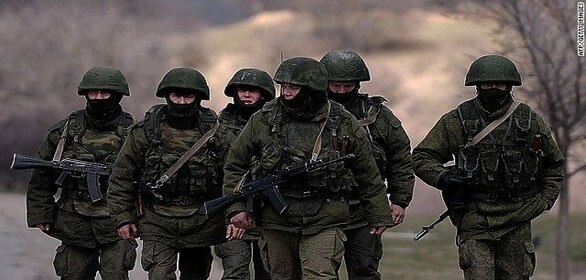
“Russia reinforced what Western and Ukrainian officials described as a stealth invasion on Wednesday [August 27], sending armored troops across the border as it expanded the conflict to a new section of Ukrainian territory. The latest incursion, which Ukraine’s military said included five armored personnel carriers, was at least the third movement of troops and weapons from Russia across the southeast part of the border this week.”
None of the photos accompanying this New York Times story online showed any of these Russian troops or armored vehicles.
“The Obama administration,” the story continued, “has asserted over the past week that the Russians had moved artillery, air-defense systems and armor to help the separatists in Donetsk and Luhansk. ‘These incursions indicate a Russian-directed counteroffensive is likely underway’, Jen Psaki, the State Department spokeswoman, said. At the department’s daily briefing in Washington, Ms. Psaki also criticized what she called the Russian government’s ‘unwillingness to tell the truth’ that its military had sent soldiers as deep as 30 miles inside Ukraine territory.”
Thirty miles inside Ukraine territory and not a single satellite photo, not a camera anywhere around, not even a one-minute video to show for it. “Ms. Psaki apparently [sic] was referring to videos of captured Russian soldiers, distributed by the Ukrainian government.” The Times apparently forgot to inform its readers where they could see these videos.
“The Russian aim, one Western official said, may possibly be to seize an outlet to the sea in the event that Russia tries to establish a separatist enclave in eastern Ukraine.”
This of course hasn’t taken place. So what happened to all these Russian soldiers 30 miles inside Ukraine? What happened to all the armored vehicles, weapons, and equipment?
“The United States has photographs that show the Russian artillery moved into Ukraine, American officials say. One photo dated last Thursday, shown to a New York Times reporter, shows Russian military units moving self-propelled artillery into Ukraine. Another photo, dated Saturday, shows the artillery in firing positions in Ukraine.”
Where are these photographs? And how will we know that these are Russian soldiers? And how will we know that the photos were taken in Ukraine? But most importantly, where are the fucking photographs?
Why am I so cynical? Because the Ukrainian and US governments have been feeding us these scare stories for eight months now, without clear visual or other evidence, often without even common sense. Here are a few of the many other examples, before and after the one above:
- The Wall Street Journal (March 28) reported: “Russian troops massing near Ukraine are actively concealing their positions and establishing supply lines that could be used in a prolonged deployment, ratcheting up concerns that Moscow is preparing for another [sic] major incursion and not conducting exercises as it claims, US officials said.”
- “The Ukrainian government charged that the Russian military was not only approaching but had actually crossed the border into rebel-held regions.” (Washington Post, November 7)
- “U.S. Air Force Gen. Philip M. Breedlove told reporters in Bulgaria that NATO had observed Russian tanks, Russian artillery, Russian air defense systems and Russian combat troops enter Ukraine across a completely wide-open border with Russia in the previous two days.” (Washington Post, November 13)
- “Ukraine accuses Russia of sending more soldiers and weapons to help rebels prepare for a new offensive. The Kremlin has repeatedly denied aiding the separatists.” (Reuters, November 16)
Since the February US-backed coup in Ukraine, the State Department has made one accusation after another about Russian military actions in Eastern Ukraine without presenting any kind of satellite imagery or other visual or documentary evidence; or they present something that’s very unclear and wholly inconclusive, such as unmarked vehicles, or unsourced reports, or citing “social media”; what we’re left with is often no more than just an accusation. The Ukrainian government has matched them.
On top of all this we should keep in mind that if Moscow decided to invade Ukraine they’d certainly provide air cover for their ground forces. There has been no mention of air cover.
This is all reminiscent of the numerous stories in the past three years of “Syrian planes bombing defenseless citizens”. Have you ever seen a photo or video of a Syrian government plane dropping bombs? Or of the bombs exploding? When the source of the story is mentioned, it’s almost invariably the rebels who are fighting against the Syrian government. Then there’s the “chemical weapon” attacks by the same evil Assad government. When a photo or video has accompanied the story I’ve never once seen grieving loved ones or media present; not one person can be seen wearing a gas mask. Is it only children killed or suffering? No rebels?
And then there’s the July 17 shootdown of Malaysia Flight MH17, over eastern Ukraine, taking 298 lives, which Washington would love to pin on Russia or the pro-Russian rebels. The US government – and therefore the US media, the EU, and NATO – want us all to believe it was the rebels and/or Russia behind it. The world is still waiting for any evidence. Or even a motivation. Anything at all. President Obama is not waiting. In a talk on November 15 in Australia, he spoke of “opposing Russia’s aggression against Ukraine – which is a threat to the world, as we saw in the appalling shoot-down of MH17”. Based on my reading, I’d guess that it was the Ukranian government behind the shootdown, mistaking it for Putin’s plane that reportedly was in the area.
Can it be said with certainty that all the above accusations were lies? No, but the burden of proof is on the accusers, and the world is still waiting. The accusers would like to create the impression that there are two sides to each question without actually having to supply one of them.
The United States punishing Cuba
For years American political leaders and media were fond of labeling Cuba an “international pariah”. We haven’t heard that for a very long time. Perhaps one reason is the annual vote in the United Nations General Assembly on the resolution which reads: “Necessity of ending the economic, commercial and financial embargo imposed by the United States of America against Cuba”. This is how the vote has gone (not including abstentions):
| Year | Votes (Yes-No) | No Votes |
|---|---|---|
| 1992 | 59-2 | US, Israel |
| 1993 | 88-4 | US, Israel, Albania, Paraguay |
| 1994 | 101-2 | US, Israel |
| 1995 | 117-3 | US, Israel, Uzbekistan |
| 1996 | 138-3 | US, Israel, Uzbekistan |
| 1997 | 143-3 | US, Israel, Uzbekistan |
| 1998 | 157-2 | US, Israel |
| 1999 | 155-2 | US, Israel |
| 2000 | 167-3 | US, Israel, Marshall Islands |
| 2001 | 167-3 | US, Israel, Marshall Islands |
| 2002 | 173-3 | US, Israel, Marshall Islands |
| 2003 | 179-3 | US, Israel, Marshall Islands |
| 2004 | 179-4 | US, Israel, Marshall Islands, Palau |
| 2005 | 182-4 | US, Israel, Marshall Islands, Palau |
| 2006 | 183-4 | US, Israel, Marshall Islands, Palau |
| 2007 | 184-4 | US, Israel, Marshall Islands, Palau |
| 2008 | 185-3 | US, Israel, Palau |
| 2009 | 187-3 | US, Israel, Palau |
| 2010 | 187-2 | US, Israel |
| 2011 | 186-2 | US, Israel |
| 2012 | 188-3 | US, Israel, Palau |
| 2013 | 188-2 | US, Israel |
| 2014 | 188-2 | US, Israel |
This year Washington’s policy may be subject to even more criticism than usual due to the widespread recognition of Cuba’s response to the Ebola outbreak in Africa.
Each fall the UN vote is a welcome reminder that the world has not completely lost its senses and that the American empire does not completely control the opinion of other governments.
Speaking before the General Assembly before last year’s vote, Cuban Foreign Minister Bruno Rodriguez declared: “The economic damages accumulated after half a century as a result of the implementation of the blockade amount to $1.126 trillion.” He added that the blockade “has been further tightened under President Obama’s administration”, some 30 US and foreign entities being hit with $2.446 billion in fines due to their interaction with Cuba.
However, the American envoy, Ronald Godard, in an appeal to other countries to oppose the resolution, said:
The international community … cannot in good conscience ignore the ease and frequency with which the Cuban regime silences critics, disrupts peaceful assembly, impedes independent journalism and, despite positive reforms, continues to prevent some Cubans from leaving or returning to the island. The Cuban government continues its tactics of politically motivated detentions, harassment and police violence against Cuban citizens.
So there you have it. That is why Cuba must be punished. One can only guess what Mr. Godard would respond if told that more than 7,000 people were arrested in the United States during the Occupy Movement’s first 8 months of protest in 2011-12 ; that many of them were physically abused by the police; and that their encampments were violently destroyed.
Does Mr. Godard have access to any news media? Hardly a day passes in America without a police officer shooting to death an unarmed person.
As to “independent journalism” – What would happen if Cuba announced that from now on anyone in the country could own any kind of media? How long would it be before CIA money – secret and unlimited CIA money financing all kinds of fronts in Cuba – would own or control most of the media worth owning or controlling?
The real reason for Washington’s eternal hostility toward Cuba has not changed since the revolution in 1959 – The fear of a good example of an alternative to the capitalist model; a fear that has been validated repeatedly over the years as many Third World countries have expressed their adulation of Cuba.
How the embargo began: On April 6, 1960, Lester D. Mallory, US Deputy Assistant Secretary of State for Inter-American Affairs, wrote in an internal memorandum: “The majority of Cubans support Castro … The only foreseeable means of alienating internal support is through disenchantment and disaffection based on economic dissatisfaction and hardship. … every possible means should be undertaken promptly to weaken the economic life of Cuba.” Mallory proposed “a line of action which … makes the greatest inroads in denying money and supplies to Cuba, to decrease monetary and real wages, to bring about hunger, desperation and overthrow of government.”
Later that year, the Eisenhower administration instituted its suffocating embargo against its everlasting enemy.
The United States judging and punishing the rest of the world
In addition to Cuba, Washington currently is imposing economic and other sanctions against Burma, Democratic Republic of the Congo, Iran, China, North Korea, South Korea, United Arab Emirates, Pakistan, Sri Lanka, Switzerland, Turkey, Germany, Malaysia, South Africa, Mexico, South Sudan, Sudan, Russia, Syria, Venezuela, India, and Zimbabwe. These are sanctions mainly against governments, but also against some private enterprises; there are also many other sanctions against individuals not included here.
Imbued with a sense of America’s moral superiority and “exceptionalism”, each year the State Department judges the world, issuing reports evaluating the behavior of all other nations, often accompanied by sanctions of one kind or another. There are different reports rating how each lesser nation has performed in the previous year in areas such as religious freedom, human rights, the war on drugs, trafficking in persons, and sponsors of terrorism. The criteria used in these reports are often political. Cuba, for example, is always listed as a sponsor of terrorism whereas anti-Castro exile groups in Florida, which have committed literally hundreds of terrorist acts over the years, are not listed as terrorist groups or supporters of such.
Cuba, which has been on the sponsor-of-terrorism list longer (since 1982) than any other country, is one of the most glaring anomalies. The most recent State Department report on this matter, in 2012, states that there is “no indication that the Cuban government provided weapons or paramilitary training to terrorist groups.” There are, however, some retirees of Spain’s Basque terrorist group ETA (which appears on the verge of disbanding) in Cuba, but the report notes that the Cuban government evidently is trying to distance itself from them by denying them services such as travel documents. Some members of the Revolutionary Armed Forces of Colombia (FARC) have been allowed into Cuba, but that was because Cuba was hosting peace talks between the FARC and the Colombian government, which the report notes.
The US sanctions mechanism is so effective and formidable that it strikes fear (of huge fines) into the hearts of banks and other private-sector organizations that might otherwise consider dealing with a listed state.
Some selected thoughts on American elections and democracy
In politics, as on the sickbed, people toss from one side to the other, thinking they will be more comfortable.
– Johann Wolfgang von Goethe (1749-1832)
- 2012 presidential election:
223,389,800 eligible to vote
128,449,140 actually voted
Obama got 65,443,674 votes
Obama was thus supported by 29.3% of eligible voters - There are 100 million adults in the United States who do not vote. This is a very large base from which an independent party can draw millions of new votes.
- If God had wanted more of us to vote in elections, he would give us better candidates.
- “The people can have anything they want. The trouble is, they do not want anything. At least they vote that way on election day.” – Eugene Debs, American socialist leader (1855-1926)
- “If persons over 60 are the only American age group voting at rates that begin to approximate European voting, it’s because they’re the only Americans who live in a welfare state – Medicare, Social Security, and earlier, GI loans, FHA loans.” – John Powers
- “The American political system is essentially a contract between the Republican and Democratic parties, enforced by federal and state two-party laws, all designed to guarantee the survival of both no matter how many people despise or ignore them.” – Richard Reeves (1936- )
- The American electoral system, once the object of much national and international pride, has slid inexorably from “one person, one vote”, to “one dollar, one vote”.
- Noam Chomsky: “It is important to bear in mind that political campaigns are designed by the same people who sell toothpaste and cars. Their professional concern in their regular vocation is not to provide information. Their goal, rather, is deceit.”
- If the Electoral College is such a good system, why don’t we have it for local and state elections?
- “All the props of a democracy remain intact – elections, legislatures, media – but they predominantly function at the service of the oligarchy.” – Richard Wolff
- The RepDem Party holds elections as if they were auctions; indeed, an outright auction for the presidency would be more efficient. To make the auction more interesting we need a second party, which must at a minimum be granted two privileges: getting on the ballot in all 50 states and taking part in television debates.
- The US does in fact have two parties: the Ins and the Outs … the evil of two lessers.
- Alexander Cockburn: “There was a time once when ‘lesser of two evils’ actually meant something momentous, like the choice between starving to death on a lifeboat, or eating the first mate.”
- Cornel West has suggested that it’s become difficult to even imagine what a free and democratic society, without great concentrations of corporate power, would look like, or how it would operate.
- The United States now resembles a police state punctuated by elections.
- How many voters does it take to change a light bulb? None. Because voters can’t change anything.
- H.L. Mencken (1880-1956): “As democracy is perfected, the office represents, more and more closely, the inner soul of the people. We move toward a lofty ideal. On some great and glorious day the plain folks of the land will reach their heart’s desire at last, and the White House will be adorned by a downright moron.”
- “All elections are distractions. Nothing conceals tyranny better than elections.” – Joel Hirschhorn
- In 1941, one of the country’s more acerbic editors, a priest named Edward Dowling, commented: “The two greatest obstacles to democracy in the United States are, first, the widespread delusion among the poor that we have a democracy, and second, the chronic terror among the rich, lest we get it.”
- “Elections are a necessary, but certainly not a sufficient, condition for democracy. Political participation is not just a casting of votes. It is a way of life.” – UN Human Development Report, 1993
- “If you don’t vote, you can’t complain!” I reply, “You have it backwards. If you DO vote, you can’t complain. You asked for it, and they’re going to give it to you, good and hard.”
- “How to get people to vote against their interests and to really think against their interests is very clever. It’s the cleverest ruling class that I have ever come across in history. It’s been 200 years at it. It’s superb.” – Gore Vidal
- We can’t use our democracy/our vote to change the way the economy functions. This is very anti-democratic.
- What does a majority vote mean other than that the sales campaign was successful?
- Roman Emperor Marcus Aurelius: “The opinion of 10,000 men is of no value if none of them know anything about the subject.”
- We do have representative government. The question is: Who does our government represent?
- “On the day after the 2002 election I watched a crawl on the bottom of the CNN news screen. It said, ‘Proprietary software may make inspection of electronic voting systems impossible.’ It was the final and absolute coronation of corporate rights over democracy; of money over truth.” – Mike Ruppert, RIP
- “It’s not that voting is useless or stupid; rather, it’s the exaggeration of the power of voting that has drained the meaning from American politics.” – Michael Ventura
- After going through the recent national, state and local elections, I am now convinced that taxation without representation would have been a much better system.
- “Ever since the Constitution was illegally foisted on the American people we have lived in a blatant plutocracy. The Constitution was drafted in secret by a self-appointed elite committee, and it was designed to bring three kinds of power under control: Royalty, the Church, and the People. All were to be subjugated to the interests of a wealthy elite. That’s what republics were all about. And that’s how they have functioned ever since.” – Richard K. Moore
- “As demonstrated in Russia and numerous other countries, when faced with a choice between democracy without capitalism or capitalism without democracy, Western elites unhesitatingly embrace the latter.” – Michael Parenti
- “The fact that a supposedly sophisticated electorate had been stampeded by the cynical propaganda of the day threw serious doubt on the validity of the assumptions underlying parliamentary democracy as a whole.” – British Superspy for the Soviets Kim Philby (1912-1988), explaining his reasons for becoming a Communist instead of turning to the Labour Party
- US Supreme Court Justice Louis Brandeis (1856-1941): “We may have democracy in this country, or we may have wealth concentrated in the hands of a few, but we cannot have both.”
- “We don’t need to run America like a business or like the military. We need to run America like a democracy.” – Jill Stein, Green Party presidential candidate 2012
Notes
- Democracy Now!, October 30, 2013
- Huffingfton Post, May 3, 2012
- Department of State, Foreign Relations of the United States, 1958-1960, Volume VI, Cuba(1991), p.885 (online here)
- For the complete detailed list, see U.S. Department of State, Nonproliferation Sanctions
- U.S. Department of State, “Country Reports on Terrorism 2012, Chapter 3: State Sponsors of Terrorism,” May 20, 2013
William Blum is the author of:
- Killing Hope: US Military and CIA Interventions Since World War 2
- Rogue State: A Guide to the World’s Only Superpower
- West-Bloc Dissident: A Cold War Memoir
- Freeing the World to Death: Essays on the American Empire
Portions of the books can be read, and signed copies purchased, at www.killinghope.org
Email to
Website: WilliamBlum.org
William Blum is a regular columnist for Veracity Voice
The Islamist State
October 18, 2014 by Administrator · Leave a Comment

You can’t believe a word the United States or its mainstream media say about the current conflict involving The Islamic State (ISIS).
You can’t believe a word France or the United Kingdom say about ISIS.
You can’t believe a word Turkey, Saudi Arabia, Qatar, Kuwait, Jordan, or the United Arab Emirates say about ISIS. Can you say for sure which side of the conflict any of these mideast countries actually finances, arms, or trains, if in fact it’s only one side? Why do they allow their angry young men to join Islamic extremists? Why has NATO-member Turkey allowed so many Islamic extremists to cross into Syria? Is Turkey more concerned with wiping out the Islamic State or the Kurds under siege by ISIS? Are these countries, or the Western powers, more concerned with overthrowing ISIS or overthrowing the Syrian government of Bashar al-Assad?
You can’t believe the so-called “moderate” Syrian rebels. You can’t even believe that they are moderate. They have their hands in everything, and everyone has their hands in them.
Iran, Hezbollah and Syria have been fighting ISIS or its precursors for years, but the United States refuses to join forces with any of these entities in the struggle. Nor does Washington impose sanctions on any country for supporting ISIS as it quickly did against Russia for its alleged role in Ukraine.
The groundwork for this awful mess of political and religious horrors sweeping through the Middle East was laid – laid deeply – by the United States during 35 years (1979-2014) of overthrowing the secular governments of Afghanistan, Iraq, Libya, and Syria. (Adding to the mess in the same period we should not forget the US endlessly bombing Pakistan, Somalia and Yemen.) You cannot destroy modern, relatively developed and educated societies, ripping apart the social, political, economic and legal fabric, torturing thousands, killing millions, and expect civilization and human decency to survive.
Particularly crucial in this groundwork was the US decision to essentially throw 400,000 Iraqis with military training, including a full officer corps, out onto the streets of its cities, jobless. It was a formula for creating an insurgency. Humiliated and embittered, some of those men would later join various resistance groups operating against the American military occupation. It’s safe to say that the majority of armored vehicles, weapons, ammunition, and explosives taking lives every minute in the Middle East are stamped “Made in USA”.
And all of Washington’s horses, all of Washington’s men, cannot put this world back together again. The world now knows these places as “failed states”.
Meanwhile, the United States bombs Syria daily, ostensibly because the US is at war with ISIS, but at the same time seriously damaging the oil capacity of the country (a third of the Syrian government’s budget), the government’s military capabilities, its infrastructure, even its granaries, taking countless innocent lives, destroying ancient sites; all making the recovery of an Assad-led Syria, or any Syria, highly unlikely. Washington is undoubtedly looking for ways to devastate Iran as well under the cover of fighting ISIS.
Nothing good can be said about this whole beastly situation. All the options are awful. All the participants, on all sides, are very suspect, if not criminally insane. It may be the end of the world. To which I say … Good riddance. Nice try, humans; in fact, GREAT TRY … but good riddance. ISIS … Ebola … Climate Change … nuclear radiation … The Empire … Which one will do us in first? … Have a nice day.
Is the world actually so much more evil and scary today than it was in the 1950s of my upbringing, for which I grow more nostalgic with each new horror? Or is it that the horrors of today are so much better reported, as we swim in a sea of news and videos?
After seeing several ISIS videos on the Internet, filled with the most disgusting scenes, particularly against women, my thought is this: Give them their own country; everyone who’s in that place now who wants to leave, will be helped to do so; everyone from all over the world who wants to go there will be helped to get there. Once they’re there, they can all do whatever they want, but they can’t leave without going through a rigorous interview at a neighboring border to ascertain whether they’ve recovered their attachment to humanity. However, since very few women, presumably, would go there, the country would not last very long.
The Berlin Wall – Another Cold War Myth
November 9 will mark the 25th anniversary of the tearing down of the Berlin Wall. The extravagant hoopla began months ago in Berlin. In the United States we can expect all the Cold War clichés about The Free World vs. Communist Tyranny to be trotted out and the simple tale of how the wall came to be will be repeated: In 1961, the East Berlin communists built a wall to keep their oppressed citizens from escaping to West Berlin and freedom. Why? Because commies don’t like people to be free, to learn the “truth”. What other reason could there have been?
First of all, before the wall went up in 1961 thousands of East Germans had been commuting to the West for jobs each day and then returning to the East in the evening; many others went back and forth for shopping or other reasons. So they were clearly not being held in the East against their will. Why then was the wall built? There were two major reasons:
1) The West was bedeviling the East with a vigorous campaign of recruiting East German professionals and skilled workers, who had been educated at the expense of the Communist government. This eventually led to a serious labor and production crisis in the East. As one indication of this, the New York Times reported in 1963: “West Berlin suffered economically from the wall by the loss of about 60,000 skilled workmen who had commuted daily from their homes in East Berlin to their places of work in West Berlin.”
It should be noted that in 1999, USA Today reported: “When the Berlin Wall crumbled [1989], East Germans imagined a life of freedom where consumer goods were abundant and hardships would fade. Ten years later, a remarkable 51% say they were happier with communism.” Earlier polls would likely have shown even more than 51% expressing such a sentiment, for in the ten years many of those who remembered life in East Germany with some fondness had passed away; although even 10 years later, in 2009, the Washington Post could report: “Westerners [in Berlin] say they are fed up with the tendency of their eastern counterparts to wax nostalgic about communist times.”
It was in the post-unification period that a new Russian and eastern Europe proverb was born: “Everything the Communists said about Communism was a lie, but everything they said about capitalism turned out to be the truth.”
It should be further noted that the division of Germany into two states in 1949 – setting the stage for 40 years of Cold War hostility – was an American decision, not a Soviet one.
2) During the 1950s, American coldwarriors in West Germany instituted a crude campaign of sabotage and subversion against East Germany designed to throw that country’s economic and administrative machinery out of gear. The CIA and other US intelligence and military services recruited, equipped, trained and financed German activist groups and individuals, of West and East, to carry out actions which ran the spectrum from juvenile delinquency to terrorism; anything to make life difficult for the East German people and weaken their support of the government; anything to make the commies look bad.
It was a remarkable undertaking. The United States and its agents used explosives, arson, short circuiting, and other methods to damage power stations, shipyards, canals, docks, public buildings, gas stations, public transportation, bridges, etc; they derailed freight trains, seriously injuring workers; burned 12 cars of a freight train and destroyed air pressure hoses of others; used acids to damage vital factory machinery; put sand in the turbine of a factory, bringing it to a standstill; set fire to a tile-producing factory; promoted work slow-downs in factories; killed 7,000 cows of a co-operative dairy through poisoning; added soap to powdered milk destined for East German schools; were in possession, when arrested, of a large quantity of the poison cantharidin with which it was planned to produce poisoned cigarettes to kill leading East Germans; set off stink bombs to disrupt political meetings; attempted to disrupt the World Youth Festival in East Berlin by sending out forged invitations, false promises of free bed and board, false notices of cancellations, etc.; carried out attacks on participants with explosives, firebombs, and tire-puncturing equipment; forged and distributed large quantities of food ration cards to cause confusion, shortages and resentment; sent out forged tax notices and other government directives and documents to foster disorganization and inefficiency within industry and unions … all this and much more.
The Woodrow Wilson International Center for Scholars, of Washington, DC, conservative coldwarriors, in one of their Cold War International History Project Working Papers (#58, p.9) states: “The open border in Berlin exposed the GDR [East Germany] to massive espionage and subversion and, as the two documents in the appendices show, its closure gave the Communist state greater security.”
Throughout the 1950s, the East Germans and the Soviet Union repeatedly lodged complaints with the Soviets’ erstwhile allies in the West and with the United Nations about specific sabotage and espionage activities and called for the closure of the offices in West Germany they claimed were responsible, and for which they provided names and addresses. Their complaints fell on deaf ears. Inevitably, the East Germans began to tighten up entry into the country from the West, leading eventually to the infamous wall. However, even after the wall was built there was regular, albeit limited, legal emigration from east to west. In 1984, for example, East Germany allowed 40,000 people to leave. In 1985, East German newspapers claimed that more than 20,000 former citizens who had settled in the West wanted to return home after becoming disillusioned with the capitalist system. The West German government said that 14,300 East Germans had gone back over the previous 10 years.
Let’s also not forget that while East Germany completely denazified, in West Germany for more than a decade after the war, the highest government positions in the executive, legislative, and judicial branches contained numerous former and “former” Nazis.
Finally, it must be remembered, that Eastern Europe became communist because Hitler, with the approval of the West, used it as a highway to reach the Soviet Union to wipe out Bolshevism forever, and that the Russians in World War I and II, lost about 40 million people because the West had used this highway to invade Russia. It should not be surprising that after World War II the Soviet Union was determined to close down the highway.
For an additional and very interesting view of the Berlin Wall anniversary, see the article “Humpty Dumpty and the Fall of Berlin’s Wall” by Victor Grossman. Grossman (née Steve Wechsler) fled the US Army in Germany under pressure from McCarthy-era threats and became a journalist and author during his years in the (East) German Democratic Republic. He still lives in Berlin and mails out his “Berlin Bulletin” on German developments on an irregular basis. You can subscribe to it at. His autobiography: “Crossing the River: a Memoir of the American Left, the Cold War and Life in East Germany” was published by University of Massachusetts Press. He claims to be the only person in the world with diplomas from both Harvard University and Karl Marx University in Leipzig.
Al Franken, the liberal’s darling
I receive a continuous stream of emails from “progressive” organizations asking me to vote for Senator Franken or contribute to his re-election campaign this November, and I don’t even live in Minnesota. Even if I could vote for him, I wouldn’t. No one who was a supporter of the war in Iraq will get my vote unless they unequivocally renounce that support. And I don’t mean renounce it like Hillary Clinton’s nonsense about not having known enough.
Franken, the former Saturday Night Live comedian, would like you to believe that he’s been against the war in Iraq since it began. But he went to Iraq at least four times to entertain the troops. Does that make sense? Why does the military bring entertainers to soldiers? To lift the soldiers’ spirits of course. And why does the military want to lift the soldiers’ spirits? Because a happier soldier does his job better. And what is the soldier’s job? All the charming war crimes and human-rights violations that I and others have documented in great detail for many years. Doesn’t Franken know what American soldiers do for a living?
A year after the US invasion in 2003, Franken criticized the Bush administration because they “failed to send enough troops to do the job right.” What “job” did the man think the troops were sent to do that had not been performed to his standards because of lack of manpower? Did he want them to be more efficient at killing Iraqis who resisted the occupation? The volunteer American troops in Iraq did not even have the defense of having been drafted against their wishes.
Franken has been lifting soldiers’ spirits for a long time. In 2009 he was honored by the United Service Organization (USO) for his ten years of entertaining troops abroad. That includes Kosovo in 1999, as imperialist an occupation as you’ll want to see. He called his USO experience “one of the best things I’ve ever done.” Franken has also spoken at West Point (2005), encouraging the next generation of imperialist warriors. Is this a man to challenge the militarization of America at home and abroad? No more so than Barack Obama.
Tom Hayden wrote this about Franken in 2005 when Franken had a regular program on the Air America radio network: “Is anyone else disappointed with Al Franken’s daily defense of the continued war in Iraq? Not Bush’s version of the war, because that would undermine Air America’s laudable purpose of rallying an anti-Bush audience. But, well, Kerry’s version of the war, one that can be better managed and won, somehow with better body armor and fewer torture cells.”
While in Iraq to entertain the troops, Franken declared that the Bush administration “blew the diplomacy so we didn’t have a real coalition,” then failed to send enough troops to do the job right. “Out of sheer hubris, they have put the lives of these guys in jeopardy.”
Franken was implying that if the United States had been more successful in bribing and threatening other countries to lend their name to the coalition fighting the war in Iraq the United States would have had a better chance of WINNING the war.
Is this the sentiment of someone opposed to the war? Or in support of it? It is the mind of an American liberal in all its beautiful mushiness.
Notes
- Derived from William Astore, “Investing in Junk Armies”, TomDispatch, October 14, 2014
- New York Times, June 27, 1963, p.12
- USA Today, October 11, 1999, p.1
- Washington Post, May 12, 2009; see a similar story November 5, 2009
- Carolyn Eisenberg, “Drawing the Line: The American Decision to Divide Germany, 1944-1949” (1996); or see a concise review of this book by Kai Bird in The Nation, December 16, 1996
- See William Blum, “Killing Hope: US Military and CIA Interventions Since World War II”, p.400, note 8, for a list of sources for the details of the sabotage and subversion.
- The Guardian (London), March 7, 1985
- Washington Post, February 16, 2004
- Star Tribune, Minneapolis, March 26, 2009
- Huffington Post, June 2005
- Washington Post, February 16, 2004
William Blum is the author of:
- Killing Hope: US Military and CIA Interventions Since World War 2
- Rogue State: A Guide to the World’s Only Superpower
- West-Bloc Dissident: A Cold War Memoir
- Freeing the World to Death: Essays on the American Empire
Portions of the books can be read, and signed copies purchased, at www.killinghope.org
Email to
Website: WilliamBlum.org
William Blum is a regular columnist for Veracity Voice
Who’s Bombing Libya?
September 27, 2014 by Administrator · Leave a Comment

In the bizarro world which is the Middle East these days, nothing is more bizarre than the repeated bombing of Libya by parties unknown. There were off-and-on aerial attacks in the eastern part of the country – Benghazi, Derna, Ajdabiyah – last spring which were believed to have been carried out by one of the contending parties in the civil war raging in Libya, but lately there have been a number of attacks in the west, around Tripoli, which no one has taken the credit – or blame – for.
The attacks in the east are attributed to remnants of the Libyan air force under the command of a dissident general from the Qaddafi era, Khalifa Haftar. Haftar spent the last couple of decades prior to NATO’s aggression against Libya ensconced in McLean, Virginia, where he would take his kids trick-or-treating down the street at his neighbor’s place: CIA Headquarters (got some treats for himself there as well no doubt). He now leads one of the umpteen militias competing for power in Libya. He calls his campaign “Operation Dignity” and has won the support of the more secular, Western-oriented players in Libyan politics.
The Operation Dignity supporters are embodied in a House of Representatives elected last June. It presently rules the country from Tobruk, a town east of Benghazi almost on the border with Egypt (yes, WW II buffs, that Tobruk),. Funny place for what bills itself as the government of the nation and is recognized as such by those countries which believe Libya has a government to reside; but they had no choice, having been driven out of the real capital, Tripoli, by an amalgam of Islamist militias calling themselves “Operation Libyan Dawn”. The Dawnists enjoy the support of the Grand Mufti of Libya and have succeeded in securing control of Tripoli and most of Benghazi.
(Funny sidelight: Tobruk, being a fairly small place, doesn’t have sufficient accommodations for all the HoR legislators and bureaucrats, so they leased a Greek car ferry, the Elyros, to live on. Now the ship’s owner wants his ship back and has demanded that they leave. As of this date, they have refused to disembark.)
No one believes Haftar’s forces have the capability to have carried out the bombings in the west of the country. The first, on August 17th and 18th, occurred in Tripoli. This was followed by an attack on an ammo dump in the town of Ghariyan on September 15th. Then, just today (9/24), Tripoli was bombed again. All the air attacks have been against positions held by Islamist forces.
No one has claimed responsibility for these attacks. We attributed the August bombings to the United Arab Emirates acting in collaboration with Egypt, but those two countries denied it was them and we rescinded our attribution. The head of the government in domestic exile, Prime Minister Abdullah al-Thinni, does not hold the UAE or Egypt responsible. Nor does Libya’s UN ambassador. So who’s bombing Libya?
Interestingly, the most recent attack came two days after 15 countries released a communique at the United Nations calling for non-interference in Libya. The countries are Algeria, Egypt, France, Germany, Italy, Qatar, Saudi Arabia, Spain, Tunisia, Turkey, the UAE, UK, US. If we take these signatories at their word (which I am not suggesting is appropriate as they have been the prime meddlers in Libyan affairs), who does that leave who could be conducting the raids?
Everyone’s, well, almost everyone’s, favorite bete noire in the area comes to mind: Israel. In fact, the Israelis pretty much win by default. Some might like to blame that other Middle Eastern bete noire,Iran, but that hardly seems likely or feasible. Why would they intervene in support of Our Man from Langley and how could they, lacking appropriate bases on land or sea. Russia? China? Burkina Fasso? No one other than the Israelis makes much sense. Now if you assume someone had their fingers crossed when they signed that communique, then a whole host of suspects arises, in fact the entire list!
If we ever do find out who is bombing Libya, it might shed some light on developments elsewhere in the turbulently jumbled Middle East. On the other hand, it might prove to be an inconsequential sideshow, a mere addendum to Libya’s existing entry in world trivia: the country in which the first aerial bombardment took place (by the Italians in 1911). Who bombed Libya in 2014? If you know the answer, you must be clairvoyant!
Ken Meyercord is a regular columnist for Veracity Voice.
Ken Meyercord produces a public access TV show called Worlddocs which “brings the world to the people of the Washington, DC area through documentaries you won’t see broadcast on corporate TV.” He has a Master’s in Middle East History from the American University of Beirut. He can be contacted at .
September 11, 2014 – What Happened To World Peace?
September 12, 2014 by Administrator · Leave a Comment

As the memorials for September 11, 2001 end it is time to remember the potential for peace which existed in the days following.
The world grieved with us.
Ordinary people around the globe reacted with outpourings of sympathy, protesting these acts of terrorism. World leaders immediately responded, condemning the murders and offering support. Among these leaders was Vladimir Putin. Russia’s president urged “the entire international community should unite in the struggle against terrorism,” also saying the attacks were “a blatant challenge to humanity.”
Libyan leader Muammar Qaddafi called the attacks “horrifying” telling Muslims that “irrespective of the conflict with America it is a human duty to show sympathy with the American people.” Mohammed Khatami, president of Iran, expressed, “deep regret and sympathy with the victims.” Yasser Arafat, Palestinian president, denounced the attacks. Appearing stunned, he repeated how, “unbelievable” they were.
Saddam Hussein expressed sympathy for those who died.
North Korea also offered its sympathy to Americans.
Few people demonstrated anything but sympathy for America. Prayers and vigils by people of most faiths took place as across the world tens of thousands came out to protest the attacks.
So, who planned the attacks?
Osama bin Laden adamantly denied involvement in the 9/11 attacks in an interview by Ummat, a Pakistani daily, published in Karachi on September 28, 2001 He expressed his views on the loss of life, saying, “Islam strictly forbids causing harm to innocent women, children, and other people.”
Osama went on to say, “They needed an enemy. So, they first started propaganda against Usamah and Taleban and then this incident happened.” Speculating who was to blame, he advised looking, “within the US system,” or for those responsible, or for persons who seeking conflict between Islam and Christianity. Finally, he suggested involvement by American intelligence agencies.
Terror, Obama said, “is the most dreaded weapon in modern age and the Western media is mercilessly using it against its own people.”
According to the CIA 15 of the 19 hijackers had Saudi citizenship, 2 United Arab Emirates, 1, Egyptian and 1 Lebanese.
No plan to invade Saudi Arabia was suggested by Bush.
Afghanistan was not involved in 9/11, yet we invaded them. Iraq had no weapons of mass destruction. Saddam Hussein expressed his willingness to leave Iraq, if paid. But we invaded. Millions died.
These wars were policy built on lies. Find those who benefited and you have all the answers.
Melinda Pillsbury-Foster will soon begin her new weekly radio program on Surviving Meltdown. The program examines how government can be brought into alignment with the spiritual goal of decentralizing power and localizing control and links also to America Goes Home americagoeshome.org, a site dedicated to providing information and resources.
She is also the author of GREED: The NeoConning of America and A Tour of Old Yosemite. The former is a novel about the lives of the NeoCons with a strong autobiographical component. The latter is a non-fiction book about her father and grandfather.
Her blog is at: http://howtheneoconsstolefreedom.blogspot.com/ She is the founder of the Arthur C. Pillsbury Foundation. She is the mother of five children and three grandchildren.
Melinda Pillsbury-Foster is a regular columnist for Veracity Voice
Splitting Up Iraq: It’s All For Israel
June 21, 2014 by Administrator · Leave a Comment

“It is no longer plausible to argue that ISIS was a result of unintentional screw ups by the US. It is a clear part of a US strategy to break up the Iran-Iraq-Syria-Hezbollah alliance. Now that strategy may prove to be a total failure and end up backfiring, but make no mistake, ISIS IS the strategy.” – Lysander, Comments line, Moon of Alabama
“US imperialism has been the principal instigator of sectarianism in the region, from its divide-and-conquer strategy in the war and occupation in Iraq, to the fomenting of sectarian civil war to topple Assad in Syria. Its cynical support for Sunni Islamist insurgents in Syria, while backing a Shiite sectarian regime across the border in Iraq to suppress these very same forces, has brought the entire Middle East to what a United Nations panel on Syria warned Tuesday was the “cusp of a regional war.” – Bill Van Auken, Obama orders nearly 300 US troops to Iraq, WSWS
Let cut to the chase: Barack Obama is blackmailing Nouri al-Maliki by withholding military support until the Iraqi Prime Minister agrees to step down. In other words, we are mid-stream in another regime change operation authored by Washington. What’s different about this operation, is the fact that Obama is using a small army of jihadi terrorists –who have swept to within 50 miles of Baghdad–to hold the gun to Mr. al Maliki’s head. Not surprisingly, al Maliki has refused to cooperate which means the increasingly-tense situation could explode into a civil war. Here’s the scoop from the Guardian in an article aptly titled “Iraq’s Maliki: I won’t quit as condition of US strikes against Isis militants”:
“A spokesman for the Iraqi prime minister, Nouri al-Maliki, has said he will not stand down as a condition of US air strikes against Sunni militants who have made a lightning advance across the country.
Iraq’s foreign minister, Hoshyar Zebari, on Wednesday made a public call on al-Arabiya television for the US to launch strikes, but Barack Obama has come under pressure from senior US politicians to persuade Maliki… to step down over what they see as failed leadership in the face of an insurgency…
The White House has not called for Maliki to go but its spokesman Jay Carney said that whether Iraq was led by Maliki or a successor, “we will aggressively attempt to impress upon that leader the absolute necessity of rejecting sectarian governance”. (Iraq’s Maliki: I won’t quit as condition of US strikes against Isis militants, Guardian)
Obviously, the White House can’t tell al Maliki to leave point-blank or it would affect their credibility as proponents of democracy. But the fix is definitely in and the administration’s plan to oust al Maliki is well underway. Check out this clip from the Wall Street Journal:
“A growing number of U.S. lawmakers and Arab allies, particularly Saudi Arabia and the United Arab Emirates, are pressing the White House to pull its support for Mr. Maliki. Some of them are pushing for change in exchange for providing their help in stabilizing Iraq, say U.S. and Arab diplomats.” (U.S. Signals Iraq’s Maliki Should Go, Wall Street Journal)
Pay special attention to the last sentence: “Some of them are pushing for change in exchange for providing their help in stabilizing Iraq”. That sounds a lot like blackmail to me.
This is the crux of what is going on behind the scenes. Barack Obama and his lieutenants are twisting al Maliki ‘s arm to force him out of office. That’s what the Thursday press conference was all about. Obama identified the group called the Isis as terrorists, acknowledged that they posed a grave danger to the government, and then breezily opined that he would not lift a finger to help. Why? Why is Obama so eager to blow up suspected terrorists in Yemen, Pakistan and Afghanistan and yet unwilling to do so in Iraq? Could it be that Obama is not really committed to fighting terrorists at all, that the terror-ruse is just a fig leaf for much grander plans, like global domination?
Of course, it is. In any event, it’s plain to see that Obama is not going to help al Maliki if it interferes with Washington’s broader strategic objectives. And, at present, those objectives are to get rid of al Maliki, who is “too tight” with Tehran, and who refused to sign Status Of Forces Agreement in 2011 which would have allowed the US to leave 30,000 troops in Iraq. The rejection of SOFA effectively sealed al Maliki’s fate and made him an enemy of the United States. It was only a matter of time before Washington took steps to remove him from office. Here’s a clip from Obama’s press conference on Thursday that illustrates how these things work:
Obama: “The key to both Syria and Iraq is going to be a combination of what happens inside the country, working with moderate Syrian opposition, working with an Iraqi government that is inclusive, and us laying down a more effective counterterrorism platform that gets all the countries in the region pulling in the same direction. Rather than try to play whack-a-mole wherever these terrorist organizations may pop up, what we have to do is to be able to build effective partnerships.”
What does this mean in language that we can all understand?
It means that “you’re either on the team or you’re off the team”. If you are on the US team, then you will enjoy the benefits of “partnership” which means the US will help to defend you against the terrorist groups which they arm, fund and provide logistical support for. (through their Gulf State allies) If you are “off the team” –as Mr. al Maliki appears to be, then Washington will look the other way while the hordes of vicious miscreants tear the heads off your soldiers, burn your cities to the ground, and reduce your country to ungovernable anarchy. So, there’s a choice to be made. Either you can play along and follow orders and “nobody gets hurt, or go-it-alone and face the consequences.
Capisce? Obama is running a protection racket just like some two-bit Mafia shakedown-artist from the ‘hood. And I am not speaking metaphorically here. This is the way it really works. The president of the United States is threatening a democratically-elected leader, who–by the way–was hand-picked and rubber-stamped by the Bush administration–because he has not turned out to be sufficiently servile in kowtowing to their demands. So, now they’re going to replace him with another corrupt stooge like Chalabi. That’s right, the shifty Ahmed Chalabi has reemerged from his spiderhole and is making a bid to take al Maliki’s place. This is from the New York Times:
“Iraq officials said Thursday that political leaders had started intensive jockeying to replace Prime Minister Nuri Kamal al-Maliki and create a government that would span the country’s deepening sectarian and ethnic divisions, spurred by what they called encouraging meetings with American officials signaling support for a leadership change…
The names floated so far — Adel Abdul Mahdi, Ahmed Chalabi and Bayan Jaber — are from the Shiite blocs, which have the largest share of the total seats in the Parliament.” (With Nod From U.S., Iraqis Seek New Leader, New York Times)
Remember Chalabi? Neocon favorite, Chalabi. The guy who –as Business Insider notes “was a central figure in the U.S.’s decision to remove the Iraqi dictator over a decade ago” and “who helped get the Iraq Liberation Act passed through Congress in 1998, a law that made regime change in Baghdad an official U.S. policy.” “Chalabi claimed that Saddam was an imminent threat to the U.S., and was both holding and developing a stockpile of weapons of mass destruction, (which) became the view of the intelligence community and eventually the majority of the U.S. congress. In the first four years of the Bush administration, Chalabi’s INC recieved $39 million from the U.S. government.” (Business Insider)
You can’t make this stuff up.
So, good old Chalabi is on the short-list of candidates to take al Maliki’s place. Great. That just illustrates the level of thinking about these matters in the Obama White House. I don’t know how anyone can objectively follow these developments and not conclude that the neocons are calling the shots. Of course they’re calling the shots. Chalabi’s “their guy”. In fact, the goals the administration is pursuing, aren’t really even in US interests at all.
Bear with me for a minute: Let’s assume that we’re correct in our belief that the administration has set its sites on four main strategic objectives in Iraq:
1–Removing al Maliki
2–Gaining basing rights via a new Status of Forces Agreement (SOFA)
3–Rolling back Iran’s influence in the region
4–Partitioning the country
How does the US benefit from achieving these goals?
The US has plenty of military bases and installations spread around the Middle East. It gains nothing by having another in Iraq. The same goes for removing al Maliki. There’s no telling how that could turn out. Maybe good, maybe bad. It’s a roll of the dice. Could come up snake-eyes, who knows? But, one thing is certain; it will further erode confidence in the US as a serious supporter of democracy. No one is going to believe that fable anymore. (Al Maliki just won the recent election.)
As for “rolling back Iran’s influence in the region”: That doesn’t even make sense. It was the United States that removed the Sunni Baathists from power and deliberately replaced them with members from the Shia community. As we’ve shown in earlier articles, shifting power from Sunnis to Shia was a crucial part of the original occupation strategy, which was transparently loony from the get go. It was as if the British invaded the US and decided to replace career politicians and Washington bureaucrats with inexperienced service sector employees from the barrios of LA. Does that make sense? The results turned out to be a disaster, as anyone with half a brain could have predicted. Because the plan was idiotic. No empire has ever operated like that. Of course, there was going to be a tacit alliance between Baghdad and Tehran. The US strategy made that alliance inevitable! Iraq did not move in Iran’s direction. That’s baloney. Washington pushed Iraq into Iran’s arms. Everyone knows this.
So, now what? So now the Obama team wants a “do over”? Is that it?
There are no do overs in history. The sectarian war the US initiated and promoted with its blistering counterinsurgency strategy–which involved massive ethnic cleansing of Sunnis in Baghdad behind the phony “surge” BS– changed the complexion of the country for good. There’s no going back. What’s done is done. Baghdad is Shia and will remain Shia. And that means there’s going to be some connection with Tehran. So, if the Obama people intend to roll back Iran’s influence, then they probably have something else in mind. And they DO have something else in mind. They want to partition the country consistent with an Israeli plan that was concocted more than three decades ago. The plan was the brainstorm of Oded Yinon who saw Iraq as a serious threat to Israel’s hegemonic aspirations, so he cooked up a plan to remedy the problem. Here’s a blurb from Yinon’s primary work titled, “A Strategy for Israel in the Nineteen Eighties”, which is the roadmap that will be used to divide Iraq:
“Iraq, rich in oil on the one hand and internally torn on the other, is guaranteed as a candidate for Israel’s targets. Its dissolution is even more important for us than that of Syria. Iraq is stronger than Syria. In the short run it is Iraqi power which constitutes the greatest threat to Israel. An Iraqi-Iranian war will tear Iraq apart and cause its downfall at home even before it is able to organize a struggle on a wide front against us. Every kind of inter-Arab confrontation will assist us in the short run and will shorten the way to the more important aim of breaking up Iraq into denominations as in Syria and in Lebanon. In Iraq, a division into provinces along ethnic/religious lines as in Syria during Ottoman times is possible. So, three (or more) states will exist around the three major cities: Basra, Baghdad and Mosul, and Shi’ite areas in the south will separate from the Sunni and Kurdish north. It is possible that the present Iranian-Iraqi confrontation will deepen this polarization.” (A Strategy for Israel in the Nineteen Eighties, Oded Yinon, monabaker.com)
Repeat: “Every kind of inter-Arab confrontation will assist us in the short run and will shorten the way to the more important aim of breaking up Iraq into denominations as in Syria and in Lebanon.”
This is the plan. The United States does not benefit from this plan. The United States does not benefit from a fragmented, Balkanized, broken Iraq. The oil giants are already extracting as much oil as they want. Iraqi oil is, once again, denominated in dollars not euros. Iraq poses no national security threat to the US. US war planners already got what they want. There’s no reason to go back and cause more trouble, to restart the war, to tear the country apart, and to split it into pieces. The only reason to dissolve Iraq, is Israel. Israel does not want a unified Iraq. Israel does not want an Iraq that can stand on its own two feet. Israel wants to make sure that Iraq never remerges as a regional power. And there’s only one way to achieve that goal, that is, to follow Yinon’s prescription of “breaking up Iraq …along ethnic/religious lines …so, three (or more) states will exist around the three major cities: Basra, Baghdad and Mosul.”
This is the blueprint the Obama administration is following. The US gains nothing from this plan. It’s all for Israel.
Mike Whitney is a regular columnist for Veracity Voice
Mike Whitney lives in Washington state. He can be reached at:
Syria: A Predictable Failure
February 4, 2014 by Administrator · Leave a Comment

U.N. mediator Lakhdar Brahimi wrapped up the first round of the “Geneva II” negotiations last Friday reporting little progress. No ceasefire was agreed, and talks on a transitional government never began. The next round is scheduled for February 10, but its prospects are dim. The opposing sides predictably blame each other for the stalemate, but in any event the talks were doomed to fail.
The first reason is John Kerry’s insistence—reasserted on the very first day of the meeting in Montreux, January 22—that Syria’s president can have no place in any future transition government. “We see only one option, negotiating a transition government born by mutual consent,” Kerry said. “That means that Bashar al-Assad will not be part of that transition government.”
Kerry’s position is absurd. No regime in history has negotiated its own demise, and the government of Syria is no exception. Any transition government “born by mutual consent” has to reflect the balance of forces on the ground. Therefore it will necessarily include Bashar, whose army has regained the initiative in the ongoing civil war. His forces control 13 out of 14 provincial capitals in the country and are steadily advancing in the rebel-held districts of Aleppo and Homs. In any event it is not up to the U.S. Secretary of State to decide who can or cannot be in charge in a faraway foreign land. Let it be recalled that his predecessor declared over two years ago that Assad’s regime was “dead man walking.”
It is possible that Kerry was serious when he declared that “there is no way, no way possible in the imagination, that the man who has led a brutal response to his own people can regain legitimacy to govern.” If so, then the U.S. policy will favor a drastic reversal of military fortunes on the ground—which may take years of hard fighting—rather than a negotiated settlement. This possibility is apparently supported by the secret Congressional approval of arms deliveries to “moderate” Syrian rebel factions. The definition of “moderate” has been stretched in Washington to the point where it includes hard-core jihadists, provided they are not affiliated to al-Qaeda. As if the Afghan blowback had never happened…
The second reason “Geneva II” had to fail is the lack of legitimacy of the rebel side. The opposition delegation, which was appointed by the self-styled “National Coalition,” was drawn from a narrow base of émigrés with minimal military clout. The men who came to Geneva have no authority over the large and powerful base of Islamist rebels. In December 2012 the anti-Assad group of foreign powers calling itself the “Friends of Syria” simply declared the Coalition to be the legitimate representative of the Syrian people, but it is nothing of the kind. The National Coalition’s minimal sway over fighters inside Syria means that its negotiators cannot guarantee that any deal reached in Switzerland would be implemented. The al-Qaeda affiliated Jabhat al-Nusra and the Islamic State of Iraq and the Levant (ISIS) are the most powerful anti-Assad groups, and their leaders would not have come to Geneva even if they had been invited. As the first round of talks ended on January 31, Russia insisted that the Syrian opposition delegation should be made more representative by including Bashar’s political opponents who have not resorted to arms. The Coalition is certain to reject this demand, thus further undermining its own credibility.
The third reason for the failure Geneva II is Iran’s exclusion from the talks. As a regional power deeply involved in the Syrian conflict, Iran should have been included—especially since Saudi Arabia, Turkey, United Arab Emirates, Qatar and Jordan—all of them staunchly anti-Assad—were represented, as well as a host of other countries. In fact Iran was belatedly invited to the conference by the United Nations secretary general, Ban Ki-moon, and thendisinvited under American pressure. This was yet another sign that the Department of State is not interested in a negotiated settlement. As an Iranian analyst has noted, “the U.S. knows very well that if ever the day comes that Bashar al-Assad needs to go quietly, Iran is the only country capable of achieving that.” After the rebuff, Iran can now be expected to make sure it secures an even stronger hand in Syria—which will additionally strengthen Assad’s position.
John Kerry took charge of the State Department announcing his intention to change Assad’s “calculation” about his ability to hold on to power. A year later it is evident that Washington’s own calculations, rather than Assad’s, need to change. Syria’s president is stronger today than at any time since early 2012. The rebels are deeply divided, and hard-line jihadists—whether affiliated to al-Qaeda or not—are dominant among them. As an Aljazeera commentator noted on the first day of Geneva II, the fragmentation and radicalization of rebel fighting forces has been the opposition’s greatest weakness: “Had a unified political-military command emerged among the rebels in the first year of the uprising, at the height of optimism over the Arab Spring, the United States and Europeans might well have been persuaded to give direct military backing to the uprising. Today, such hopes have been dashed.” Infighting among rival rebel militias claimed over a thousand lives in January alone.
Six weeks ago, prompted by ex-CIA Director Michael Hayden’s blunt admission that Assad’s victory would be the least bad outcome in Syria, we argued in this column that Syria no longer exists as a single political entity and that its de facto partition should be condoned in preference to a zero-sum game in which neither side can hope to prevail. The U.S. policy should support this outcome, albeit behind a single-state façade. It is less risky for U.S. interests than arming some fictitious “moderate” rebels and insisting on preordained outcomes which Washington has neither the will nor the money to enforce.
Srdja (Serge) Trifkovic, author, historian, foreign affairs analyst, and foreign affairs editor of “Chronicles.” He has a BA (Hon) in international relations from the University of Sussex (UK), a BA in political science from the University of Zagreb (Croatia), and a PhD in history from the University of Southampton (UK).
Dr. Srdja Trifkovic is a regular columnist for Veracity Voice
Volgograd And The Conquest of Eurasia: Has The House of Saud Seen Its Stalingrad?
January 4, 2014 by Administrator · Leave a Comment


The events in Volgograd are part of a much larger body of events and a multi-faceted struggle that has been going on for decades as part of a cold war after the Cold War—the post-Cold War cold war, if you please—that was a result of two predominately Eurocentric world wars. When George Orwell wrote his book 1984 and talked about a perpetual war between the fictional entities of Oceania and Eurasia, he may have had a general idea about the current events that are going on in mind or he may have just been thinking of the struggle between the Soviet Union and, surrounded by two great oceans, the United States of America.
So what does Volgograd have to do with the dizzying notion presented? Firstly, it is not schizophrenic to tie the events in Volgograd to either the conflict in the North Caucasus and to the fighting in Syria or to tie Syria to the decades of fighting in the post-Soviet North Caucasus. The fighting in Syria and the North Caucuses are part of a broader struggle for the mastery over Eurasia. The conflicts in the Middle East are part of this very grand narrative, which to many seems to be so far from the reality of day to day life.
“Bandar Bush” goes to Mother Russia
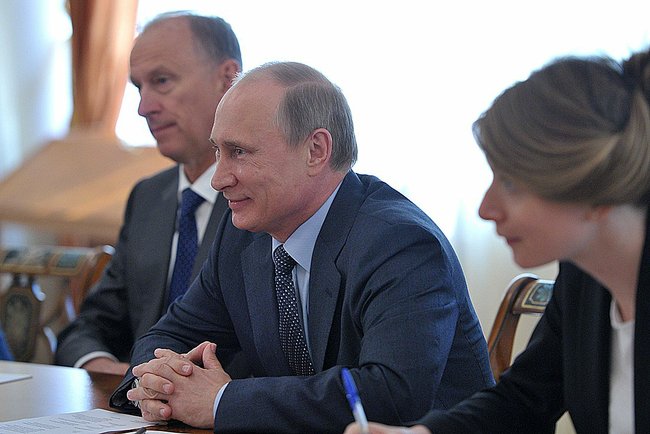
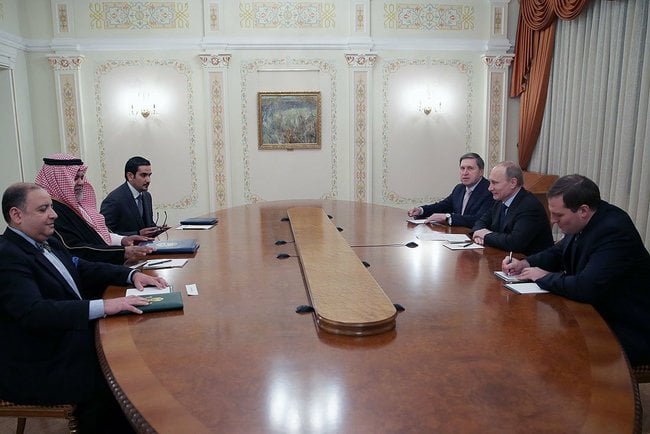
For the purposes of supporting such an assertion we will have to start with the not-so-secret visit of a shadowy Saudi regime official to Moscow. Prince Bandar bin Sultan bin Abdulaziz Al-Saud, the infamous Saudi terrorist kingpin and former House of Saud envoy to Washington turned intelligence guru, last visited the Russian Federation in early-December 2013. Bandar bin Sultan was sent by King Abdullah to solicit the Russian government into abandoning the Syrians. The goal of Prince Bandar was to make a deal with the Kremlin to let Damascus be overtaken by the Saudi-supported brigades that were besieging the Syrian government forces from Syria’s countryside and border regions since 2011. Bandar met with Russian President Vladimir Putin and the two held closed-door discussions about both Syria and Iran at Putin’s official residence in Novo-Ogaryovo.
The last meeting that Bandar had with Putin was a few months earlier in July 2013. That meeting was also held in Russia. The July talks between Prince Bandar and President Putin also included Secretary Nikolai Patrushev, the head of the Security Council of the Russian Federation. One would also imagine that discussion about the Iranians increased with each visit too, as Bandar certainly tried to get the Russians on bad terms with their Iranian allies.
After Bandar’s first meeting with President Putin, it was widely reported that the House of Saud wanted to buy Russia off. Agence France-Presse and Reuters both cited the unnamed diplomats of the Arab petro-monarchies, their March 14 lackeys in Lebanon, and their Syrian opposition puppets as saying that Saudi Arabia offered to sign a lucrative arms contract with Moscow and give the Kremlin a guarantee that the Arab petro-sheikdoms would not threaten the Russian gas market in Europe or use Syria for a gas pipeline to Europe.
Russia knew better than to do business with the House of Saud. It had been offered a lucrative arms deal by the Saudi regime much earlier, in 2008, to make some backdoor compromises at the expense of Iran. After the compromises were made by Moscow the House of Saud put the deal on ice. If the media leaks in AFP and Reuters were not tactics or lies in the first place aimed at creating tensions between the Syrian and Russian governments, the purportedly extravagant bribes to betray Syria were wasted on the ears of Russian officials.
The House of Saud and the undemocratic club of Arab petro-monarchies that form the Gulf Cooperation Council (GCC) have always talked large about money. The actions of these self portrayed lords of the Arabia Peninsula have almost never matched their words and promises. To anyone who deals with them, the House of Saud and company are known for habitually making grand promises that they will never keep, especially when it comes to money. Even when money is delivered, the full amount committed is never given and much of it is stolen by their corrupt partners and cronies. Whether it is the unfulfilled 2008 arms contract with Russia that was facilitated with the involvement of Iraqi former CIA asset Iyad Allawi or the overabundant commitments of financial and logistical aid to the Lebanese and Palestinian peoples that never materialized, the Arab petro-sheikhdoms have never done more than talk grandly and then get their propagandist to write articles about their generosity and splendor. Underneath all the grandeur and sparkles there has always been bankruptcy, insecurity, and emptiness.
A week after the first meeting with Bandar, the Kremlin responded to the media buzz about the attempted bribe by Saudi Arabia. Yury Ushakov, one of Putin’s top aides and the former Russian ambassador to the US, categorically rejected the notion that any deal was accepted or even entertained by the Kremlin. Ushakov avowed that not even bilateral cooperation was discussed between the Saudis and Russia. According to the Kremlin official, the talks between Bandar and Putin were simply about the policies of Moscow and Riyadh on Syria and the second international peace conference being planned about Syria in Geneva, Switzerland.
More Leaks: Fighting Fire with Fire?
If his objective was to get the Russians to abandon Syria, Prince Bandar left both meetings in Russia empty-handed. Nevertheless, his visit left a trail of unverifiable reports and speculation. Discretion is always needed when analyzing these accounts which are part of the information war about Syria being waged on all sides by the media. The planted story from the Saudi side about trying to buy the Russians was not the only account of what took place in the Russian-Saudi talks. There was also a purported diplomatic leak which most likely surfaced as a counter-move to the planted story about Bandar’s proposal. This leak elaborated even further on the meeting between Bandar and Putin. Threats were made according to the second leak that was published in Arabic by the Lebanese newspaper As-Safir on August 21, 2013.
According to the Lebanese newspaper, not only did Prince Bandar tell the Russians during their first July meeting that the regimes of the GCC would not threaten the Russian gas monopoly in Europe, but he made promises to the Russians that they could keep their naval facility on the Mediterranean coast of Syria and that he would give the House of Saud’s guarantee to protect the 2014 Winter Olympics being held in the North Caucasian resort city of Sochi, on the eastern coast of the Black Sea, from the Chechen separatist militias under Saudi control. If Moscow cooperated with Riyadh and Washington against Damascus, the leak discloses that Bandar also stated that the same Chechen militants fighting inside Syria to topple the Syrian government would not be given a role in Syria’s political future.
When the Russians refused to betray their Syrian allies, Prince Bandar then threatened Russia with the cancellation of the second planned peace conference in Geneva and with the unleashing of the military option against the Syrians the leak imparts.
This leak, which presents a veiled Saudi threat about the intended attacks on the Winter Olympics in Sochi, led to a frenzy of speculations internationally until the end of August 2013, amid the high tensions arising from the US threats to attack Syria and the threats coming from Iran to intervene on the side of their Syrians allies against the United States. Originating from the same politically affiliated media circle in Lebanon, reports about Russian military preparations to attack Saudi Arabia in response to a war against Syria began to circulate from the newspaper Al-Ahed also, further fueling the chain of speculations.
A House of Saud Spin on the Neo-Con “Redirection”
Seymour Hersh wrote in 2007 that after the 2006 defeat of Israel in Lebanon that the US government had a new strategy called the “redirection.” According to Hersh, the “redirection” had “brought the United States closer to an open confrontation with Iran and, in parts of the region, propelled it into a widening sectarian conflict between Shiite and Sunni Muslims.” With the cooperation of Saudi Arabia and all the same players that helped launch Osama bin Ladin’s career in Afghanistan, the US government took “part in clandestine operations aimed at Iran and its ally Syria.” The most important thing to note is what Hersh says next: “A by-product of these activities has been the bolstering of Sunni extremist groups that espouse a militant vision of Islam and are hostile to America and sympathetic to Al Qaeda.”
A new House of Saud spin on the “redirection” has begun. If there is anything the House of Saud knows well, it is rounding up fanatics as tools at the service of Saudi Arabia’s patrons in Washington. They did it in Afghanistan, they did it Bosnia, they have done it in Russia’s North Caucasus, they did it in Libya, and they are doing it in both Lebanon and Syria. It does not take the British newspaperThe Independent to publish an article titled “Mass murder in the Middle East is funded by our friends the Saudis” for the well-informed to realize this.
The terrorist bombings in Lebanon mark a new phase of the conflict in Syria, which is aimed at forcing Hezbollah to retreat from Syria by fighting in a civil war on its home turf. The attacks are part of the “redirection.” The House of Saud has accented this new phase through its ties to the terrorist attacks on the Iranian Embassy in Beirut on November 19, 2013. The attacks were carried out by individuals linked to the notorious Ahmed Al-Assir who waged a reckless battle against the Lebanese military from the Lebanese city of Sidon as part of an effort to ignite a sectarian civil war in Lebanon.
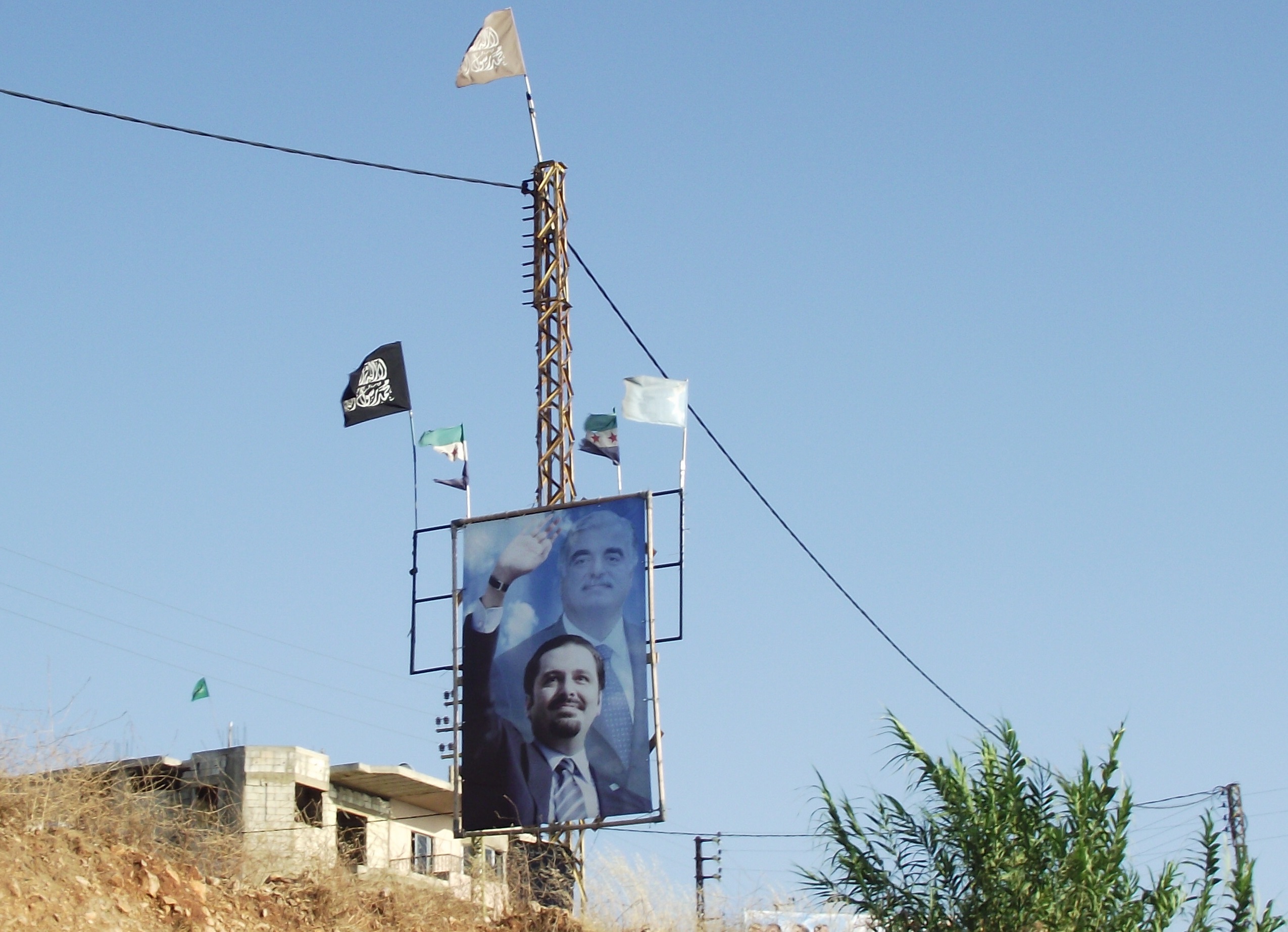
Al-Assir’s rise, however, was politically and logistically aided by the House of Saud and its shameless Hariri clients in Lebanon. He is also part of the same “redirection” policy and current that brought Fatah Al-Islam to Lebanon. This is why it is no surprise to see Hariri’s Future Party flag flying alongside Al-Qaeda flags in Lebanon. After Al-Assir’s failed attempt to start a sectarian Lebanese civil war, he went into hiding and it was even alleged that he was taken in by one of the GCC embassies.
In regard to the House of Saud’s roles in the bombings in Lebanon, Hezbollah would confirm that the attack on the Iranian Embassy in Beirut was linked to the House of Saud. Hezbollah’s leadership would report that the Abdullah Izzam Brigade, which is affiliated to Al-Qaeda and tied to the bombings, is directly linked to the intelligence services of Saudi Arabia.
Moreover, the Saudi agent, Majed Al-Majed, responsible for the attack would be apprehended by Lebanese security forces in late-December 2013. He had entered Lebanon after working with Al-Nusra in Syria. Fars News Agency, an Iranian media outlet, would report on January 2, 2014 that unnamed Lebanese sources had also confirmed that they had discovered that the attack was linked to Prince Bandar.
Wrath of the House of Saud Unleashed?
A lot changed between the first and second meetings that Prince Bandar and Vladimir Putin had, respectively in July 2013 and December 2013. The House of Saud expected its US patron to get the Pentagon involved in a conventional bombing campaign against Syria in the month of September. It is more than likely that Riyadh was in the dark about the nature of secret negotiations that the US and Iran were holding through the backchannel of Oman in the backdrop of what appeared to be an escalation towards open war.
Bandar’s threat to reassess the House of Saud’s ties with Washington is probably a direct result of the US government keeping the House of Saud in the dark about using Syria as a means of negotiating with the Iranian government. US officials may have instigated the House of Saud to intensify its offensive against Syria to catalyze the Iranians into making a deal to avoid an attack on Syria and a regional war. Moreover, not only did the situation between the US and Iran change, Russia would eventually sign an important energy contract for Syrian natural gas in the Mediterranean Sea. The House of Saud has been undermined heavily in multiple ways and it is beginning to assess its own expendability.
If one scratches deep enough, they will find that the same ilk that attacked the Iranian Embassy in Beirut also attacked the Russian Embassy in Damascus. Both terrorist attacks were gifts to Iran and Russia, which served as reprisals for the Iranian and Russian roles in protecting Syria from regime change and a destructive war. It should, however, be discerned if the House of Saud is genuinely lashing out at Iran and Russia or if it being manipulated to further the goals of Washington in the US negotiations with Tehran, Moscow, and Damascus.
In the same manner, the House of Saud wants to generously reward Hezbollah too for its role in protecting Syria by crippling Hezbollah domestically in Lebanon. Riyadh may possibly not want a full scale war in Lebanon like the Israelis do, but it does want to neutralize and eliminate Hezbollah from the Lebanese landscape. In this regard, Saudi Arabia has earnestly been scheming to recruit Lebanon’s President Michel Suleiman and the Lebanese military against Hezbollah and its supporters.
The Saud grant of three billion dollars to the Lebanese Armed Forces is not only blood money being given to Lebanon as a means of exonerating Saudi Arabia for its role in the terrorist bombings that have gripped the Lebanese Republic since 2013, the Saudi money is also aimed at wishfully restructuring the Lebanese military as a means of using it to neutralize Hezbollah. In line with the House of Saud’s efforts, pledges from the United Arab Emirates and reports that NATO countries are also planning on donating money and arms to the Lebanese military started.
In addition to the terrorists bombings in Lebanon and the attack on the Russian Embassy in Damascus, Russia has also been attacked. Since the Syrian conflict intensified there has been a flaring of tensions in Russia’s North Caucasus and a breakout of terrorist attacks. Russian Muslim clerics, known for their views on co-existence between Russia’s Christian and Muslim communities and anti-separatist views, have been murdered. The bombings in Volgograd are just the most recent cases and an expansion into the Volga of what is happening in the North Caucasus, but they come disturbingly close to the start of the Winter Olympics that Prince Bandar was saying would be “protected” if Moscow betrayed Syria.
Can the House of Saud Stand on its Own Feet?
It is a widely believed that you will find the US and Israelis pulling a lot of the strings if you look behind the dealings of the House of Saud. That view is being somewhat challenged now. Prince Mohammed bin Nawaf bin Abdulaziz Al-Saud, Saudi Arabia’s ambassador to the UK, threatened that Saudi Arabia will go it alone against Syria and Iran in a December 2013 article. The letter, like the Saudi rejection of their UN Security Council seat, was airing the House of Saud’s rage against the realists running US foreign policy.
In this same context, it should also be noted for those that think that Saudi Arabia has zero freedom of action that Israeli leaders have stressed for many years that Tel Aviv needs to cooperate secretly with Saudi Arabia to manipulate the US against Iran. This is epitomized by the words of Israeli Brigadier-General Oded Tira: “We must clandestinely cooperate with Saudi Arabia so that it also persuades the US to strike Iran.”
Along similar lines, some may point out that together the House of Saud and Israel got France to delay an interim nuclear agreement between the Iranians and the P5+1 in Geneva. The House of Saud rewarded Paris through lucrative deals, which includes making sure that the grant it gives to the Lebanese military is spent on French military hardware. Saad Hariri, the main Saudi client in Lebanon, even met Francois Hollande and French officials in Saudi Arabia in context of the deal. Appeasing the House of Saud and Israel, French President Hollande has replicated France’s stonewalling of the P5+1 interim nuclear deal with Iran by trying to spoil the second Syria peace conference in Geneva by saying that there can be no political solution inside Syria if President Bashar Al-Assad stays in power.
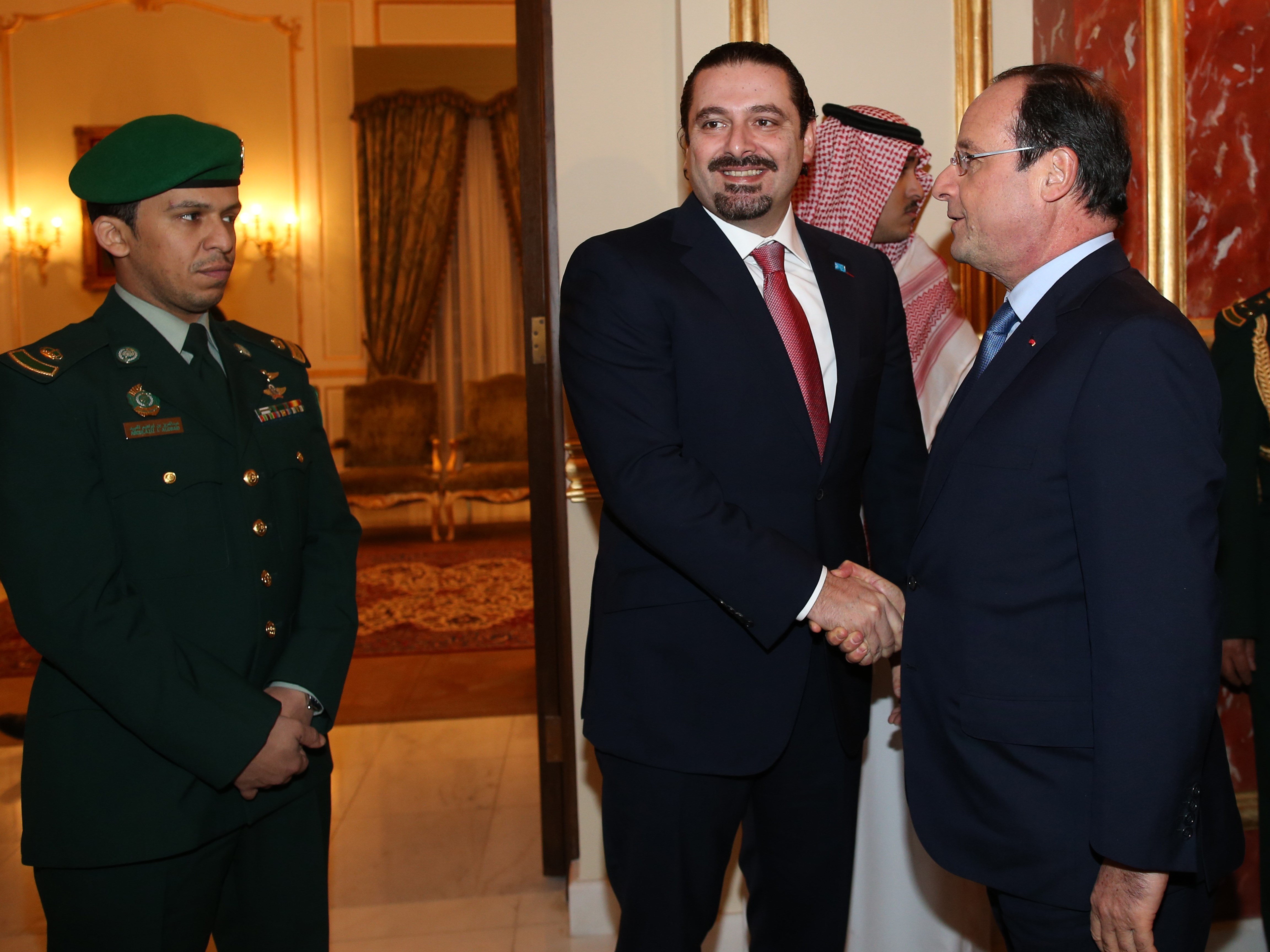
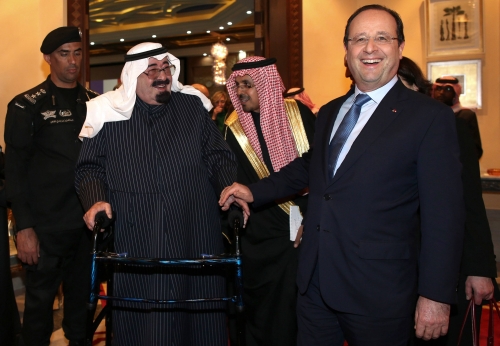
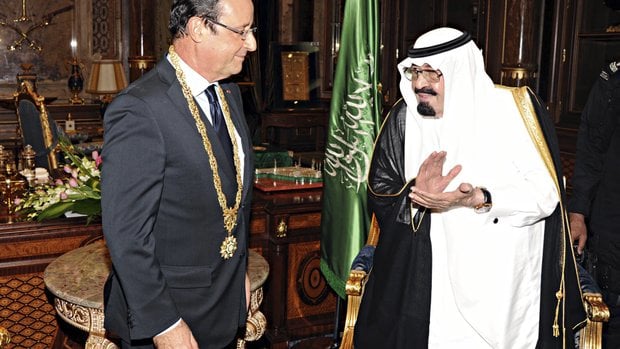
Again, however, it has to be asked, is enraging Saudi Arabia part of a US strategy to make the Saudis exert maximum pressure on Tehran, Moscow, and Damascus so that the United States can optimize its gains in negotiations? After all, it did turn out that the US was in league with France in Geneva and that the US used the French stonewalling of an agreement with Iran to make additional demands from the Iranians during the negotiations. Russian Foreign Minister Sergey Lavrov revealed that the US negotiation team had actually circulated a draft agreement that had been amended in response to France’s demands before Iran and the other world powers even had a chance to study them. The draft by the US team was passed around, in Foreign Minister Lavrov’s own words, “literally at the last moment, when we were about to leave Geneva.”
Instead of debating on the level of independence that the House of Saud possesses, it is important to ask if Saudi Arabia can act on its own and to what degree can the House of Saud act as an independent actor. This looks like a far easier question to answer. It is highly unlikely that Saudi Arabia can act on its own in most instances or even remain an intact state. This is why Israeli strategists very clearly state that Saudi Arabia is destined to fall apart. “The entire Arabian Peninsula is a natural candidate for dissolution due to internal and external pressures, and the matter is inevitable especially in Saudi Arabia,” the Israeli Yinon Plan deems. Strategists in Washington are also aware of this and this is also why they have replicated models of a fragmented Saudi Arabia. This gives rise to another important question: if they US assess that the Kingdom of Saudi Arabia is not a sustainable entity, will it use it until the burns out like a flame? Is this what is happening and is Saudi Arabia being sacrificed or setup to take the blame as the “fall guy” by the United States?
Who is Hiding Behind the House of Saud?
Looking back at Lebanon, the messages from international media outlets via their headlines is that the bombings in Lebanon highlight or reflect a power struggle between the House of Saud and Tehran in Lebanon and the rest of the region. Saying nothing about the major roles of the US, Israel, and their European allies, these misleading reports by the likes of journalists like Anne Barnard casually blame everything in Syria and Lebanon on a rivalry between Saudi Arabia and Iran, erasing the entire history behind what has happened and casually sweeping all the interests behind the conflict(s) under the rug. This is dishonest and painting a twisted Orientalist narrative.
The outlets trying to make it sound like all the Middle East’s problems are gravitating around some sort of Iranian and Saudi rivalry might as well write that “the Saudis and Iranians are the sources behind the Israeli occupation of Palestine, the sources behind the Anglo-American invasion of Iraq that crippled the most advanced Arab country, the ones that are blockading medication from reaching Gaza due to their rivalry, the ones who enforced a no-fly zone over Libya, the ones that are launching killer drone attacks on Yemen, and the ones that are responsible for the billions of dollars that disappeared from the Iraqi Treasury in 2003 after Washington and London invaded that country and controlled its finances.” These outlets and reports are tacitly washing the hands of actors like Washington, Tel Aviv, Paris, and London clean of blood by trying to construct a series of false narratives that either blame everything on a regional rivalry between Tehran and Riyadh or the premise that the Sunni Muslims and Shia Muslims are fighting an eternal war that they are biologically programmed to wage against one another.
Arabs and Iranians and Shias and Sunnis are tacitly painted as un-human creatures that cannot be understood and savages to audiences. The New York Times even dishonestly implies that the Sunni Muslims and Shiite Muslims in Lebanon are killing one another in tit-for-tat attacks. It sneakily implies that Hezbollah and its Lebanese rivals are assassinating one another. Bernard, its reporter in Lebanon who was mentioned earlier, along with another colleague write:
In what have been seen as tit-for-tat attacks, car bombs have targeted Hezbollah-dominated neighborhoods in the southern suburbs of Beirut and Sunni mosques in the northern city of Tripoli.
On Friday, a powerful car bomb killed Mohamad B. Chatah, a former Lebanese finance minister who was a major figure in the Future bloc, a political group that is Hezbollah’s main Sunni rival.
The New York Times is cunningly trying to make its readers think that Hezbollah was responsible for the bombing as part of a Shiite-Sunni sectarian conflict by concluding with an explanation that the slain former Lebanese finance minister belonged to “Hezbollah’s main Sunni rival” after saying that the bombings in Lebanon “have been seen as tit-for-tat attacks” between the areas that support Hezbollah and “Sunni mosques” in Tripoli
The US and Israel wish that a Shiite-Sunni sectarian conflict was occurring in Lebanon and the rest of the Middle East. They have been working for this. It has been them that have been manipulating Saudi Arabia to instigate sectarianism. The US and Israel have been prodding the House of Saud—which does not represent the Sunni Muslims, let alone the people of Saudi Arabia which are under its occupation—against Iran, all the while trying to conceal and justify the conflict being instigated as some sort of “natural” rivalry between Shiites and Sunnis that is being played out across the Middle East.
It has been assessed with high confidence by outsiders concerned by the House of Saud’s inner dealings that Prince Bandar is one of the three Al-Saud princes managing Saudi Arabia’s security and foreign policy; the other two being Prince Abdulaziz bin Abdullah bin Abdulaziz Al-Saud, the Saudi deputy foreign minister and one of King Abdullah’s point men on Syria due to his ties to Syria from his maternal side, and Prince Mohammed bin Nayef bin Abdulaziz Al-Saud, the interior minister. All three of them are tied to the United States more than any of their predecessors. Prince Bandar himself has a long history of working closely with the United States, which explains the endearing moniker of “Bandar Bush” that he is widely called by. “Chemical Bandar” can be added to the list too, because of the reports about his ties to the Syrian chemical weapon attacks in Ghouta.
As a US client, Saudi Arabia is a source of instability because it has been conditioned hence by Washington. Fighting the terrorist and extremist threat is now being used by the US as a point of convergence with Iran, which coincidently has authored the World Against Violence and Extremism (WAVE) motion at the United Nations. In reality, the author of the regional problems and instability has been Washington itself. In a masterstroke, the realists now at the helm of foreign policy are pushing American-Iranian rapprochement on the basis of what Zbigniew Brzezinski, the former national security advisor of the US, said would be based on Tehran and Washington working together to secure Iran’s “volatile regional environment.” “Any eventual reconciliation [between the US and Iranian governments] should be based on the recognition of a mutual strategic interest in stabilizing what currently is a very volatile regional environment for Iran,” he explains. The point should not be lost either that Brzezinski is the man who worked with the Saudis to arm the Afghan Mujahedeen against the Soviets after he organized an intelligence operation to fool the Soviets into militarily entering Afghanistan in the first place.
The House of Saud did not work alone in Afghanistan during the Cold War either. It was rigorously backed by Washington. The United States was even more involved in the fighting. It is the same in Syria. If the diplomatic leak is to be believed about the meeting between Bandar and Putin, it is of merit to note that “Bandar Bush” told Putin that any “Saudi-Russian understanding” would also be part of an “American-Russian understanding.”
Has the “Redirection” Seen its Stalingrad?
Volgograd was called Stalingrad for a part of Soviet history, in honour of the Republic of Georgia’s most famous son and Soviet leader Joseph Stalin. It was Volgograd, back then called Stalingrad, where the Germans were stopped and the tide of war in Europe was turned against Hitler and his Axis allies in Europe. The Battle of Stalingrad was where the Nazis were defeated and it was in the Soviet Union and Eastern Europe where the bulk of the fighting against the Germans was conducted. Nor is it any exaggeration to credit the Soviets—Russian, Kazakh, Uzbek, Tajik, Tartar, Georgian, Armenian, Ukrainian, Belarusian, Chechen, and all—for doing most of the fighting to defeat the Germans in the Second World War.
Judging by the of Russian President Vladimir Putin, the terrorist attacks in Volgograd will be the start of another Battle of Stalingrad of some sorts and the launch of another Russian “war on terror.” Many of the terrorists that Russia will go after are in Syria and supported by the House of Saud.
The opponents of the Resistance Bloc that Iran, Syria, Hezbollah, and the Palestinian resistance groups form have called the battlefields in Syria the Stalingrad of Iran and its regional allies. Syria has been a Stalingrad of some sorts too, but not for the Resistance Bloc. The alliance formed by the US, Britain, France, Saudi Arabia, Qatar, Turkey, and Israel has begun to unravel in its efforts to enforce regime change in Syria. The last few years have marked the beginning of a humiliating defeat for those funding extremism, separatism, and terrorism against countries like Russia, China, Iran, and Syria as a means of preventing Eurasian cohesion. Another front of this same battle is being politically waged by the US and the EU in the Ukraine in a move to prevent the Ukrainians from integrating with Belarus, Russia, and Kazakhstan.
Volgograd and the Conquest of Eurasia
While speculation has been entertained with warning in this text, most of what has been explained has not been speculative. The House of Saud has had a role in destabilizing the Russian Federation and organizing terrorist attacks inside Russia. Support or oppose the separatist movements in the North Caucasus, the point is that they have been opportunistically aided and used by the House of Saud and Washington. Despite the authenticity of the narrative about Bandar’s threats against Russia, Volgograd is about Syria and Syria is about Volgograd. Both are events taking place as part of the same struggle. The US has been trying to encroach into Syria as a means of targeting Russia and encroaching deeper in the heart of Eurasia.
When George Orwell wrote 1984 he saw the world divided into several entities at constant or “eternal” war with one another. His fictitious superstates police language, use total surveillance, and utterly manipulate mass communication to indoctrinate and deceive their peoples. Roughly speaking, Orwell’s Oceania is formed by the US and its formal and informal territories in the Western Hemisphere, which the Monroe Doctrine has essentially declared are US colonies, confederated with Britain and the settler colonies-cum-dominions of the former British Empire (Australia, Canada, Ireland, New Zealand, and South Africa). The Orwellian concept of Eurasia is an amalgamation of the Soviet Union with continental Europe. The entity of Eastasia on the other hand is formed around China. Southeast Asia, India, and the parts of Africa that do not fall under the influence of Oceanic South Africa are disputed territory that is constantly fought for. Although not specifically mentioned, it can be extrapolated that Southwest Asia, where Syria is located, or parts of it are probably part of this fictional disputed territory, which includes North Africa.
If we try to fit Orwellian terms onto the present set of global relations, we can say that Oceania has made its moves against Eurasia/Eastasia for control of disputed territory (in the Middle East and North Africa).
1984 is not just a novel, it is a warning from the farseeing Orwell. Nonetheless, never did he imagine that his Eurasia would make cause with or include Eastasia through a core triple alliance and coalition comprised of Russia, China, and Iran. Eurasia will finish, in one way or another, whatOceania has started. All the while, as the House of Saud and the other rulers of the Arab petro-sheikhdoms continue to compete with one another in building fancy towers, the Sword of Damocles is getting heavier over their heads.
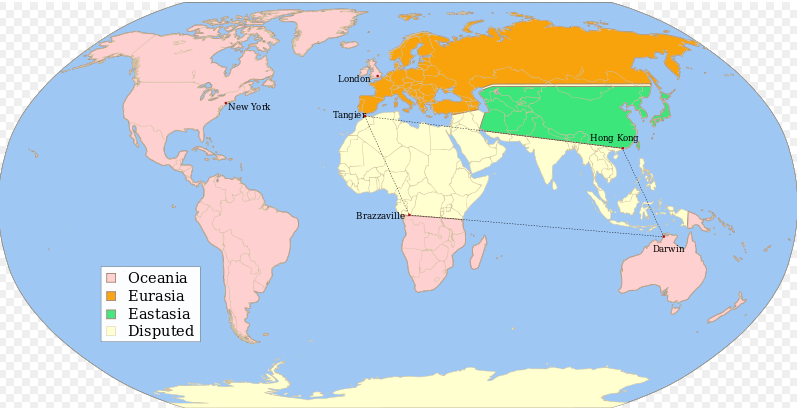
Source: Global Research
Bibi And Bandar Badger Obama: Better Six Billion Than Six Trillion
December 7, 2013 by Administrator · Leave a Comment

Damascus – The Gulf Cooperation Council (GCC) member states—Bahrain, , , , , and the —along with certain Arab League countries, plus Turkey and Israel, have this past week reportedly committed themselves to raising nearly $6 billion to “beef up” the just-hatched Islamic Front (IF) in Syria. These “best friends of America” want the Obama administration to sign onto a scheme to oust the Syrian government by funding, arming, training, facilitating and generally choreographing the movement of fighters of this new front, a front formed out of an alliance of seven putatively “moderate” rebel factions.
Representatives of Saudi intelligence chief Bandar bin Sultan reportedly told staff members on Capitol Hill that committing several billions to defeat the Assad regime by supporting the IF makes fiscal sense and will cost much less than the six trillion dollar figure tallied by the recent study by Brown University as part of its Costs of War project. According to the 2013 update of the definitive Brown study, which examined costs of the US wars in Iraq, Afghanistan, and Pakistan, the total amount for all three topped six trillion dollars. This never before released figure includes costs of direct and indirect Congressional appropriations, lost equipment, US military and foreign contractors fraud, and the cost of caring for wounded American servicemen and their families.
Among the Islamist militia joining the new GCC-backed coalition are Aleppo’s biggest fighting force, Liwa al-Tawhid (Tawhid Brigade), the Salafist group Ahrar al-Sham, Suqour al-Sham, al-Haq Brigades, Ansar al-Sham and the Islamic Army, which is centered around Damascus. The Kurdish Islamic Front also reportedly joined the alliance.
IF’s declared aim is to topple Syrian President Bashar al-Assad’s government, whatever the human and material cost it may require, and replace it with an “Islamic state.” Abu Firas, the new coalition’s spokesman, declared that “we now have the complete merger of the major military factions fighting in Syria.”
Formally announced on 11/22/13, the IF includes groups from three prior umbrella organizations: the Syrian Islamic Front (SIF), the Syrian Islamic Liberation Front (SILF), and the Kurdish Islamic Front (KIF). From the SIF, Harakat Ahrar al-Sham al-Islamiyya (HASI), Kataib Ansar al-Sham, and Liwa al-Haqq all joined, as did the KIF as a whole, and former SILF brigades Suqur al-Sham, Liwa al-Tawhid, and Jaish al-Islam. None of these groups have been designated foreign terrorist organizations by the US, and therefore, as an Israeli official argued in a meeting with AIPAC and Congress this week, nothing stands in the way of US funding and support for them. The Israeli official in question is the country’s new national security advisor, Yossie Cohen, who assures key congressional leaders that the tens of thousands of rebels making up the IF will all support “one policy and one military command.” Cohen also pledges that the new group is not as “insane” as other Muslim militia—Daash or al-Nusra or the Islamic State of Iraq and the Levant, for instance—that comprise the IF’s chief rivals. Cohen and AIPAC are further telling Congress members and congressional staffers that the emergence of the IF is one of the war’s most important developments, and he vows that the new organization in effect brings seven organizations into a combined force that will fight under one command, a force estimated by the CIA to number at around 75,000 fighters. Reportedly the objective will link the fight in the north with that in the south in a manner that will stretch loyalist forces, and the Saudi-Israel team is also asking the Obama Administration to more than double the monthly “graduation class” of CIA-trained rebels in Turkey, Syria and Jordan—from its current level of 200 per month, up to 500 a month.
What the GCC/Arab League/Israeli team is asking of its western allies (meaning of course mainly the US) is to immediately fund the IF to the tune of $ 5.5 billion. This, Israeli security officials argue, is pocket change compared to the $6 trillion spent in US terrorist wars of the past decade. Plus it will have the presumed “benefit” of toppling the Assad regime and truncating Iran’s growing influence. The plan has reportedly been dismissed by some in the Obama administration as “risible and pathetic.” Nonetheless, Tel Aviv, the US Congressional Zionist lobby, and to a lesser extent Ankara, are pressing ahead under the assumption that linking with the IF now makes sense and that they can take their chances will al-Qaeda later. Ironically these are some of the same voices from AIPAC’s Congressional Team who four years ago were claiming that al-Qaeda was “on the ropes and will soon collapse.” Yet they are optimistic that if Assad goes, “we can deal with the terrorists and it won’t cost six trillion dollars.”
One House member who strongly agrees with AIPAC is Representative Duncan Hunter (R-CA), who recently declared that “in my heart I am a Tea Party guy.” A member of the House Armed Services Committee, Hunter believes the US should use nuclear weapons against Tehran. In a Fox TV interview this week he declared his opposition to any talks with Iran, insisting that US policy should include a “massive aerial bombardment campaign” utilizing “tactical nuclear devices” to set Iran “back a decade or two or three.”
According to sources in Aleppo and Damascus, the IF’s top leadership positions have been parceled out among five of the seven groups. This at least is as of 12/5/13. Four days after the IF was announced, the organization released an official charter. In terms of its basic architecture, the document is similar to that put out by the SIF in January, but the new version is filled with more generalities than other militia proclamations, and seems designed to accommodate differing ideas among member groups. The charter calls for an Islamic state and the implementation of sharia law, though it does not define exactly what this means. The IF is firmly against secularism, human legislation (i.e., it believes that laws come from God, not people), civil government, and a Kurdish breakaway state. The charter states that the group will secure minority rights in post-Assad Syria based on sharia, which could mean the dhimma (“protected peoples”) system, or de facto second-class citizenship for Christians and other minorities. According to Saudi officials in Lebanon, the IF seeks to unify other rebel groups so long as they agree to acknowledge the sovereignty of God. Given this ‘moderate’ wording, the expectation of some is that that the southern-based Ittihad al-Islami li-Ajnad al-Sham will join the IF.
According to the Netanyahu government, the IF’s leading foreign cheerleader, this new coalition gives substance to that which states who have been wanting regime change in Syria have been calling for. One analyst on the Syrian conflict, Aron Lund, believes a grouping of mainstream and hardline Islamists, excluding any al-Qaeda factions, is significant. “It’s something that could be very important if it holds up,” he explained. “The Islamic Front’s formation was a response to both regime advances and the ‘aggressive posture’ of jihadists against other rebels, plus a good deal of foreign involvement, not least of which is Saudi and GCC pushing to unify the rebels.”
Contrary to reports out of Occupied Palestine that the Netanyahu regime is not worried about or much interested in the crisis in Syria, a measure of delight seems to be felt in Tel Aviv that Muslims and Arabs are once more killing each other, along with smugness over Hezbollah’s loss of key mujahedeen as it faces, along with Iran, its own “Vietnam experience.” Yet all this notwithstanding, near panic is reported to have been felt in Israeli government circles over Hezbollah’s achievements in Syria. Truth told, Tel Aviv knows that despite manpower losses by Hezbollah, the dominant Lebanese political party is bringing about major enhancements of its forces. It also knows that there is no substitute for urban battlefield experience with regard to effecting such force regeneration, and Israeli officials have also stated their belief that the Resistance is organizing non-Hezbollah brigades that share one goal in common despite disparate beliefs. That sacred goal is liberating Al Quds by any and all means.
A US Congressional source summarized the Obama administration’s take on this week’s assassination of a key Hezbollah commander as part of a major new Netanyahu government project to weaken Hezbollah. Hassan Houlo Lakkis’ assassination on the night of December 3-4 is deemed in Washington to be particularly significant since Lakkis was in charge of strategic files related to Israel and the Palestinians and also oversaw a number of key operations. The Resistance commander was deeply involved in the development of drones for Hezbollah, as well as smuggling weapons to Gaza via Egypt. He also had good relationships with the Palestinian factions in Gaza, Syria, and Lebanon. Lakkis was known by Washington to be a highly important cadre and a second rank Hezbollah official. According to one analyst “Israel appeared as if it was telling Hezbollah, come and fight me. Israel is upset over the Western-Iranian agreement. It is also upset over the new position that the West has concerning Hezbollah whereby the West is now viewing the party as a force that opposes the Takfiris. Thus, Israel’s objective behind the assassination is to lure the party into a confrontation thus allowing Tel Aviv to tell the West: Hezbollah is still a terrorist organization.”
According to sources on the US Foreign Relations Committee, the White House is being heavily pressured by the US Zionist lobby and the Netanyahu government to take “remedial measures” for the “catastrophic historic mistake” it made in defusing the Iranian nuclear issue and refusing to bomb Damascus. The measures being pushed for, of course, are funding and support for the IF, though doubts persist in Washington as to how “remedial” they will in fact be. The $5.5 billion “investment” is to be paid in large part by GCC/Arab League countries, with US and Zionist contributions. Cash from the latter two sources will come directly and indirectly out of the pockets of American taxpayers—with Israel paying nothing.
Some Washington officials and analysts are wondering if US participation would help unify notoriously hostile rebel ranks and curtail the growing power of al-Qaeda in Syria, or whether it is simply another zany Bander bin Sultan-concocted project, the latest of many—in this case to create a hierarchical revolutionary army with the aim of fighting the Syrian regime essentially alongside al-Qaeda? Secretary of Defense Chuck Hagel expressed his personal suspicions this week that “the Israel-Saudi team is trying to drag the US back into a potentially deepening morass,” alluding to what apparently is an effort to head off any plans the Obama administration may have of living with the Assad government until such time as Geneva II happens, that is if it happens, according to one congressional staffer.
Many among the American public also have doubts because they have been told that their government was ‘winding down’ its Middle East wars in favor of rebuilding America’s infrastructure, roads, health care and education systems, all of which, especially the latter, appear to be suffering dramatically. According to the most recent international survey, released this week, the average Chinese student, aged fifteen in Shanghai, is two full years ahead of America’s best students surveyed in Massachusetts. Recent top scores among secondary school youngsters, particularly in , were considerably lower than those achieved by students in Shanghai, Singapore, Hong Kong, Taiwan or Japan. The US is far down the list and declining, and the survey suggests that the gap is widening.
It’s too early to say whether this latest Saudi-Israel-Arab League collaboration will fail as others have recently, but given the continuing Obama administration efforts at taking back US Middle East policy from Tel Aviv, plus the perceptible movement away from support for the Netanyahu government along with growing angst among American taxpayers over funding the occupation of Palestine, it just might collapse.
Dr. Franklin Lamb is Director, Americans Concerned for Middle East Peace, Beirut-Washington DC, Board Member of The Sabra Shatila Foundation, and a volunteer with the Palestine Civil Rights Campaign, Lebanon. He is the author of and is doing research in Lebanon for his next book. He can be reached at
Dr. Franklin Lamb is a regular columnist for Veracity Voice
White House Expected To Ease Sanctions Targeting Syria
November 2, 2013 by Administrator · Leave a Comment
Iran to Follow?

Damascus — Additional easing of Syrian sanctions is expected by mid-November according to staff at the US Treasury Department’s Office of Financial Asset Control (OFAC).
Pressure on Obama from Putin is part of the ‘price tag’ for Russia’s role in bailing out the American president, whose chemical weapons ‘redline’ became something of an albatross. But another reason for the relaxation is that the White House believes it needs to communicate to Damascus that prospects for better relations, and possibly even some cooperation, are not completely dead, despite the 32-month crisis still raging in the Syrian Arab Republic.
This second easing of sanctions will show more balance and neutrality than those of last June, which were perceived as supporting Saudi and Gulf aid to the rebels while weakening the Assad government just as the Syrian Army had begun gaining back ground from the rebels. At that time, licenses for exports of certain goods related to reconstruction of infrastructure were allowed in areas held by the rebels. Specifically, OFAC indicated that license applications would be accepted for commodities, technology and software related to water supply and sanitation, agricultural production and food processing, power generation, oil and gas production, construction and engineering, transportation, and educational infrastructure. Most benefited would be rebel-controlled areas.
No doubt it is with a deep patriotic spirit of wanting to help out their fellow Americans, that the US Treasury Departments heavily pro-Zionist OFAC asks US citizens to “consult our Frequently Asked Questions (FAQ) to find answers to your most commonly-asked questions about how Syrian and Iranian sanctions may affect your own families and your business.”
That is unlikely to be easy given the obfuscatory legalize of the sanctions texts.
There are currently three types of sanctions that the U.S. government has imposed against Syria. The most comprehensive sanction, called the Syria Accountability Act (SAA) of 2004, prohibits the export of most goods containing more than 10% U.S.-manufactured component parts to Syria. Another sanction, resulting from the USA Patriot Act, was levied specifically against the Commercial Bank of Syria in 2006. The third type of sanction contains many Executive Orders from the President that specifically deny certain Syrian citizens and entities access to the U.S. financial system due to their participation in proliferation of weapons of mass destruction, association with Al Qaida, the Taliban or Osama bin Laden; or destabilizing activities in Iraq and Lebanon.
Syria Accountability and Lebanese Sovereignty Restoration Act
In May 2004, the President signed implementing the Syria Accountability and Lebanese Sovereignty Restoration Act (SAA) which imposes a series of sanctions against Syria for its support for terrorism, involvement in Lebanon, weapons of mass destruction programs, and the destabilizing role it is playing in Iraq.
In addition, the Treasury Department’s Statement of Policy indicated that OFAC would consider on a case-by-case basis applications to permit certain services in the agricultural sector, as well as in the Syrian telecommunication industry, enabling private citizens better access to the Internet, while certain petroleum transactions benefiting rebel forces were also authorized. OFAC also revised Syria General License 11 and replaced it with authorizing NGOs to engage in activities to preserve the cultural heritage of the country, including museums, historic buildings and archaeological sites.
The new lifting of sanctions, tentatively scheduled to be announced next month, will help the Assad government because international banking and trade prohibitions are expected to be reduced. At the same time, US officials are discussing with their Russian “partners” a number of proposals that would acknowledge the right of the Syrian people to choose who to support in next year’s Presidential elections without Washington insisting that Syrian President Bashar Assad step down as part of a “transition to democracy.”
In addition, the White House is telling Congressional leaders, loudly enough for all to hear, that the president’s recent waiving of restrictions on supplying arms to Syrian rebels was much more limited than depicted in mainstream media reports. In fact, the waiver—on certain portions of the Arms Export Control Act—authorizes only specific transfers to “vetted” members of the opposition and to NGOs in Syria. The defense items to be provided are described as those “necessary for the conduct of …operations inside or related to Syria, or to prevent the preparation, use, or proliferation of Syria’s chemical weapons.” Who was to be responsible for “vetting” the opposition members was not specified, nor were the particular articles detailed. But significantly the White House claims this is not a general waiver, but rather one with regard to a single specific contemplated transaction. Defense companies do not now have a blanket license to ship their wares to the Syrian opposition. This is because Section 40(g) of the Arms Export Control Act, , specifically gives the President authority to waive the provisions of the Act with respect to a specific transaction should he find that the waiver is “essential to the national security interests of the United States” and should he make the requisite report on the waiver to Congress. His determination on that finding directs the Secretary of State to make the required report to Congress.
The main opposition to White House plans to lessen the civilian targeting sanctions comes, as usual, from the US Congressional Zionist lobby. Israel’s supporters in Congress seek to prevent any lessening of US sanctions—against Iran first, and Syria second. Two days of talks are about to begin in Vienna between experts from the P5+1 (the United States, Russia, China, Britain, France, and Germany) and their Iranian counterparts, who will discuss technical issues relating to Tehran’s nuclear program and international sanctions. The meeting will help lay the groundwork for the next round of diplomatic negotiations, scheduled to take place in Geneva on November 7-8, and it is anticipated that the White House will accede to EU and Russian proposals to send a reciprocal good faith response to Tehran by lifting some of the sanctions targeting Iranian civilians. Although the P5+1 and Tehran have agreed to keep the contents of their negotiations secret, the general aim of the talks has been for Iran to reduce its capacity to enrich uranium and certain other nuclear activities in return for relief from the sanctions regime, which is strangling the nation’s economy. The main hurdles include verification of any concessions Iran makes and the sequencing of any reduction in sanctions.
Signs of progress were visible earlier this week in comments made after separate talks between Iran and the International Atomic Energy Agency. In a rare joint statement, both sides called the talks “very productive”—a significant departure from eleven previous meetings in recent years, all of which failed to achieve progress in resolving what the IAEA has called the “possible military dimensions” of Iran’s nuclear program. The new joint statement also indicates that a document discussed in past meetings has been set aside and a new approach taken.
Eager as it is for negotiations to succeed, the Obama administration has also echoed the Zionist lobby’s contention that “no deal is better than a bad deal.” Yet if the talks fail, international support for sanctions will likely begin to fall apart, reducing U.S. leverage even further.
The world is watching, particularly U.S. allies in Europe and Asia, as well as regional “friends” like Jordan, the United Arab Emirates, and Saudi Arabia. Though reportedly interested in lifting some of the sanctions on Syria and Iran, the White House is facing stiff opposition from Tel Aviv and Riyadh, with both governments criticizing the US for its lack of resolve in Syria and its presumed conciliatory attitude toward Iran.
Secretary of State John Kerry is reportedly slated to continue meetings with Saudi-Israeli officials in an attempt to tamp down their growing angst.
Dr. Franklin Lamb is Director, Americans Concerned for Middle East Peace, Beirut-Washington DC, Board Member of The Sabra Shatila Foundation, and a volunteer with the Palestine Civil Rights Campaign, Lebanon. He is the author of and is doing research in Lebanon for his next book. He can be reached at
Dr. Franklin Lamb is a regular columnist for Veracity Voice
Syria’s Violent Stalemate
October 20, 2013 by Administrator · Leave a Comment
 The international crisis may be over, but the multisided war in Syria is continuing. On Friday government planes bombarded rebel positions in the eastern city of Deir al-Zor after heavy clashes claimed the life of one of President Bashar al-Assad’s top military intelligence officers. In the long-contested city of Aleppo, a renewed rebel assault on the city’s central prison has run out of steam. The Syrian Army is preparing an offensive in the Qalamoun region east of Damascus and secure the key road connecting the capital with Homs, near the border with Lebanon. Last Wednesday dozens of fighters were reported killed in clashes between the Kurdish YPG militia and al-Nusra Front jihadists in the oil-rich Hasake province in northeastern Syria.
The fighting will continue, but no strategically decisive event is on the horizon. A military stalemate is taking shape. The rebels are controlling large areas in the north and east of the country, while government forces have extended control over their strongholds in Damascus, the coastal strip, and the areas along the border with Lebanon. The capture of the town of Qusair in June and the failure of the U.S. military intervention to materialize in September have given the government a major boost, while accentuating political divisions among the rebels.
On October 16 dozens of rebel groups in southern Syria announced that they have severed links with the Turkey-based Syrian National Coalition, the political arm of the Free Syrian Army. Only weeks earlier several powerful rebel factions in the north of the country broke with the Coalition and declared support for the introduction of Sharia in the country. The rebels’ foreign backers are increasingly exasperated at the fighting groups’ failure to conceal their Jihadist agenda and their inability to present a coherent front. A major snag for the Obama Administration is the opposition’s reluctance to attend a peace conference in Geneva, tentatively scheduled for November 23-24 and jointly sponsored by the U.S. and Russia. The discord in opposition ranks casts serious doubts over whether any credible representatives will turn up. The Western powers and the Arab Gulf states are promising fresh assistance if they do attend, but no opposition leader seems willing to allow the possibility of a transitional government in which President Bashar al-Assad would play a role.
The rebels’ insistence on Bashar’s exclusion is unrealistic, now that the American military intervention is no longer on the cards and the Syrian government’s cooperation is essential in the process of dismantling the country’s chemical weapons arsenal. Unfortunately for the rebels, the program is proceeding smoothly and Washington is not interested in jeopardizing its success by supporting the rebels’ unreasonable demands. The Organization for the Prohibition of Chemical Weapons announced last Wednesday that its inspectors have so far visited 11 of more than 20 sites linked to the chemical weapons program. The team destroyed “critical equipment” at six sites as well as unloaded chemical weapons munitions, said the OPCW. At the same time there have been fresh calls on the rebels to provide inspectors with unhindered access. On Friday The New York Times quoted a Western diplomat as saying that “however divided the opposition might be, it would look very bad if the government was seen to be cooperating fully, while inspections were held up because of problems with the opposition.”
The U.N. peace envoy for Syria, Lakhdar Brahimi, insists that the Geneva conference is needed because everyone in Syria is at military and political dead-end. “Geneva is a way out for everyone: the Americans, Russia, the Syrian regime and the opposition,” he said in a veiled warning to Bashar’s foes to get their act together. “Whoever realizes this first will benefit. Whoever does not realize it will find himself overboard, outside the political process.” The International Crisis Group (ICG), which has advocated robust U.S. engagement in the past, now says that the Syrian opposition “should develop a realistic strategy towards what remains the best hope for ending the war,” including “reaching internal consensus on workable negotiation parameters.” The Guardian, long an advocate of Western intervention, now notes that “mainstream opposition figures are alarmed at the growing success of the Syrian government’s argument that the country now faces a stark choice between Assad and al-Qaida.”
The rebels’ behavior in those areas they control has given ample credence to that argument. Cold-blooded executions of captured government soldiers have been going on for months, but the mass murder of unarmed villagers is a novelty. Proportionate to their numbers, the Christians are the main victims, as we have repeatedly warned they would be. According to Melkite Greek Catholic Patriarch Gregorios III, more than 450,000 Christians out of a total population of 1.75 million had been displaced or left the country. Similar warnings came from Archbishop Cyril Karim of the Syrian Orthodox Church of Antioch in the United States, who last summer led protests against the possibility of an American military strike on Syria.
Feeling abandoned by the West, Syria’s Christians are turning to Russia for protection. Tens of thousands want to apply for Russian citizenship, not in order to flee Syria but to be “under the protection of Russia if we face the threat of being physically eliminated by terrorists.” Over 50,000 Syrian Christians signed the address, including doctors, engineers, lawyers and businessmen from the Kalamoun area near Damascus. Their appeal follows President Vladimir Putin’s strong attack last July on the infringement of the rights of Christians and other religious minorities in the Middle East and elsewhere around the world.
The United States, in the meantime, continues to supply the rebels with arms and training, directly or by proxy. The Administration is also preparing a new massive arms shipment to our good friends in Saudi Arabia and the United Arab Emirates—$13 billion worth of “various munitions and associated equipment, parts, training and logistical support.” This comes at a time of ongoing sabre-rattling from Gulf leaders who “threaten to stand steadfast to the cause—in spite of US ‘weakness’—determined to remake the Middle East in their authoritarian image.”
Srdja (Serge) Trifkovic, author, historian, foreign affairs analyst, and foreign affairs editor of “Chronicles.” He has a BA (Hon) in international relations from the University of Sussex (UK), a BA in political science from the University of Zagreb (Croatia), and a PhD in history from the University of Southampton (UK).
Dr. Srdja Trifkovic is a regular columnist for Veracity Voice
Towards The Vindication of The Syrian Invasion
September 5, 2013 by Administrator · Leave a Comment
 In a stern tone, Russian President Vladimir Putin warned the West on Wednesday not to indulge any one-sided military action against Syria amid increasing fears that Washington is preparing to put this sinister idea into practical shape in cahoots with regional puppet regimes.
In an interview with Channel One television, Putin clarified his stance on the issue, saying that only the “UN Security Council can give approval for the use of force against another state,” and warned against any such move which would be considered as an act of “aggression.”
“Any other ways to justify the use of force against another sovereign and independent state are unacceptable and cannot be qualified as anything other than aggression,” Putin said.
Yet, in a not-too-clandestine move, US Secretary of State John Kerry has formed a union with regional puppet regimes including Saudi Arabia, the United Arab Emirates, Qatar and Turkey and marshaled up their servile support for military action against the Syrian government of President Bashar al-Assad with the express intention of sending Assad’s ‘regime’ straight to the morgue.
The realities on the ground clearly indicate that Washington’s former partners have been replaced by new ones in its warmongering pursuits. The vocal support of Saudi Arabia, Turkey and Qatar plus their dollar aids to those who persevere in fermenting chaos and commotion in Syria have sufficed to convince the Americans that they do not need to worry about the potentially colossal financial losses in case of a military strike as they would be taken care of. This fact, which strikes hard across the face of truth, was also reflected in the words of US Defense Secretary Chuck Hagel on Tuesday during a hearing before the Senate Foreign Relations Committee.
“Key partners, including France, Turkey, Saudi Arabia, the United Arab Emirates and other friends in the region, have assured us of their strong support for US action,” Hagel said.
On Tuesday, the White House won backing for military action from two powerful Republicans e.g. House of Representatives Speaker John Boehner and House majority leader Eric Cantor.
In the midst of all this came a joint missile test by the US and Israel conducted on Tuesday in the eastern Mediterranean where they fired a missile from the sea toward the Israeli coast “to test the tracking by the country’s missile defense system.”
Strangely enough, the missile test fire was initially denied by the US. However, a statement released later by the Pentagon on Tuesday confirmed US involvement in the exercise.
Pentagon press secretary George Little told CBS that the US “provided technical assistance and support to the Israeli Missile Defense Organization flight test of a Sparrow target missile over the Mediterranean Sea.”
“The United States and Israel cooperate on a number of long-term ballistic missile defense development projects to address common challenges in the region,” added Little.
Apart from the regional allies, France seems to be a stalwart supporter of aggression against the Arab country. In Paris, French President Hollande said, “A large coalition must therefore be created on the international scale, with the United States — which will soon take its decision — (and) with Europe … and Arab countries,” Hollande said.
Mitigating all irritating doubts, he made it clear that even a no-vote by the Congress would entail no changes in France’s attitude towards Syria.
If Congress votes no, France “will take up its responsibilities by supporting the democratic opposition (in Syria) in such a way that a response is provided,” he added.
In a naked lobbying effort, three pro-Israel groups i.e. by the American Israel Public Affairs Committee (AIPAC), the Anti-Defamation League (ADL) and the Republican Jewish Coalition (RJC) urged American lawmakers on Tuesday to authorize President Barack Obama to launch an attack on Syria.
In the ADL’s statement, National Chair Barry Curtiss-Lusher and National Director Abraham Foxman said that “any nation that violates international norms and obligations which threaten the peace and security of the world must face the consequences of those dangerous acts.”
As a major beneficiary to an invasion of Syria, Tel Aviv may end up a bad loser in the eventuality of a war on Syria.
Palestinian Islamic Jihad has warned that it would lob rockets at Israel if it enters the war. A high-ranking official from Islamic Jihad told Al-Monitor on condition of anonymity, “Up until now, there has been no decision within Islamic Jihad to bomb Israel in response to an aggression on Syria. But that may happen in one circumstance: if Israel joins that war as a principal party.”
This warning aside, Israel will have to brook the ire of the entire Muslim world for partaking of the consequential chaos and for shedding the blood of innocent Muslim blood.
Despite all the intimidating techniques of the West and the lavish Zionist lobbying against the government of Syria, Syrian President Bashar al-Assad does not appear to want to waver an inch from his position as he says he has acquired conviction that those who fight against his government are but al-Qaeda-affiliated terrorist groups and that he does not have the least intention of abandoning his country into the hands of those terrorists.
In an interview with the French newspaper Le Figaro published on Monday, Mr. Assad said, “In the beginning, the solution should have been found through a dialogue from which political measures would have been born.”
“That is no longer the case,” he said, repeating his constant refrain that 90 percent of the opposition fighters are terrorists affiliated with Al Qaeda. “The only way to cope with them is to liquidate them,” he said. “Only then will we be able to discuss political measures.”
This collective effort to bring Syria down to its knees stems to a large extent from the fact that the country has always been viewed by the West as a hotbed for dramatic changes which could be geared towards the supremacy of imperialist powers if they ever seized their grasp upon the country. It is unfortunate to note that this goal is being advanced by some regional countries harnessed by the West in the course of time.
The bipolarization of the world into the West and the Rest is not a new story and an invasion of Syria is only to be seen as a continuation of that accursed legacy which has lingered since time immemorial.
Dr. Ismail Salami is a regular columnist for Veracity Voice
Dr. Ismail Salami is an Iranian author and political analyst. A prolific writer, he has written numerous books and articles on the Middle East.
CIA Gun-Running, Qatar-Libya-Syria
August 10, 2013 by Administrator · Leave a Comment

A has reintroduced “Benghazi-Gate” to the US media spotlight. The report claims that “dozens” of CIA operatives were on the ground in Benghazi on the night of the attack, and the CIA is going to great lengths to suppress details of them and their whereabouts being released. The report alleges that the CIA is engaged in “unprecedented” attempts to stifle employee leaks, and “intimidation” to keep the secrets of Benghazi hidden, allegedly going as far as changing the names of CIA operatives and “dispersing” them around the country.
One suspects this has a single and defined purpose – to hide the CIA’s culpability in supplying arms to known extremists in Libya and Syria. Moreover, the CNN report alludes to the CIA supplying “surface-to-air missiles” from Benghazi to rebels in Syria, but this may only be the tip of the iceberg. The report goes on to state: (my emphasis)
Sources now tell CNN dozens of people working for the CIA were on the ground that night, and that the agency is going to great lengths to make sure whatever it was doing, remains a secret. CNN has learned the CIA is involved in what one source calls an unprecedented attempt to keep the spy agency’s Benghazi secrets from ever leaking out.
Since January, some CIA operatives involved in the agency’s missions in Libya, have been subjected to frequent, even monthly polygraph examinations,according to a source with deep inside knowledge of the agency’s workings. The goal of the questioning, according to sources, is to find out if anyone is talking to the media or Congress. It is being described as pure intimidation, with the threat that any unauthorized CIA employee who leaks information could face the end of his or her career.
Speculation on Capitol Hill has included the possibility the U.S. agencies operating in Benghazi were secretly helping to move surface-to-air missiles out of Libya, through Turkey, and into the hands of Syrian rebels.
Although Saudi Arabia have recently been kindly given “the Syrian card” by the United States – with Prince Bandar once again becoming “Prince of the Jihad”; it has become common knowledge that since the onset of the Syrian crisis, it was Qatar at the forefront of supplying arms and funds to both the political and militant elements of the so-called “opposition”. This has undoubtedly included tacit support of the dominant radical elements among the plethora of brigades on the ground in Syria; with Jabhat al Nusra being the most obvious beneficiary of Qatari largesse. Earlier this year it wasreported that the CIA had been in direct “consultation” with the Qatari Monarchys’ network of arms smugglers – run primarily from the Emir’s palace in Doha. Accordingly, it seems certain that both the CIA and Qatari intelligence were involved in an operation to ship arms stockpiles from “rebels” in Libya; to the “rebels” in Syria: both varieties of which are inextricably linked to Al Qaeda affiliates and radical Salafi-Jihadi militants.
A New York Times report from 30th March 2011 reveals that the CIA had been active in Libya “for weeks”, to “gather information for [NATO] airstrikes, and to contact and ‘vet’ the rebels battling “Gaddafi’s forces”. The New York Times report also states that Obama had signed a presidential finding in the weeks previous, which gave authority to the CIA to arm and fund the rebels. Furthermore, the Independent revealed in March 2011 that Obama had requested Saudi Arabia supply arms to the Libyan militants. Obama had also given his blessing for Qatar and the United Arab Emirates to ship arms into Benghazi, urging them to supply non-US manufactured arms to avert suspicion – in violation of the No-Fly Zone and arms embargo he helped to enforce, and all in total violation of the US Constitution and International Law.
The current Libyan authorities have made little effort to disassociate themselves from reports of large-scale arms shipments bound for Syria, leaving from the port of Benghazi. As stated in a UN Security Council report; the sheer size, monetary and logistical requirement to organise such delivery would almost certainly require at least some local government knowledge and assistance, one Libyan congress-member has openly admitted as such. Moreover, in a Telegraph report from November 2011, it is noted that the post-Gaddafi Libyan military commander Abdel Hakim Belhadj – widely regarded as the former leader of Al Qaeda affiliate: the Libyan Islamic Fighting Group (LIFG) and a lead figure in the militant uprising against Gaddafi – visited members of the Syrian opposition “Free Syrian Army” (FSA) in Turkey to discuss sending “money and weapons”, and also discussed “Libyan fighters to train troops”.
In a Fox News report from December 2012 an “International Cargo-Shipper” candidly revealed that arms shipments from Libya to Syria commenced “almost immediately after the fall of Muammar Qaddafi” (Oct 2011) and had continued on a weekly basis from multiple ports including Misrata and Benghazi. Some of the “sources” shipments were reported to be in excess of 600 tons. The report goes on to quote anonymous “sources” on the ground in Benghazi as alleging that: “Weapons and fighters were absolutely going to Syria, and the U.S. absolutely knew all about it – though most shipments have stopped since the attack on the American Consulate,”
Furthermore, an extensive UN report from the Security Council group of experts, from April 2013, also highlights the rife lawless proliferation of arms throughout Libya, and seeping beyond its borders. The report stated that arms were fueling conflicts from Syria to Mali, and arms were spreading from Libya at an “alarming rate”. Qatar and the United Arab Emirates were singled out in the UN report for blatant violations of the arms embargo during the 2011 “uprising” against Gaddafi; the report revealed that multiple Qatari arms shipments had been allowed to flow into Libya with the full knowledge and acquiescence of NATO – in much the same way they have been allowed to flow into Turkey from Qatar, with Syria being the final destination.
Elements of the Libyan “military” leadership undoubtedly have strong links to former Al Qaeda affiliates, and were brought to power via Qatari largesse and special forces, CIA coordination, and a NATO airforce. Considering this, it is not hard to imagine the same actors would be willing to at least “turn a blind eye” to what has become an overt and unabated Libyan arms-smuggling route into Syria, as is once again demonstrated in this June 18th 2013 report from Reuters, titled: “The adventures of a Libyan weapons dealer in Syria:
Abdul Basit Haroun (former comander of “February 17th brigade”) says he is behind some of the biggest shipments of weapons from Libya to Syria, which he delivers on chartered flights to neighboring countries and then smuggles over the border…. A Reuters reporter was taken to an undisclosed location in Benghazi to see a container of weapons being prepared for delivery to Syria. It was stacked with boxes of ammunition, rocket launchers and various types of light and medium weapons.
Haroun says he can collect weapons from around the country and arrange for them to be delivered to the Syrian rebels because of his contacts in Libya and abroad. “They know we are sending guns to Syria,” Haroun said. “Everyone knows.” His weapon dealing activities appear to be well-known, at least in Libya’s east. Senior officials in Libya’s army and government told Reuters they backed supplying weapons to the Syrian opposition, while a member of Libya’s congress said Haroun was doing a great job of helping the Syrian rebels.
Furthermore, according to a recent New York Times report from June 29th 2013, Qatar have been carrying out arms shipments to “rebels” in Syria from Libya, since at least the same time they “stepped up efforts” to oust Colonel Gaddafi. Consequently, this can only be interpreted as Qatar commencing shipments of arms to Syria – from Benghazi – before Gaddafi had been killed, which means before October 2011.
It is highly plausible that Benghazi was indeed a CIA-run, arms “buy-back” program – with the further “possible” intent of forwarding those arms to Syria. As the State Department has confirmed, it allocated $40 million dollars for the purchase and “collection” of arms used during the conflict in Libya, including a “missing” stockpile of up to 20,000 MANPADS – which at least 15,000 are still unaccounted for. A report written by former US special forces operatives who served in Libya titled “Benghazi: the definitive report”, alleges that the “consulate” and weapons stockpile program was entirely run by John Brennan – Obama’s National Security Advisor at the time and now Director of the CIA – and outside the usual CIA chain of command with the sole purpose of “moving the stockpiled weapons to the another conflict – possibly Syria”. Furthermore, it should also be noted that several prominent US government figures (Clinton, Brennan, Patreaus, et al) were openly lobbying for that precise policy; this adds the possiblity that certain players within the government or the many factions of the Military Industrial Complex may have been acting outside of the Obama administrations specific consent – or building the logistics to fulfill such policy in the future. Thus, a possible explanation of the attack on the “consulate” – which we can now assume was a CIA operated arms cache – was the Obama administrations’ public reluctance to supply MANPADS or other specific heavy weaponry to the rebels fighting in Syria. Moreover, the authors of “Benghazi: the definitive report” claim that John Brennnan was targetting hardline Islamist militia in Libya via drone strikes and special operations, which may provide another pretext for the attack. Certain rebel factions, their regional donors, or their Libyan affiliates may have felt aggrieved and decided to act against the CIA and attempt to seize the weapons under their own volition.
The Libyan weapons route to Syria has quite possibly been ongoing since Qatari (and Western) special forces and their Libyan Al Qaeda affiliated proxies took a hold of Benghazi. In turn the shipments to Syria have gradually increased as Gaddafi’s stockpiles became available and the lawless possibilities inside Libya expanded. These developments could also explain fighters of Libyan origin representing a large percentage of foreign fighters within the oppositions ranks; with a recent study finding Libyan fighters making up over twenty percent of foreign fatalities. If Qatar were indeed coordinating arms shipments from Libya to Syria during the early stages of the Syrian crisis in 2011, and the CIA have also been “consulting” the Qatari shipments and their follow-on transit points through Turkey; then the simplistic mainstream narrative and timeline of the conflict in Syria merely erupting from the suppression of peaceful protesters, and in turn spiralling into full-blown civil-war, is again brought into doubt.
Uncovering the chain of events that led to the attack on the US “consulate”, and the variety of militia the US and its allies were arming in Libya; could in turn reveal the full extent of the Obama administrations’ support of extremist proxy-forces in Syria. Which may explain the administrations’ zealous attempts to stifle any debate or serious questioning of the events that surround Benghazi.
Source: Global Research
Fake Washington Terror Threat
August 4, 2013 by Administrator · Leave a Comment
 They’re in various forms. They repeat with disturbing regularity. America’s war on terror targets Islam. At issue is duplicitous scaremongering. It advances Washington’s imperium.
Wars of aggression follow. False arrests target innocent victims. Terror threats repeat. They’re strategically timed. They change the subject. They divert attention.
They fool most Americans. They do so most of the time. Here we go again. Media scoundrels march in lockstep. They regurgitate Big Lies.
On August 2, The New York Times headlined “Qaeda Messages Prompt US Terror Warning,” saying:
“The United States intercepted electronic communications this week among senior operatives of Al Qaeda, in which the terrorists discussed attacks against American interests in the Middle East and North Africa, American officials said Friday.”
“The intercepts and a subsequent analysis of them by American intelligence agencies prompted the United States to issue an unusual global travel alert to American citizens on Friday, warning of the potential for terrorist attacks by operatives of Al Qaeda and their associates beginning Sunday through the end of August.”
Fact check
Al Qaeda’s a longstanding US asset. It’s used strategically as enemy and ally. Terror threats are fabricated. Bin Ladin was used as “Enemy Number One” years after he died.
Obama didn’t kill him. He was seriously ill with kidney disease. He had other illnesses. In December 2011, he died naturally. The Pakistan Observer reported it. So did BBC and Fox News.
In July 2002, The New York Times said he’s been dead for “almost six months.” He was “buried in the mountains of southeast Afghanistan.”
On August 1, 2013, The State Department headlined “Temporary Post Closures and Worldwide Travel Alert.” It’s like previous ones. They’re fake.
“The following posts normally open on Sunday will be closed” on August 3 and 4, 2013. It’s because of “increased security concerns.”
“For further information, please click on the links below. A Worldwide Travel Alert has also been issued.”
US Embassy Abu Dhabi, United Arab Emirates
US Embassy Algiers, Algeria
US Embassy Amman, Jordan
US Embassy Baghdad, Iraq
US Consulate Basrah, Iraq
US Embassy Cairo, Egypt
US Consulate Dhahran, Saudi Arabia
US Embassy Djibouti, Djibouti
US Embassy Dhaka, Bangladesh
US Embassy Doha, Qatar
US Consulate Dubai, United Arab Emirates
US Consulate Erbil, Iraq
US Consulate Jeddah, Saudi Arabia
US Embassy Kabul, Afghanistan
US Embassy Khartoum, Sudan
US Embassy Kuwait City, Kuwait
US Embassy Manama, Bahrain
US Embassy Muscat, Oman
US Embassy Nouakchott, Mauritania
US Embassy Riyadh, Saudi Arabia
US Embassy Sana’a, Yemen
US Embassy Tripoli, Libya
According to an unnamed senior American official,”more than the usual chatter” was intercepted. Specifics were omitted. There are none. They don’t exist.
They come at Ramadan’s close. They followed Russia granting Snowden asylum. They came three days after fake Israeli/Palestinian peace talks began.
They’re during worsening economic crisis conditions. They affect growing millions. They’re when Washington threatens escalated war on Syria.
They’re at the same time administration officials try justifying institutionalized global spying. Meta-data mining is standard practice. NSA monitors everyone it targets all the time everywhere.
Russell Tice is a former Office of Naval Intelligence/Defense Intelligence Agency/NSA analyst. His career spanned 20 years.
In December 2005, he accused NSA and DIA of unconstitutionally wiretapping US citizens. He got national attention, saying:
“Everyone at NSA knew what they were doing was illegal, because it’s drilled into our heads over and over that it’s against NSA policy, that you do not do that. The choice is to speak out and get fired.”
On August 1, he was interviewed on PBS’ News Hour. He said NSA collects “everything.” It accumulates content “word for word, everything of every domestic communication in this country.”
Every phone call, email, and other personal communication is gathered and stored. Nothing escapes its scrutiny. It lies claiming otherwise. Meta-data collection is official policy. It’s longstanding. It’s done with technological ease.
Earlier he said NSA “targets, sucks-in, stores and analyzes illegally obtained content from the masses in the United States.”
Elected officials are monitored. So are federal judges. Candidate Obama’s phone was tapped. His private emails were read.
Public awareness grows. Fearmongering diverts attention. False flags shift attention from what matters. Administration officials take full advantage.
On August 2, Russia Today headlined “US issues global travel alert over al-Qaeda attack threat,” saying:
It “warn(ed) US citizens about the ‘continued potential for terrorist attacks’ in the Middle East and North Africa.”
It comes weeks ahead of the 12th 9/11 anniversary. It’s also the Benghazi, Libya first anniversary.
The travel alert remains throughout August. The State Department “alert(ed) US citizens to the continued potential for terrorist attacks, particularly in the Middle East and North Africa and possibly occurring and emanating from the Arabian Peninsula.”
“Current information suggest that al-Qaeda and affiliated organizations continue to plan terrorists attacks booth in the region and beyond and they may focus efforts to conduct attacks in the period between now and the end of August.”
Americans were warned about potential dangers on subways, air travel, railways, ships, other forms of public transportation, and prime tourist sites.
Media scoundrels regurgitate fearmongering. They do it ad nauseam. On August 3, CNN headlined “US issues global travel alert, to close embassies due to al Qaeda threat.”
Embassy closings and travel alert warning remain in place. Britain and Germany said they’ll “close their embassies in the Yemeni capital, Sana’a, on Sunday and Monday. The UK Foreign Office said it was a precautionary measure.”
An unnamed US senior official in Yemen called the threat there “much worse than it has (been) in a long time.”
According to other unnamed US officials:
“Various Western targets – not just those tied to the United States -are under threat.”
Former US ambassador to Iraq Christopher Hill said:
“There have been incidents where they’ve closed down a number of embassies in the Middle East because the information is not specific enough to say that ‘embassy X’ got to be closed as opposed to other embassies.”
“But I think this, closing all of these embassies in the Middle East to North Africa, is in fact unprecedented. At least, I didn’t see this during my career.”
Unsubstantiated fearmongering lacks credibility. The usual “experts” hype it. US broadcasters and cable channels feature them. So do major broadsheets.
Notable past terror attacks were false flags. Perhaps Obama has another one in mind. Perhaps multiple ones. Maybe something major.
Last April’s Boston Marathon bombing was a black ops scheme. It was state-sponsored terrorism. Tamerlan and Dzhokhar Tsarnaev were set up. They were innocent patsies.
They had nothing to do with it. Police murdered Tamerlan in cold blood. Dzhokhar faces longterm hard time.
The FBI bears responsibility for US terror plots. So does CIA. It’s longstanding policy. Post-9/11, it escalated.
Bush declared war on terrorism. Obama continues what he began. Washington needs enemies. When none exist, they’re invented.
Muslims are America’s target of choice. Innocent victims are entrapped. Doing so lets FBI operatives claim fabricated war on terror victories.
It lets NSA officials saying spying uncovers plots before they hatch. It lets America get away with murder. It does so on a global scale.
Lies, damn lies, and repeated lies facilitate state sponsored terrorism. It remains ongoing. Lots more is planned. America’s waging war on humanity. It’s longstanding US policy.
Stephen Lendman lives in Chicago. He can be reached at .
His new book is titled “Banker Occupation: Waging Financial War on Humanity.”
http://www.claritypress.com/LendmanII.html
Visit his blog site at sjlendman.blogspot.com.
Professor Falk Graces Lebanon And Gets An Ear Full
May 13, 2013 by Administrator · Leave a Comment
 The United Nations Special Rapporteur for Palestine, Professor Richard Falk, came to Lebanon last week on an unofficial visit to survey opinion while fact finding the condition in Palestinian refugee’s camps.
It was the Professors first visit to Lebanon since the fateful summer of 1982. Back then, en route by sea to Beirut, which was under Israeli siege and blockade, Falk was Vice-Chair of the Sean McBride Commission of Inquiry into Israeli crimes against Lebanon. Mid –way between Cyprus and Lebanon, the Zionist navy, in a blatant act of piracy on the high seas, intercepted, circled and demanded the passenger list from the vessel.
Eventually, under reported American pressure via US Envoy Morris Draper’s telephoned profanity to Tel Aviv, the pirates allowed Falk’s delegation to disembark at the port of Jounieh, just north of Beirut. Draper, who like so many US diplomats, claims he finally “saw the light after retiring”, told this observer that “I never swore so much in my life as I did at those SOBS during that summer of 1982 and after I learned the details of Ariel Sharon’s choreography of the Sabra-Shatila massacre!” Ambassador Draper added, “The world will never know the extent of Israeli crimes committed against Lebanon and its refugees until Washington threatens to cut off all aid until Tel Aviv opens up its archives on this period.”
Professor Falk, as he mentioned during several events here, including a first-rate conference on the status of Palestinian refugees in Lebanon and their struggle for the most elementary civil rights to work and to own a home, organized by the Institute of Palestine Studies, came to Lebanon not to offer counsel to Lebanon’s sects or even to the Palestinians. (The IPS, (http://www.palestine-studies.org) founded in 1969, is considered by this observer and many others, as the most reliable and authoritative source of information on Palestinian affairs and the Arab-Israel conflict.)
Falk came to listen and to learn. He did both. He listened intently to each speaker, scribing hurried notes regarding the current conditions of Palestinian refugee, including education and health status, in Lebanon’s 12 camps and two dozen “gatherings,” reports that were presented by several academics and NGO’s based here.
Falk and others in attendance at the briefings found the findings sobering and alarming. They included but are not limited to, the following.
There are currently 42,000 Palestinian refugees from Syria who have been forced into Lebanon as a result of the crisis in Syria. The United Nations Relief and Works Agency for Palestine Refugees in the Near East – UNRWA -reported to the IPS workshop, that they expect 80,000 Palestinians by the end of the year. Others estimate the December 2013 number will exceed 100,000. According to figures, forwarded to Professor Falk by the Palestine Civil Rights Campaign, supplied by refugee camp committees, approximately 6,000 Palestinians who fled Syria remain in Lebanon’s Bekaa |Valley, close to the Syrian borders, in two main gatherings, al-Jalil (4,216 refugees) and central Bekaa (2,352). In the North, Baddawi camp hosts 4,116 and Nahr al Bared 2,016. In Beirut, Burj al-Barajneh camp hosts 2,928 additional refugees from Syria, Shatila and the surrounding areas 2,800, and Mar Elias 862. In the South, 8,549 refugees arrived to Ain al-Hilweh and 2,400 are dispersed around Saida. Mieh Mieh camp hosts 1,512, with an additional 2,160 in Wadi al-Zaineh. Further south to Tyre, Palestinian refugees from Syria are distributed among Shabriha (184), Rashidieh (1,370), Al Bass (478), Burj al-Shemali (2,800), Qasimiyeh (372), and Jal al-Bahr (128).
Falk knew, before gracing Lebanon with his visit, that UNWRA is basically out of money and cannot continue to meet its mandate for aiding Lebanon’s Palestinians even less those arriving from Syria at the rate of more than two dozen families per day. On 5/5/13, the popular committee representative at Jalil Camp near Baalbec reported that they receive on average 8 additional families per day, with dozens now living in the Jalil camp cemetery.
Palestinian children in Lebanon, Falk was advised, unfortunately provide textbook examples of the fact of life that it is difficult to concentrate on school when ones stomach is growling with hunger. And it’s even harder to stay in school when there’s even a remote chance to work odd jobs and earn money for food – something education doesn’t immediately offer. One new local initiative is the Meals for Schools, whose organizers hope serve food to impoverished schoolchildren in Lebanese slum areas. One idea is to give coupons for meals to schools. Unfortunately the scope will not include Palestinian children “at this time due to limited funding”, according to one AUB student hoping to help children stay in school by helping them to have breakfasts.
Palestinian refugee children have limited access to the public educational system in Lebanon. Only 11 per cent these “foreign” children can access free public education in Lebanon while most refugees can’t afford the high tuition fees of private schools. Palestinian refugees who attend one of the 58 UNRWA begin at age seven since UNWRA cannot afford pre-school level education. Consequently, for Palestinians here, while the elementary sector comprises more than 60% of students, the number drops to 28% in intermediate and only 10% at the secondary level. While the attendance rate for 7 year olds is 98.6%, by the time they reach age 11 attendance falls to 93.4%. But from this level, the primary level school completion rate cascades to only 37%, due to astronomical dropout rates. The above figures reveal that Palestinian education levels have been indeed progressively dropping in recent years. This is further supported by the passing rate in the Brevet Official exams (official diploma qualifying entry into secondary) which was in some schools as low as 13.6% in some schools according to the UNRWA results of Brevet exams, despite the average passing rate in UNRWA schools being 43% for the 2009-10 academic year.
Professor Falk was briefed on myriad realities including the fact that Palestinians camps in Lebanon remain sites of control and surveillance by the Lebanese Army. People’s mobility and access to construction materials have been restricted by the army check points at the entrance of camps. Palestinian refugees are forbidden by law – since 2001 – to own or inherit real estate in Lebanon; consequently when a Palestinian dies, even if she or he inherited property between 1948-2001, before a wave of revenge led to the 2001 racist law, the property goes to Sunni Muslim Dar al-Fatwa one of the richest real estate holding entities in Lebanon. Accused of deep corruption by some, their leadership has a history of opposing full civil rights for Palestinian refugees here remain opposed to home ownership.
The UN’s humanitarian chief, Valerie Amos, reported this week that seven million people need humanitarian assistance in Syria. “The needs are growing rapidly and are most severe in the conflict and opposition-controlled areas” of the civil-war ravaged country, the global body’s humanitarian chief Valerie Amos told the U.N. Security Council. Amos cited data showing there are 6.8 million people in need — out of a total population of 20.8 million — along with 4.25 million people internally displaced and an additional 1.3 million who have sought refuge in neighboring countries.
Falk was briefed on most recent household surveys of Palestinian refugees carried out by the American University of Beirut which show that two thirds of Palestine refugees are poor. The extreme poverty rate in camps (7.9%) is almost twice of that observed in gatherings (4.2%). The study also developed a Deprivation Index based on components of welfare which included components such as good health, food security, and adequate education, access to stable employment, decent housing, and ownership of essential household assets. The Deprivation Index showed that 40% of Palestine Refugees living in Lebanon are deprived. The study reported that 56% of refugees are jobless and only 37% of the working age population is employed (Hanafi et al. 2012). It is unsurprising that the poor socio-economic situation often encourages students to leave school to get a paid job.
Despite the importance of education fewer Palestinian refugee students are actually interested in continuing their higher education. Lack of motivation to learn, is believed to be one of the main reasons for the high dropout rates. Palestinian refugees’ access to Lebanon’s public university is limited by their status as foreigners, and their access to private universities is restricted by a lack of resources to pay tuition fees (Hroub, 2012).
The old cliché that stated that “The Palestinians are the most educated Arab nation”, is just a myth today. This educational hemorrhage among young Palestinians has been attributed to a number of factors such as the deteriorating socio-economic conditions amongst Palestinian refugees and the growing disillusionment with schooling and the benefits it brings. Palestinian students also suffer from an education acculturation as they are forced to learn only the Lebanese curriculum without being able to access the country’s system. The following section examines these three main challenges.
Statistics indicate that just under half of the classrooms in public schools have less than 15 students per class while 20 % are overcrowded with 26 to 35 students per class. However, in UNRWA schools, the average number of students per classroom is 30 making them the most crowded classrooms in Lebanon.
With respect to the UN refugee agency, (UNHCR) the current situation in both Syria and among the more than 450,000 Syrian in Lebanon is only marginally better than the conditions of arriving Palestinians. As Maeve Murphy, UNHCR’s Senior Field Coordinator in Lebanon’s Bekaa Valley, explained to this observer and others during a visit on 5/5/13, near the Nicolas Khoury Center in Zahle, Lebanon, amidst sea of hundreds of Syrians, some waiting for three months or longer just to get registered, the UN refugee agency is also unable to meet its mandate for the same reason as UNRWA and the World Food Program and others. Ms. Murphy reported that over 453,000 Syrians have either registered with the U.N. agency or are waiting to register. An additional several hundred thousand people are thought to be refugees but haven’t approached the U.N.
Complicating the desperate situation of Palestinian and Syrian refugees seeking sanctuary in Lebanon is the fact that millions of Syrian refugees face food rationing and cutbacks to critical medical programs because oil-rich Gulf states have failed to deliver the funding they promised for emergency humanitarian aid, an investigation by James Cusick for The Independent on Sunday has found. Pledges for $ 650 minion in donations from various sources including Saudi Arabia, the United Arab Emirates, Qatar and Bahrain, made during the January 2013, Kuwait UN emergency conference, have yet to materialize.
The World Food Program (WFP), the food aid arm of the UN, says it is spending $19m a week to feed 2.5 million refugees inside Syria and a further 1.5 million who have fled to official camps in Jordan, Turkey, Lebanon and Iraq. By July, the WFP says, there is no guarantee that its work on the Syrian crisis can continue. A spokesman told the UK Independent, “We are already in a hand-to-mouth situation. Beyond mid-June – who knows?”
The emergency conference in Kuwait – hosted by the Emir of Kuwait and chaired by Mr Ban Ki Moon – promised to bring a “message of hope” to the four million Syrian refugees. Mr Ban proclaimed the outcome a shining example of “global solidarity in action”. The reality has been markedly different. Oxfam recently issued an appeal: “The League of Arab States must urge all Arab countries that have pledged to the Syrian crisis, to be transparent and to share information about their commitments, and mechanisms for fulfilling their pledges.”
Mousab Kerwat, Islamic Relief’s Middle East institutional funding manager, said: “It’s better for countries to stay away from donor conferences than to attend and make pledges they don’t intent to keep. As a minimum, they should communicate where their pledges have gone in a transparent process.
If Professor Falk was weary as he left Lebanon from all the data, visits, and wrenching experiences he was presented with, it would be understandable. But the humanitarian and scholar he showed no signs of fatigue but rather appeared to be energized by the experience. Given his history as a supporter of resistance to occupation and oppression, Richard Falk’s assurances that he will continue his work armed with the above sampling of data offers new hope for Palestinian and Syrian refugees from Syria and to those who support their Right and Responsibility to Return to Palestine.
Dr. Franklin Lamb is Director, Americans Concerned for Middle East Peace, Beirut-Washington DC, Board Member of The Sabra Shatila Foundation, and a volunteer with the Palestine Civil Rights Campaign, Lebanon. He is the author of and is doing research in Lebanon for his next book. He can be reached at
Dr. Franklin Lamb is a regular columnist for Veracity Voice
The Syria-Iran Red Line Show
May 3, 2013 by Administrator · Leave a Comment
 This eminently Bushist Obama “red line” business, applied to Syria, Iran or both, is becoming a tad ridiculous.
Take Pentagon head Chuck Hagel’s tour of Israel and the “friendly” GCC (the de facto Gulf Counter-revolution Club) last week. US defense contractors had the Moet flowing as Hagel merrily congregated with that prodigy of democracy – United Arab Emirates (UAE) Crown Prince Mohammed bin Zayed – to celebrate the sale of 25 F-16 fighter jets.
There’s more on the way; 48 Terminal High Altitude Area Defense, or THAAD missile interceptors, at a cool US$1 billion. The Pentagon is sending one of its only two of such systems to Guam this month to counter that other threat – missiles from North Korea.
The weaponizing free fest to Israel and the Gulf petro-monarchies – missile defense, fighter jets, mega-bombs – could not but be duly hailed as the proverbial “message” to “counter Iran’s nuclear ambitions”, or “the air and missile threat posed by Iran”, or the general “worry about Iran’s pursuit of a nuclear weapon” or “Washington’s determination to stop Iran from acquiring nuclear weapons.”
There’s no “red line” here; just hardcore weaponizing of Israel and the GCC. Any doubts, blame it on Iran. And this while Saudi-controlled media in the Middle East – roughly everything except al-Jazeera – was breathlessly spinning that Tel Aviv is pursuing a deal to use Turkish soil for an attack on Iran.
Wait; there’s more weaponizing on the way – bound to neighboring latitudes. Kraus-Maffei Wegmann (KMW) from Germany closed another $2.48 billion deal with Qatar – five years in the making – to deliver 62 Leopard 2 tanks and 24 self-propelled howitzers. Qatar is not exactly using them for the 2022 FIFA World Cup; they are bound to “friendly groups in other countries” – as in Syria’s “rebels”, via Turkey.
Ask the Nenets
Now take the Syria chemical weapons charade. The White House now seems to be convinced that the CIA believes, with “varying degrees of confidence”, that the Syrian government has used chemical weapons. Secretary of State John Kerry – an “intervention” cheerleader posing as a dove – was already convinced.
But then Hagel said, “Suspicions are one thing; evidence is another.” Just to flip-flop a little while later, during his visit to Israel, he became convinced Bashar al-Assad was using sarin gas. Of course; after all, Hagel finally had unimpeded access to Israeli – not US – intel.
And now for the beauty of Hagel’s marketing; what about embarking as a traveling salesman to “our bastards” with a sales pitch of ” Look, Iran and Syria are both crazy, you might consider stacking up on this, this and this.”
The Nenets of Siberia – crossing the Ob river to enter the Arctic Circle – could teach a thing or two about real strategy to those limping armchair warriors in US Think Tankland. Even the Nenets would know that the current chemical weapons hysteria is a total fabrication by the CIA, MI6 and Israeli intelligence – corroborated by zero evidence. Still, the prevailing Washington “wisdom” is that a “red line” must be enforced over Syria so a “red line” must be enforced on Iran.
The fact is that the al-Assad government initially accused the “rebels” of using chemical weapons – and asked the United Nations for an official investigation.
Even the New York Times was forced, grudgingly, to admit the “rebels” acknowledged an attack happened in territory controlled by the government, with 16 Syrian Army dead, plus 10 civilians and over a hundred injured. But then the “rebels” changed the narrative, blaming Damascus of bombing their own soldiers. It was Moscow that introduced a measure of reality, detailing how Washington was stalling the UN investigation.
Our Nenets of Siberia would also know there’s hardly anything secular leading the “rebels” in Syria; it’s a motley crew of varying degrees of fanaticism. Once again, the Nenets would not need to freeze to death reading the New York Times to find out that the CIA is “secretly” funneling a free for all weaponizing to the “rebels” via Saudi Arabia and Qatar. Still the Obama administration peddles the fiction that Washington only supplies “non lethal” aid as Capitol Hill nutters keep insisting that Obama install a “no fly zone” over Syria – as in Libya-style NATO war remix.
Follow-on strike package, anyone?
US Think Tankland nonetheless is ecstatic that the GCC petro-monarchies now have access to precision-guided munitions to “strike Iranian targets”.
But nothing compares to the cheerleading of Israel’s new access to KC-135 aerial refueling tankers – or Stratotankers. Then there’s the imminent transfer of anti-radiation missiles as well – advanced versions of the AGM-88 HARM missiles. These toys will “reduce the threat to Israel’s follow-on strike package.”
No, this is not exactly about “US circumspection”, or “US resolve in the campaign against Iranian nuclear weapons”; it’s unqualified Dog of War barking.
Meanwhile, that police state run by King Playstation, also known as Jordan, has opened its airspace to Israeli drones now engaged in “monitoring” Syria.
As Asia Times Online has repeatedly warned, Obama in Syria is fast becoming a remix of Reagan in 1980s Afghanistan. We all know what came out of those “freedom fighters” afterwards. In this context, Robert Ford, Obama’s alleged Syria expert, telling the Senate Foreign Relations Committee that it’s important for Washington to “weigh in” to affect “the internal balance of power in Syria” qualifies as a joke line, not a red line.
There’s wild speculation that after the Boston bombing Obama and Russia’s Vladimir Putin made a deal; Washington lets Moscow do whatever it wants in Chechnya like, forever, but gets a nod to install a “no-fly zone” and further mayhem in Syria. There’s no evidence to that. What a geopolitically savvy Putin wants to know is what does he get out of Syria in practical terms (and Obama does not have a clue). Crumbs from a NATO banquet don’t apply.
As for allowing Syria to become a “Western-friendly” Wahhabi emirate or yet another failed Muslim Brotherhood fiefdom, one needs to go no further than Hezbollah’s Sheikh Nasrallah … “the goal of anyone standing behind the war in Syria, is destroying Syria so that a strong, centralized state would not be established in it, and so that it would become too weak to take decisions related to its oil, sea, or borders.”
Now that’s what a red line is all about.
Pepe Escobar is the author of (Nimble Books, 2007) and . His new book, just out, is (Nimble Books, 2009).
He may be reached at .
Source: Asia Times
Burn, Burn – Africa’s Afghanistan
January 19, 2013 by Administrator · Leave a Comment
 LONDON – One’s got to love the sound of a Frenchman’s Mirage 2000 fighter jet in the morning. Smells like… a delicious neo-colonial breakfast in Hollandaise sauce. Make it quagmire sauce.
Apparently, it’s a no-brainer. Mali holds 15.8 million people – with a per capita gross domestic product of only around US$1,000 a year and average life expectancy of only 51 years – in a territory twice the size of France (per capital GDP $35,000 and upwards). Now almost two-thirds of this territory is occupied by heavily weaponized Islamist outfits. What next? Bomb, baby, bomb.
So welcome to the latest African war; Chad-based French Mirages and Gazelle helicopters, plus a smatter of France-based
Rafales bombing evil Islamist jihadis in northern Mali. Business is good; French president Francois Hollande spent this past Tuesday in Abu Dhabi clinching the sale of up to 60 Rafales to that Gulf paragon of democracy, the United Arab Emirates (UAE).
The formerly wimpy Hollande – now enjoying his “resolute”, “determined”, tough guy image reconversion – has cleverly sold all this as incinerating Islamists in the savannah before they take a one-way Bamako-Paris flight to bomb the Eiffel Tower.
French Special Forces have been on the ground in Mali since early 2012.
The Tuareg-led NMLA (National Movement for the Liberation of Azawad), via one of its leaders, now says it’s “ready to help” the former colonial power, billing itself as more knowledgeable about the culture and the terrain than future intervening forces from the CEDEAO (the acronym in French for the Economic Community of Western African States).
Salafi-jihadis in Mali have got a huge problem: they chose the wrong battlefield. If this was Syria, they would have been showered by now with weapons, logistical bases, a London-based “observatory”, hours of YouTube videos and all-out diplomatic support by the usual suspects of US, Britain, Turkey, the Gulf petromonarchies and – oui, monsieur – France itself.
Instead, they were slammed by the UN Security Council – faster than a collection of Marvel heroes – duly authorizing a war against them. Their West African neighbors – part of the ECOWAS regional bloc – were given a deadline (late November) to come up with a war plan. This being Africa, nothing happened – and the Islamists kept advancing until a week ago Paris decided to apply some Hollandaise sauce.
Not even a football stadium filled with the best West African shamans can conjure a bunch of disparate – and impoverished – countries to organize an intervening army in short notice, even if the adventure will be fully paid by the West just like the Uganda-led army fighting al-Shabaab in Somalia.
To top it all, this is no cakewalk. The Salafi-jihadis are flush, courtesy of booming cocaine smuggling from South America to Europe via Mali, plus human trafficking. According to the UN Office of Drugs Control, 60% of Europe’s cocaine transits Mali. At Paris street prices, that is worth over $11 billion.
Turbulence ahead
General Carter Ham, the commander of the Pentagon’s AFRICOM, has been warning about a major crisis for months. Talk about a self-fulfilling prophecy. But what’s really going on in what the New York Times quaintly describes as those “vast and turbulent stretches of the Sahara”?
It all started with a military coup in March 2012, only one month before Mali would hold a presidential election, ousting then president Amadou Toumani Toure. The coup plotters justified it as a response to the government’s incompetence in fighting the Tuareg.
The coup leader was one Captain Amadou Haya Sanogo, who happened to have been very cozy with the Pentagon; that included his four-month infantry officer basic training course in Fort Benning, Georgia, in 2010. Essentially, Sanogo was also groomed by AFRICOM, under a regional scheme mixing the State Department’s Trans Sahara Counter Terrorism Partnership program and the Pentagon’s Operation Enduring Freedom. It goes without saying that in all this “freedom” business Mali has been the proverbial “steady ally” – as in counterterrorism partner – fighting (at least in thesis) al-Qaeda in the Islamic Maghreb (AQIM).
Over the last few years, Washington’s game has elevated flip-flopping to high art. During the second George W Bush administration, Special Forces were very active side by side with the Tuaregs and the Algerians. During the first Obama administration, they started backing the Mali government against the Tuareg.
An unsuspecting public may pore over Rupert Murdoch’s papers – for instance, The Times of London – and its so-called defense correspondent will be pontificating at will on Mali without ever talking about blowback from the Libya war.
Muammar Gaddafi always supported the Tuaregs’ independence drive; since the 1960s the NMLA agenda has been to liberate Azawad (North Mali) from the central government in Bamako.
After the March 2012 coup, the NMLA seemed to be on top. They planted their own flag on quite a few government buildings, and on April 5 announced the creation of a new, independent Tuareg country. The “international community” spurned them, only for a few months later to have the NMLA for all practical purposes marginalized, even in their own region, by three other – Islamist – groups; Ansar ed-Dine (“Defenders of the Faith”); the Movement for Unity and Jihad in West Africa (MUJAO); and al-Qaeda in the Islamic Maghreb (AQIM).
Meet the players
The NMLA is a secular Tuareg movement, created in October 2011. It claims that the liberation of Azawad will allow better integration – and development – for all the peoples in the region. Its hardcore fighters are Tuaregs who were former members of Gaddafi’s army. But there are also rebels who had not laid down their arms after the 2007-2008 Tuareg rebellion, and some that defected from the Malian army. Those who came back to Mali after Gaddafi was executed by the NATO rebels in Libya carried plenty of weapons. Yet most heavy weapons actually ended up with the NATO rebels themselves, the Islamists supported by the West.
AQIM is the Northern African branch of al-Qaeda, pledging allegiance to “The Doctor”, Ayman al-Zawahiri. Its two crucial characters are Abu Zaid and Mokhtar Belmokhtar, former members of the ultra-hardcore Algerian Islamist outfit Salafist Group for Predication and Combat (SGPC). Belmokhtar was already a jihadi in 1980s Afghanistan.
Abu Zaid poses as a sort of North African “Geronimo”, aka Osama bin Laden, with the requisite black flag and a strategically positioned Kalashnikov featuring prominently in his videos. The historical leader, though, is Belmokhtar. The problem is that Belmokhtar, known by French intelligence as “The Uncatchable”, has recently joined MUJAO.
MUJAO fighters are all former AQIM. In June 2012, MUJAO expelled the NMLA and took over the city of Gao, when it immediately applied the worst aspects of Sharia law. It’s the MUJAO base that has been bombed by the French Rafales this week. One of its spokesmen has duly threatened, “in the name of Allah”, to respond by attacking “the heart of France”.
Finally, Ansar ed-Dine is an Islamist Tuareg outfit, set up last year and directed by Iyad ag Ghali, a former leader of the NMLA who exiled himself in Libya. He turned to Salafism because of – inevitably – Pakistani proselytizers let loose in Northern Africa, then engaged in valuable face time with plenty of AQIM emirs. It’s interesting to note in 2007 Mali President Toure appointed Ghali as consul in Jeddah, in Saudi Arabia. He was then duly expelled in 2010 because he got too close to radical Islamists.
Gimme ‘a little more terrorism’
No one in the West is asking why the Pentagon-friendly Sanogo’s military coup in the capital ended up with almost two-thirds of Mali in the hands of Islamists who imposed hardcore Sharia law in Azawad – especially in Gao, Timbuktu and Kidal, a gruesome catalogue of summary executions, amputations, stonings and the destruction of holy shrines in Timbuktu. How come the latest Tuareg rebellion ended up hijacked by a few hundred hardcore Islamists? It’s useless to ask the question to US drones.
The official “leading from behind” Obama 2.0 administration rhetoric is, in a sense, futuristic; the French bombing “could rally jihadis” around the world and lead to – what else – attacks on the West. Once again the good ol’ Global War on Terror (GWOT) remains the serpent biting its own tail.
There’s no way to understand Mali without examining what Algeria has been up to. The Algerian newspaper El Khabar only scratched the surface, noting that “from categorically refusing an intervention – saying to the people in the region it would be dangerous”, Algiers went to “open Algerian skies to the French Mirages”.
Secretary of State Hillary Clinton was in Algeria last October, trying to organize some semblance of an intervening West African army. Hollande was there in December. Oh yes, this gets juicier by the month.
So let’s turn to Professor Jeremy Keenan, from the School of Oriental and African Studies (SOAS) at London University, and author of The Dark Sahara (Pluto Press, 2009) and the upcomingThe Dying Sahara (Pluto Press, 2013).
Writing in the January edition of New African, Keenan stresses, “Libya was the catalyst of the Azawad rebellion, not its underlying cause. Rather, the catastrophe now being played out in Mali is the inevitable outcome of the way in which the ‘Global War on Terror’ has been inserted into the Sahara-Sahel by the US, in concert with Algerian intelligence operatives, since 2002.”
In a nutshell, Bush and the regime in Algiers both needed, as Keenan points out, “a little more terrorism” in the region. Algiers wanted it as the means to get more high-tech weapons. And Bush – or the neo-cons behind him – wanted it to launch the Saharan front of the GWOT, as in the militarization of Africa as the top strategy to control more energy resources, especially oil, thus wining the competition against massive Chinese investment. This is the underlying logic that led to the creation of AFRICOM in 2008.
Algerian intelligence, Washington and the Europeans duly used AQIM, infiltrating its leadership to extract that “little more terrorism”. Meanwhile, Algerian intelligence effectively configured the Tuaregs as “terrorists”; the perfect pretext for Bush’s Trans-Saharan Counter-Terrorism Initiative, as well as the Pentagon’s Operation Flintlock – a trans-Sahara military exercise.
The Tuaregs always scared the hell out of Algerians, who could not even imagine the success of a Tuareg nationalist movement in northern Mali. After all, Algeria always viewed the whole region as its own backyard.
The Tuaregs – the indigenous population of the central Sahara and the Sahel – number up to 3 million. Over 800,000 live in Mali, followed by Niger, with smaller concentrations in Algeria, Burkina Faso and Libya. There have been no less than five Tuareg rebellions in Mali since independence in 1960, plus three others in Niger, and a lot of turbulence in Algeria.
Keenan’s analysis is absolutely correct in identifying what happened all along 2012 as the Algerians meticulously destroying the credibility and the political drive of the NMLA. Follow the money: both Ansar ed-Dine’s Iyad ag Ghaly and MUJAO’s Sultan Ould Badi are very cozy with the DRS, the Algerian intelligence agency. Both groups in the beginning had only a few members.
Then came a tsunami of AQIM fighters. That’s the only explanation for why the NMLA was, after only a few months, neutralized both politically and militarily in their own backyard.
Round up the usual freedom fighters
Washington’s “leading from behind” position is illustrated by this State Department press conference. Essentially, the government in Bamako asked for the French to get down and dirty.
And that’s it.
Not really. Anyone who thinks “bomb al-Qaeda” is all there is to Mali must be living in Oz. To start with, using hardcore Islamists to suffocate an indigenous independence movement comes straight from the historic CIA/Pentagon playbook.
Moreover, Mali is crucial to AFRICOM and to the Pentagon’s overall MENA (Middle East-Northern Africa) outlook. Months before 9/11 I had the privilege to crisscross Mali on the road – and by the (Niger) river – and hang out, especially in Mopti and Timbuktu, with the awesome Tuaregs, who gave me a crash course in Northwest Africa. I saw Wahhabi and Pakistani preachers all over the place. I saw the Tuaregs progressively squeezed out. I saw an Afghanistan in the making. And it was not very hard to follow the money sipping tea in the Sahara. Mali borders Algeria, Mauritania, Burkina Faso, Senegal, the Ivory Coast and Guinea. The spectacular Inner Niger delta is in central Mali – just south of the Sahara. Mali overflows with gold, uranium, bauxite, iron, manganese, tin and copper. And – Pipelineistan beckons! – there’s plenty of unexplored oil in northern Mali.
As early as February 2008, Vice Admiral Robert T Moeller wassaying that AFRICOM’s mission was to protect “the free flow of natural resources from Africa to the global market”; yes, he did make the crucial connection to China, pronounced guilty of ” challenging US interests”.
AFRICOM’s spy planes have been “observing” Mali, Mauritania and the Sahara for months, in thesis looking for AQIM fighters; the whole thing is overseen by US Special Forces, part of the classified, code-named Creek Sand operation, based in next-door Burkina Faso. Forget about spotting any Americans; these are – what else – contractors who do not wear military uniforms.
Last month, at Brown University, General Carter Ham, AFRICOM’s commander, once more gave a big push to the “mission to advance US security interests across Africa”. Now it’s all about the – updated – US National Security Strategy in Africa, signed by Obama in June 2012. The (conveniently vague) objectives of this strategy are to “strengthen democratic institutions”; encourage “economic growth, trade and investment”; “advance peace and security”; and “promote opportunity and development.”
In practice, it’s Western militarization (with Washington “leading from behind”) versus the ongoing Chinese seduction/investment drive in Africa. In Mali, the ideal Washington scenario would be a Sudan remix; just like the recent partition of North and South Sudan, which created an extra logistical headache for Beijing, why not a partition of Mali to better exploit its natural wealth? By the way, Mali was known as Western Sudan until independence in 1960.
Already in early December a “multinational” war in Mali was on the Pentagon cards.
The beauty of it is that even with a Western-financed, Pentagon-supported, “multinational” proxy army about to get into the action, it’s the French who are pouring the lethal Hollandaise sauce (nothing like an ex-colony “in trouble” to whet the appetite of its former masters). The Pentagon can always keep using its discreet P-3 spy planes and Global Hawk drones based in Europe, and later on transport West African troops and give them aerial cover. But all secret, and very hush hush.
Mr Quagmire has already reared its ugly head in record time, even before the 1,400 (and counting) French boots on the ground went into offense.
A MUJAO commando team (and not AQIM, as it’s been reported), led by who else but the “uncatchable” Belmokhtar, hit a gas field in the middle of the Algerian Sahara desert, over 1,000 km south of Algiers but only 100 km from the Libyan border, where they captured a bunch of Western (and some Japanese) hostages; a rescue operation launched on Wednesday by Algerian Special Forces was, to put it mildly, a giant mess, with at least seven foreign hostages and 23 Algerians so far confirmed killed.
The gas field is being exploited by BP, Statoil and Sonatrach. MUJAO has denounced – what else – the new French “crusade” and the fact that French fighter jets now own Algerian airspace.
As blowback goes, this is just the hors d’oeuvres. And it won’t be confined to Mali. It will convulse Algeria and soon Niger, the source of over a third of the uranium in French nuclear power plants, and the whole Sahara-Sahel.
So this new, brewing mega-Afghanistan in Africa will be good for French neoloconial interests (even though Hollande insists this is all about “peace”); good for AFRICOM; a boost for those Jihadis Formerly Known as NATO Rebels; and certainly good for the never-ending Global War on Terror (GWOT), duly renamed “kinetic military operations”.
Django, unchained, would be totally at home. As for the Oscar for Best Song, it goes to the Bush-Obama continuum: There’s no business like terror business. With French subtitles, bien sur.
Pepe Escobar is the author of (Nimble Books, 2007) and . His most recent book is (Nimble Books, 2009). He may be reached at
Source: Asia Times Online
Next Page »

